Pay As You Go - AI Model Orchestration and Workflows Platform



Centralizing AI workflows is transforming how businesses manage tools, costs, and compliance. Disconnected systems lead to inefficiencies like 25–55% productivity loss, rising costs, and governance gaps. Platforms like Prompts.ai solve this by unifying access to 35+ top AI models (e.g., GPT-5, Claude, Gemini) in a single interface. This approach cuts AI costs by up to 98%, simplifies operations, and ensures compliance with built-in audit trails and role-based access controls.
Key benefits:
Switching to a centralized platform like Prompts.ai ensures streamlined operations, reduced costs, and better control, helping organizations scale AI effectively.

Impact of Disconnected vs Centralized AI Workflows on Business Operations
When AI tools operate in isolation, the challenges can quickly pile up. These disconnected systems - often referred to as Shadow AI - pose security risks and demand constant manual effort to fill operational gaps. Tackling these issues is essential for moving toward a centralized platform that simplifies and optimizes workflows.
"Users act as human glue, repeatedly restating intent, manually tracking dependencies, and stitching together disparate tools."
- Yun Wang and Yan Lu, Microsoft Research Asia
Frequent switching between applications, sometimes called "swivel-chair processing", adds strain to mental focus and hampers productivity. A striking 27% of employees say their productivity suffers most from time wasted in meetings and responding to emails - often a byproduct of disconnected workflows and information silos. These inefficiencies highlight the need to address the following key challenges.
One of the most visible consequences of disconnected workflows is tool sprawl, which can lead to soaring costs. Multiple AI subscriptions can strain budgets, often unpredictably. Without centralized management, teams might use expensive premium models for tasks that simpler, more affordable tools could handle. Advanced orchestration offers a solution, delivering the same outcomes with 2.5× greater efficiency and at just 30% of the cost. When departments manage tools independently, opportunities for optimization are missed. Unused AI agents may remain active, unnecessarily consuming resources and exposing organizations to security risks.
"Without centralized oversight and active lifecycle management, organizations face shadow AI proliferation, budget overruns, and security vulnerabilities."
- Microsoft
Fragmented systems make it difficult to enforce consistent data policies. Each tool often requires its own security settings, which are frequently outdated. This lack of cohesion introduces regulatory risks, such as inconsistent data residency requirements, missing audit trails, and potential data leaks through unmonitored channels. Organizations using AI agents typically deploy twice as many applications as those that don’t, adding layers of complexity to oversight. Additionally, when users manually transfer data between platforms like ChatGPT and other tools, the absence of an audit trail increases the risk of mishandling sensitive information.
Disconnected workflows create information silos that stifle collaboration and innovation. Teams struggle to share prompts, best practices, or insights when they rely on different tools. In multi-step processes, these inefficiencies can snowball, reducing overall process reliability from 80% to as low as 30%. This forces constant human intervention, negating potential efficiency gains and leading to memory loss as tasks transition between different platforms or agents.
| Problem Area | Impact of Disconnected Workflows |
|---|---|
| Costs | Budget overruns and inefficient resource use |
| Security | Increased attack surface; inconsistent policy enforcement; data leaks |
| Productivity | "Swivel-chair" switching; manual data re-entry; information silos |
| Governance | Lack of audit trails; opaque policies; compliance risks |
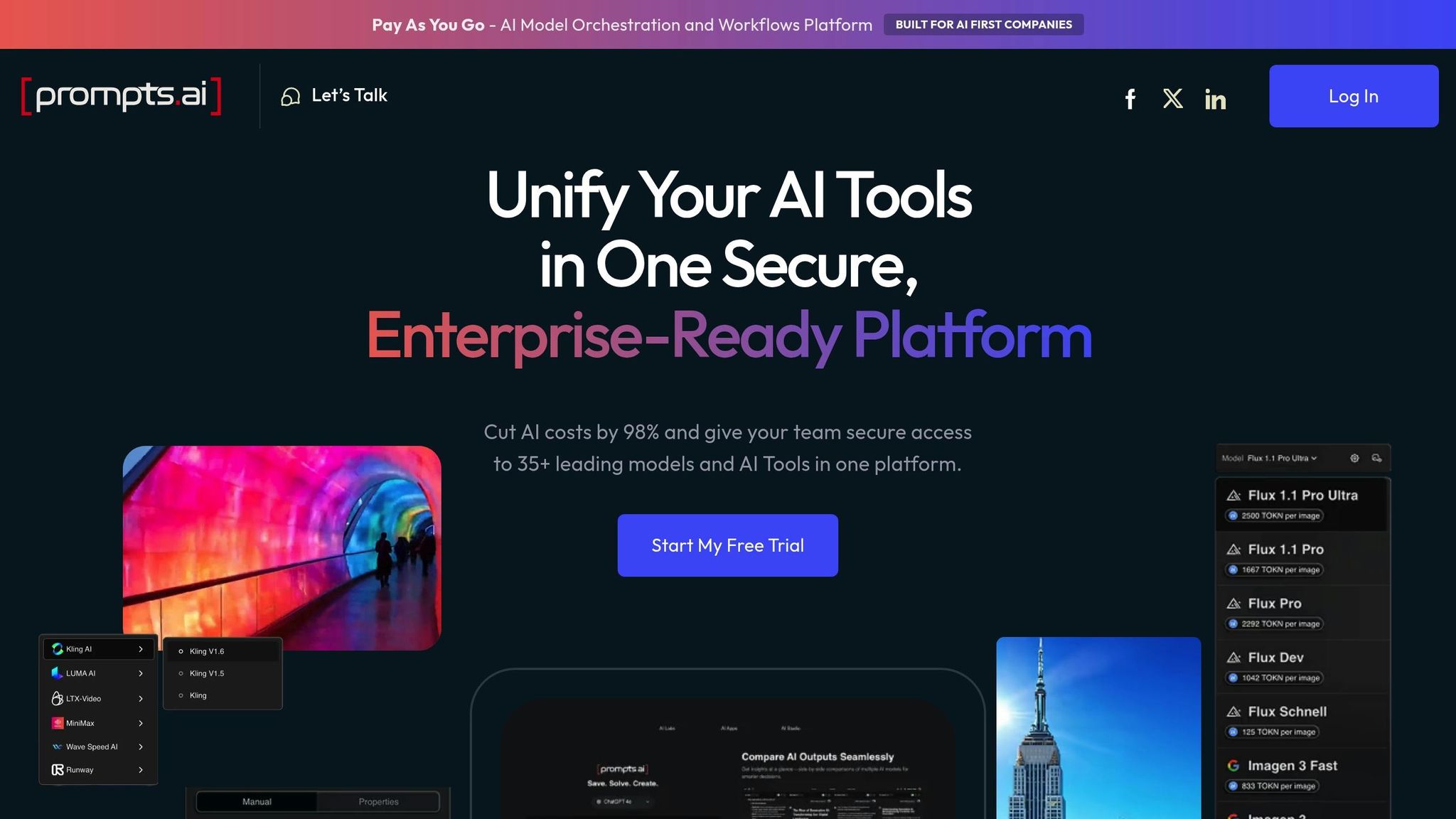
Prompts.ai tackles the challenges of fragmented tools and inefficiency by bringing everything together in one secure, streamlined platform. It serves as a unified hub where teams can access all the resources they need without constantly switching between tools. This transformation turns scattered experiments into scalable, compliant workflows that can be deployed across entire organizations, whether it's a Fortune 500 company, a creative agency, or a research lab.
The platform's design is focused on four key areas to address tool overload, rising costs, governance issues, and poor collaboration. By unifying access to models, standardizing workflows, embedding cost controls, and ensuring compliance, Prompts.ai offers a level of operational efficiency that disconnected systems simply can't match. With its capabilities, organizations can replace over 35 separate AI tools and reduce related costs by as much as 95% - all in under 10 minutes.
One of the standout features of Prompts.ai is the ability to access over 35 leading large language models through a single interface. This includes models like GPT-5, Claude, LLaMA, Gemini, Grok-4, Flux Pro, and Kling. Teams no longer need individual subscriptions or accounts for each provider, keeping all data securely within the platform instead of being dispersed across multiple third-party services.
The side-by-side comparison tool allows users to test multiple models simultaneously, helping them quickly find the best fit for specific tasks without tedious manual testing. According to user feedback, this feature can improve team productivity by up to 10×.
Prompts.ai's prompt workflow builder transforms isolated tasks into repeatable, scalable processes. By standardizing workflows, teams can capture and share best practices, ensuring consistency across projects. This feature directly addresses collaboration barriers by making individual expertise accessible to the entire organization.
"With Prompts.ai's LoRAs and workflows, he now completes renders and proposals in a single day".
This eliminates the need to manually combine outputs from various tools. Workflows can be easily shared, turning individual know-how into assets that benefit the entire team.
Prompts.ai places a strong emphasis on financial efficiency with its real-time cost tracking tools. The usage analytics feature provides clear visibility into every AI interaction and expense. Through TOKN pooling, organizations can allocate token credits across teams and projects, ensuring that resources are directed to high-priority tasks without unnecessary waste. Centralized storage pooling further optimizes data management costs.
These controls also allow teams to choose the most cost-effective model for each task. For example, they can test if a smaller model like LLaMA can handle a project instead of defaulting to a more expensive option like GPT-5. With these tools, organizations can cut AI costs by up to 98%, making AI spending far more efficient.
Prompts.ai integrates enterprise-grade governance tools directly into the platform. Comprehensive audit trails track every interaction, prompt, and user activity, providing the transparency required by regulators and security teams. The platform is designed to meet compliance standards such as SOC 2 Type II, HIPAA, and GDPR, helping organizations avoid the costly consequences of data breaches or non-compliance. Centralized policy enforcement ensures that security settings remain up to date and consistent across all AI activities.
Shifting from a scattered collection of AI tools to a unified platform doesn’t have to be overwhelming. By assessing your current setup, transitioning workflows gradually, and equipping your team with the right training, you can simplify operations and start seeing efficiency gains without unnecessary disruptions.
Start by conducting a "Shadow AI" audit across your organization. This means identifying every AI subscription, API key, and third-party service being used - even those tools employees may have signed up for independently. Many companies are surprised to find they’re paying for 20 to 35 separate AI platforms when they assumed only a handful were in use. Document where prompts are stored and map out how workflows are being shared across teams. This audit not only uncovers the true cost of tool sprawl but also reveals governance issues, such as sensitive data being managed outside secure channels. By understanding your current setup, you’ll lay a solid foundation for a seamless transition to a centralized system.
Once you’ve mapped out your existing tools, it’s time to consolidate. The Core Plan, priced at $99 per member per month, is tailored for teams looking to centralize their AI workflows. This plan replaces multiple subscriptions with unified access to over 35 models. Begin with a phased migration strategy by selecting a pilot department to test the platform before expanding it to the entire organization. Move critical prompts into a centralized library to create standardized practices. Additionally, setting up FinOps controls from the outset allows you to monitor usage and allocate TOKN credits effectively, ensuring a quicker return on investment rather than waiting months to see results.
Centralization is only as effective as the people using the system. To ensure success, provide your teams with thorough training. Host onboarding sessions that cover the unified interface, the model comparison tool, and the prompt workflow builder. Training should focus on navigating the 35+ models available, using standardized prompt management for consistency, and leveraging built-in governance tools to meet compliance standards. Use Prompts.ai’s analytics dashboards to monitor how well teams are adapting and address any support needs right away. Establish measurable KPIs, such as time saved on tasks, cost per project, and the number of workflows standardized, to track progress against your previous fragmented system. As new models and features are introduced, schedule regular training updates to keep your team’s skills aligned with the evolving technology.
Centralized AI workflows are making a tangible difference across various industries. From improving governance in large corporations to boosting creativity in advertising, the transition from scattered tools to unified platforms is delivering clear, measurable outcomes. Let’s explore how these workflows are solving real-world challenges.
Managing AI usage across massive enterprises can be daunting, especially with thousands of employees relying on AI tools without proper oversight. Fortune 500 companies are tackling this issue by using Prompts.ai to ensure compliance and security. Through role-based access control (RBAC), employees are granted access tailored to their specific roles. For instance, an AI agent reviewing contracts could access legal documents but would be restricted from viewing sensitive marketing strategies.
A centralized artifact registry further enhances governance by storing and versioning all prompts, tools, and datasets. This creates a single source of truth, which becomes essential during audits and compliance reviews. By logging every AI interaction and maintaining detailed audit trails, companies can meet regulatory standards without hindering innovation. This system also eliminates the risks associated with employees using unapproved external AI tools, ensuring both security and accountability.
In the creative industry, agencies are leveraging centralized workflows to produce an astounding volume of content while maintaining quality and consistency. Take Coca-Cola, for example - during a FIFA World Cup campaign, the company created more than 120,000 personalized videos for fans, leading to a 20% increase in social media engagement. Similarly, Nutella’s "Unica" campaign, executed by Ogilvy Italy, used AI to design 7 million unique jar labels, with the entire stock selling out in just one month. Another standout example is Cadbury, which generated over 130,000 personalized ads featuring Shah Rukh Khan, each tailored to specific viewer locations.
These examples highlight how centralized AI systems enable agencies to scale creative output like never before. Early adopters of generative AI report saving an average of 11 hours per week on tasks such as brainstorming and drafting, while AI-powered automation has boosted operational efficiency by 40% for many agencies.
Research institutions are also benefiting from centralized workflows, particularly when it comes to collaboration and experimentation. With access to over 35 leading AI models, researchers using Prompts.ai can benchmark performance and compare results across multiple large language models (LLMs) for their scientific studies. Standardized workflows ensure that experiments are reproducible and that prompt versions are meticulously tracked.
Evaluating ROI is essential to understanding the benefits of centralized AI workflows. These benefits span financial, operational, and risk-related improvements. Prompts.ai allows enterprises to monitor metrics that were previously challenging to track across fragmented tools. To measure progress effectively, establish a baseline before centralization and then monitor key metrics tied to financial performance, operational efficiency, and risk management. These measurements connect directly to the enhanced efficiency and governance advantages discussed earlier.
Financial Metrics
Review AI subscription costs both before and after centralization to identify savings. Pay close attention to the payback period, which reflects how quickly the investment in centralization pays off. For example, in 2025, companies like Nestlé and Chobani significantly reduced expense processing times, resulting in a threefold increase in finance team efficiency.
Operational Metrics
Monitor reductions in process cycle times and increases in automation to evaluate operational improvements. Many organizations report an average 40% decrease in cycle times due to AI-driven workflow automation. In 2025, Microsoft optimized its supply chain by cutting manual planning processes in half and achieving a 75% improvement in on-time planning. Additionally, tracking the proportion of tasks managed by AI versus manual efforts, along with productivity gains per employee, provides clear evidence of progress.
Governance and Risk Metrics
Improvements in governance can be assessed by tracking reductions in compliance issues, fraud, or other risks. For instance, SA Power Networks utilized an AI-powered tool in 2025 to manage aging infrastructure, saving $1 million in one year while achieving a 99% success rate in identifying corroding assets. Categorizing users based on prompt frequency also helps optimize spending and maintain compliance. These measurable outcomes highlight the value of centralizing AI operations.
"AI isn't valuable on its own. It's valuable when it moves the needle on something the business already cares about."
– SAP
Before centralization, organizations often faced high tool costs, slow workflows, and recurring compliance challenges. After adopting Prompts.ai, many enterprises report substantial improvements. Process automation delivers an average ROI of 240% within the first year, with 60% of organizations seeing positive returns during that time. Additionally, 74% of companies with advanced AI programs meet or exceed ROI expectations. Over five years, integrating AI into operational systems can yield a conservative ROI of 214%.
Fragmented AI workflows often lead to tool overload, compliance risks, and reduced productivity. Prompts.ai tackles these issues head-on by bringing together access to over 35 top AI models into one secure, unified platform. By eliminating inefficiencies caused by scattered tools, it simplifies operations and boosts productivity.
With built-in FinOps controls, users gain real-time insights into spending, cutting costs by up to 98% while maintaining oversight. Features like SOC 2 compliance and role-based access close governance gaps, ensuring teams no longer need to rely on unsanctioned AI tools. Additionally, standardized prompt management transforms one-off experiments into reliable, auditable workflows that can be scaled across departments.
Centralizing AI workflows not only reduces costs but also enhances operational flexibility, directly benefiting an organization’s bottom line. Whether you're managing compliance for a Fortune 500 company, scaling creative output for an agency, or supporting research in a lab, a unified platform like Prompts.ai delivers measurable value.
Start by evaluating your current AI tools for redundancies and compliance risks, then transition to Prompts.ai's Core Plan. Train your teams on standardized workflows while tracking key performance metrics such as cost reductions, streamlined processes, and improved compliance.
In today’s fast-paced environment, enterprises cannot afford the inefficiencies of disconnected AI tools. Discover how Prompts.ai transforms fragmented workflows into a cohesive, governed, and cost-efficient AI solution designed to grow with your organization’s needs.
Centralizing AI workflows brings everything into one secure hub, allowing teams to efficiently monitor, manage, and oversee models, data pipelines, and automations. By eliminating the constant need to juggle multiple tools, this approach not only saves time but also cuts down on inefficiencies. With fewer distractions, employees can dedicate their energy to work that truly adds value.
A unified platform also encourages smarter reuse of modular components, such as pre-built model orchestrations or shared data connectors. This means teams can quickly prototype and scale processes without having to start from scratch every time. The benefits are clear: fewer errors, faster iteration cycles, and stronger collaboration across departments. Ultimately, this leads to higher productivity, reduced costs, and smoother operations throughout the organization.
Prompts.ai empowers U.S. businesses to significantly cut expenses by uniting over 35 AI models, including GPT-4 and Claude, into a single, streamlined platform. By eliminating the need for multiple software licenses, companies can reduce costs by as much as 98%. To further enhance financial oversight, the platform features a built-in FinOps dashboard that provides real-time expense tracking, helping teams set budgets and avoid overspending.
Operational savings are another key benefit, with businesses reporting reductions of up to 31% by automating labor-intensive tasks such as invoice processing and ticket routing. This not only reduces reliance on manual labor but also minimizes errors and ensures smoother compliance, which can lower payroll expenses and prevent costly regulatory penalties. For a company with an annual operations budget of $500,000, this could translate into savings of approximately $155,000, freeing up resources for growth-focused investments.
By centralizing tools, offering clear financial insights, and cutting operational costs, Prompts.ai delivers tangible ROI for businesses aiming to boost efficiency and profitability.
Prompts.ai prioritizes security and compliance by unifying AI workflows within a single, controlled platform. With support for over 35 models, including GPT-4 and Claude, the platform offers robust tools for administrators to manage role-based access controls, enforce strict data policies, and maintain comprehensive audit logs for every interaction. These capabilities enable organizations to meet critical regulatory requirements such as GDPR, HIPAA, and SOC 2, eliminating the need for extra compliance tools.
Data is safeguarded through encryption both in transit and at rest, while workloads are kept isolated for each tenant to ensure privacy. The platform also features real-time dashboards that monitor activity, flagging any policy violations or unusual behavior immediately. By integrating tools and processes into one system, Prompts.ai helps businesses minimize security risks, streamline audits, and operate with confidence and efficiency.