Pay As You Go - AI Model Orchestration and Workflows Platform



In 2026, AI governance is critical for businesses navigating regulations like the EU AI Act, which enforces fines of up to $35 million or 7% of global revenue for non-compliance. With 75% of large enterprises now using governance platforms, organizations are adopting tools to manage risks, ensure compliance, and streamline operations.
Here’s a quick look at the top AI governance tools:
These platforms automate compliance, reduce risk, and ensure AI systems align with global regulations. Whether you need real-time monitoring, metadata management, or regulatory compliance, these tools simplify governance for scalable AI operations.
| Tool | Key Features | Deployment Options | Compliance Focus | Ideal For |
|---|---|---|---|---|
| Prompts.ai | LLM orchestration, real-time compliance | Cloud | EU AI Act | High-speed applications |
| Credo AI | Risk scenarios, policy packs | Cloud/On-prem | EU AI Act, NYC Local Law 144 | Enterprise-level compliance |
| Atlan | Metadata lakehouse, lineage tracking | Hybrid/On-prem | EU AI Act | Data-centric organizations |
| IBM watsonx | AI Factsheets, hybrid governance | Hybrid/Cloud | ISO 42001, NIST, EU AI Act | Mixed-model environments |
| OneTrust | Risk dashboards, automation | Cloud/On-prem | EU AI Act, ISO 42001 | Privacy and risk-focused teams |
| Fiddler AI | Bias monitoring, real-time alerts | Cloud/Hybrid | SR 11-7, GDPR | Post-deployment oversight |
| DataRobot | Fast deployment, humility rules | SaaS/On-prem | EU AI Act, NIST AI RMF | Fast-paced AI deployment |
| Clarifai | AI Lake, orchestration-layer governance | Edge/Cloud | GDPR, HIPAA | Regulated industries |
| Holistic AI | Risk scoring, global regulation tracking | Cloud/On-prem | EU AI Act, NYC Local Law 144 | Global compliance |
| Lumenova AI | Real-time agent monitoring, kill-switch | Cloud/Regional | GDPR, EU AI Act | Autonomous AI systems |
Governance tools are no longer optional - they’re essential for scaling AI responsibly while avoiding costly penalties. Choose the one that aligns with your compliance needs and operational goals.
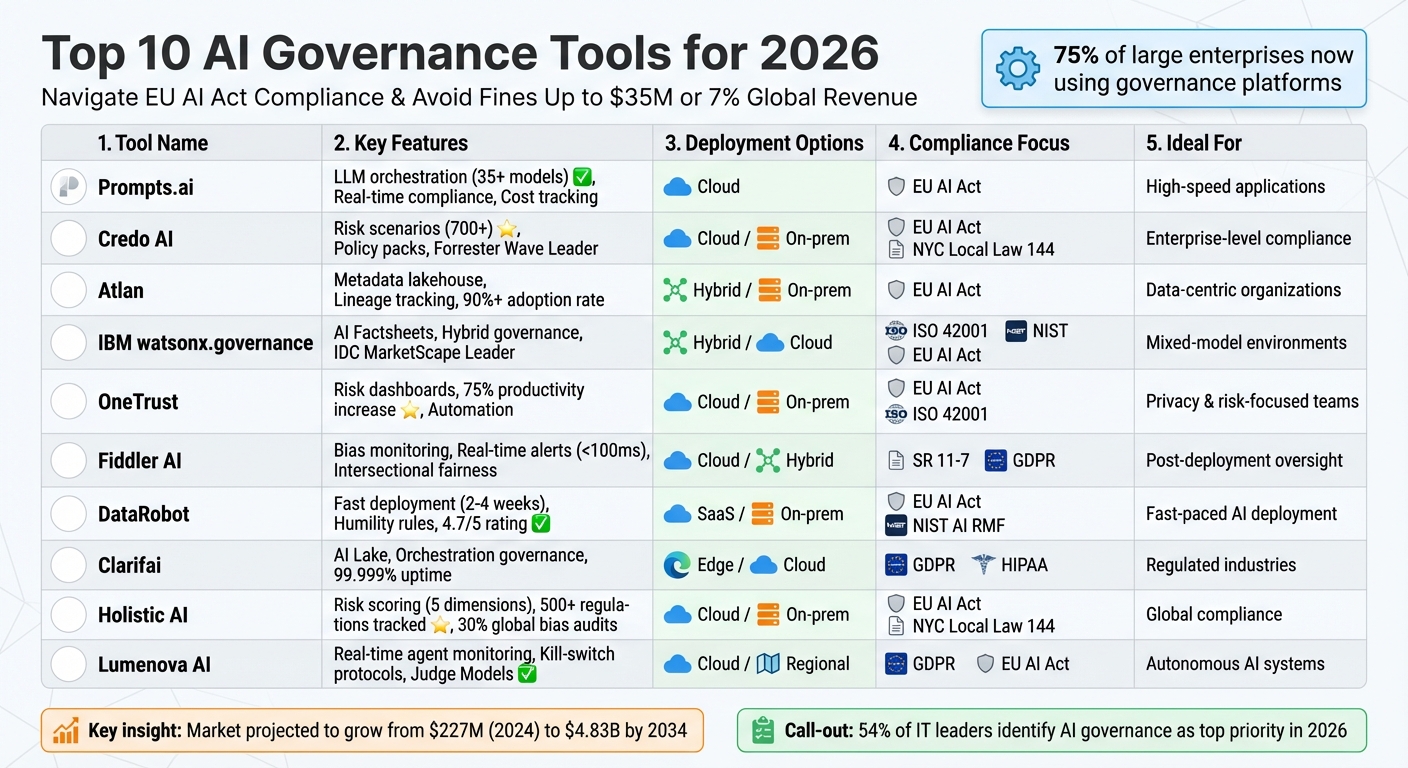
Top 10 AI Governance Tools 2026: Features, Deployment & Compliance Comparison
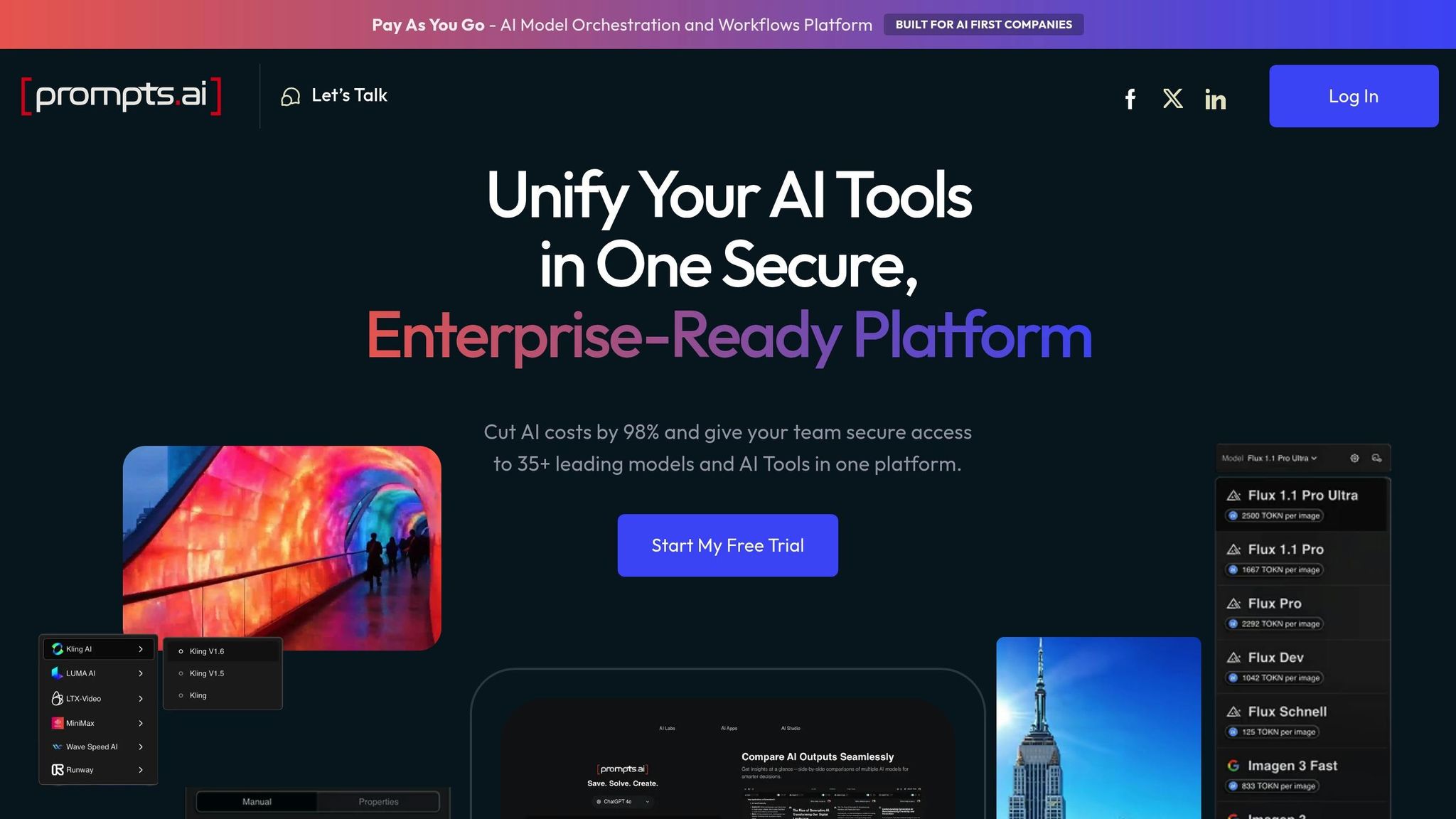
Prompts.ai serves as a centralized platform for managing AI operations, bringing together over 35 top-tier large language models like GPT-5, Claude, LLaMA, and Gemini. By uniting these tools within a single, secure interface, the platform simplifies access while ensuring better oversight and traceability for all AI activities.
Every AI interaction is meticulously recorded on the platform. This includes details such as model usage, version history, data sources, and usage patterns. These comprehensive logs make auditing and oversight straightforward and efficient.
Prompts.ai integrates automated workflows designed to align with global standards, such as the EU AI Act. This feature simplifies compliance documentation and strengthens governance measures.
The platform integrates smoothly with existing enterprise systems, using pay-as-you-go TOKN credits to maintain seamless workflows. This setup supports effective communication between various systems, applications, and agents, all while adhering to governance protocols. A real-time FinOps layer tracks token usage and directly connects spending to business results, offering finance and IT teams the transparency they need to manage costs effectively.
Credo AI earned recognition as a Forrester Wave™ Leader in Q3 2025, achieving top scores in 12 evaluation criteria. The platform simplifies the challenges of AI oversight by offering centralized tools for inventory management, risk mitigation, and continuous monitoring across the entire AI lifecycle.
At its core, Credo AI features a centralized AI Registry that tracks both internal and third-party AI systems, capturing key metadata to help prioritize projects based on risk and value. The AI Agent Registry goes a step further by monitoring autonomy levels, lineage, and agent-specific risks, such as emergent behavior and deployment drift. With built-in integrations that auto-detect assets, the platform minimizes manual work for technical teams, streamlining operations.
Credo AI simplifies regulatory compliance using pre-built Policy Packs tailored to frameworks like the EU AI Act and NYC Local Law No. 144. These tools identify high-risk use cases and automate the creation of necessary technical documentation. For example, the platform supports mandatory annual bias audits for automated employment decision tools under NYC LL 144, leveraging its Credo AI Lens Assessment Framework. Brian DeAngelis, Chief Data Scientist at AdeptID, shared that compliance timelines for high-risk AI in talent matching were reduced tenfold with Credo AI. This strong regulatory foundation naturally extends into ongoing risk monitoring.
Expanding on its compliance tools, Credo AI provides a robust risk management suite, featuring a library of 700 AI risk scenarios, including over 400 specific to generative AI. Organizations using Credo AI report a 60% reduction in manual effort through governance automation and 30–50% faster governance cycles. Real-time dashboards highlight compliance gaps, data risks, and ethical concerns, while automated control suggestions help mitigate risks during development and deployment.
Credo AI supports a "Policy-to-Code" workflow through its SDK and direct integrations, allowing technical teams to send evidence directly from their existing tools. Deployment options include public cloud for scalability, private cloud for infrastructure control, and self-hosted environments for air-gapped setups requiring strict data residency. This flexibility ensures compatibility with a wide range of AI systems, from proprietary models to third-party tools, open-source technologies, and autonomous agents. By offering such adaptable deployment options, Credo AI is well-positioned to continue advancing governance solutions.
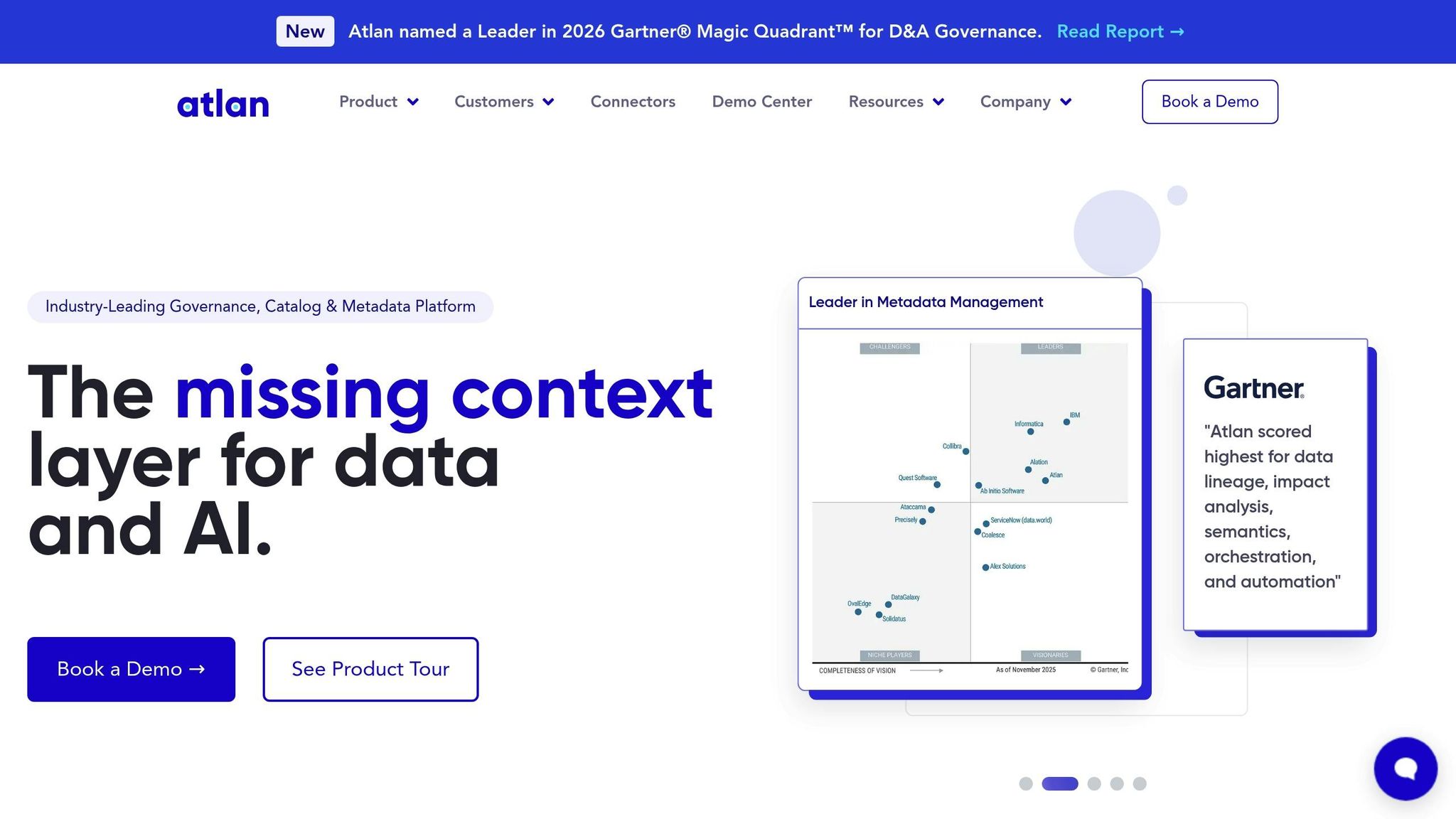
Atlan has received recognition from top industry analysts for its innovative approach to AI asset management. Its metadata lakehouse architecture offers a unified control plane, enabling seamless management of AI assets across hybrid and multi-cloud environments. Organizations adopting Atlan have reported 90%+ adoption rates across all enterprise roles within just 90 days.
Atlan's Automatic Intake uses active metadata to discover and catalog AI applications automatically, eliminating the need for manual tracking. The platform provides a centralized model registry, tracking all versions and statuses of models to serve as a single source of truth, regardless of where the assets were created. For instance, in 2025, Kiwi.com consolidated thousands of scattered data assets into 58 discoverable data products, reducing central engineering workload by 53% and increasing satisfaction among data users by 20%. Governance templates streamline change management workflows, integrating tools like Jira and ServiceNow to ensure every AI model modification is formally approved. This centralized registry also aids in maintaining compliance with regulations.
Atlan's centralized model registry enhances compliance workflows with its Policy Center and prebuilt compliance templates tailored for regulations such as the EU AI Act. The platform automatically tracks data lineage, audit logs, and decision logs, which are essential for regulatory audits. In 2025, North, a payments solution provider handling over $100 billion annually, used Atlan to classify and govern more than 225,000 assets in Snowflake. This included implementing dynamic data masking and RBAC policies to meet FINRA and PCI-DSS requirements. For the EU AI Act, Atlan supports deployer obligations like transparency, human oversight, and monitoring for unusual AI behavior - key elements for avoiding fines ranging from $7.5 million to $35 million for non-compliance with high-risk AI systems.
Atlan's governance and compliance tools integrate seamlessly with existing data ecosystems. Metadata is stored in non-proprietary formats, allowing any compatible compute engine to query directly using SQL. Its bidirectional metadata sync ensures that tags and policies are consistently applied across source systems like data warehouses and BI tools. Highlighting this capability, Brian Ames, Sr. Manager of Production AI & Data Products at General Motors, stated:
"We use Atlan for end-to-end visibility from the cloud all the way back to our on-prem."
The Atlan MCP Server connects with AI agents and copilots like ChatGPT and Claude, ensuring governed enterprise context to reduce the risk of hallucinations. At Dr. Martens in 2025, Karthik Ramani, Global Head of Data Architecture, noted that downstream impact analysis, which previously took four to six weeks, now takes under 30 minutes thanks to Atlan's automated lineage. Open APIs and SDKs in Java and Python empower developers to create custom connectors, while deployment options range from cloud-native SaaS to self-hosted environments, meeting the needs of air-gapped setups with strict data residency requirements.
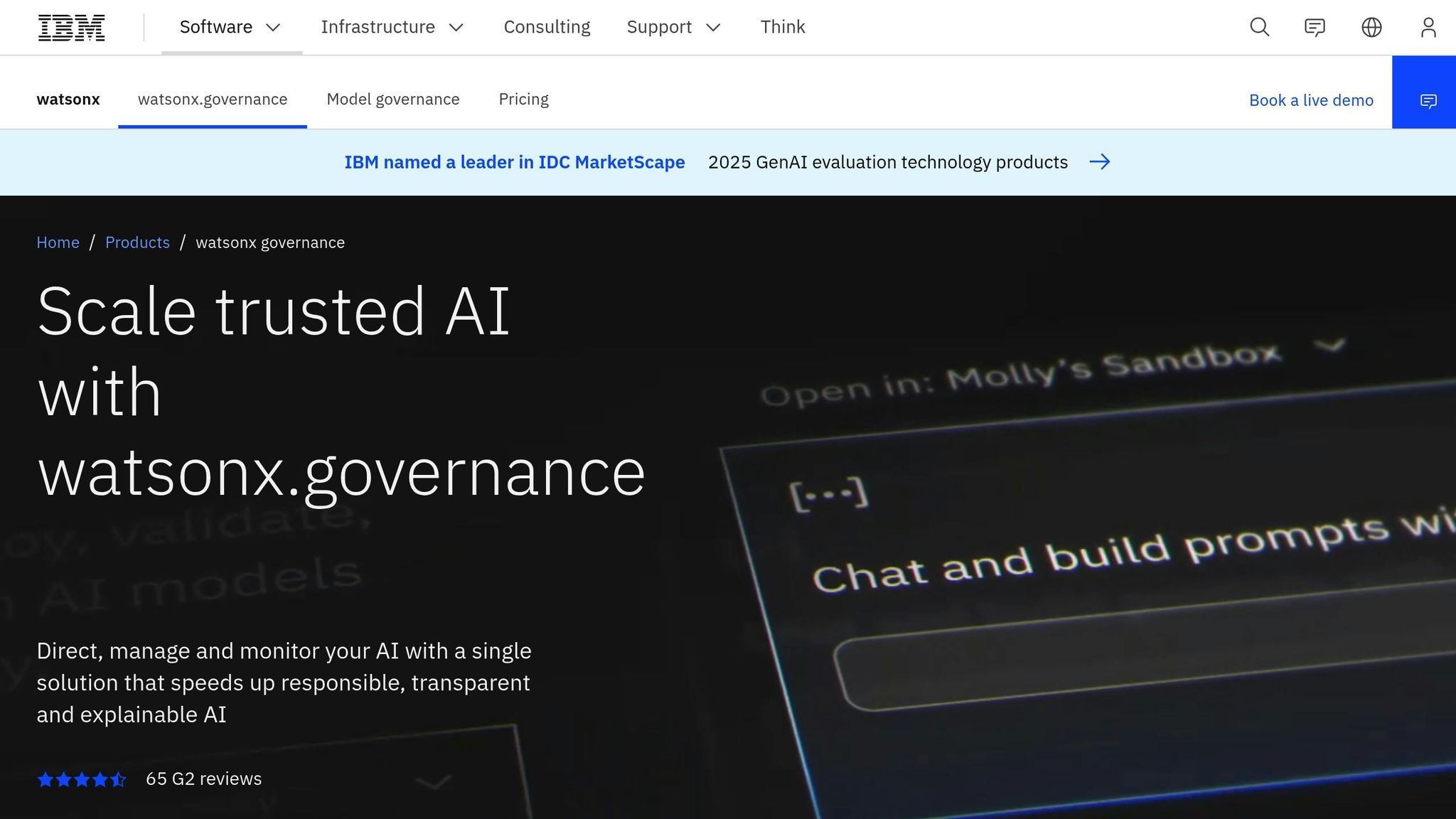
IBM watsonx.governance has been recognized as a leader in the 2025 IDC MarketScape for Worldwide GenAI Model Evaluation and the Forrester Wave for AI Governance solutions. It also received an iF Design Award for its user-friendly interface, backed by 65 G2 reviews. A standout feature of the platform is its AI Factsheets - detailed "nutritional labels" that automatically track and monitor model data throughout its lifecycle. These tools help position watsonx.governance as a robust solution for managing interoperable, compliant, and automated AI governance.
The platform’s Common Model Inventory Dashboard offers centralized tracking for models, prompt templates, and AI agents. Automated metadata collection captures essential details such as creation dates, datasets, inputs and outputs, ownership, and compliance requirements. The AI Use Cases repository manages models from initial requests to production, enabling version tracking and comparisons of different approaches.
In 2025, Infosys utilized watsonx.governance to manage 2,700 AI use cases, achieving a 150% improvement in operational efficiency and cutting data clearance processing time by 58%. IBM itself approved over 1,000 models for internal reuse. The platform also tracks metadata for Python functions, ensuring transparency in custom logic used in production workflows. A new Governed Agentic Catalog allows organizations to find, register, and compare AI tools and agents, making it easier to reuse governed AI components. These centralized tools simplify compliance and risk management, as discussed further below.
IBM watsonx.governance provides compliance accelerators for frameworks like the EU AI Act, ISO 42001, NIST AI RMF, and new policies such as NYC Local Law No. 144. The platform identifies regulatory requirements and translates them into enforceable technical policies. AI Factsheets maintain detailed records of model development and performance, which can serve as documentation during regulatory audits. For example, the US Open used watsonx.governance in 2024/2025 to remove bias from tournament data, improving their court fairness metric from 71% to 82%.
Organizations can also integrate AI Factsheets with the IBM OpenPages-based Governance console, enabling advanced workflows and comprehensive risk assessment questionnaires for enterprise-wide oversight.
The platform assigns risk scores based on potential impact, helping organizations focus on high-risk models, such as those used in credit scoring. Its agentic monitoring capabilities extend governance to autonomous AI agents and the tools they utilize. Banco do Brasil implemented the platform in 2024/2025 to unify AI oversight, incorporating real-time monitoring and proactive alerts to ensure compliance across their AI systems. Integration with IBM Guardium further strengthens security by identifying "shadow AI" and vulnerabilities within a single, unified view. These risk insights enable organizations to maintain transparency while ensuring compatibility across deployments.
IBM watsonx.governance stands out for its ability to govern generative AI and machine learning models across a variety of platforms, including Amazon Bedrock, Microsoft Azure, OpenAI, and Amazon SageMaker. The platform supports deployment in hybrid cloud environments, on-premises, or through specific cloud providers like IBM Cloud and AWS GovCloud. It also evaluates generative AI outputs in multiple languages, including English, Japanese, German, French, Spanish, and Arabic. Beyond governing traditional models, watsonx.governance extends its oversight to AI agents, custom Python functions, and prompt templates, offering flexibility to meet diverse operational needs.
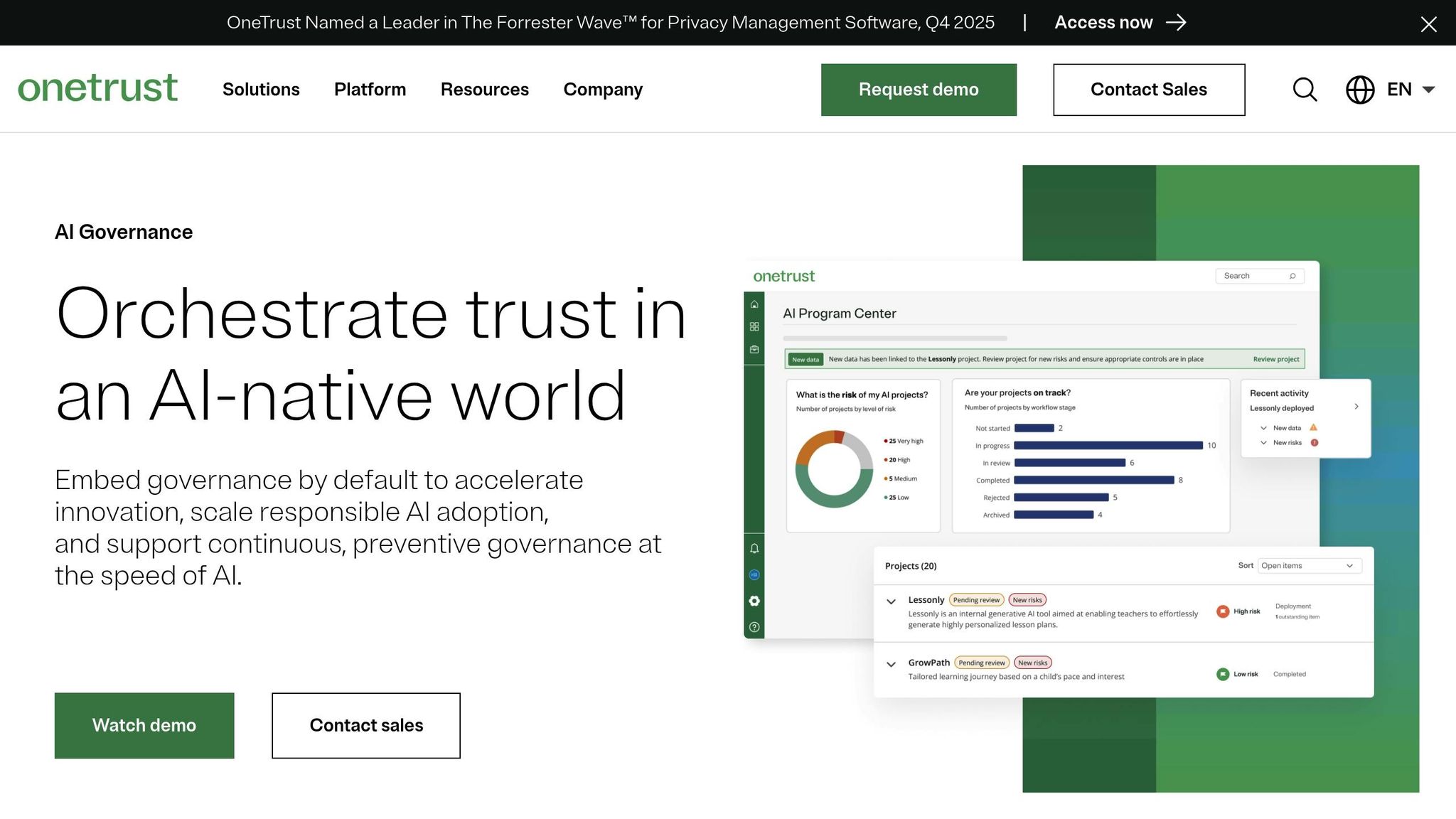
OneTrust AI Governance has been highlighted in the 2025 Gartner® Market Report for AI Governance Platforms. Trusted by more than 14,000 customers, including half of the Global 2,000, it also holds the #21 spot on the Forbes Cloud 100 list. According to a 2024 Forrester Consulting Total Economic Impact™ study, OneTrust helps privacy and risk teams achieve a 75% productivity increase and an 87% faster time-to-value in ensuring responsible data and AI practices. Its extensive features cover inventory, compliance, risk, and interoperability, addressing AI governance needs comprehensively.
OneTrust integrates seamlessly with MLOps platforms like Databricks, enabling automatic detection of model changes and their synchronization into a central inventory for real-time visibility. It supports governance for AI systems regardless of their origin - whether developed in-house, sourced from third parties, or based on open-source models. The platform produces model cards, AI Bills of Materials (BoMs), and lineage reports to ensure traceability from data input to model output. Ren Nunes, Senior Manager of Data & AI Governance at Blackbaud, shared:
"With OneTrust, our AI governance council has a technology-driven process to review projects, assess data needs, and uphold compliance."
Building on its inventory capabilities, OneTrust streamlines compliance by aligning AI systems with global standards such as the EU AI Act, ISO 42001, and the NIST Risk Management Framework. It automates the classification of AI systems by risk level - flagging high-risk systems under the EU AI Act, for example - and initiates the required conformity assessments and technical documentation. For regulations like NYC Local Law No. 144, which focuses on bias in automated hiring tools, OneTrust identifies sensitive data driving bias and continuously monitors models for drift, bias, and performance. The platform also generates audit-ready reports, simplifying regulatory reviews and demonstrating accountability.
OneTrust embeds risk assessment into every phase of the AI lifecycle, from project intake to deployment, ensuring continuous oversight. It assigns risk levels for factors like bias, fairness, and transparency, escalating high-risk projects for further review. Real-time dashboards provide visibility into AI risks and performance, with alerts for anomalies. By connecting to both structured and unstructured data sources, OneTrust can automatically identify sensitive data that might lead to algorithmic bias, helping organizations reduce regulatory risk by up to 75%.
OneTrust connects technical oversight with compliance through pre-built integrations that provide insights into models and their intended use without disrupting workflows. Its customizable workflows and federated policy management allow organizations to tailor governance to their specific needs. Bryan McGowan, Global and US Trusted AI Leader at KPMG, highlighted this adaptability:
"Working closely with OneTrust, we have integrated these capabilities with the KPMG Trusted AI intake, inventory, rules logic, and control catalogs, to provide a comprehensive technology-enabled AI governance solution."
Organizations can adopt "shift-left" governance by scheduling evaluations at key development stages and setting alerts for data drift or model changes across platforms. This proactive approach ensures governance remains aligned with operational and compliance goals.

Fiddler AI has earned a place among the top governance platforms, being recognized in the IDC ProductScape 2025 and the CB Insights AI 100 list. Acting as a control plane for AI systems, Fiddler provides technical observability and runtime monitoring for both predictive and generative AI. It’s designed for organizations needing more than basic compliance, enabling continuous, trust-focused governance throughout the AI lifecycle.
Fiddler addresses intersectional fairness by allowing teams to monitor multiple protected attributes like race, gender, and sexual orientation, helping prevent bias in AI outcomes. For generative AI, the Fiddler Trust Service uses proprietary models to evaluate and flag LLM responses containing harmful content such as racism or sexism. Automated alerts are triggered when metrics exceed thresholds, supported by tools like 3D UMAP visualizations and "Slice and Explain" for deeper insights. The platform's Model Risk Management (MRM) framework aligns with regulatory standards like SR 11-7, offering detailed diagnostics to pinpoint causes of model degradation. Notably, in partnership with the U.S. Department of Defense under Project AMMO, Fiddler reduced model retraining time from 12 months to just 2 weeks, significantly advancing autonomous capabilities for unmanned underwater vehicles.
Fiddler simplifies compliance by generating detailed audit trails that document every model decision and performance metric. These trails support frameworks like the EU AI Act, GDPR, HIPAA, and NYC Local Law No. 144. The platform proactively identifies risks such as toxic outputs, PII/PHI leakage, model drift, and unfair results. For high-risk decisions, it incorporates human-in-the-loop workflows, ensuring manual approval is required before AI actions are executed. This approach aligns with oversight requirements in the EU AI Act. Kevin Alvero, Chief Compliance Officer at Integral Ad Science, highlighted Fiddler’s audit capabilities:
"One of the things that was appealing to IAS about Fiddler was its ability to customize the monitoring to specific model type, data volume and desired insights. Additionally, the dashboard views, automated alerting and ability to generate audit evidence also factored into the decision to work with Fiddler."
Fiddler’s platform is designed to be model, framework, and data-agnostic, integrating seamlessly with tools like Databricks (via MLflow and Spark), Amazon SageMaker, Google Vertex AI, Snowflake, and BigQuery. It also provides native SDKs for agentic frameworks such as LangGraph and Strands, along with a Python Client SDK and REST API for broader compatibility. Deployment options range from Fiddler's managed AWS cloud to private clouds (AWS, Azure, Google, IBM), Virtual Private Clouds (VPC), and air-gapped environments, making it ideal for highly regulated sectors like government and defense. With response times under 100ms, the platform’s Trust Models enforce real-time policies without disrupting workflows. This flexibility and speed position Fiddler as a strong contender in the evolving landscape of AI governance tools.
DataRobot sets itself apart in the evolving landscape of AI governance by combining fast deployment, automated compliance, and strong risk management into a single platform. Recognized in Gartner's 2024 Critical Capabilities report with a 4.10/5 score for Governance Use Cases, it also holds a 4.7/5 overall rating on Gartner Peer Insights, with 90% of users recommending it. Marc Neumann of BMW Group highlights its machine learning blueprints and explainability features as key strengths.
DataRobot consolidates a wide range of AI assets - such as predictive models, LLMs, agents, vector databases, and notebooks - into a centralized registry. This registry captures critical metadata, including test results, build environments, ownership, model age, and validation benchmarks. With this metadata-driven approach, the platform enables one-click deployments, seamlessly converting pipelines and prompting strategies into production-ready REST API endpoints. Its version-controlled prompt management system ensures reproducibility, while end-to-end lineage tracking simplifies audits by documenting data transformations from experimentation to production.
To address the complexities of global AI regulations, DataRobot automates development testing and continuous assessments, ensuring compliance with frameworks such as the EU AI Act, NYC Law No. 144, California AB-2013, Colorado Law SB21-169, and NIST AI RMF. The platform generates one-click compliance reports that map regulatory requirements directly to technical documentation, removing the need for manual processes.
"DataRobot gives us reassurance that we are accessing generative AI through a well-governed and secure environment." - Tim Reed, Head of Data Science & Analytics at NZ Post
By streamlining compliance, organizations can deploy machine learning and generative AI applications into production within just 2 to 4 weeks, a timeframe much shorter than traditional methods. This automated framework supports proactive risk management throughout the AI lifecycle.
DataRobot employs a color-coded fairness threshold system (Green, Yellow, Red) to track the 30-day predictive performance of protected features. Its Humility Rules provide real-time alerts when models encounter unfamiliar data or make uncertain predictions. Before deployment, the platform conducts automated red-teaming using both synthetic and custom datasets to identify vulnerabilities such as bias, toxicity, jailbreaks, and inaccuracies. Real-time shields and guards actively monitor LLM outputs, preventing issues like PII leakage, hallucinations, prompt injections, and biased content.
"Our ability to leverage data science to help us identify disparities, remove barriers, and enable informed decisions from our data... has been made much easier with DataRobot." - Lakshmi Purushothaman, VP Innovation in Data Science at Freddie Mac
In addition to managing risks, the platform ensures seamless integration across various systems.
DataRobot supports bolt-on observability for models built on external platforms like Google Vertex, Databricks, and Microsoft Azure, requiring minimal coding. It offers deployment options across managed SaaS, virtual private clouds, on-premise setups, and even air-gapped environments, making it ideal for industries with stringent regulations. The platform accommodates over 40 modeling techniques and 9 major problem types, including time series, anomaly detection, and generative AI.
"DataRobot is an indispensable partner helping us maintain our reputation both internally and externally by deploying, monitoring, and governing generative AI responsibly and effectively." - Tom Thomas, VP of Data Strategy, Analytics & Business Intelligence at FordDirect
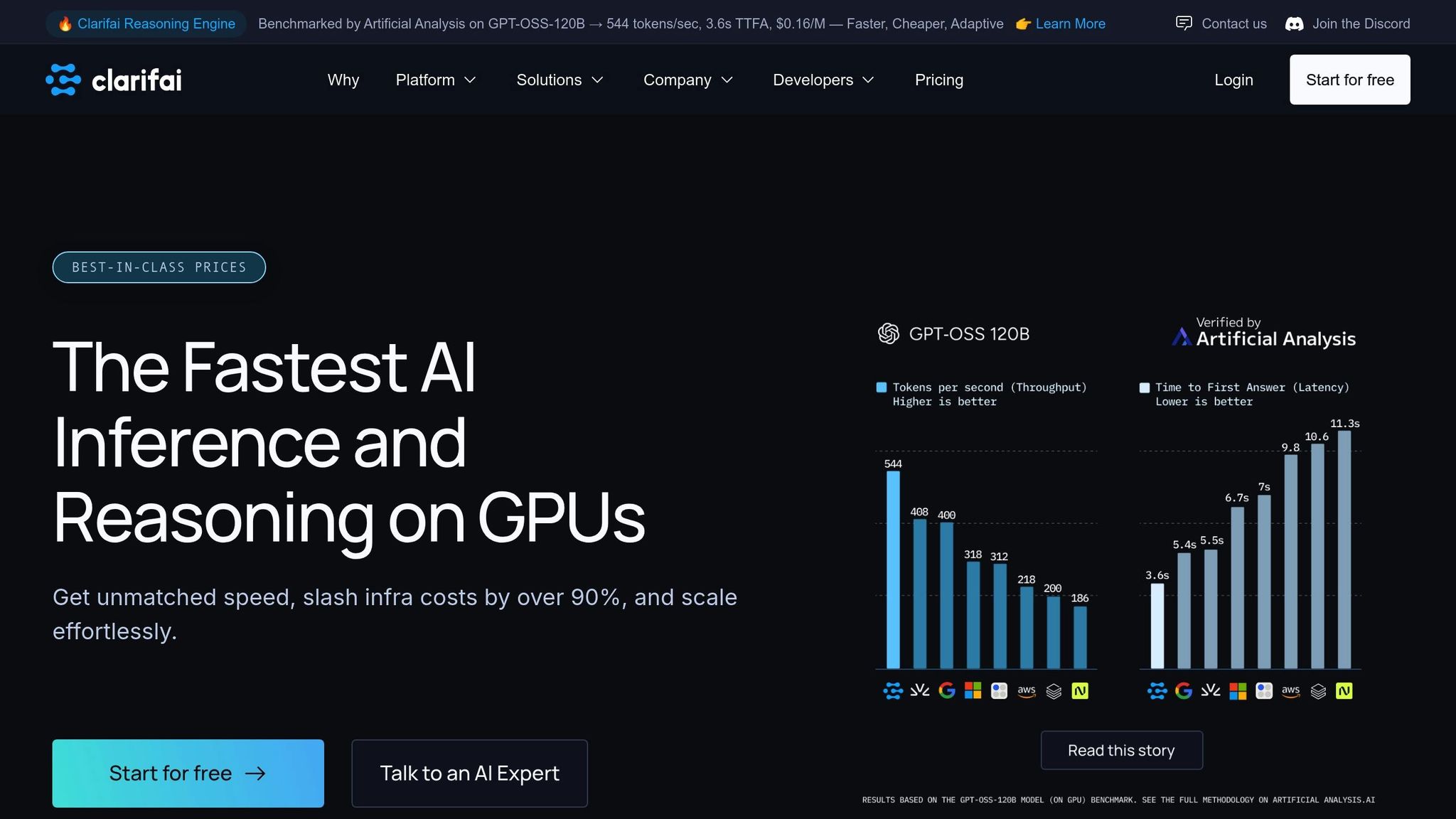
Clarifai offers a comprehensive AI infrastructure platform designed to manage the entire AI lifecycle while embedding governance directly into its orchestration layer. This ensures that compliance and innovation go hand-in-hand. With a 4.3/5 rating from industry experts, Clarifai provides an integrated system for managing assets, automating workflows, monitoring risks, and offering deployment flexibility for enterprises. Below is a closer look at how Clarifai supports these key areas.
Clarifai's AI Lake™ acts as a centralized repository, consolidating all essential AI components - models, datasets, annotations, workflows, and UI modules - into one accessible location. Paired with the Spacetime search engine, users can efficiently filter and rank assets using metadata, AI predictions, and human annotations, simplifying auditing processes. Metadata can be automatically generated from unstructured data, while teams can include custom Markdown notes to document usage instructions.
For workflow design, the Mesh drag-and-drop engine allows users to chain models and logical operators into computation graphs that execute as a single API call. Meanwhile, Pipelines oversee longer processes, offering recovery options in case of failures. The Control Center dashboard provides a unified view of resource usage, compute hours, and user activity across all AI projects, giving teams a clear operational overview.
Clarifai is built to support major regulatory frameworks, including the EU AI Act, GDPR, and HIPAA, ensuring compliance is integrated into operations. Its fairness dashboards and bias detection metrics enable real-time model auditing. For organizations handling sensitive data, Local Runners allow workloads to operate on-premises or in air-gapped environments, ensuring data remains within specific jurisdictions to meet privacy and residency requirements. This feature is particularly beneficial for industries like finance and healthcare.
The Control Center also provides detailed audit logs, tracking every action with precision - who performed it, when, what was changed, and where it occurred. This creates a defensible audit trail for regulatory inspections. Additionally, LLM Guardrails prevent harmful outputs and data leaks, ensuring compliance with emerging safety standards.
Clarifai incorporates fairness checks and continuous monitoring directly into its orchestration layer, ensuring models cannot be deployed without passing risk assessments. Real-time dashboards monitor key metrics like model performance, data drift, and fairness as data evolves, supporting smooth AI workflow automation at scale. Developers can use fairness assessment tools to test models with balanced datasets and apply bias mitigation strategies during training and validation.
The platform automatically generates model cards summarizing vital details like data sources, hyperparameters, performance metrics, and bias statistics to maintain transparency. Multimodal moderation models can detect unsafe content, deepfakes, and toxicity across text, images, and video. Additionally, explainability modules provide clear reasoning for model decisions, helping stakeholders understand and audit AI outputs effectively.
"The ability to enforce governance policies directly within the orchestration layer, ensuring compliance without slowing down innovation." - Clarifai
Clarifai excels in deployment flexibility, supporting multi-cloud environments like AWS, Azure, and GCP, alongside bare-metal and edge deployments through its Flare offering. The Pay-As-You-Go (PAYG) plan, launched in early 2026, eliminates monthly minimums and uses prepaid credits to ensure uninterrupted governance pipelines.
With enterprise-grade infrastructure boasting 99.999% uptime, Clarifai is ideal for mission-critical applications. Organizations can choose between scalable cloud-based solutions or on-premises execution with Local Runners, enabling data sovereignty while benefiting from Clarifai's robust governance and workflow automation capabilities. This flexibility ensures the platform meets the growing challenges of AI regulation and operational demands.
Holistic AI has established itself as a leader in managing AI lifecycles, particularly in the areas of oversight and compliance. Highlighted in the 2025 IDC ProductScape for Worldwide AI Governance Platforms, the platform has achieved impressive milestones, including conducting over 30% of global bias audits, automating 80% of AI workflows, and helping users reduce AI operational costs by 40%.
The AI Asset Discovery feature is a standout tool that continuously scans enterprise environments such as GitHub repositories, SharePoint, and Azure cloud systems. Its purpose is to uncover shadow AI and hidden tools that might otherwise go unnoticed. This dynamic inventory collects crucial metadata for each AI system, including lifecycle stage, risk profile, and ownership. To ensure transparency and accountability, every deployment is documented with standardized model cards. The platform currently manages visibility for over 50,000 LLMs and ML endpoints, making it a robust solution for enterprises seeking comprehensive oversight.
Holistic AI simplifies compliance by automatically mapping AI use cases to risk categories that align with regulations like the EU AI Act, NYC Local Law No. 144, NIST AI RMF, and ISO 42001. Through gap analyses, the platform provides prioritized remediation guidance, allowing teams to address non-compliance ahead of enforcement deadlines. In November 2024, Michael Fetzer, Associate Partner at Aon, shared how the Holistic AI Tracker saved his firm "hundreds of hours of manual labor" by automating the tracking of global talent management legislation. Currently, the platform monitors nearly 500 emerging AI laws and over 80 lawsuits tied to generative AI. Its global Atlas feature delivers real-time regulatory intelligence, offering organizations a proactive approach to risk and compliance management.
Holistic AI excels in automated risk scoring, evaluating AI systems across five critical dimensions: Bias, Privacy, Efficacy, Transparency, and Robustness. Real-time monitoring, coupled with the AI Safeguard feature, identifies drift and prevents harmful outputs from jeopardizing compliance. Additional tools, such as modules for AI Red Teaming and AI Systems Testing, help uncover vulnerabilities. In early 2026, Sam Dover, Global AI Strategy Lead at Unilever, credited Holistic AI for ensuring compliance in over 200 AI use cases, successfully mitigating risks in 50% of them.
"With Holistic AI, we've ensured compliance for over 200 AI use cases, mitigating risks in 50% of them. Governance has enabled us to scale responsibly, boosting trust across the board." - Sam Dover, Global AI Strategy Lead, Unilever
Holistic AI seamlessly integrates with existing enterprise systems, including cloud platforms, DevOps/CI/CD pipelines, and file storage solutions. Its modular design allows organizations to adopt specific modules - such as Identify for discovery, Protect for risk testing, or Enforce for compliance - and expand as their AI capabilities grow. For industries like finance and healthcare that require stricter data security, the platform offers on-premises deployment with AES 256 encryption. This adaptability allows organizations to govern AI from various sources, whether developed internally, acquired from vendors, or embedded in third-party products. By maintaining continuous discovery and updates across the entire AI ecosystem, Holistic AI supports operational efficiency while ensuring adherence to regulatory standards.
Lumenova AI functions as a comprehensive platform, connecting high-level governance with practical execution. It embeds automated guardrails based on organizational policies, integrating smoothly with existing MLOps pipelines. This reflects a growing trend in the industry - by 2026, 54% of IT leaders identify AI governance as a top priority, a significant jump from 29% in 2024. Lumenova AI’s approach to managing AI assets, ensuring regulatory compliance, and enabling interoperability is outlined below.
At the core of the platform is the AI Registry, a centralized repository that tracks all AI models and related data within an organization. Each model is documented with detailed Model Cards, which include key metadata such as training data sources, version history, intended purpose, and performance metrics. This lifecycle tracking ensures visibility from the experimental phase through deployment, effectively addressing the issue of shadow AI by creating auditable records that remain accessible no matter where systems are deployed.
Lumenova AI supports compliance with over 19 regulatory frameworks, including the EU AI Act, NYC Local Law No. 144, NIST AI RMF, ISO 42001, and Colorado SB 24-205. For the EU AI Act, the platform classifies systems into four risk levels - unacceptable, high, limited, and minimal - while automating audit trails and ensuring GDPR compliance through anonymization and encryption. Automated alerts help organizations stay ahead of regulatory enforcement. For NYC Local Law No. 144, it facilitates independent bias audits for automated employment decision tools, producing transparent reports. Its evaluation engine leverages over 200 metrics, both quantitative and qualitative, to identify bias, drift, and hallucinations, supported by a library of 80+ predefined risk scenarios aligned with industry standards.
Lumenova AI integrates seamlessly with existing technology stacks and CI/CD pipelines, avoiding the need for tool replacement. It supports Sovereign Cloud deployments, enabling regional instances in locations like Frankfurt or Paris to meet data residency requirements - an increasingly important feature for global firms managing regional infrastructure. In 2026, the platform introduced Judge Models, which monitor agent outputs in real time with latency as low as 300–500ms, and Kill Switch protocols to halt API access if autonomous agents exceed risk thresholds. These tools provide robust real-time monitoring and risk management for autonomous AI systems. Additionally, the platform’s Forward Deploy Team offers hands-on integration support, helping organizations accelerate AI deployment timelines by up to 50% through tailored implementation assistance.
Selecting the right governance tool comes down to your organization's specific needs - whether it’s infrastructure-level compliance, development processes, or post-deployment monitoring. For example, Prompts.ai ensures compliance directly at the gateway level with minimal latency, making it a great choice for high-performance applications where speed is critical. On the other hand, Credo AI and OneTrust focus on policy-driven compliance frameworks, simplifying the management of complex regulations, particularly for industries like finance and healthcare. Tools such as IBM watsonx.governance, which creates "AI Factsheets" akin to nutrition labels, and DataRobot, capable of generating extensive audit reports with just one click, are especially beneficial for organizations navigating hefty fines under regulations like the EU AI Act.
For teams with advanced data governance programs, Atlan integrates data catalogs and AI model registries, tracking data lineage to ensure models are trained on compliant sources. Fiddler AI is a strong contender for post-deployment monitoring, offering real-time bias detection, while Lumenova AI focuses on autonomous agent oversight with features like Judge Models and Kill Switch protocols. Meanwhile, Clarifai supports on-premise and edge deployments tailored for regulated industries, and Holistic AI provides independent third-party audits for organizations that need external validation of ethical standards.
Deployment flexibility also sets some tools apart. Platforms like Credo AI, IBM watsonx.governance, and Clarifai support public cloud, private cloud, on-premises, and hybrid environments, making them ideal for enterprises with diverse infrastructure requirements. Pricing for these tools varies significantly, often requiring custom quotes based on the scope of systems and features needed.
The trend toward "shift-left governance" is reshaping how compliance is handled, with more teams embedding controls into development pipelines instead of waiting for post-deployment audits. Prompts.ai automates compliance at the infrastructure level to prevent bypasses, while Credo AI and Holistic AI focus on converting policies into actionable code. With 75% of large enterprises expected to adopt AI governance platforms by 2026, and the market projected to grow from $227 million in 2024 to $4.83 billion by 2034, the real question is no longer if governance tools are necessary - it’s about finding the right fit for your operations.
"Governance shouldn't slow innovation. It should accelerate safe deployment." - Sprinto
User ratings provide additional insight into these platforms' strengths. Atlan and Credo AI both boast impressive ratings of 4.8/5 for their metadata management and regulatory compliance features. Similarly, Fiddler AI has earned a solid 4.4/5 rating according to Clarifai Review. For teams scaling AI deployment, Lumenova AI offers customizable testing templates, while Prompts.ai provides simulation and quality evaluation tools designed to balance speed with control.
AI governance tools have transitioned from being theoretical ideals to practical necessities by 2026. With regulatory fines escalating - such as penalties under the EU AI Act reaching up to €35 million or 7% of global annual revenue - organizations can no longer afford to overlook compliance. Modern governance platforms simplify this challenge by automating regulatory controls, identifying demographic biases in algorithms, and producing audit-ready reports in a fraction of the time previously required.
These tools combine automated controls with real-time monitoring, ensuring compliance without compromising performance. Selecting the right platform depends on your organization's risk tolerance, infrastructure, and regulatory landscape. For industries like finance and healthcare, which face stringent oversight, compliance tools aligned with frameworks like NIST AI RMF and ISO 42001 are essential. Platforms such as Prompts.ai enforce controls at the entry point with minimal latency, making them suitable for high-speed applications. Meanwhile, organizations deploying autonomous AI agents need tools that provide continuous behavior monitoring instead of relying solely on static model evaluations.
"You need to pick a tool that increases the speed of safe shipping, not just the number of documents." - Sucheth, Sprinto
Visibility is key: effective governance starts with understanding your AI footprint. Discovery features can identify all AI usage, even shadow AI, which remains a significant risk - 48% of employees reportedly upload sensitive data to public tools. As projections indicate that 75% of large enterprises will adopt dedicated AI governance platforms by 2026, now is the time to find the solution that best aligns with your operational and compliance needs before regulators tighten enforcement.
Using an AI governance tool is a smart move to meet the requirements of the EU AI Act. These tools assist in managing critical aspects such as data lineage, conducting risk assessments, ensuring transparency, and implementing operational controls. By aligning with regulatory standards, they simplify compliance efforts and promote responsible AI practices.
When selecting an AI governance tool for agentic AI, focus on features that provide strong oversight, ensure compliance, and maintain control over autonomous systems. Opt for tools that streamline workflow management, automate governance tasks, and align with regulations like the EU AI Act or NIST AI RMF. Essential capabilities to look for include real-time monitoring of models, effective risk management, and flexible controls to support ethical and compliant AI operations in ever-changing conditions.
AI governance tools help organizations manage risks effectively while keeping deployment processes efficient. By automating tasks like oversight, compliance tracking, and real-time monitoring, these tools ensure adherence to regulations such as the EU AI Act and ISO 42001. They tackle critical concerns like data privacy, bias, and regulatory violations. Integrated directly into workflows, they promote transparency and accountability, allowing businesses to deploy AI responsibly and confidently without slowing down progress or innovation.