Pay As You Go7 天免费试用;无需信用卡



AI model orchestration tools simplify managing machine learning and generative AI workflows by automating data preparation, model training, deployment, and monitoring. They reduce engineering time, optimize compute resources, and help teams achieve faster results with lower costs. This article explores four affordable platforms - Prompts.ai, Zapier, n8n, and Workato - highlighting their pricing, features, and security.
| Platform | Starting Price | Key Features | Best For |
|---|---|---|---|
| Prompts.ai | $0/month | 35+ AI models, real-time cost tracking | Small teams, enterprises |
| Zapier | $19.99/month | 8,000+ app integrations, AI assistant | Non-technical users |
| n8n | Free/$22/month | Self-hosting, unlimited workflow steps | Developers, startups |
| Workato | Custom Pricing | 1,200+ integrations, enterprise-grade | Large enterprises |
Choose the tool that matches your budget, technical skills, and workflow complexity to maximize efficiency and reduce costs.
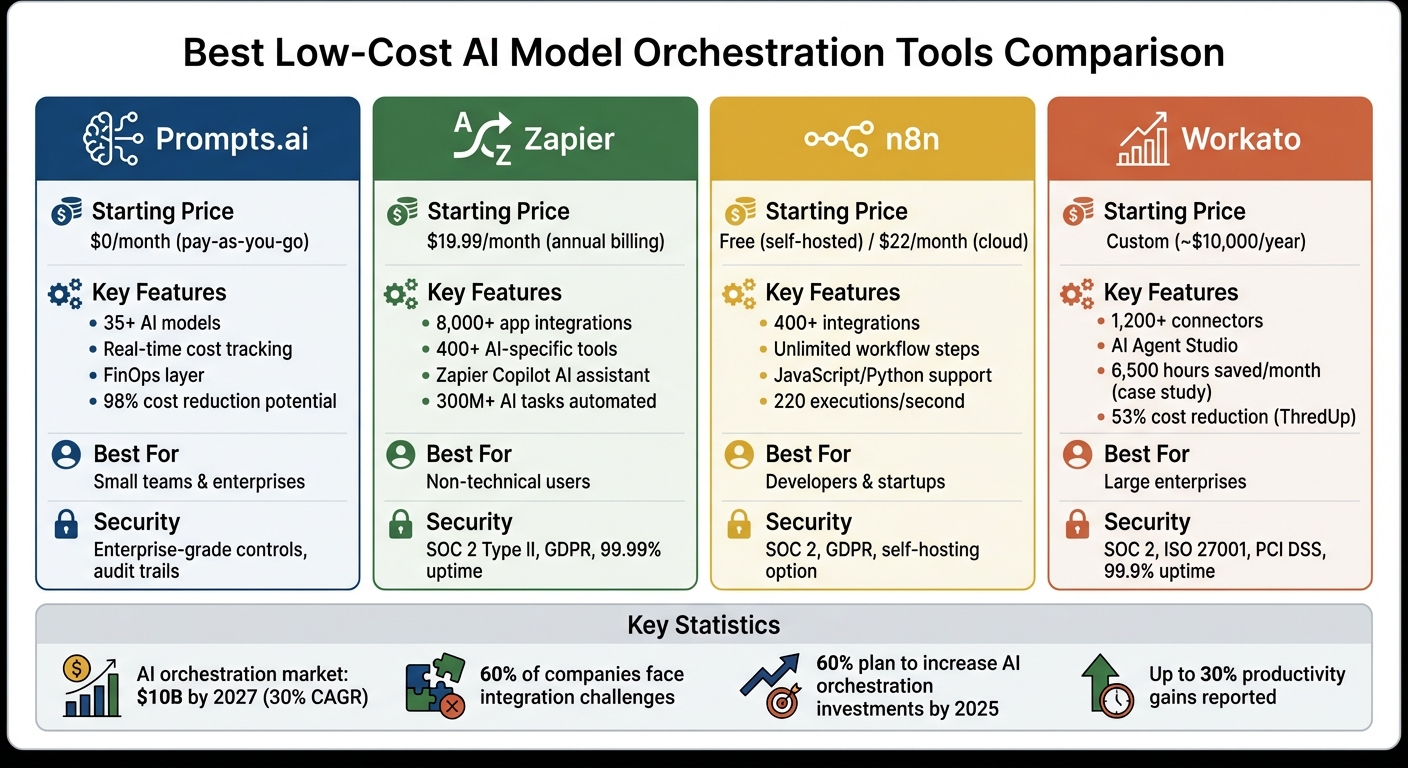
Comparison of Low-Cost AI Model Orchestration Tools: Pricing and Features
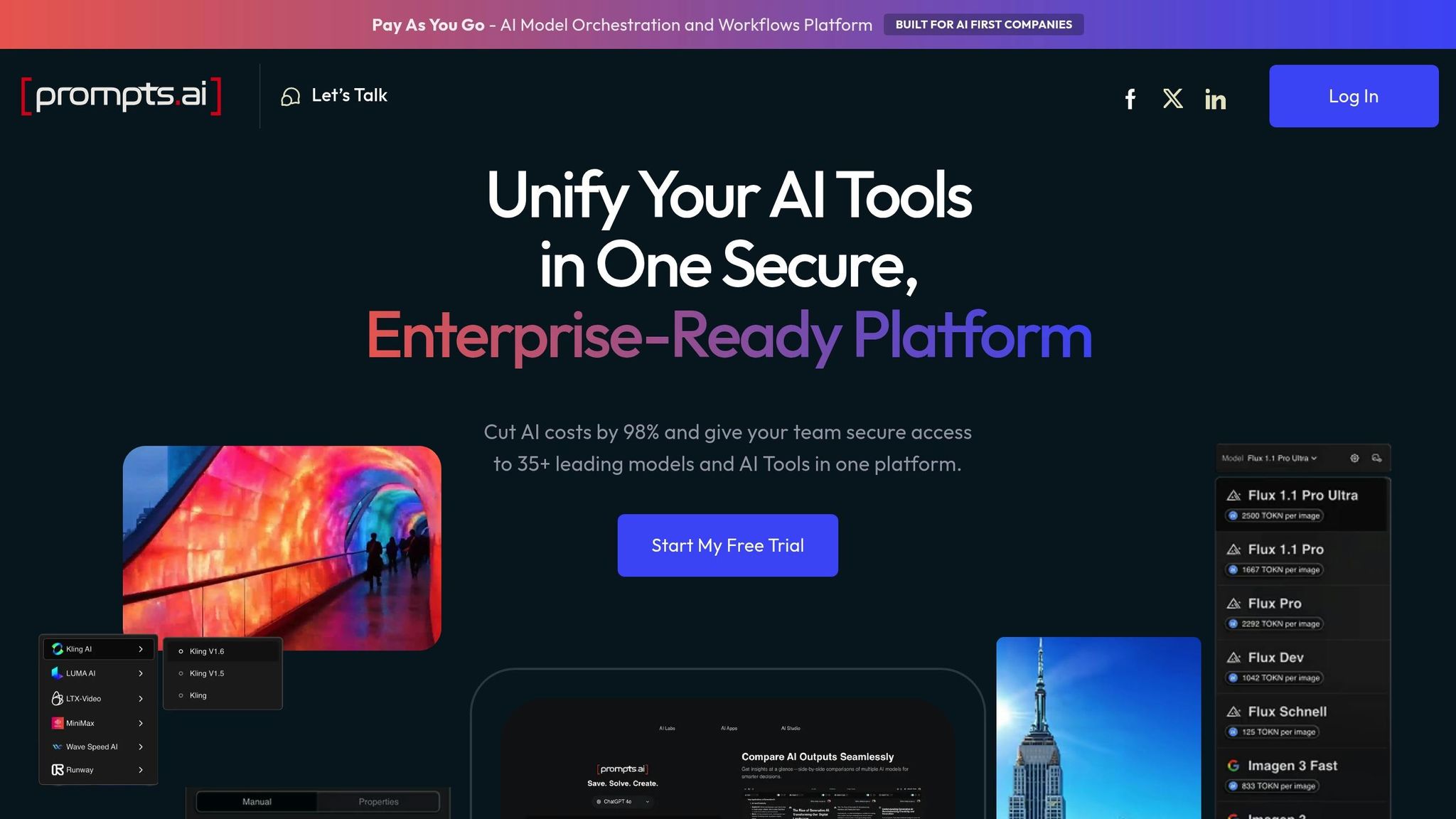
Prompts.ai takes a flexible approach to pricing with its pay-as-you-go TOKN credit system, ensuring you only pay for what you use. This eliminates recurring subscription fees, making it a cost-effective choice for teams that need adaptability without overspending.
The platform offers a $0/month exploration tier, allowing users to test the system without any financial commitment. For smaller teams or individuals, the Creator plan is available at $29/month, while business-oriented plans range from $99 to $129 per member monthly, tailored to team size and needs. By consolidating access to over 35 AI models and streamlining billing, Prompts.ai can cut costs by as much as 98% compared to juggling multiple AI tool subscriptions.
Beyond affordability, the platform is packed with features that simplify workflows and enhance productivity.
Prompts.ai brings together 35+ leading large language models into one unified workspace, eliminating the hassle of managing multiple AI platforms. Users can compare models side-by-side, making it easier to choose the best tool for specific tasks. Additionally, the platform includes a FinOps layer that tracks token usage in real-time, offering full visibility into spending and helping teams identify workflows that deliver the highest return on investment.
To further streamline operations, Prompts.ai offers a Prompt Engineer Certification program and provides expert-designed workflow templates, known as "Time Savers." These templates are built on proven practices, allowing users to deploy effective workflows quickly instead of starting from scratch. The platform also supports enterprise-grade governance and audit trails, ensuring all AI interactions align with organizational policies.
Security is a key focus of Prompts.ai, with enterprise-grade controls safeguarding sensitive data throughout every process. Governance policies are enforced automatically, reducing the risk of accidental data exposure or compliance violations. Real-time audit trails track every model interaction, prompt execution, and user action, providing the transparency needed for regulatory reviews and internal audits. This ensures teams can operate confidently, knowing their workflows are secure and compliant.
Zapier uses a task-based pricing model, charging based on the number of completed tasks, which helps users manage costs predictably. For those just starting, the free tier costs $0/month and includes 100 tasks, unlimited Zaps, Tables, and Interfaces - perfect for experimenting with AI orchestration without spending a dime. For users looking to scale, the Professional plan starts at $19.99/month (billed annually), offering 750 tasks, multi-step workflows, and AI-powered fields for data enrichment. Tools like Filters, Paths, and Formatters are not counted against task limits, allowing users to create complex workflows without additional charges. If you exceed your monthly task quota, Zapier offers flexible overage billing at 1.25× the base task cost. For larger teams, the Team plan is available at $69/month for up to 25 users, while custom Enterprise plans cater to organizations with higher demands. This pricing approach supports a rich ecosystem designed to streamline workflow integration.
Zapier connects with over 8,000 apps, including more than 400 AI-specific tools, and had automated 300 million AI tasks by early 2026. Every plan includes Zapier Copilot, an AI assistant that simplifies workflow creation and troubleshooting through natural language commands. The platform's Model Context Protocol (MCP) acts as a translator, enabling external AI models to securely interact with the app ecosystem. Each MCP tool call uses two tasks from your quota. Additionally, Zapier Tables serve as automation-first databases, allowing AI fields to auto-populate based on prompts, while Zapier Interfaces enable users to create custom forms and dashboards without any coding experience.
A real-world example of Zapier's capabilities comes from Vendasta’s Marketing Operations Specialist Jacob Sirrs, who, in 2025, used the platform to develop an AI-driven sales engine integrating ChatGPT with CRM tools. This automation enriched leads and summarized calls, recovering $1 million in previously lost revenue and saving the sales team 20 hours of manual work every day.
Zapier prioritizes security with SOC 2 Type II and SOC 3 certifications and compliance with GDPR and CCPA standards. Data in transit is safeguarded with TLS 1.2, and data at rest is encrypted using AES-256. Enterprise customers are automatically excluded from third-party AI model training, while other users can opt out through a request form. The platform supports SAML-based Single Sign-On (SSO) and SCIM for automated user provisioning, along with detailed audit logs for compliance tracking. For organizations with stringent security needs, Enterprise plans offer VPC Peering to securely connect internal data sources. With a 99.99% uptime and trust from 87% of Forbes Cloud 100 companies, Zapier is a reliable choice for secure and compliant automation.
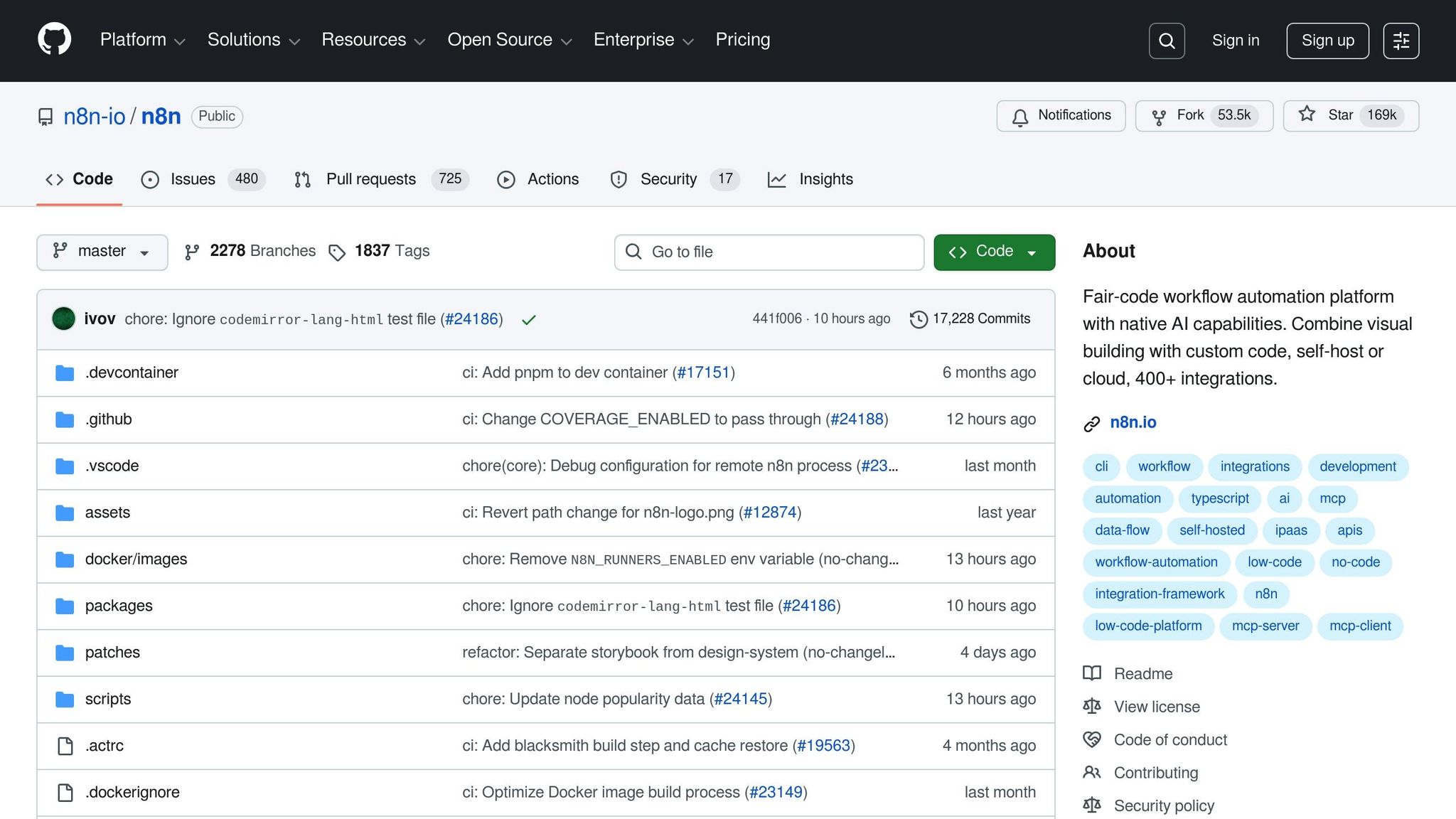
n8n offers a flexible execution-based model paired with extensive integration options, making it a standout choice for cost-conscious AI orchestration.
n8n adopts an execution-based billing system, charging per workflow run rather than per step. This approach allows a single workflow execution to include unlimited steps, making it an economical option for complex processes. For those who prefer self-hosting, n8n provides a free Community Edition, which can be deployed via Docker or npm. This version supports unlimited workflows without requiring a monthly subscription.
For managed hosting, n8n Cloud starts at $22/month (€20 annually) and includes 2,500 executions, 50 AI Workflow Builder credits, and unlimited users. The Pro plan, priced at $55/month (€50 annually), offers 10,000 executions and 150 AI credits. For larger teams, the Business plan costs $733/month (€667 annually) and includes 40,000 executions, along with features like SSO and Git version control. Startups with fewer than 20 employees and less than €5 million in funding can qualify for a 50% discount on the Business plan, reducing the cost to around $367/month.
n8n boasts over 400 pre-configured integrations and more than 1,700 workflow templates, streamlining the development process. The platform includes native AI nodes with LangChain support, alongside an HTTP Request node for custom API calls, GraphQL, and cURL commands.
For users needing advanced customization, n8n supports JavaScript and Python code nodes, enabling complex data transformations. With a thriving community of 200,000 members and 167,500 GitHub stars, n8n ranks among the top 50 projects on the platform. Its performance is equally impressive, managing up to 220 workflow executions per second on a single instance.
Marketplace Tech Lead Luka Pilic shared how his team achieved remarkable efficiency using n8n:
"We've sped up our integration of marketplace data sources by 25X. It takes me 2 hours max to connect up APIs and transform the data we need. You can't do this that fast in code."
- Luka Pilic, Marketplace Tech Lead, StepStone
This efficiency highlights n8n’s ability to simplify tasks that would otherwise demand significant time and coding expertise.
n8n prioritizes security and compliance, maintaining SOC 2 audit compliance and offering on-premise deployment options for air-gapped environments. The platform secures sensitive AI API keys with encrypted secret stores and supports external vaults like AWS Secrets Manager and HashiCorp Vault. Self-hosting ensures organizations retain full control over their data, meeting GDPR and SOC 2 compliance requirements. For hosted plans, data is stored on EU servers located in Frankfurt, Germany.
Workato blends enterprise-grade functionality with a flexible, usage-based pricing model, making it an option for businesses of all sizes.
Workato's pricing structure combines a base fee with scalable usage costs, ensuring businesses only pay for what they use. The Standard edition covers essential integration and automation needs, while the Business edition adds advanced orchestration and broader connectivity options. For larger enterprises, the Enterprise edition offers enhanced security and governance tools, and Workato One provides access to the full platform, including AI agent capabilities.
Each edition supports unlimited connections, workflows, and collaborators, enabling controlled and predictable growth. Workato also forecasts usage across key capabilities like workflows, API management, and event streams, helping businesses plan their budgets effectively. For example, in 2025, ThredUp reported a 53% reduction in operating costs after transitioning to Workato’s cloud-native platform, while development speeds increased by 5–6× compared to traditional methods. Stanley Toh, Head of Enterprise Services & Experience at Broadcom, highlighted the platform’s efficiency:
"We have over 300 automations running between 105,000 to 120,000 jobs a month...we save about 6,500 human hours a month."
This adaptable pricing model supports a wide range of integrations, simplifying even the most complex workflows.
Workato offers more than 1,200 pre-built connectors, enabling seamless workflows across SaaS tools, on-premise systems like SAP and ServiceNow, databases, data lakes such as Snowflake, and LLMs like OpenAI and Claude. The AI by Workato Utility Connector leverages models from Anthropic (Sonnet 4) and OpenAI (GPT-4o mini) to handle tasks such as text analysis, categorization, email drafting, and translation - all without requiring manual prompt engineering.
With Workato One, users gain access to Agent Studio, a low-code platform for creating, testing, and deploying AI agents capable of making context-driven decisions. The platform also supports the Model Context Protocol (MCP), which allows LLMs to securely interact with external data and tools. Additionally, Workato Genies are prebuilt AI agents tailored for specific business functions, like sales (CPQ), HR (onboarding), and IT (password management), streamlining deployment.
The AI by Workato connector has a rate limit of 60 requests per minute for customer workspaces, while sandbox environments for developers allow up to 10,000 tokens per request.
Workato guarantees 99.9% uptime. Its serverless, containerized runtime ensures elastic performance and stateful execution for handling complex processes. In 2025, Atlassian completed an ERP transformation 40% faster - finalizing the project in just nine months while managing over 1,000 requirements, 2,800 test cases, and 73+ new integrations.
Workato adheres to stringent security and compliance standards, including SOC 2 Type II, ISO 27001, PCI DSS, and GDPR. The platform incorporates robust security measures such as RBAC, data isolation, encryption, secure authentication, and verified user access. AI workflows benefit from these protections, with data residency ensured in the US and EMEA, as all AI processing occurs within the same region as the originating data center.
Centralized governance dashboards and detailed audit logs track all automated actions and changes. Additionally, the platform supports lifecycle management, allowing teams to oversee automation workflows across development, testing, and production environments. These features make Workato a reliable and secure choice for managing AI workflows efficiently.
Different platforms bring their own mix of costs, complexity, and features. Prompts.ai offers enterprise-grade orchestration with transparent, usage-based pricing, access to over 35 models, and strong governance tools. Zapier, known for its extensive integration ecosystem with over 8,000 apps, includes a specialized Model Context Protocol connector. However, its Professional plan starts at $19.99 per month when billed annually. n8n provides self-hosting and supports more than 300 integrations, with cloud plans starting at around $20 per month, though it requires JavaScript skills for custom node creation . Workato emphasizes enterprise-grade governance and offers over 1,000 connectors, but its pricing is only available upon request. These differences in pricing and features lead to broader technical and operational considerations.
Developer-focused tools like LangChain, often used in orchestration workflows, demand advanced Python or JavaScript knowledge. They can also add a 15–25% latency overhead compared to direct model calls. Additionally, 46% of product teams cite a lack of integration with existing tools as a significant obstacle to AI adoption. To address this, Zapier provides a no-code visual builder, while n8n's node-based editor appeals to teams with technical expertise.
Resource demands further complicate matters. Some orchestration engines require significant compute and memory resources; for instance, SuperAGI has a baseline memory footprint of roughly 1.2 GB. These requirements can impact cost efficiency. Moreover, telemetry is often fragmented across platforms, making it difficult to track costs and ownership effectively. As Rachel Whitener, SEO Content Editor at CloudZero, aptly puts it:
"Clouds are the stage. Orchestrators are the director. The show runs across AWS, Azure, and GCP - not inside the tool".
Security is another critical consideration. Platforms vary widely in their approach to security and compliance. Solutions like Workato and Prompts.ai prioritize robust role-based access controls and detailed audit trails, while some AI-first tools lack mature governance capabilities. Additionally, over 87% of businesses struggle to utilize data effectively due to siloed systems and complex pipelines, underscoring the importance of centralized monitoring.
The quality of documentation and the reliability of integrations also pose challenges. Open-source tools like n8n often suffer from limited documentation, and even platforms with extensive connector libraries can experience trigger failures or difficulties in customizing workflows. While the global AI orchestration market is projected to reach $10 billion by 2027, growing at a 30% compound annual growth rate, 60% of companies still face integration challenges that delay projects and drive up costs.
Choosing the right orchestration tool depends on your team's technical expertise, budget, and the complexity of your workflows. Prompts.ai stands out with its enterprise-level AI orchestration, offering access to over 35 models and usage-based pricing. It's an excellent choice for teams aiming to fine-tune AI responses and streamline operations.
Zapier caters to non-technical teams needing quick setup and broad app integrations, with plans starting at around $50/month (billed annually). Its no-code interface makes it ideal for those seeking simplicity without sacrificing functionality.
For technically skilled startups, n8n offers a cost-effective, scalable solution. Its free self-hosted version eliminates per-task fees, keeping costs low while allowing for advanced workflow control. For cloud hosting, plans begin at approximately $20/month, making it a budget-friendly option for teams with at least one developer comfortable managing infrastructure.
Workato, on the other hand, is tailored for large enterprises with high-volume demands. With annual contracts starting around $10,000, it’s a significant investment but delivers extensive connector libraries and strong governance capabilities, meeting the needs of organizations requiring enterprise-scale operations.
Ultimately, the right tool depends on your team's needs. Non-technical users may favor visual interfaces like Zapier, while developers might prefer platforms with code-first flexibility. As a forward-looking note, 60% of organizations plan to increase their AI orchestration investments by 2025, with many reporting productivity gains of up to 30%. Align your choice with your current skill set, budget, and long-term goals to ensure you get the best balance of cost, usability, and performance.
When choosing an AI model orchestration tool like Prompts.ai, it's essential to start by examining the total cost of ownership. Look for pricing models that offer flexibility, such as pay-as-you-go plans, which allow you to pay only for the compute resources you actually use. This approach can help trim your budget significantly. Many platforms offer pricing tiers starting at $99–$129 per user per month, making them accessible to businesses of various sizes.
It's also important to assess the tool's integration capabilities. A reliable platform should support multiple AI models, such as GPT-4 or Claude, within a unified interface. This eliminates the hassle of managing separate APIs and helps streamline your workflows. Additionally, built-in automation features that enable you to design and monitor workflows without the need for manual scripting can save both time and effort while minimizing errors.
Lastly, focus on scalability, security, and governance. Choose a platform that accommodates workload scaling and provides essential compliance tools like audit logs. Robust security features, including role-based access control and data encryption, are non-negotiable. An intuitive dashboard offering real-time insights into costs, performance, and compliance will ensure you can manage your AI operations with ease and confidence.
Prompts.ai introduces a pay-as-you-go pricing model powered by TOKN credits, giving users the flexibility to start at $0 per month and only pay for the AI model calls they actually use. This approach ensures real-time cost tracking and adapts automatically to your workload, making it an ideal choice for teams with fluctuating demands.
Unlike traditional subscription-based platforms that impose a flat monthly or annual fee regardless of usage, this model eliminates unnecessary expenses for teams with low or sporadic usage. By switching to Prompts.ai, users can enjoy up to 98% savings compared to fixed-fee pricing, all while maintaining full control over their budget.
When selecting an AI orchestration tool, it's essential to prioritize identity and access control, data protection, and governance to ensure your workflows remain secure and compliant.
By focusing on these key features, you can protect your AI workflows, maintain regulatory compliance, and effectively manage multiple models and services with confidence.