Pay As You Go7 天免费试用;无需信用卡



AI compliance is no longer optional. With enforcement deadlines approaching, enterprises face steep penalties - up to €35 million or 7% of global revenue - for non-compliance with high-risk AI systems. By 2025, AI powered 90% of commercial applications, yet only 18% of companies had governance frameworks in place. The solution? AI compliance software.
These tools convert complex regulations like the EU AI Act and GDPR into actionable controls, offering real-time monitoring for risks such as bias, data quality issues, and model drift. They also centralize oversight, reduce manual tasks, and ensure audit readiness. Here’s a breakdown of three leading platforms:
Each platform addresses different challenges, from managing shadow AI to integrating governance into MLOps workflows. Below is a quick comparison to help you choose the best fit for your organization.
| Software | Key Strengths | Key Weaknesses | Best For |
|---|---|---|---|
| Prompts.ai | Tracks regulatory changes, unifies 35+ models, pay-as-you-go pricing saves costs | Limited regulatory playbook libraries | Organizations seeking cost transparency, multi-model governance, and reduced tool sprawl |
| AI Governance Suite | Automates compliance, pre-built playbooks, enterprise-grade scalability | Steep learning curve | Large enterprises managing multiple frameworks and requiring standardized project intake |
| ComplyAI Pro | Simplifies regulatory tracking, tailored dashboards, cost-effective pricing | Lacks real-time model intervention capabilities | Organizations needing straightforward compliance updates with minimal infrastructure changes |
Your next step: Evaluate your compliance priorities and operational needs to determine which platform aligns best with your goals.

AI Compliance Software Comparison: Prompts.ai vs OpenReg vs ComplyAI Pro
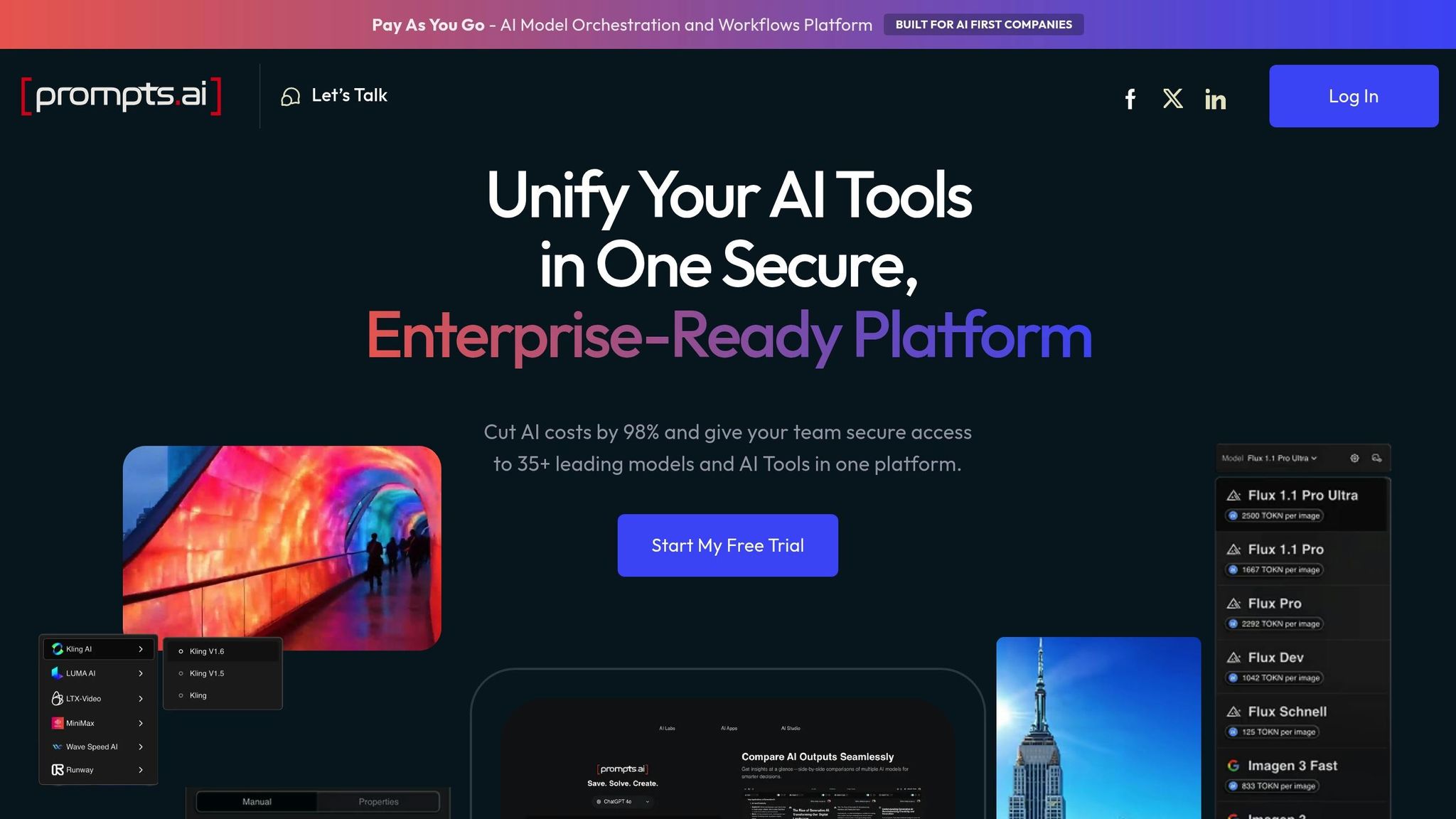
Prompts.ai integrates strong governance into AI workflows, ensuring organizations stay ahead of regulatory demands. It tracks regulatory changes in real time and sends automated alerts when new rules emerge. A built-in audit trail captures every AI interaction, providing a clear record for compliance purposes.
The platform also includes an AI-powered risk assessment tool that detects bias and anomalies, allowing potential issues to be flagged early. For data privacy, it adheres to major standards like GDPR and CCPA by offering secure document sharing and automated compliance documentation. Covering over 35 language models, including GPT-5, Claude, and Gemini, Prompts.ai ensures these compliance measures adapt to organizational growth.
Prompts.ai is designed to grow with its users, whether they’re individuals or large enterprises. Its cloud-based architecture enables smooth scaling, while a centralized AI metadata repository keeps track of models and datasets. With API integration, it fits easily into existing workflows. Scalable testing templates for detecting model drift and collaboration tools ensure governance remains intact as teams expand.
To improve visibility, the platform addresses unauthorized AI usage with policy packs tailored to U.S. and global compliance requirements. This unified system reduces tool sprawl and helps organizations maintain governance as their AI initiatives grow.
Prompts.ai offers a cost-effective approach with its pay-as-you-go TOKN credits, aligning expenses with actual usage. By automating evidence collection and providing real-time insights, it significantly reduces manual compliance tasks, saving valuable time. Consolidating over 35 models into one secure platform, businesses can cut AI software expenses by up to 98% while still maintaining strong governance measures.
OpenReg's AI Governance Suite simplifies regulatory compliance by automatically aligning AI projects with global standards, eliminating the need for cumbersome manual spreadsheets. It covers frameworks such as the EU AI Act, NIST AI Risk Management Framework, ISO 42001, and more. A Chief Risk Officer from a Fortune 500 insurance company shared:
"Openlayer automates compliance for us, mapping projects to the EU AI Act while generating the audit-ready documentation our regulators demand. We can finally prove oversight without slowing down engineering."
The suite includes over 100 automated tests to detect issues like hallucinations, bias, toxicity, PII leakage, and robustness. Real-time guardrails are in place to block threats such as prompt injections and data exfiltration during inference, ensuring immediate protection. These features provide a solid foundation for scaling AI across enterprises.
Tailored for large enterprises and Fortune 500 companies, the Suite integrates effortlessly across teams and global locations. It is particularly suited for sectors such as finance, insurance, healthcare, telecommunications, and utilities. The platform offers centralized oversight for a variety of AI systems, including traditional machine learning models, large language models, AI agents, and multimodal workflows, all managed through a unified control interface.
The Suite supports on-premises, private cloud, and hybrid deployments, adhering to SOC 2 standards and data sovereignty requirements. Its vendor-agnostic design allows seamless integration with existing lifecycle tools. Backed by $14.5 million in Series A funding, the platform is designed to meet the demands of enterprise-scale operations.
The platform actively monitors LLM pipeline costs and latency in real time to prevent potential failures. It automates compliance testing and evidence collection, significantly reducing the need for manual legal reviews. Additionally, it tracks AI expenditures with detailed audit trails, ensuring better cost management and improved ROI.
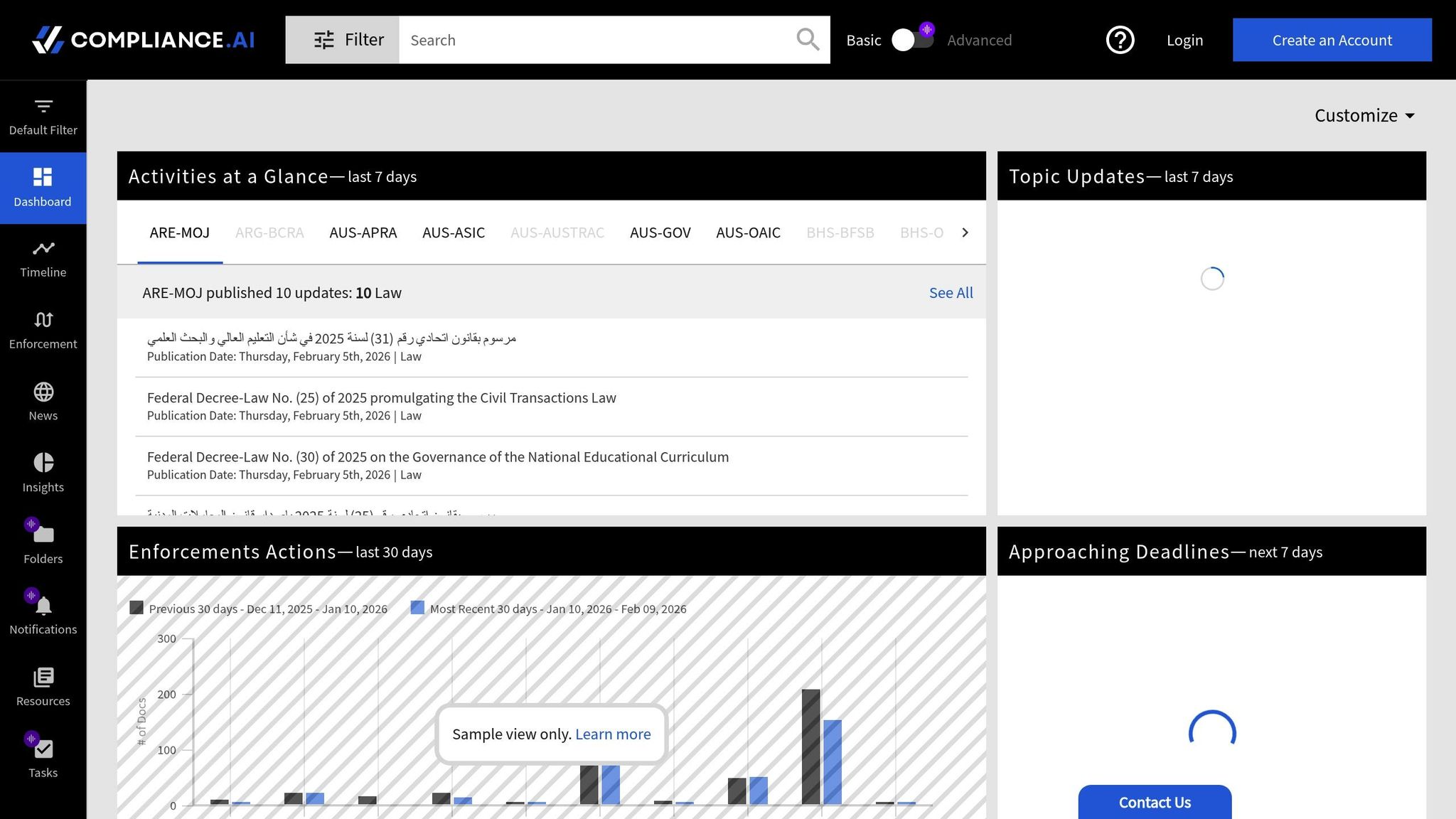
ComplyAI Pro provides real-time insights into regulatory changes through tailored, role-specific dashboards. These dashboards keep users informed about proposed and finalized rules, enforcement actions, and industry updates. The platform automatically filters updates to focus on what matters to your organization, cutting through the clutter of unnecessary compliance information.
It also simplifies compliance by mapping controls across various frameworks, revealing a 60–80% overlap in regulatory requirements. This approach allows organizations to address multiple compliance obligations using a single control. With over 100 integrations, ComplyAI Pro seamlessly connects to your existing tools and workflows, eliminating the need for significant infrastructure modifications.
The platform’s compliance tools are designed to scale effortlessly across departments and business units. Whether managing compliance for a single product line or coordinating across multiple divisions and locations, ComplyAI Pro adapts to your needs. Its automated filtering and control mapping ensure smooth operations, enabling quick deployment and effective management of complex compliance requirements.
With pricing between $3,000 and $8,000 and an implementation effort of just 20–50 hours, ComplyAI Pro offers a cost-effective solution. The platform also includes a money-back guarantee, minimizing financial risk. By automating tasks like regulatory monitoring and control mapping, it significantly reduces the manual workload for legal and compliance teams, saving both time and resources.
When evaluating platforms, it’s crucial to weigh their strengths and weaknesses to determine how well they align with your organization's compliance requirements. The right choice depends on your operational priorities and compliance goals.
| Software | Key Strengths | Key Weaknesses | Best For |
|---|---|---|---|
| Prompts.ai | Offers unified access to over 35 language models with built-in governance; includes real-time FinOps tracking that can cut AI costs by up to 98%; pay-as-you-go credits eliminate recurring fees; provides audit trails and controls | Focused more on AI orchestration than on providing extensive regulatory playbook libraries | Ideal for organizations prioritizing cost transparency, multi-model flexibility, and centralized governance without tool sprawl |
| AI Governance Suite by OpenReg | Automates regulatory compliance and asset discovery; includes pre-built playbooks for frameworks like the EU AI Act and NIST AI RMF; enables cross-functional collaboration across legal, IT, and business teams | Steep learning curve; its governance-centric approach may lack real-time technical observability for smaller teams | Best suited for large enterprises managing multiple regulatory frameworks and requiring standardized project intake processes |
| ComplyAI Pro | Simplifies regulatory tracking with streamlined compliance workflow updates | Limited to essential tracking and lacks real-time model intervention capabilities | A good fit for organizations needing straightforward regulatory notifications and easy deployment |
These comparisons emphasize the strategic choices organizations must make to ensure their compliance tools align with both their operational needs and long-term goals.
Staying compliant is essential for unlocking AI's full potential in today’s rapidly evolving landscape. With AI expected to support 90% of commercial applications by the end of 2025[1], selecting a platform that adapts to your growing needs has never been more important.
Prompts.ai simplifies AI management by consolidating tools and enforcing governance. It optimizes complex workflows through real-time monitoring and a pay-as-you-go pricing model, ensuring both cost clarity and centralized oversight. By maintaining strong controls, it reduces tool sprawl and keeps compliance as a top priority.
Under the EU AI Act, an AI system is classified as "high-risk" if it has a substantial impact on individuals' health, safety, or fundamental rights. These systems are commonly employed in sensitive areas such as healthcare or law enforcement and are subject to rigorous regulations. To comply, they must undergo conformity assessments and be continuously monitored. Annexes I and III of the Act outline specific high-risk applications, aiming to ensure safety, transparency, and accountability prior to their deployment.
Starting an AI compliance program without governance can be managed effectively with a clear, step-by-step approach. Start by building a basic AI governance framework that focuses on key areas like data management, legal requirements, and risk control. Assemble a team specifically tasked with creating policies and maintaining accountability. Leverage tools designed for automated monitoring and controls, and introduce governance gradually by running pilot projects. This step-by-step method helps establish compliance and encourages responsible AI practices over time.
When assessing AI compliance software, it's important to choose tools that align with major regulations such as SOC 2, HIPAA, and GDPR. Key features to consider include workflow automation, bias monitoring, audit trails, and policy management, all of which contribute to ethical and secure AI practices. Additionally, opt for platforms that seamlessly integrate with your current systems, provide room for growth, and are easy to use. These qualities will help simplify compliance processes and keep pace with changing standards.