Pay As You Go - AI Model Orchestration and Workflows Platform



AI orchestration platforms simplify managing complex AI workflows by integrating tools, ensuring security, and optimizing costs. They help businesses reduce inefficiencies, enhance governance, and save up to 98% in expenses. Here's a quick overview of the top 10 platforms designed to meet diverse needs, from startups to Fortune 500 companies:
Each platform excels in areas like integration, scalability, deployment flexibility, and cost transparency. Below is a Quick Comparison Table summarizing their features and use cases.
| Platform | Key Features | Deployment Options | Security Controls | Pricing | Best Use Cases |
|---|---|---|---|---|---|
| Prompts.ai | 35+ LLMs, Cost analytics, Governance tools | Cloud, Hybrid, On-premises | SOC 2, GDPR, Audit trails | $0/month (pay-as-you-go) | Enterprise AI management |
| Domo | Data visualization, BI tools | Cloud-native | Role-based access, Encryption | Enterprise pricing | Data-driven AI workflows |
| IBM watsonx | Natural language automation, Compliance tools | Cloud, On-premises, Hybrid | Zero-trust architecture | $0.40/API call | Finance, legacy system automation |
| UiPath | AI agents, Workflow automation | Cloud, On-premises | Advanced encryption, RBAC | $420/user/month | Process automation, RPA |
| Kubiya AI | Cloud provisioning via Slack | Cloud-native, Multi-cloud | DevSecOps, Secret management | $50/user/month | DevOps, Cloud management |
| SuperAGI | Open-source, Autonomous agents | Self-hosted, Cloud | Customizable security | Free (open-source) | Custom agent development |
| Anyscale (Ray) | Distributed AI, Model serving | Multi-cloud, On-premises | Network security, Isolation | Pay-per-use compute | AI training, Research |
| Kore.ai | Conversational AI, Multi-channel deployment | Cloud, Hybrid, On-premises | PII protection, Audit logs | $15/month (starter) | Customer service, Virtual assistants |
| Microsoft AutoGen | Multi-agent collaboration | Cloud, Hybrid, On-premises | Azure AD, Microsoft security | Azure usage-based pricing | Software development |
| Botpress | Conversational AI, API-first design | Cloud, Hybrid, On-premises | Community-driven security | Free (open-source) | E-commerce chatbots, Custom bots |
Choose a platform that aligns with your goals - whether it's unifying AI tools, automating workflows, or scaling operations. Each solution addresses specific business challenges, making AI orchestration more efficient and cost-effective.

Prompts.ai brings together over 35 AI models, including GPT-5, Claude, LLaMA, and Gemini, within a secure and unified platform. By consolidating these leading language models, it helps U.S. enterprises tackle the complexities of managing multiple, fragmented AI tools.
Prompts.ai offers seamless access to top-tier AI language models through a single interface, enabling users to compare performance side by side. Beyond this, the platform integrates with tools like Slack, Microsoft 365, and Google Workspace, making it easy to automate multi-step workflows.
The platform’s versatility is evident in real-world use cases. For example, in May 2025, Johannes V., a Freelance AI Director, used Prompts.ai to create a promotional video by combining various AI tools for image generation and animation. He noted:
the video was assembled with Prompts.ai at every step.
Prompts.ai supports interoperable workflows, fine-tuning of LoRA models, and the creation of custom AI agents, all while maintaining centralized oversight. These capabilities are backed by a strong foundation of security and compliance.
Designed with enterprise-grade governance at its core, Prompts.ai incorporates best practices from SOC 2 Type II and GDPR standards to protect user data. Through its partnership with Vanta, the platform ensures continuous monitoring of controls and began its SOC 2 Type II audit process on June 19, 2025. Users can access detailed, real-time insights into security and compliance through the platform’s Trust Center (https://trust.prompts.ai/).
Prompts.ai’s "Govern at Scale" approach provides full visibility and auditability across all AI activities. Enterprise plans include advanced features like compliance monitoring and governance tools, making it easier to manage operations at scale.
Prompts.ai’s architecture is built to handle enterprise-wide AI workflow management with ease. Its horizontal scaling capabilities allow organizations to execute thousands of AI workflows simultaneously without performance issues. Deployment options include fully managed cloud services with auto-scaling, as well as hybrid and on-premises setups, catering to businesses with strict data residency needs.
For example, a U.S.-based financial services firm successfully used Prompts.ai to automate client onboarding. By integrating document classification using LLMs, identity verification APIs, and CRM updates into one workflow, they reduced manual processing time by 80% and saved over $100,000 annually in operational costs.
Prompts.ai addresses a major challenge in enterprise AI adoption: cost management. Its detailed cost analytics dashboards provide insights into usage by workflow, user, and AI model, helping businesses optimize their AI spending. Key FinOps features include budget alerts, usage caps, and real-time cost tracking. With a usage-based pricing model charging per workflow execution or API call, Prompts.ai simplifies cost control. The platform promises to replace over 35 disconnected tools and reduce costs by 95% in less than 10 minutes.
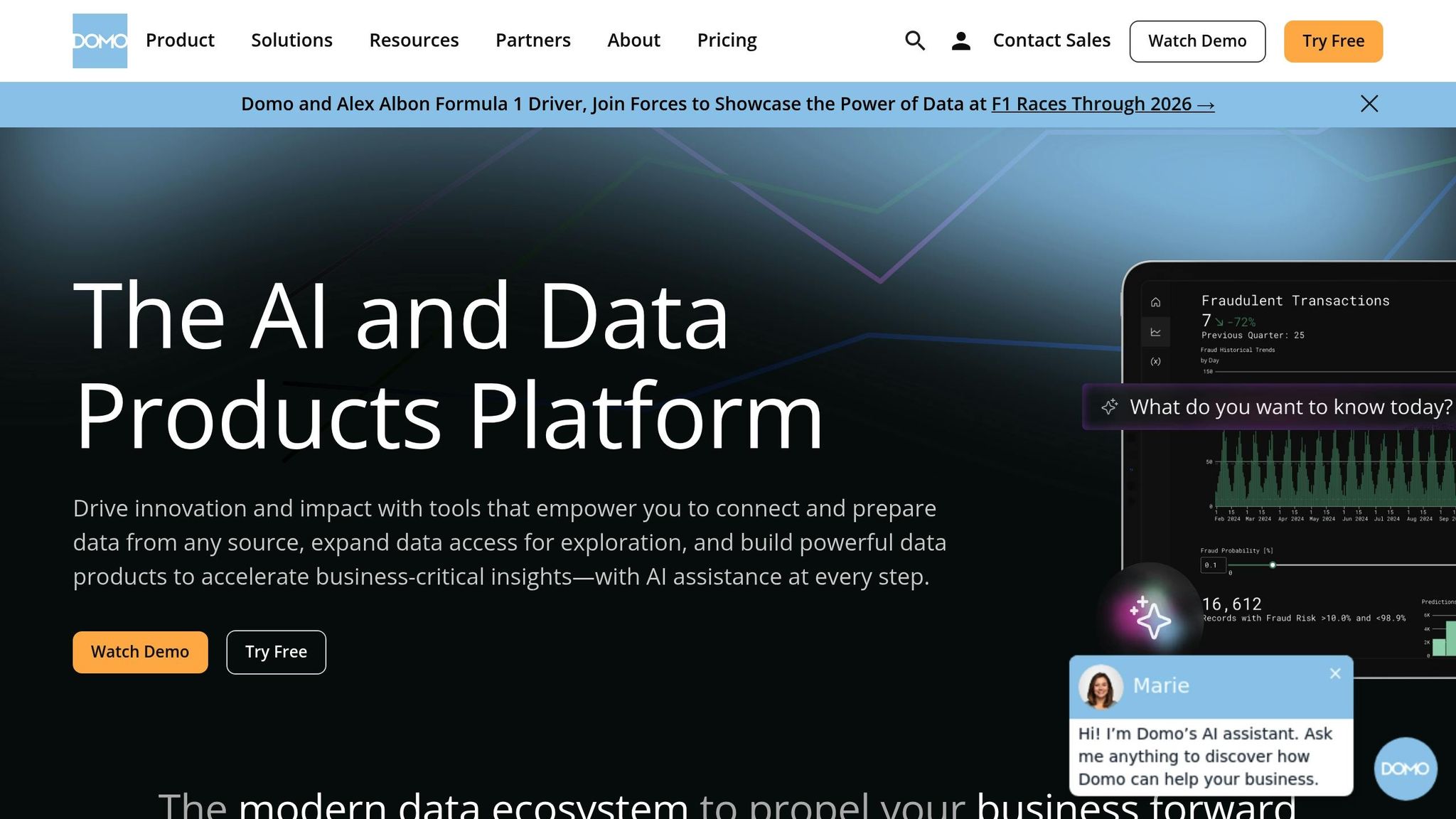
Domo stands out as a business intelligence platform designed with a cloud-native architecture that integrates AI orchestration seamlessly. It excels in connecting to a wide range of data sources, including cloud services, on-premises databases, and third-party applications, enabling efficient, data-driven workflows. This interconnected framework strengthens its ability to handle complex data integration tasks.
Domo simplifies the process of unifying data by bringing together information from multiple sources into a single environment. This consolidation paves the way for more streamlined and actionable AI insights.
In addition to its integration strengths, Domo prioritizes governance and data security. The platform includes scalable governance tools, built-in security protocols, and compliance monitoring systems. Proactive alerting ensures data integrity is maintained throughout AI workflows. These features align with Domo's cloud-based deployment strategy, offering users confidence in the safety and reliability of their data operations.
As a fully cloud-based platform, Domo is designed to adapt to fluctuating workload demands through dynamic resource allocation. This ensures that computing power scales efficiently as needed. While Domo does not provide on-premises or hybrid deployment options, it compensates by securely connecting to on-premises data sources through encrypted connectors.
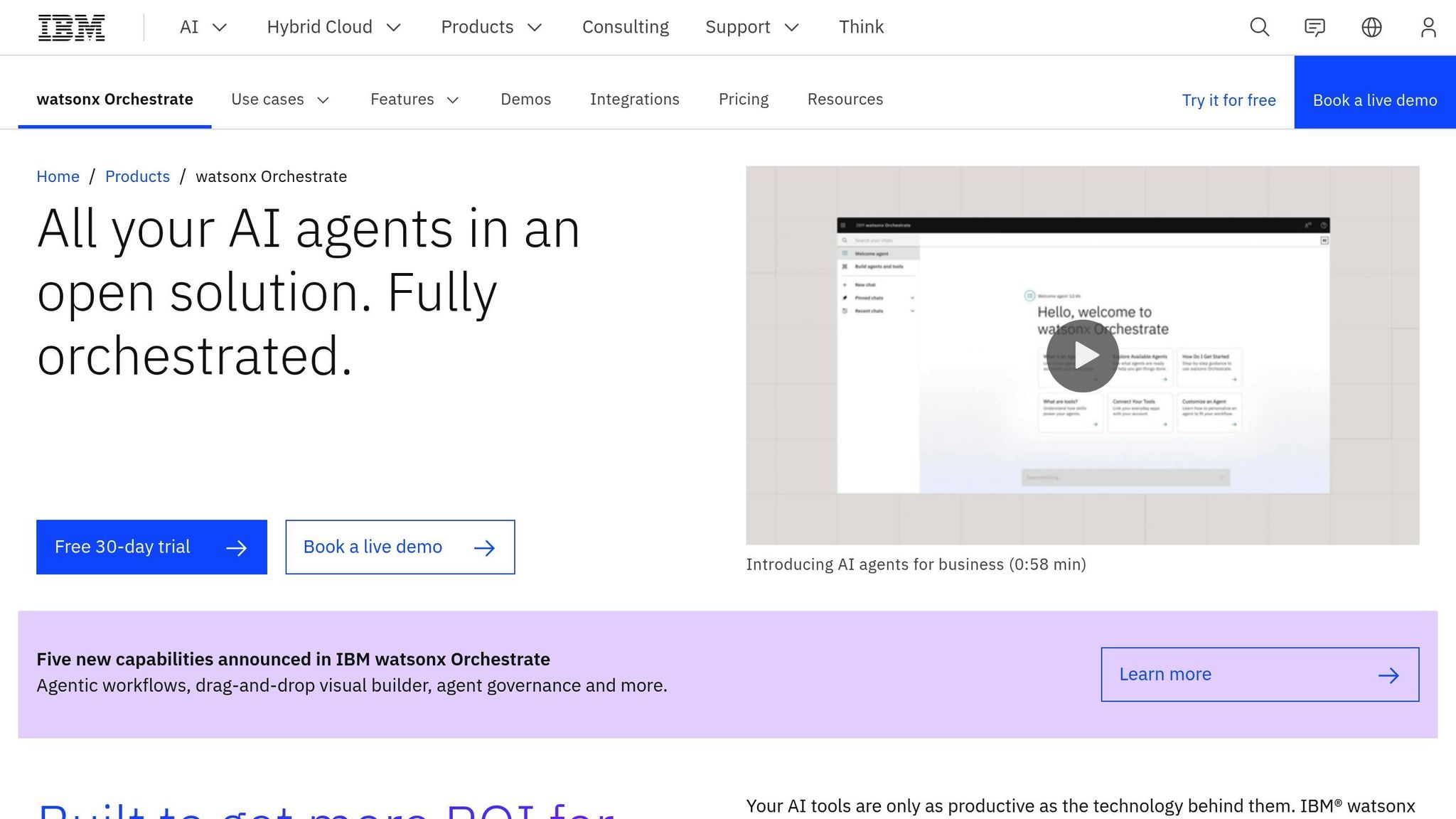
IBM watsonx Orchestrate offers a powerful AI orchestration platform designed for enterprise needs, with a focus on automation, governance, and flexible deployment. It’s particularly well-suited for industries like finance, where compliance and precision are critical.
With IBM watsonx Orchestrate, employees can activate AI workflows simply by describing their needs in everyday language - no technical commands required. The platform bridges multiple backend systems, enabling tasks such as processing loan applications or managing service requests with ease.
Its integration capabilities extend to major cloud providers like AWS and Azure through specialized connectors. These features not only enhance operational efficiency but also ensure the platform meets the compliance and scalability demands of regulated industries.
The platform incorporates a comprehensive governance framework, complete with compliance tools to ensure workflows align with regulatory and organizational standards. For example, a leading financial institution implemented IBM watsonx Orchestrate to automate customer support and back-office operations, resulting in faster processing times, fewer errors, and improved customer satisfaction.
IBM watsonx Orchestrate adapts to various enterprise environments, supporting cloud, on-premises, and hybrid deployment models. Its dynamic scalability allows businesses to grow while meeting regulatory demands across different regions. Organizations can extend automation to new use cases and refine AI models over time, ensuring continuous improvement. This adaptability makes it an ideal choice for large enterprises navigating complex and evolving operational landscapes.
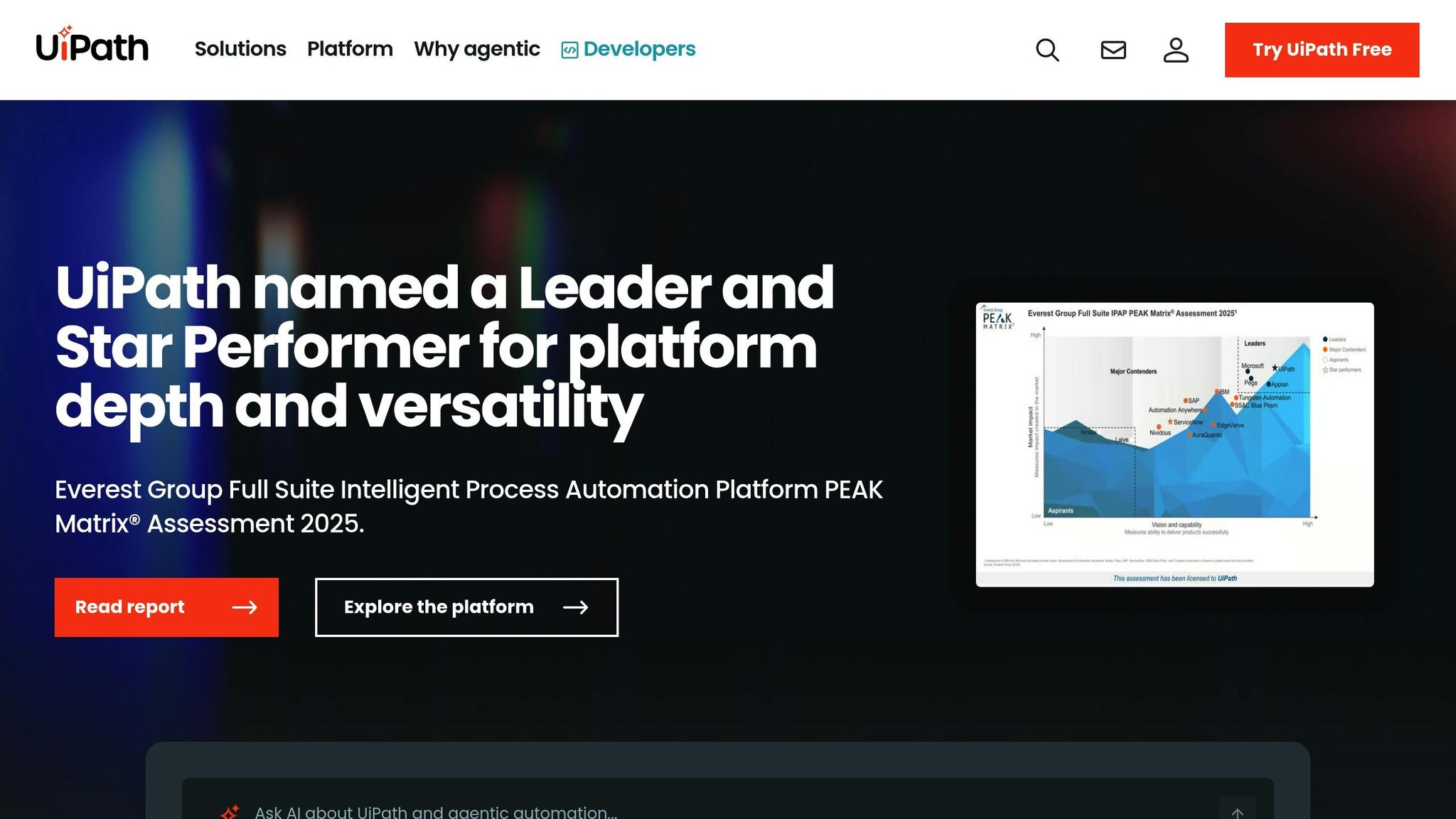
The UiPath Agentic Automation Platform takes AI orchestration to the next level by blending advanced automation with UiPath's robust automation foundation. This combination allows organizations to build AI agents capable of reasoning, decision-making, and independently handling complex tasks.
The platform integrates a variety of large language models - both proprietary and open-source - through a unified orchestration layer. This setup ensures that the best-suited AI model can be chosen for each specific task, all within a streamlined workflow.
With its AI agent framework, users can interact with automated processes through natural language, making communication with these agents intuitive and conversational. These AI agents can seamlessly access and manipulate data across enterprise systems, from CRM platforms to financial databases, all while maintaining context during intricate, multi-step operations. Additionally, the platform supports popular AI development frameworks, enabling data scientists and developers to deploy custom models directly into UiPath workflows. These features lay a strong foundation for secure and well-governed automation.
UiPath prioritizes enterprise security with comprehensive audit trails and monitoring tools that offer full visibility into automated decision-making processes. This is especially critical for industries like healthcare and finance, where compliance is non-negotiable. Every action taken by an AI agent is logged, ensuring traceability.
The platform includes role-based access controls and approval workflows, ensuring that AI agents are deployed only after meeting internal standards. Sensitive information is safeguarded through data encryption and secure API connections, providing peace of mind throughout the AI orchestration process.
The platform supports flexible deployment options, including cloud, on-premises, and hybrid environments. Its containerized architecture makes scaling effortless, automatically adjusting computational resources to meet workflow demands.
With a multi-tenant architecture, large enterprises can manage AI orchestration across various business units while maintaining strict data isolation and security. This is particularly beneficial for organizations operating in multiple regions with differing data residency requirements. The platform's deployment adaptability ensures it integrates seamlessly with existing IT infrastructure, eliminating the need for costly system overhauls. Alongside its scalability, the platform also emphasizes financial oversight.
UiPath provides detailed tools for tracking and optimizing costs. Its analytics dashboard breaks down expenses by AI agents, workflows, and resource usage, allowing for accurate budget management and accountability across cost centers.
The platform's cost optimization features suggest actionable improvements, such as consolidating workflows or selecting AI models that balance performance with cost efficiency. This financial transparency is vital for enterprises managing extensive AI deployments across multiple departments and use cases.
Kubiya AI simplifies cloud infrastructure management by enabling developers to provision setups using natural language commands directly within Slack. By extending interoperability from AI models to cloud infrastructure orchestration, Kubiya AI helps eliminate delays caused by lengthy approval processes.
Kubiya AI employs multi-agent orchestration to translate natural language commands into actionable infrastructure tasks. The platform integrates with tools like Terraform for infrastructure-as-code deployments, making it easier for teams to manage complex cloud environments without requiring extensive scripting expertise. Through secure API connections with providers such as AWS, Kubiya facilitates real-time infrastructure provisioning. For instance, when a developer submits a request via Slack, the AI agents analyze the request, apply organizational policies, and orchestrate deployment steps across various cloud services. Kubiya also tracks context across multi-step operations, ensuring seamless execution of comprehensive infrastructure deployments. These capabilities support compliance and scalability, making it a powerful tool for modern cloud management.
Kubiya AI is designed with enterprise-grade security in mind, automating policy enforcement and maintaining detailed audit trails. Every infrastructure request is evaluated by a policy engine to ensure it aligns with company standards before deployment. The platform generates thorough logs of all infrastructure changes, ensuring traceability and accountability. Automated approval workflows further enhance security by ensuring all deployments comply with established rules. This focus on compliance allows Kubiya AI to scale effectively and securely, even in demanding enterprise environments.
Built for Kubernetes-native scalability, Kubiya AI is ideal for enterprises managing intricate cloud infrastructures. It can be deployed through secure connections to existing cloud accounts and Kubernetes setups, whether accessed via the Kubiya dashboard or a command-line interface.
"Kubiya AI addresses infrastructure challenges by allowing developers to use natural language commands in platforms like Slack to request complex infrastructure setups, significantly reducing setup times from days to hours while ensuring automatic enforcement of security and compliance rules with full auditability."
Kubiya AI’s flexible deployment options make it easy for organizations to integrate the platform into their existing DevOps workflows without requiring major changes to their infrastructure. Its ability to scale and integrate seamlessly demonstrates its value as a critical tool for streamlining AI-driven workflows.
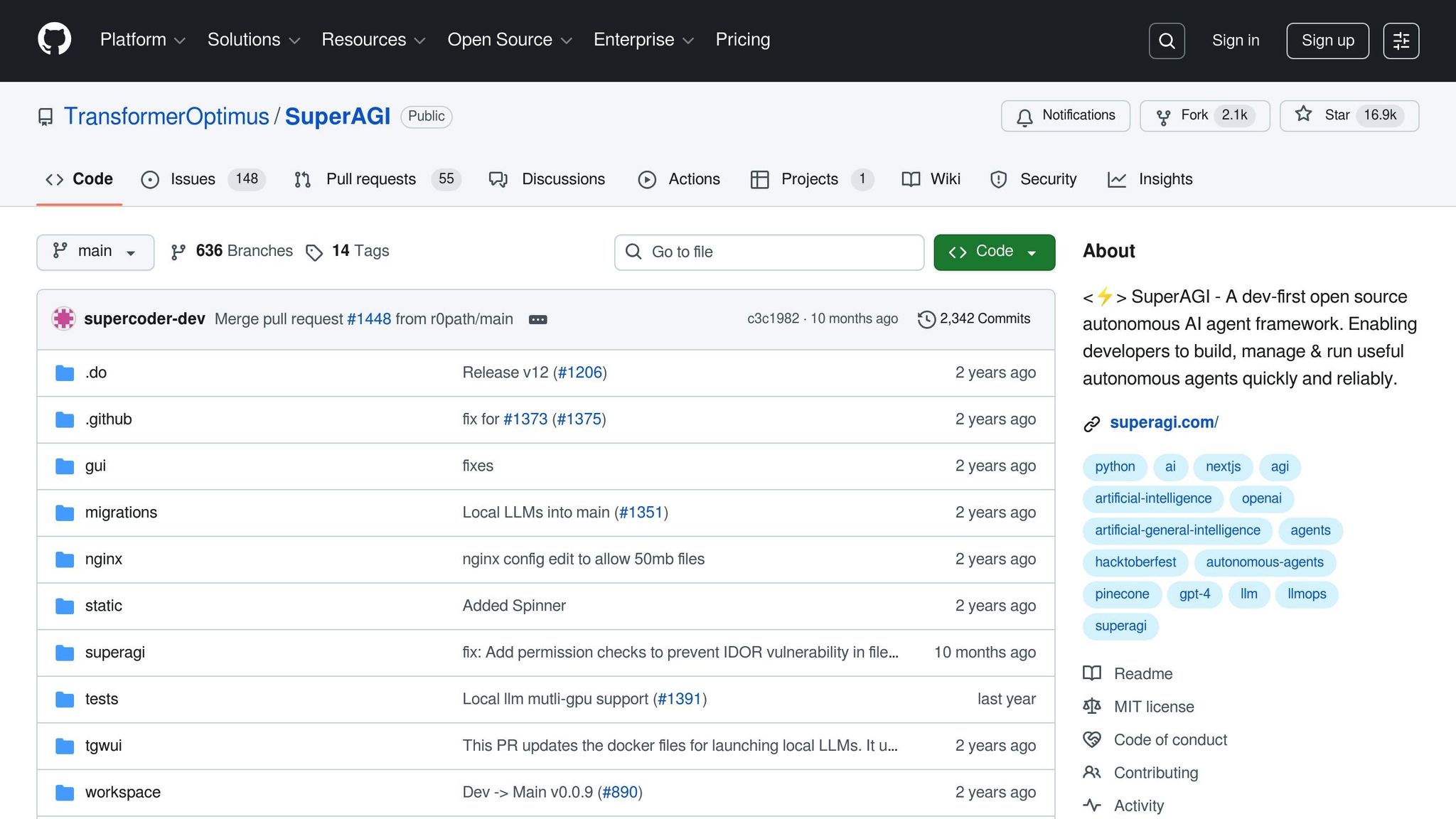
SuperAGI is an open-source framework designed to help developers create, deploy, and manage autonomous AI agents capable of handling complex workflows. It equips these agents with the ability to reason, plan, and maintain context over extended operations.
SuperAGI integrates seamlessly with top-tier large language models, including GPT-4, while also supporting open-source alternatives. This flexibility enables developers to choose models based on their specific needs, balancing performance and cost effectively.
The framework’s plugin architecture expands its capabilities by connecting agents to external tools like databases, file systems, web browsers, and more. This functionality makes it particularly useful for automating software development tasks, such as coding or managing repetitive operations. These integrations establish a robust foundation for building diverse AI-driven workflows.
SuperAGI also includes a memory management system, ensuring agents can retain context across lengthy, multi-session tasks. This feature is essential for tackling more intricate workflows.
Though designed for flexibility and rapid development, SuperAGI incorporates basic monitoring and logging tools to track agent activity. As an open-source platform, it also offers developers the freedom to customize governance, compliance, and security measures to align with their specific needs.
SuperAGI provides multiple deployment options, supporting cloud, hybrid, and on-premises environments. Developers can deploy the platform using Docker containers or run it on Kubernetes clusters with major cloud providers like AWS, Google Cloud, or Microsoft Azure. This adaptability makes it easy to scale as workloads grow.
Its distributed architecture allows for the deployment of multiple agents working together on complex tasks. For larger-scale operations, SuperAGI integrates seamlessly into CI/CD pipelines, enabling dynamic scaling of agent instances to maximize resource efficiency.
Anyscale is powered by the open-source Ray framework, designed to orchestrate and scale distributed AI workloads in enterprise environments. It supports training, inference, and deployment across clusters and diverse computing setups.
Anyscale integrates effortlessly with machine learning frameworks, fitting seamlessly into existing toolchains. It can distribute training tasks across multiple GPUs, making it well-suited for developing and fine-tuning large language models.
A standout feature is Ray Serve, a key component of the Ray framework. This tool manages high-performance, distributed model serving and deployment, enabling fast and scalable AI rollouts. It's particularly useful for latency-sensitive applications that demand quick response times.
The platform's ability to scale inference dynamically ensures organizations can adjust computing resources as demand changes. This adaptability supports flexible deployment while keeping scaling costs efficient.
Anyscale offers hybrid deployment options, supporting both cloud-based and on-premises environments. This flexibility allows organizations to keep sensitive data on-site while tapping into cloud resources for additional computing power when needed.
The platform is built to handle distributed AI deployments with features like auto-scaling and enterprise-grade model management. Ray Serve simplifies the process of deploying multiple models at the same time, ensuring each model gets the resources it requires based on demand.
Whether deploying on any cloud provider or integrating into existing on-premises infrastructure, Anyscale's distributed architecture supports running multiple training and inference jobs simultaneously. Its dynamic scaling adjusts resources as demand shifts, naturally optimizing costs. These capabilities make Anyscale a strong choice for meeting the complex and evolving needs of enterprise AI workloads.
Kore.ai provides an enterprise-level conversational AI platform designed to streamline and automate workflows. Recognized by both Gartner and Forrester as a leader in its field, Kore.ai offers a reliable solution for businesses aiming to deploy AI agents across intricate operational processes.
Kore.ai’s platform is built to work seamlessly with a variety of AI models, whether commercial, open-source, or custom-built. It supports essential functionalities like automatic speech recognition (ASR), text-to-speech (TTS), and natural language understanding (NLU), ensuring compatibility across different model types.
The platform features over 100 pre-built search connectors and native support for agentic RAG (Retrieval Augmented Generation), simplifying integration with enterprise data sources. Businesses can link core applications such as Salesforce, SAP, and Epic, while also tapping into unstructured data from tools like SharePoint, Slack, Confluence, and Google Drive.
To assist developers and engineers, Kore.ai offers a suite of AI tools, including the Model Hub, Prompt Studio, and Evaluation Studio, for managing and optimizing AI models. Developer-friendly APIs and SDKs further enable the customization and extension of AI agent functionalities.
Strategic partnerships enhance the platform’s versatility, with integrations available for services like Amazon Bedrock, Amazon Q, Amazon Connect, Azure AI Foundry, Microsoft Teams, Microsoft 365 Copilot, and Microsoft Copilot Studio.
"Our strategic partnership with Kore.ai marks a significant milestone in our mission to accelerate enterprise AI transformation. By integrating Kore.ai's advanced conversational and GenAI capabilities with Microsoft's robust cloud and AI services, we are enabling enterprises to adopt AI at scale and with enterprise-grade security." - Puneet Chandok, President, India and South Asia, Microsoft
This extensive integration framework ensures businesses can scale their AI initiatives while maintaining strong governance.
Kore.ai prioritizes enterprise security with a comprehensive governance framework designed to enforce policies, meet regulatory requirements, and support responsible AI usage at scale.
The platform includes enterprise guardrails to regulate AI behavior, alongside Role-Based Access Control (RBAC) for managing user permissions. Detailed audit logs provide full transparency into system activities, aiding accountability and compliance efforts.
Organizations benefit from deep insights into AI agent performance through features like tracing, real-time analytics, and event monitoring. A versioning system ensures consistent performance across deployments while allowing for controlled updates.
Built on AWS infrastructure, Kore.ai delivers high reliability and security. Its integration with Microsoft environments leverages Azure’s cloud and AI services, adding another layer of security. This robust foundation ensures the platform can meet the diverse and demanding needs of enterprise clients.
Kore.ai offers flexible deployment options, supporting cloud, hybrid, and on-premises environments. It integrates with major cloud providers such as AWS, Microsoft Azure, and Google Cloud, while also accommodating existing on-premises setups.
The platform’s scalability has been demonstrated in real-world applications. For example, Pfizer deployed 60 AI agents globally in 2025, covering research, medical, commercial, and manufacturing operations.
"Since we started with Kore.ai, we've deployed 60 AI agents across the enterprise - covering research, development, medical, commercial, and manufacturing across global markets and multiple languages. We needed a scalable platform, and these agents will only continue to become more intelligent." - Vik Kapoor, Head of GenAI Platforms & Products, Pfizer
Deutsche Bank expanded its use of Kore.ai from a regional FAQ chatbot in 2020 to a multi-region automation strategy by 2025, showcasing the platform’s growth potential. Similarly, Eli Lilly’s Tech@Lilly service desk achieved 70% automation of requests, significantly boosting employee productivity.
Kore.ai’s architecture is built to handle enterprise-scale operations, enabling complex workflows and efficient AI agent orchestration. Strategic partners like Mphasis emphasize the platform’s AWS foundation, which ensures reliability and scalability for large-scale deployments.
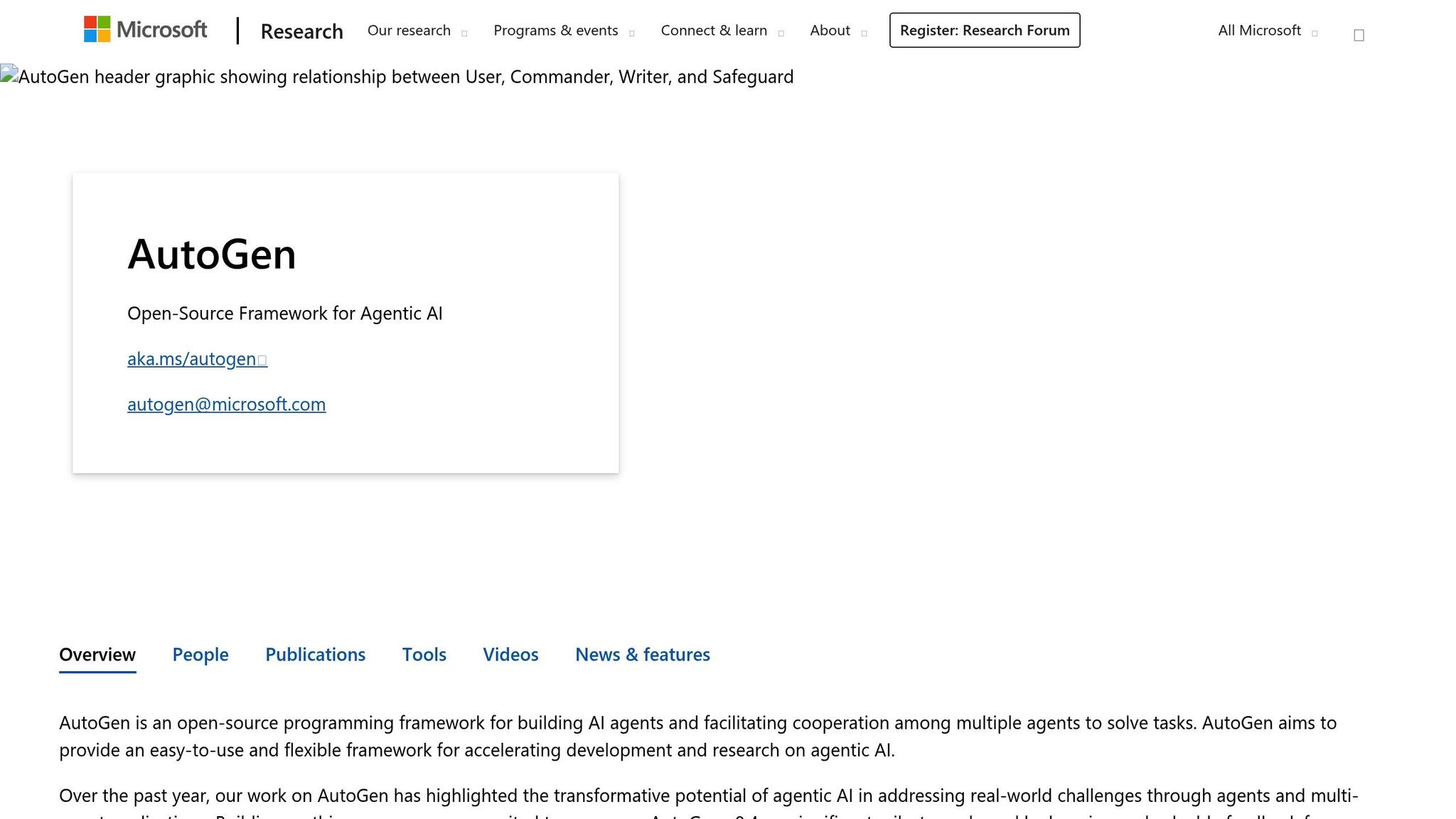
Microsoft AutoGen is an open-source orchestration framework designed to streamline AI-driven workflows by integrating large language models and other AI tools. It addresses the challenges of managing complex AI environments, focusing on smooth integration and efficient workflow operations.
One of AutoGen's standout features is its ability to enable multi-agent conversations, where multiple AI agents work together to tackle complex tasks. These agents can execute code, access APIs, and maintain context throughout extended interactions, making the platform particularly effective for problem-solving. AutoGen supports a variety of large language models, including GPT-4, Claude, and open-source options, allowing organizations to leverage the strengths of multiple models within a single workflow.
The framework’s architecture offers flexibility, supporting deployments in cloud, hybrid, and on-premises environments. With containerized scaling options, it can adjust to varying computational needs. Built-in logging and monitoring tools provide visibility into agent interactions and workflow performance, and enterprises often add extra governance measures to meet compliance standards.
For managing costs, AutoGen includes features for tracking usage and optimizing resource allocation. This helps organizations monitor API calls and computational resources across workflows. A notable use case involves automating software development, where coding agents collaborate with review agents to write, test, and refine code. This approach shortens development cycles while maintaining high-quality outcomes.
Microsoft AutoGen’s capabilities align with the broader goals of orchestration platforms, offering a strong foundation for comparing different solutions in this space.
Botpress is an open-source AI platform designed to manage conversations by seamlessly combining scripted dialog flows with responses powered by generative AI.
"Botpress is an open-source conversational platform that mixes scripted flows with generative LLM calls, designed for developers who want transparency and extensibility." - AI Acquisition
This platform is built to handle complex conversations by coordinating various AI components. For instance, an e-commerce company might use a Botpress assistant to answer product-related queries via a language model, check real-time inventory through an API, and process orders in the backend system - all working together seamlessly.
Botpress stands out with its modular, API-first structure, which allows it to blend scripted dialog flows with generative AI. This hybrid approach strikes a balance between deterministic, rule-based responses for routine queries and the flexibility of language models for more nuanced interactions.
The API-first design ensures smooth integration with external tools and services. Companies can connect Botpress agents to CRM platforms, databases, payment systems, and other business applications. Developers can easily expand its functionality by adding integrations or custom features as organizational needs grow.
Additionally, Botpress supports dynamic API calls, enabling conversational agents to take real-world actions based on user intent and context. For example, an agent can update customer records or process payments while maintaining a natural, conversational tone. This capability not only enhances the user experience but also ensures operational efficiency, making it a powerful tool for scalable and adaptable deployments.
Botpress offers flexibility in deployment, supporting cloud, on-premises, and hybrid environments to address varying security and compliance requirements.
"Botpress provides streamlined orchestration tailored for conversational AI by enabling the rapid development, management, and deployment of customizable chatbot experiences for enterprises." - Akka
The platform's visual routing tools make it easy to design complex conversational flows, including smooth transitions between automated responses and human support. With an active community contributing tools and extensions, organizations can benefit from ongoing advancements while maintaining complete control over their conversational AI systems. This combination of scalability, customization, and community-driven innovation makes Botpress a reliable choice for enterprise-grade chatbot solutions.
Below is a detailed comparison of platforms, highlighting features, integrations, deployment options, security measures, pricing, and ideal use cases. This table provides a side-by-side view to help you quickly assess which platform aligns with your needs.
| Platform | Key Features | Supported Integrations | Deployment Options | Security Controls | Pricing (USD) | Best Use Cases |
|---|---|---|---|---|---|---|
| Prompts.ai | 35+ LLMs (GPT-5, Claude, LLaMA, Gemini), Real-time FinOps, Prompt workflows, Side-by-side comparisons | Enterprise APIs, CRM systems, Business applications | Cloud, On-premises, Hybrid | Governance, Audit trails, Data protection | Pay-as-you-go: $0/month, Creator: $29/month, Business: $99-129/member/month | Fortune 500 companies, Creative agencies, Research labs seeking unified AI management |
| Domo | Business intelligence focus, Data visualization, Automated insights | 1,000+ cloud connectors, Enterprise databases, SaaS platforms | Cloud-native, Private cloud | Role-based access, Data encryption, Compliance frameworks | Enterprise pricing | Large enterprises requiring data-driven AI orchestration |
| IBM watsonx Orchestrate | Pre-built skills library, Natural language automation, Enterprise integration | IBM ecosystem, Third-party APIs, Legacy systems | IBM Cloud, On-premises, Hybrid | IBM Security framework, Zero-trust architecture | Usage-based pricing from $0.40 per API call | Enterprise automation, Legacy system modernization |
| UiPath Agentic Automation Platform | Robotic process automation, AI-powered agents, Workflow automation | 500+ pre-built connectors, Enterprise applications | Cloud, On-premises | Advanced encryption, Compliance certifications, Access controls | Platform licensing from $420/user/month | Process automation, Document processing, Customer service |
| Kubiya AI | DevOps focus, Infrastructure automation, Kubernetes integration | Cloud providers (AWS, Azure, GCP), CI/CD tools, Monitoring systems | Cloud-native, Multi-cloud | DevSecOps integration, Secret management | Team plans from $50/user/month | DevOps teams, Infrastructure management, Cloud operations |
| SuperAGI | Open-source framework, Multi-agent systems, Custom AI agents | Open APIs, Custom integrations, Developer tools | Self-hosted, Cloud deployment | Community-driven security, Custom implementations | Open-source (free), Enterprise support available | AI research, Custom agent development, Experimental projects |
| Anyscale (Ray) | Distributed computing, ML model training, Scalable inference | Python ecosystem, ML frameworks, Cloud services | Multi-cloud, On-premises | Network security, Resource isolation | Pay-per-use compute pricing | Machine learning teams, Large-scale AI training, Research institutions |
| Kore.ai | Conversational AI, Virtual assistants, Multi-channel deployment | 100+ enterprise systems, Communication platforms, CRM tools | Cloud, On-premises, Hybrid | Enterprise security, PII protection, Audit logs | Starter: $15/month, Enterprise pricing | Customer service, Employee assistance, Conversational interfaces |
| Microsoft AutoGen | Multi-agent conversations, Code generation, Collaborative AI | Microsoft 365, Azure services, OpenAI models | Azure Cloud, Local development | Microsoft security stack, Azure AD integration | Usage-based Azure pricing | Software development, Research collaboration, Automated coding |
| Botpress | Open-source conversational AI, Scripted flows with generative AI, Visual routing | API-first integrations, CRM platforms, Payment systems | Cloud, On-premises, Hybrid | Community security, Custom implementations | Open-source (free), Cloud hosting from $10/month | E-commerce chatbots, Customer support, Conversational interfaces |
Choosing the right platform depends on your organization's priorities - whether it's unified AI management, automation, tailored development, or conversational AI capabilities. Each platform is designed to meet specific needs, so understanding your goals is crucial before making a decision.
AI orchestration platforms simplify intricate workflows and ensure that technology aligns with business goals. When evaluating these platforms, it's essential to weigh factors like security, cost management, scalability, deployment options, and integration features.
Security and compliance take center stage, especially for enterprises managing sensitive data. Opt for platforms that offer strong security measures and detailed audit trails to maintain trust and accountability.
Cost management is another critical consideration. Platforms with real-time FinOps tools and transparent pricing models, such as pay-as-you-go, can help avoid overspending on unused licenses or resources.
Scalability is key as your business grows. Open-source platforms can be highly customizable but often demand advanced technical expertise, while commercial platforms usually provide quicker deployment with dedicated support.
Deployment flexibility also plays a vital role. Cloud-native solutions allow for rapid scaling and minimal maintenance, while hybrid setups offer the advantage of hosting sensitive workloads on-premises. Choosing the right approach depends on your organization's technical abilities and operational needs.
Integration capabilities are equally important. Pre-built connectors can speed up implementation and reduce the reliance on custom development, ensuring the platform fits seamlessly into your existing tech ecosystem.
Before deciding, take a close look at your current AI capabilities, growth objectives, and technical limitations to ensure the platform aligns with your long-term vision.
AI orchestration platforms are transforming how businesses operate by cutting costs and boosting efficiency. By automating repetitive tasks like deployment and scaling, they minimize the need for constant manual effort. This not only simplifies daily operations but also frees up teams to concentrate on higher-level, strategic initiatives.
Beyond automation, these platforms excel at managing resources. They dynamically adjust computational power to match workload demands, ensuring critical tasks get the attention they need without overspending on infrastructure. Moreover, they speed up development and deployment by allowing teams to reuse components and establish consistent workflows. This streamlined approach helps companies roll out AI solutions faster and with greater precision.
When selecting an AI orchestration platform, it's crucial to focus on strong security measures to keep sensitive information safe. Opt for platforms that offer role-based access controls, which limit workflow access to authorized users, and encryption to protect data both during transfer and when stored. Platforms with compliance certifications like SOC 2 or GDPR show they meet important regulatory standards.
Equally important are tools for oversight, such as real-time dashboards and audit trails, which allow you to monitor performance, spot potential problems, and maintain accountability. These features work together to create a secure and transparent framework for managing AI workflows effectively.
To select the best AI orchestration platform for your business, it’s essential to weigh several critical factors to ensure it meets your specific needs and objectives. Start with integration capabilities - opt for platforms that easily connect with your current tools, APIs, and hybrid or multi-cloud setups without unnecessary complexity.
Next, look for automation features that simplify processes like deployment, scaling, and version control. These tools can significantly improve efficiency and reduce the time spent on manual tasks.
Don’t overlook governance and security either. A reliable platform should provide strong access controls, encryption, and compliance with industry regulations to keep your data safe. Platforms offering modularity and extensibility are also worth considering, as they allow you to adapt and expand your AI solutions as your business evolves.
Lastly, focus on ease of use. Platforms that include no-code tools can empower non-technical team members, while developer-friendly options ensure flexibility for technical staff. By concentrating on these factors, you’ll be better equipped to choose a platform that enhances and supports your AI initiatives.