Pay As You Go - AI Model Orchestration and Workflows Platform



Artificial intelligence is transforming enterprise workflows, with AI-driven processes expected to jump from 3% to 25% of operations by the end of 2025. Businesses now face the challenge of scaling AI efficiently, reducing costs, and ensuring governance. Here’s a quick guide to the top software platforms designed to simplify AI workflow orchestration, streamline operations, and enforce compliance.
These platforms differ in scalability, governance, integration capabilities, and cost models. For example, Prompts.ai excels in multi-model orchestration and cost transparency, while Kubeflow leverages Kubernetes for horizontal scaling. Choose based on your operational needs, budget, and compliance requirements.
| Platform | Key Strengths | Deployment Options | Ideal Use Cases | Cost Model |
|---|---|---|---|---|
| Prompts.ai | Multi-model access, cost savings | Cloud-based SaaS | Enterprise AI workflows, cost control | Pay-as-you-go TOKN |
| Kubeflow | Kubernetes integration | On-premises, cloud, hybrid | ML pipelines in containers | Open-source |
| Apache Airflow | Workflow orchestration | Self-hosted, managed cloud | Data engineering, ETL workflows | Open-source |
| IBM watsonx | Governance, compliance | IBM Cloud, hybrid | Regulated industries, enterprise AI | Licensing |
| UiPath | RPA with AI integration | Cloud, on-premises, hybrid | Process automation | Per-bot licensing |
| SuperAGI | Autonomous agents | Cloud-native | Multi-agent AI processes | Usage-based |
| Prefect | Python-native, dynamic workflows | Cloud, self-hosted | Data science, AI pipelines | Compute-based |
| Dagster | Data pipeline optimization | Self-hosted, Dagster Cloud | Data engineering | Open-source |
| Ray Serve | Distributed model serving | Self-managed, cloud | Real-time inference | Infrastructure |
| DataRobot MLOps | Lifecycle management | Cloud, on-premises | Model deployment, monitoring | Subscription |
For enterprises scaling AI, Prompts.ai offers unmatched cost efficiency and governance. Open-source platforms like Kubeflow and Airflow provide flexibility but may require more technical expertise. Evaluate your scalability, compliance, and budget needs to find the right fit.
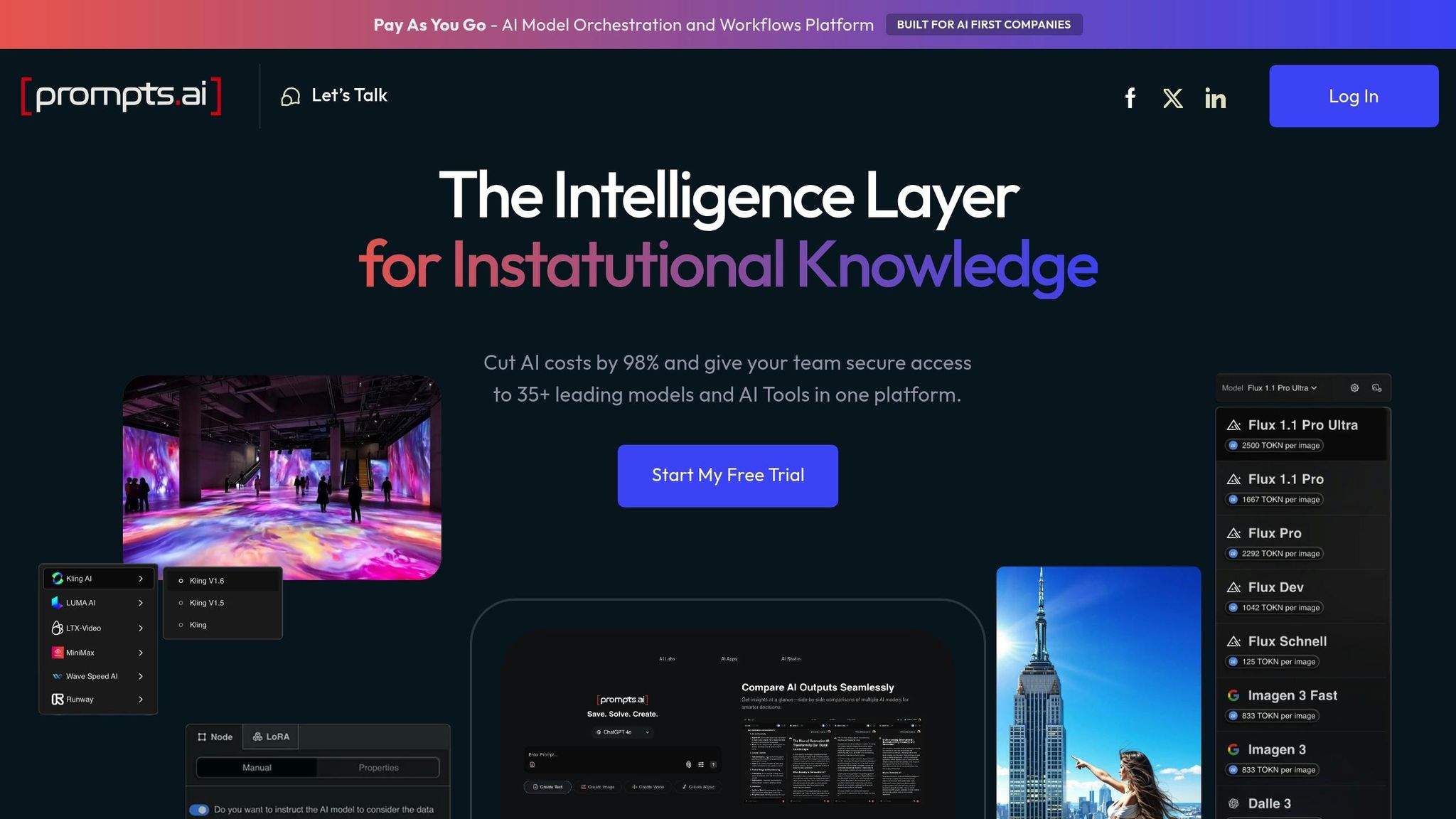
Prompts.ai is a cutting-edge platform designed to streamline AI operations for enterprises by bringing multiple AI models into a single, unified interface. It tackles the challenges of managing fragmented tools and escalating costs by offering a centralized solution that integrates over 35 leading AI models - such as GPT-5, Claude, LLaMA, and Gemini. With this secure and efficient platform, businesses can automate workflows and enhance prompt engineering without juggling multiple disconnected tools.
The platform transforms AI deployment by turning one-off tasks into repeatable, scalable AI-driven workflows, creating a strong foundation for enterprise-level operations.
Built to meet the needs of large enterprises, Prompts.ai supports high-throughput operations with parallel prompt execution, ensuring smooth and reliable performance even as workflows grow in complexity and scale. Its orchestration tools - like version control, automated testing, and monitoring - help maintain this reliability, making it a dependable choice for handling large-scale AI demands.
The platform’s Problem Solver plan accommodates up to 99 collaborators with unlimited workspaces, while its Business AI plans offer unrestricted access and manage between 500,000 and 1,000,000 TOKN credits monthly. This scalability is further bolstered by seamless integration with top AI/ML frameworks, ensuring smooth operations across departments.
Prompts.ai goes beyond basic API connections by offering native support for top AI/ML frameworks and large language model (LLM) providers. It integrates seamlessly with major players like OpenAI, Anthropic, and Google, eliminating the need for custom-built connections.
Organizations can also take advantage of SDKs and API connectors to incorporate the platform into their existing workflows and data pipelines with minimal disruption. Its flexible orchestration allows for easy switching between AI models or incorporating new ones, ensuring that businesses stay ahead of the curve and protect their AI investments.
Prompts.ai helps businesses reduce AI costs by up to 98%, thanks to intelligent optimization and a pay-as-you-go TOKN system. Pricing starts at $99 per month for team plans and $129 per member per month for the Elite tier. The platform’s FinOps layer provides real-time tracking of TOKN credits, allowing organizations to monitor spending as it happens.
This pay-as-you-go model ties costs directly to usage, offering a predictable pricing structure and helping businesses avoid budget overruns often associated with traditional AI subscriptions. Real-time analytics and reporting tools further enable teams to track expenses, set budget alerts, and optimize workflows to cut down on unnecessary API calls or excessive compute usage.
Prompts.ai prioritizes enterprise governance and security with compliance certifications such as SOC 2 Type 2, HIPAA, and GDPR. Features like role-based access control (RBAC), audit logs, and approval workflows ensure complete visibility and accountability for AI interactions, making it ideal for industries that handle sensitive or regulated data.
Security is reinforced with data encryption both in transit and at rest, along with ongoing monitoring through Vanta for continuous compliance. The platform’s commitment to security is highlighted by its SOC 2 Type 2 audit process, which began on June 19, 2025.
For added transparency, Prompts.ai offers a dedicated Trust Center where organizations can review its real-time security posture, policies, and compliance progress. This level of governance and security gives businesses the confidence to deploy AI securely and responsibly.
Kubeflow is an open-source platform designed to simplify the development, deployment, and management of machine learning workflows on Kubernetes. While its specific scalability metrics aren't extensively detailed, it offers strong capabilities for automating workflows.
The platform seamlessly integrates with widely-used AI and machine learning frameworks, ensuring compatibility across various tools. Additionally, it includes robust access controls and compliance features, making it suitable for teams transitioning from experimentation to secure production environments.
Kubeflow serves as a reliable framework for managing machine learning processes, particularly in settings where scalability and secure oversight are priorities. Its comprehensive features create a solid groundwork for building more specialized platforms to handle AI workflows effectively.
Apache Airflow is a widely-used open-source tool designed to simplify the orchestration of AI workflows by seamlessly connecting with top AI and machine learning frameworks.
Airflow offers built-in support for major frameworks like TensorFlow, PyTorch, Scikit-learn, and MLflow. By leveraging its Python-based Directed Acyclic Graph (DAG) structure, users can create modular pipelines that handle everything from data preparation to deployment. This adaptable design makes Apache Airflow an essential resource for managing and scaling AI workflows efficiently.
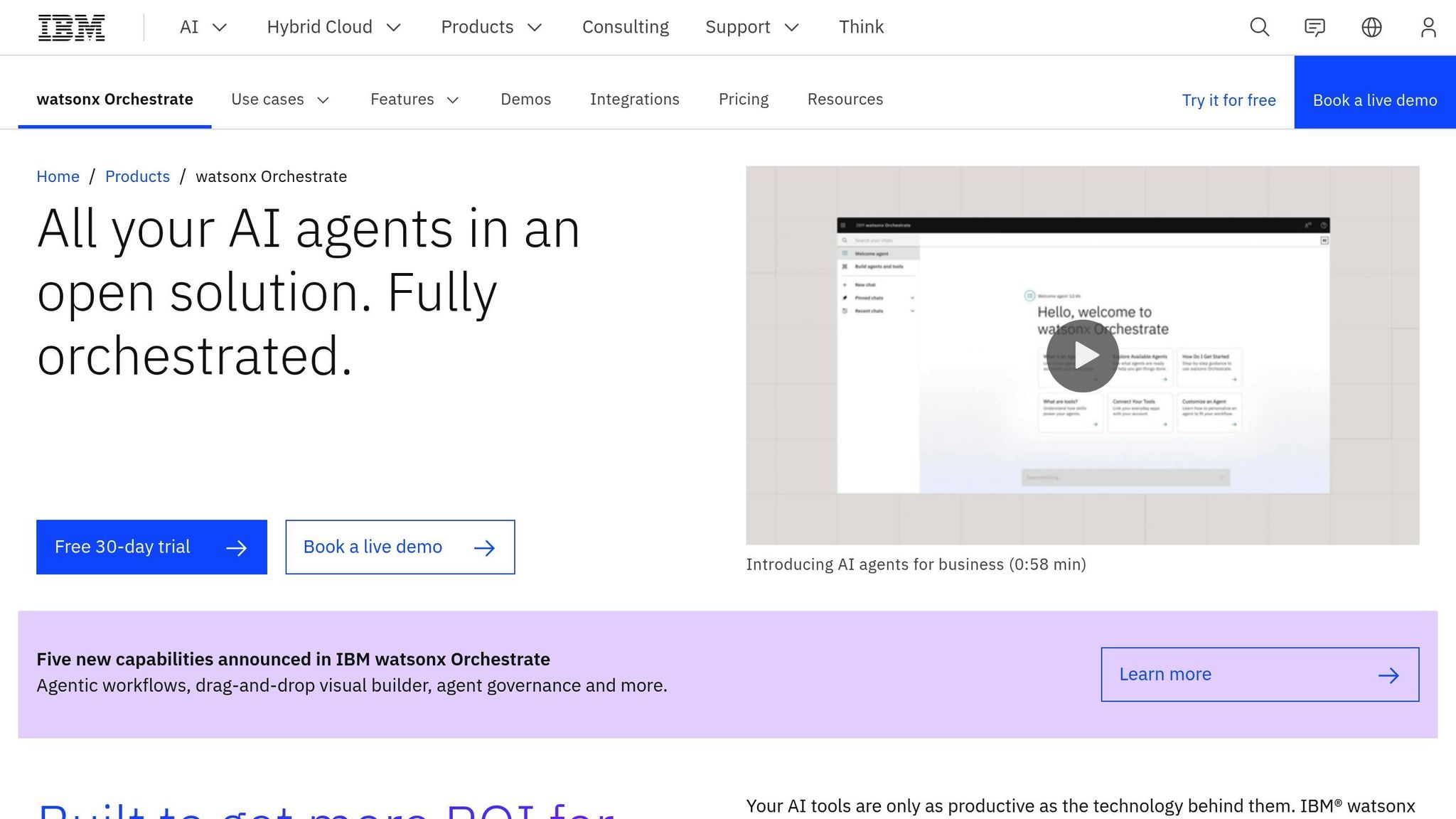
IBM watsonx Orchestrate simplifies managing AI workflows for large enterprises. Built to handle the complexity of advanced AI processes, it ensures efficient orchestration while maintaining the secure governance required for today’s AI operations. The platform is tailored to meet the rigorous demands of AI-driven tasks in large organizations, providing a reliable foundation for seamless integration and management.
This solution highlights IBM's dedication to offering secure and scalable tools for managing AI workflows effectively.
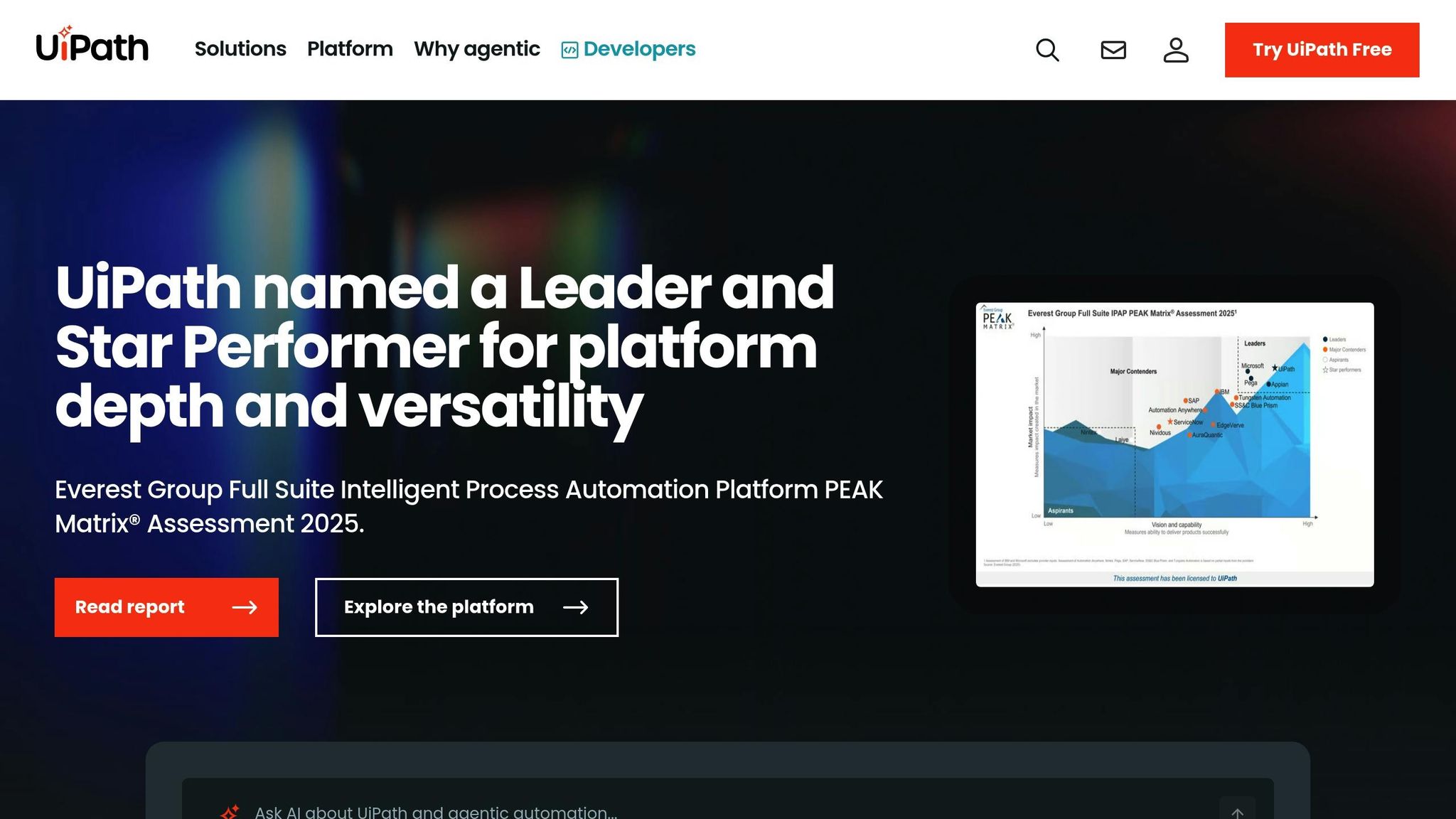
UiPath uses robotic process automation (RPA) to simplify AI workflows, focusing on automation-first principles to bridge legacy systems with modern AI solutions. The platform automates critical tasks such as data preparation, model deployment, and result processing, enabling teams to create efficient workflows. With its visual workflow designer, users can build automated sequences that manage everything from data ingestion to model inference, ensuring smooth integration with top AI frameworks.
UiPath's AI Center directly integrates with widely-used frameworks like TensorFlow, PyTorch, and scikit-learn, allowing seamless collaboration between automation and machine learning tools.
The platform's Document Understanding feature showcases its AI capabilities by blending computer vision with natural language processing. This tool extracts and processes data from documents automatically, feeding clean, structured information into AI workflows for further analysis.
UiPath's robust API architecture supports custom integrations with proprietary AI tools. Development teams can use its REST API capabilities to connect with specialized frameworks, offering flexibility across various tech environments. Alongside its integration capabilities, UiPath emphasizes governance to ensure secure and efficient automation.
UiPath's Orchestrator provides centralized control, maintaining detailed audit trails for all processes to ensure transparency and accountability.
With role-based access controls, only authorized personnel can modify or execute specific workflows. The platform integrates seamlessly with enterprise identity management systems such as Active Directory and SAML-based authentication, ensuring consistent security across the organization.
To meet industry compliance requirements, UiPath employs data encryption for both data in transit and at rest, making it a suitable choice for sectors like healthcare and finance that demand high security standards.
The platform also includes built-in version control and rollback features, allowing teams to track changes, compare workflow versions, and quickly revert to earlier configurations if needed. This ensures stability and reliability during production deployments, reinforcing UiPath's focus on secure and efficient AI workflow management.
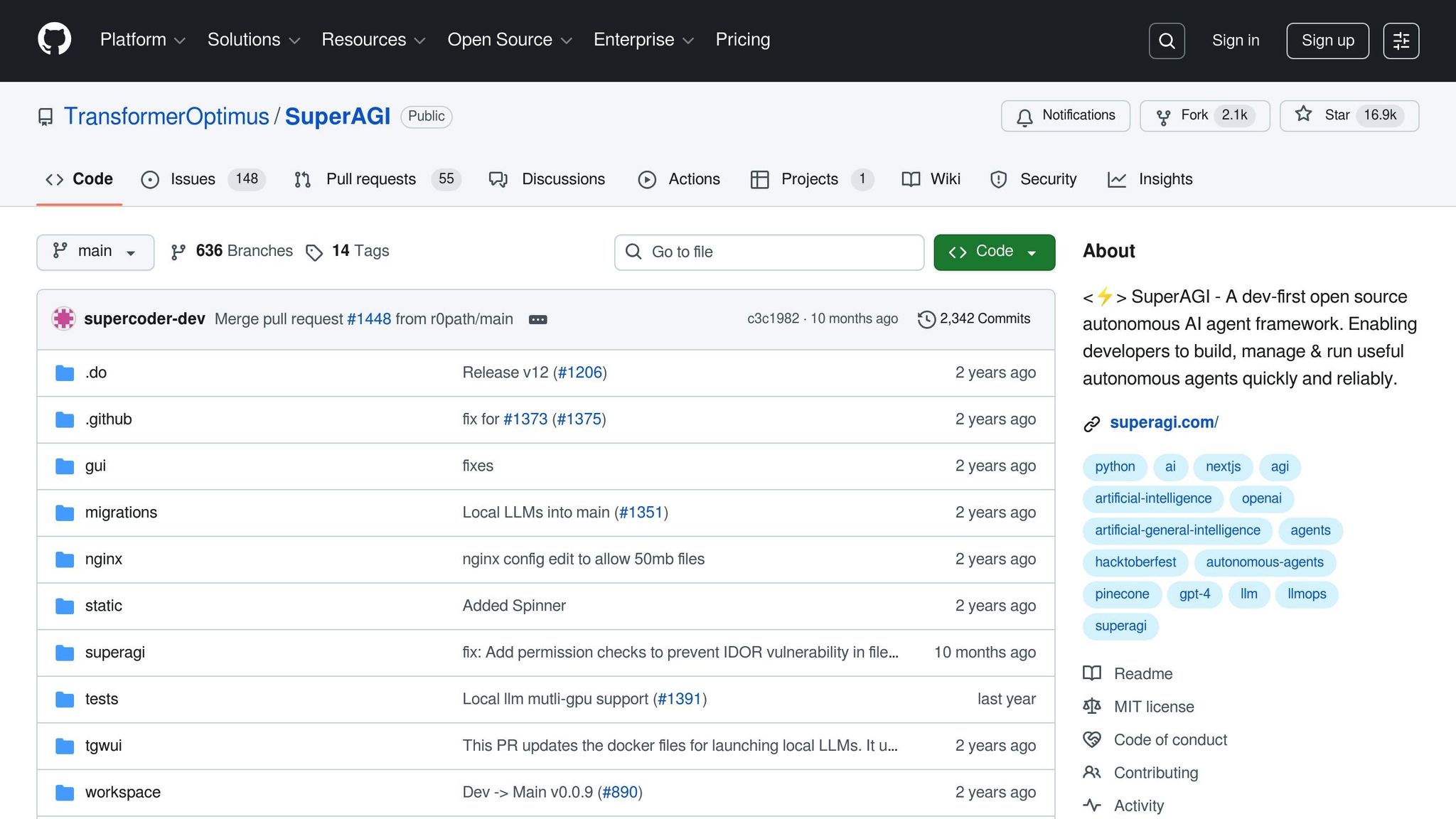
SuperAGI is an open-source platform designed for deploying and managing autonomous AI agents on a large scale. By utilizing agent-based orchestration, it enables the creation of multi-step, automated AI processes that operate independently.
The platform’s modular architecture allows users to tailor workflows by integrating various AI models seamlessly. This adaptability makes it a strong choice for organizations that require both precision and the ability to scale quickly.
SuperAGI excels in managing distributed agents and supports horizontal scaling, making it possible to execute tasks across multiple servers or cloud environments simultaneously. For example, a financial services firm leveraged this capability to reduce customer onboarding times from several days to just a few hours, all while processing thousands of sign-ups monthly.
To ensure consistent performance, the platform incorporates load balancing and resource pooling, even as workflows and agent numbers expand. This distributed framework ensures reliability during peak activity periods, which is especially critical for businesses managing fluctuating or seasonal workloads.
SuperAGI integrates seamlessly with major frameworks like TensorFlow, PyTorch, Hugging Face, and OpenAI, supporting both pre-trained and custom models. It also facilitates communication between autonomous agents, enabling them to share information and coordinate tasks automatically.
This level of interoperability allows teams to incorporate existing models, custom pipelines, and third-party services into their workflows without requiring extensive development. As a result, development teams can quickly prototype, deploy, and refine AI solutions, simplifying everything from data ingestion to model inference.
The ability of SuperAGI’s agents to communicate and collaborate autonomously makes it possible to orchestrate complex, multi-step processes with minimal manual input. This feature enables more advanced automation scenarios, positioning SuperAGI as a key player in the AI workflow ecosystem.
SuperAGI includes dashboards that track resource usage, agent activity, and execution times. While the platform itself is free as an open-source tool, these monitoring features help organizations manage their infrastructure spending effectively.
Users can set usage limits and alerts to avoid unexpected cloud expenses during large-scale operations. Additionally, SuperAGI integrates with cloud cost management tools, offering detailed insights into spending and helping teams pinpoint areas for optimization.
By providing clear visibility into resource consumption, the platform enables organizations to identify inefficiencies, allocate resources more effectively, and better predict operational costs. This is particularly useful for teams running multiple AI agents, where workload variations can lead to fluctuating resource demands.
SuperAGI prioritizes governance and security with features like role-based access control, detailed audit logging, and support for enterprise identity providers such as SSO and LDAP. The platform also ensures data security through encryption both in transit and at rest, and it includes workflow approval mechanisms to meet compliance standards.
The audit trails offered by SuperAGI provide a comprehensive record of agent activities, workflow executions, and system changes. These logs are invaluable for compliance reporting and help organizations maintain accountability in their AI-driven processes, addressing concerns about oversight in automated decision-making systems.
Prefect is a modern platform designed to orchestrate workflows with a fresh approach tailored for AI and machine learning teams. Unlike traditional tools, Prefect adopts a code-first approach, enabling data scientists and engineers to define workflows directly in Python. This makes it a natural fit for teams already immersed in Python-based environments.
One of its standout features is the ability to manage the intricate dependencies that often arise in AI model development. Prefect takes care of task scheduling, retry logic, and error handling automatically, significantly reducing the manual effort required to oversee complex AI pipelines. This streamlined, Python-friendly design is especially beneficial for AI teams aiming to stay agile and efficient.
Prefect's distributed execution engine is built to scale workflows dynamically, whether horizontally or vertically, across multiple machines or cloud instances. This makes it an excellent choice for organizations handling massive datasets or running resource-intensive processes like model training.
A key feature is its hybrid execution model, which allows teams to develop workflows locally and then seamlessly transition them to cloud environments for production. This flexibility is invaluable, enabling quick iterations during development while ensuring scalability for tasks like production inference.
Prefect also supports task concurrency, allowing multiple tasks to run simultaneously when their dependencies permit. This parallel execution can significantly cut down the time needed for complex workflows, such as hyperparameter tuning or ensemble training. These scaling capabilities align perfectly with the needs of AI/ML teams working on demanding projects.
Prefect integrates effortlessly with major cloud platforms like AWS, Google Cloud Platform, and Microsoft Azure, simplifying the incorporation of cloud-based AI services and storage. It also supports large-scale data processing tools like Apache Spark and Dask.
The platform includes a robust task library with pre-built connectors for databases, file storage systems, and notification services. This library reduces the need for custom coding, speeding up workflow development and enabling teams to focus on higher-value tasks.
Additionally, Prefect works smoothly with popular machine learning libraries such as scikit-learn, TensorFlow, and PyTorch. Teams can integrate their existing Python-based AI code into Prefect workflows without extensive refactoring, preserving their prior investments in model development.
Prefect provides detailed execution metrics and logs, offering visibility into resource consumption across workflows. Teams can track task execution times, resource usage, and failure rates, helping them identify areas for improvement.
The flow run history feature keeps a comprehensive record of workflow executions, including resource usage data. This historical insight is particularly useful for teams running recurring tasks, like model training or batch inference, as it highlights trends in resource consumption over time.
Prefect also helps optimize costs with its scheduling capabilities, allowing teams to run resource-heavy workloads during off-peak hours when cloud costs are lower. Conditional execution features further reduce unnecessary expenses by skipping tasks when specific criteria, like unchanged input data, are met. These tools make Prefect a practical choice for teams aiming to balance performance with cost efficiency.
Dagster stands out as a data orchestration platform designed to optimize the efficiency of data pipelines. It plays a key role in managing AI model workflows by simplifying pipeline processes and ensuring seamless integration. With its flexible orchestration capabilities, Dagster supports scalable execution while prioritizing secure data handling. For those looking to delve deeper into how Dagster can help streamline AI data pipelines, the official Dagster documentation is an excellent resource for further exploration.
Ray Serve is a library designed to deploy and manage AI models efficiently, built on Ray's distributed computing framework. It focuses on delivering high performance and reliability for production environments.
Ray Serve is tailored to handle extensive AI workloads with its distributed architecture that automatically scales across multiple machines and cloud environments. By dynamically adjusting resources based on traffic, it ensures optimal performance while keeping costs in check.
Its horizontal scaling capability allows inference tasks to be distributed across clusters, managing thousands of simultaneous requests effortlessly. With real-time autoscaling, it monitors metrics continuously and allocates additional resources as needed, making it a reliable solution for both small startups and large enterprises.
DataRobot MLOps simplifies the entire machine learning lifecycle, from initial development to full-scale production. It enables seamless deployment and continuous monitoring of AI models, all while ensuring compliance with governance requirements. Designed to adapt to various operational setups, this platform is perfect for teams looking to integrate AI into their workflows efficiently. Its advanced deployment and monitoring tools enhance the functionality already discussed, making it a strong choice for operationalizing AI initiatives.
Choose the right software based on your specific needs, budget, and technical requirements.
| Platform | Key Strengths | Deployment Options | Integration Capabilities | Ideal Use Cases | Cost Optimization |
|---|---|---|---|---|---|
| Prompts.ai | Unified access to 35+ LLMs, real-time FinOps, up to 98% cost reduction | Cloud-based SaaS | Enterprise APIs, model aggregation, governance controls | Multi-model workflows, cost management, enterprise AI governance | Pay-as-you-go TOKN credits, transparent token tracking |
| Kubeflow | Native Kubernetes integration, open-source flexibility | On-premises, cloud, hybrid | Kubernetes ecosystem, TensorFlow, PyTorch | ML pipelines in containerized environments | Optimized resource scheduling |
| Apache Airflow | Complex workflow orchestration, extensive plugin ecosystem | Self-hosted, managed cloud services | 1,000+ integrations, custom operators | Data engineering, ETL, scheduled workflows | Resource-based scaling |
| IBM watsonx Orchestrate | Enterprise governance, compliance features, Watson AI integration | IBM Cloud, hybrid deployment | IBM ecosystem, enterprise systems | Large enterprise AI initiatives, regulated industries | Enterprise licensing model |
| UiPath | RPA integration, business process automation | Cloud, on-premises, hybrid | Business applications, legacy systems | Process automation with AI components | Per-bot licensing |
| SuperAGI | Autonomous agent creation, multi-agent coordination | Cloud-native | API integrations, tool marketplace | Autonomous AI agents, research projects | Usage-based pricing |
| Prefect | Modern Python-native design, dynamic workflows | Cloud, self-hosted | Python ecosystem, REST APIs | Data science workflows, dynamic pipelines | Compute-based billing |
| Dagster | Asset-centric approach, data lineage tracking | Self-hosted, Dagster Cloud | Data tools, observability platforms | Data engineering, analytics pipelines | Development team scaling |
| Ray Serve | High-performance model serving, distributed computing | Self-managed, cloud providers | ML frameworks, monitoring tools | Real-time inference, large-scale deployments | Infrastructure optimization |
| DataRobot MLOps | End-to-end ML lifecycle, automated model monitoring | Cloud, on-premises | MLOps tools, business intelligence platforms | Production ML models, model governance | Subscription-based pricing |
This table serves as a quick reference guide, breaking down each platform’s standout features and how they align with specific use cases. To dive deeper, here’s a summary of how these platforms differ across several key attributes:
When selecting AI workflow software, focus on three key factors: scalability, governance, and cost efficiency. These elements serve as the foundation for making an informed decision.
For enterprises managing large-scale AI operations, Prompts.ai offers a standout solution with its unified access to various models and the ability to scale teams quickly. Kubeflow is another strong contender, providing powerful horizontal scaling for Kubernetes-based setups. For organizations anticipating fast growth, platforms that support auto-scaling and distributed processing are worth considering.
Governance needs differ widely across industries. Prompts.ai caters to enterprise-level requirements with frameworks like SOC 2 Type II, HIPAA, and GDPR, ensuring complete visibility and auditability for AI activities. Similarly, IBM watsonx Orchestrate delivers robust governance features tailored for large enterprises. For businesses with lighter regulatory needs, tools like Apache Airflow and Prefect offer essential governance controls without overwhelming complexity.
Cost considerations are equally vital. Pay-as-you-go models can help minimize recurring expenses, offering flexibility and reduced operational costs. While open-source options may cut licensing fees, they often demand additional resources for infrastructure management. On the other hand, enterprise platforms with subscription pricing provide predictability and are ideal for high-volume usage.
To make the best choice, start with a pilot workflow that mirrors your primary integration needs. The AI workflow automation landscape prioritizes multi-model support and enterprise-level governance. Select a platform that aligns with your current demands while being flexible enough to evolve alongside your future goals.
To choose the best AI workflow software, begin by pinpointing your business's unique needs. Consider factors like automation goals, how well the software integrates with your current tools, and whether it can scale as your operations grow. These priorities will guide your search.
Next, take a close look at the software's features. Focus on user-friendliness, the strength of its AI capabilities, and whether it offers customization to adapt to your specific processes. These elements should align with your objectives to ensure the software meets your expectations.
Budget is another key factor. Compare pricing models to find a solution that balances cost with the features you require. Many platforms offer free trials or demos, which can be an excellent way to test how the software performs and whether it fits your needs before committing.
To implement AI workflow software responsibly, businesses must focus on enterprise-grade governance tools, maintain comprehensive audit trails, and establish robust security systems. These steps are essential for protecting data integrity, ensuring transparency, and adhering to changing regulatory demands.
Staying informed about industry regulations is equally important. Incorporating software that aligns with standards such as GDPR or CCPA can streamline compliance efforts. Regular audits and ongoing monitoring also play a key role in boosting accountability and minimizing potential risks.
The way AI workflow platforms structure their pricing can play a crucial role in how large enterprises manage resources and scale their operations. Options like pay-as-you-go or subscription-based pricing give businesses the flexibility to match costs directly with their actual usage, helping to maintain budget control while expanding capabilities.
It’s also essential to assess how a platform’s pricing model supports growth. Tiered plans or volume discounts for higher usage can make scaling more economical. At the same time, be mindful of potential hidden costs - such as charges for integrations or premium features - that could lead to unplanned expenses as your AI workflows grow.