Pay As You Go - AI Model Orchestration and Workflows Platform



AI workflow platforms are transforming business operations by automating complex tasks with advanced technologies like large language models (LLMs) and machine learning. By 2026, enterprises will rely heavily on these platforms to boost efficiency, reduce costs, and improve decision-making. For example, IBM saved $4.5 billion in productivity using autonomous AI agents, while other businesses have cut low-value tasks by 25%-40% and sped up processes by 30%-50%.
This article compares Prompts.ai, Microsoft Power Automate, and AWS Bedrock - three leading platforms for AI-driven workflows. Each offers unique strengths in LLM integration, cost management, and scalability, helping enterprises meet their automation goals.
| Platform | Key Feature | Best For | Pricing Example |
|---|---|---|---|
| Prompts.ai | Multi-model orchestration | Flexible AI integration | $99-$129/user/month |
| Microsoft Power Automate | Low-code automation & RPA | Microsoft ecosystem users | Starting at $15/user/month |
| AWS Bedrock | Secure, scalable serverless workflows | Large enterprises in regulated sectors | Pay-as-you-go token pricing |
Each platform addresses different needs, from cost control and ease of use to robust security and scalability. Read on to find the best fit for your business.
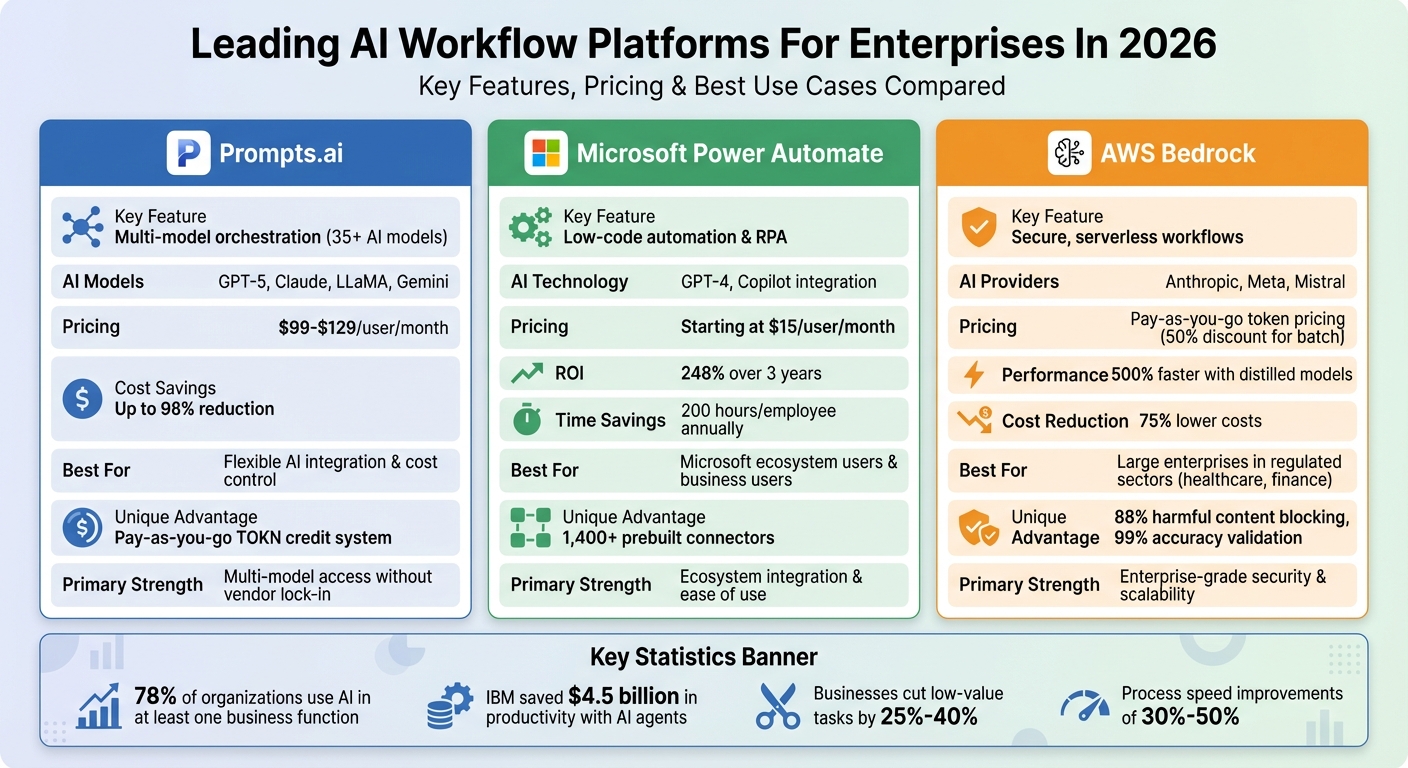
Comparison of Top 3 AI Workflow Platforms for Enterprises 2026
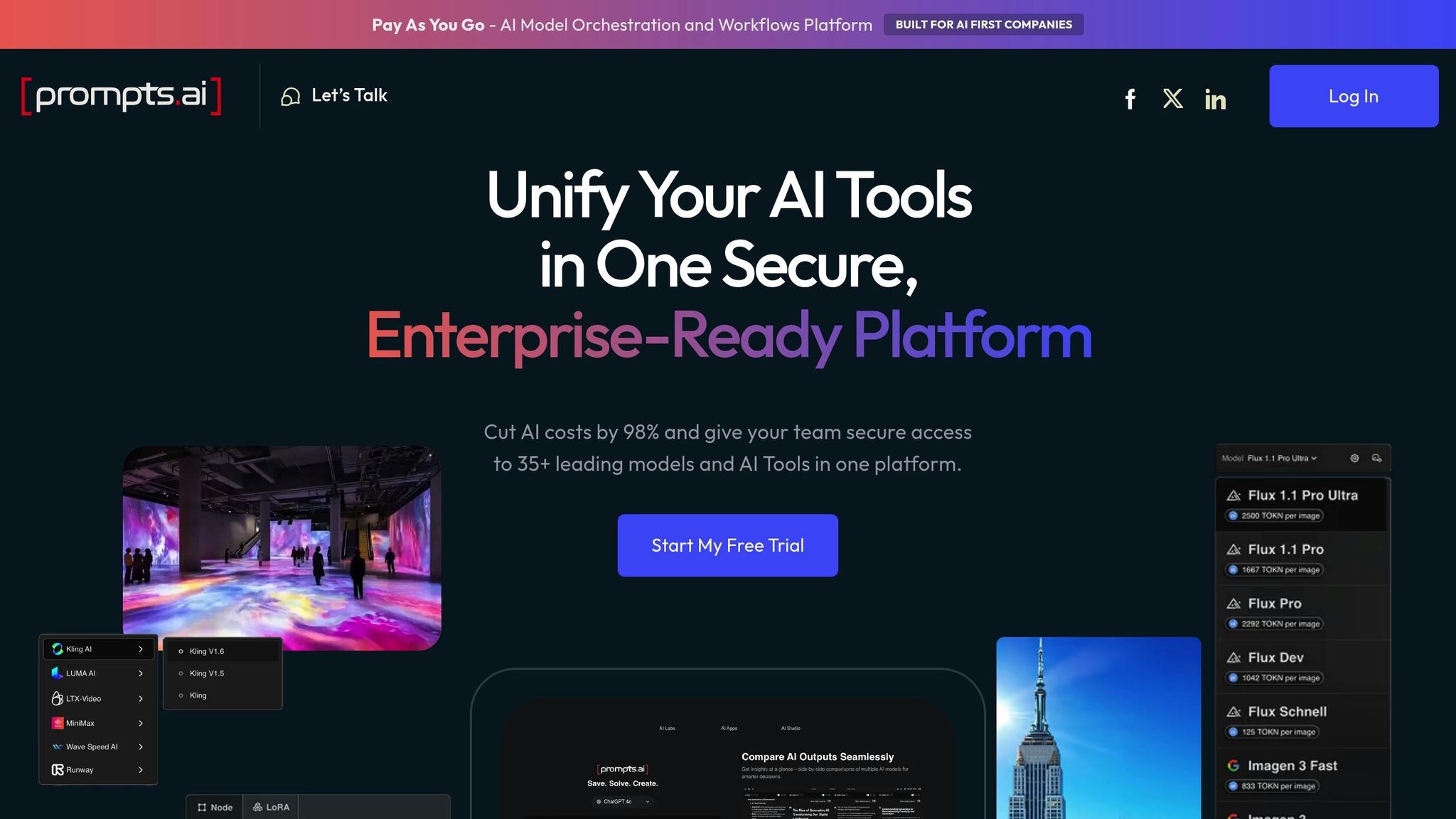
Prompts.ai is designed as a high-performance AI orchestration platform that brings together over 35 leading large language models, such as GPT-5, Claude, LLaMA, and Gemini, into one streamlined, secure interface. By consolidating these tools, it eliminates the inefficiencies caused by scattered workflows and complicated management processes. This unified platform simplifies integration and boosts workflow efficiency.
The platform's multi-model orchestration supports foundation models from major providers like OpenAI, Anthropic, and Google, and also allows for "Bring Your Own Model" (BYOM) setups. Its advanced per-step routing ensures that tasks are matched with the most suitable model for optimal results. Additionally, the prompt-to-build feature enables teams to describe agents or workflows in plain language, automatically generating the required framework for implementation.
Prompts.ai tackles hidden expenses with its pay-as-you-go TOKN credit system and a built-in FinOps layer, achieving cost reductions of up to 98%. Pricing options include business plans ranging from $99 to $129 per user per month, along with a free personal tier for individual users.
The platform includes robust governance tools, offering real-time monitoring and detailed audit trails. These features ensure compliance with security standards and minimize the risks associated with unregulated tools.
Prompts.ai's architecture is built for quick scaling, enabling the addition of new models, users, or teams in just minutes. A thriving prompt engineering community and certification programs empower organizations to develop internal AI experts, promoting consistent and quality-driven adoption across the enterprise.
Microsoft Power Automate stands out as a platform designed to simplify automation by leveraging AI technologies like generative AI and Copilot. By enabling workflow creation through natural language, it bridges the gap between structured and unstructured data tasks. From straightforward API triggers to handling complex documents, Power Automate showcases how AI integration can streamline operations and enhance productivity.
Power Automate taps into the growing demand for AI-powered automation by ensuring efficient data processing across various workflows. Using GPT-4 technology, the platform easily handles unstructured data, such as invoices, medical reports, and emails, without requiring extensive user training. Its Generative Actions feature examines documents like PDFs and company policies to optimize conditional approvals. A notable example is from 2024, when VP John Haisch at Nsure used Power Automate to validate carrier data, reducing manpower needs and achieving a 60% time savings alongside a 50% cost reduction.
The platform also introduces multi-modal AI recording, allowing users to create workflows by simply sharing their screen and narrating tasks. Additionally, the "Repair with Copilot" feature ensures smooth operations by automatically fixing UI issues in both attended and unattended modes, minimizing interruptions.
Power Automate offers flexible pricing plans to accommodate different needs. The Premium plan, priced at $15.00 per user per month (billed annually), includes features like cloud flows, attended RPA, and 50 MB of process mining. For more advanced needs, the Process plan costs $150.00 per bot per month, providing unattended RPA and cloud flows accessible to unlimited users. Organizations using the platform report impressive returns, with a 248% ROI over three years and an annual saving of 200 hours per employee on high-impact automation tasks.
Chad Aronson, Global Head of Intelligent Automation at Uber, shared that implementing Power Automate saved the company 3,400 hours annually, translating to an estimated $30 million in cost savings. The platform also includes an Automation Center, which provides ROI analytics and centralized monitoring. For those interested in exploring its capabilities, a 30-day free trial of premium features is available.
Power Automate strengthens enterprise governance with features like Managed Environments, offering centralized visibility and control. Data Loss Prevention (DLP) policies protect sensitive information by limiting which connectors can be used together, while role-based access control (RBAC) ensures that permissions for building, testing, and approving workflows are clearly defined. Audit logs and exception handling further enhance transparency in operations.
Microsoft’s commitment to robust governance is reflected in its recognition as a Leader in the June 2025 Gartner Magic Quadrant for Robotic Process Automation. Additionally, integration with Microsoft 365 and Azure security frameworks ensures compliance with key regulations, including SOC 2, GDPR, and HIPAA.
With over 1,400 prebuilt, certified connectors, Power Automate integrates seamlessly with major enterprise systems like SAP, Salesforce, and Dynamics 365, reducing the need for custom API development. Komatsu Australia demonstrated the platform’s efficiency by deploying an invoice automation solution in just three weeks, saving over 300 hours of manual data entry during the pilot phase.
The platform’s process mining capabilities use AI to identify bottlenecks and prioritize automation opportunities with the highest potential impact before scaling up. Additionally, organizations benefit from pooled Dataverse database and file capacity entitlements, which allow flexible resource allocation across the enterprise. For companies aiming to reduce IT overhead, the Hosted Process plan - priced at $215.00 per bot per month - eliminates the need for virtual machine management by shifting it to Microsoft. These features position Power Automate as a valuable tool in advancing AI-driven workflow automation across industries.
AWS Bedrock connects foundation models from leading AI providers like Anthropic, Meta, and Mistral through a single API, simplifying the process for enterprises to build and deploy AI workflows at scale. Trusted by over 100,000 organizations, it has become a cornerstone for enterprise AI automation. Its serverless architecture eliminates the need for complex infrastructure management, while offering tools to design AI agents and workflows with ease.
AWS Bedrock introduces two standout features for automating workflows: Bedrock Flows and Bedrock Agents. With Bedrock Flows, developers can visually construct workflows by dragging and dropping components such as prompts, models, knowledge bases, and AWS Lambda functions - eliminating the need for coding[21,23]. Bedrock Agents, on the other hand, break down user requests, interact with APIs via Action Groups, and query knowledge bases to execute business logic seamlessly[24,25].
The platform also supports Retrieval Augmented Generation (RAG) through its Knowledge Bases feature, which securely links foundation models to internal data sources like Amazon S3. This ensures responses are based on proprietary data, providing accurate and reliable outputs[24,25].
To enhance safety, Bedrock Guardrails block up to 88% of harmful content and verify model responses with up to 99% accuracy. Meanwhile, its distilled models operate 500% faster and cost 75% less without compromising on accuracy.
"Bedrock Flows will enable us to create complex, flexible, multi-prompt workflows which we can easily evaluate, compare and version. We can also quickly integrate flows with our applications using the SDK APIs for serverless flow execution - without wasting time in deployment and infrastructure management."
– Laura Skylaki, VP of Artificial Intelligence, Business Intelligence and Data Platforms, Thomson Reuters
These integrations highlight AWS Bedrock’s ability to streamline operations while keeping costs manageable.
AWS Bedrock offers three pricing options tailored to different needs:
For large-scale predictions, batch inference is available at a 50% discount. Additionally, Provisioned Throughput allows businesses to secure dedicated capacity with one- or six-month commitments.
Between June and December 2025, Robinhood expanded its AI operations from 500 million to 5 billion tokens daily using AWS Bedrock. This move cut AI costs by 80%, reduced development time by 50%, and maintained compliance with strict financial regulations. Features like Intelligent Prompt Routing and Prompt Caching further optimize costs, delivering up to a 30% cost reduction and a 90% discount on cached tokens, along with an 85% improvement in latency[22,26].
AWS Bedrock places a strong emphasis on security and compliance. Customer data is never used to train base models, and inputs and outputs remain private from third-party model providers. Data is encrypted both at rest and in transit, with AWS Key Management Service (KMS) handling encryption keys and AWS PrivateLink ensuring private connectivity between VPCs and Bedrock.
The platform also supports fine-grained access control through AWS Identity and Access Management (IAM) and provides detailed audit trails via AWS CloudTrail. Bedrock Guardrails enable customizable filters for harmful content like hate speech or violence, and can automatically redact personally identifiable information (PII). Automated Reasoning checks validate model responses with up to 99% accuracy, while contextual grounding checks filter over 75% of hallucinated outputs in RAG and summarization tasks. AWS Bedrock complies with major standards including ISO, SOC, CSA STAR Level 2, GDPR, FedRAMP High, and HIPAA eligibility.
AWS Bedrock’s design ensures scalability without manual intervention. For example, in 2025, marketing firm Epsilon used AWS Bedrock AgentCore to automate complex campaign workflows. By leveraging intelligent agents on this managed platform, Epsilon reduced its development lifecycle from months to weeks, enabling personalized marketing at scale.
The serverless architecture allows agents and workflows to scale automatically. Features like Application Inference Profiles let enterprises attach custom cost-allocation tags for transparent usage tracking across business units. Organizations can adopt decentralized, centralized, or federated models to balance agility with governance and risk management. Versioning and aliasing capabilities enable quick rollbacks and A/B testing, supporting faster iterations in production environments[21,23].
With its seamless integration of AI models, flexible pricing, and automated scalability, AWS Bedrock is shaping the future of enterprise AI platforms.
This comparison highlights the core strengths and trade-offs of each platform, helping you determine which one best suits your enterprise needs.
Each platform offers distinct benefits for managing enterprise AI workflows, but they also come with considerations that might shape your decision based on your organization's priorities.
Prompts.ai stands out by integrating over 35 AI models, including GPT-5, Claude, and Gemini, into a single interface. This eliminates vendor lock-in and reduces the chaos of managing multiple tools. Its real-time FinOps controls can cut AI software costs by as much as 98%, while the pay-as-you-go TOKN credit system ensures you're only paying for what you actually use. However, achieving full process automation may require additional integration with enterprise systems.
Microsoft Power Automate shines when it comes to ecosystem integration, offering extensive connectivity within its environment. Its low-code design empowers business users to create workflows without needing deep technical skills, and its robotic process automation is effective for handling legacy systems. That said, its subscription pricing can become expensive as team sizes grow, and it lacks the multi-model AI orchestration capabilities of more specialized platforms.
AWS Bedrock is tailored for enterprise-grade security, featuring a scalable, serverless architecture and flexible pricing options to meet the demands of large organizations. However, its complexity makes it less accessible to non-technical users, requiring significant expertise to fully leverage its capabilities.
| Platform | Primary Strength | Best For | Key Limitation |
|---|---|---|---|
| Prompts.ai | Multi-model access & cost savings | Teams needing flexible AI integration & cost control | May need extra integration for full automation |
| Microsoft Power Automate | Ecosystem integration & ease of use | Business users & organizations in Microsoft ecosystems | Subscription costs can rise with team size |
| AWS Bedrock | Security & scalability | Technical teams & regulated industries | Steep learning curve for non-developers |
Ultimately, the right platform for your organization will depend on your team's technical expertise, existing infrastructure, and specific automation goals.
Aligning your organization’s technical strengths, infrastructure, and automation goals with the right platform is crucial, as each option caters to different enterprise needs.
Prompts.ai stands out by offering access to over 35 AI models without vendor lock-in, paired with real-time FinOps controls that help cut costs. This combination makes it a strong choice for teams focused on using diverse models while managing variable workloads efficiently.
For organizations deeply integrated with Microsoft tools, Microsoft Power Automate provides an excellent alternative. Its low-code interface allows business users to quickly create workflows, making it especially appealing for non-technical teams. Subscription costs are scalable, starting at around $15 per user per month, making it a budget-friendly option for growing teams.
On the other hand, AWS Bedrock is a compelling choice for enterprises prioritizing security and scalability. With its serverless architecture and robust security features, it’s well-suited for regulated industries such as healthcare, finance, and government. However, its advanced capabilities come with a steeper learning curve, requiring skilled cloud architects and developers to unlock its full potential.
Considering that 78% of organizations already use AI in at least one business function and 79% of senior executives report adopting AI agents, choosing a platform that matches your expertise, security needs, and budget will help you achieve the best outcomes from your AI investment by 2026.
Prompts.ai stands out as a specialized platform for AI orchestration, bringing together 35+ foundation models - including GPT-5, Claude, and Gemini - into a single, streamlined interface. It operates on a token-based pricing system known as TOKN Credits and adheres to rigorous SOC 2 and GDPR compliance standards. These features make it particularly well-suited for enterprises that value secure, centralized, and efficient management of AI workflows.
Microsoft Power Automate focuses on low-code automation, catering to both desktop and cloud applications. It offers tools such as task mining, cloud flows, and AI-powered suggestions. While it doesn’t feature proprietary foundation models, it integrates seamlessly with existing business systems, making it a practical choice for organizations looking to enhance automation without heavy coding requirements.
AWS Bedrock serves as a generative AI platform, providing access to hundreds of foundation models from multiple providers. Its key features include AgentCore for agent development, a visual flow builder, and seamless compatibility with AWS services. This makes it an attractive option for businesses aiming to implement large-scale AI solutions with deep AWS integration.
To summarize, Prompts.ai excels in centralized model management, Power Automate specializes in low-code automation, and AWS Bedrock offers a broad selection of models with strong AWS service integration.
AI workflow platforms are designed to keep costs in check with a pay-as-you-go approach, charging only for the resources and model calls you actually utilize. By consolidating access to various large language models, these platforms eliminate redundant API calls and provide real-time cost comparisons, helping to significantly reduce AI-related expenses. Features like cost dashboards, budget alerts, and automated shutdowns for idle jobs add transparency and prevent surprise charges, making it easier to manage and predict expenses.
When it comes to scalability, these platforms rely on centralized orchestration to allocate resources dynamically as demand increases. Whether you're running on public cloud services or on-premises infrastructure, workflows can automatically adjust CPU and GPU capacity without requiring manual intervention, ensuring smooth and consistent performance. With all tools and models managed in a single environment, businesses can effortlessly introduce new use cases or expand existing workflows without complicated reconfigurations, supporting growth that aligns with their goals.
For organizations bound by strict security and compliance requirements - like SOC 2, ISO 27001, or specific industry regulations - Activepieces stands out as a strong contender. The platform meets SOC 2 Type II standards and incorporates advanced security measures, including comprehensive documentation on best practices and the flexibility of self-hosted deployment. This setup allows businesses to safeguard their data behind their own firewalls while retaining complete control over access and permissions.
Activepieces’ emphasis on compliance certifications and robust security features makes it a reliable option for industries where data protection and governance are critical priorities.