Pay As You Go - AI Model Orchestration and Workflows Platform


AI workflow tools are transforming how businesses manage automation, data, and decision-making. Choosing the right tool depends on your needs - whether you're focused on AI-specific workflows, broad integrations, or enterprise-level operations. Here's a quick overview:
Quick Comparison:
| Tool | Best For | Strengths | Limitations | Pricing |
|---|---|---|---|---|
| Prompts.ai | AI-specific workflows | LLM orchestration, cost control, compliance | Limited for non-AI processes | $99–$129/user/month |
| General Platforms | Broad integrations | Connects SaaS tools, user-friendly builders | Limited AI governance, scaling challenges | Varies (some free tiers) |
| Enterprise Suites | Large-scale operations | Security, compliance, deep system integration | High cost, slower deployment | Custom pricing |
Each tool serves a distinct purpose. Prompts.ai excels in AI-focused tasks, while general platforms and enterprise suites cater to broader or large-scale needs. Choose based on your team's scale, technical needs, and compliance goals.
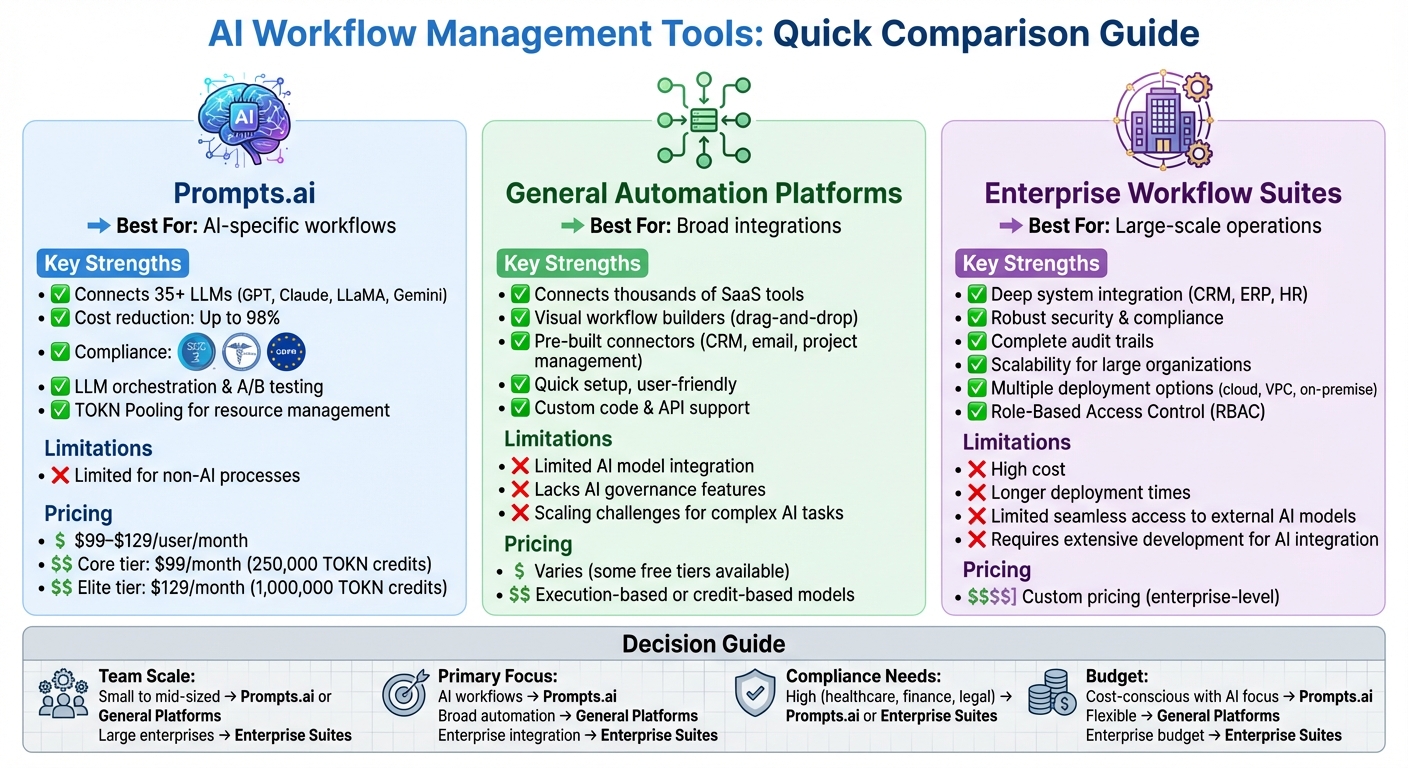
AI Workflow Management Tools Comparison: Features, Pricing, and Best Use Cases
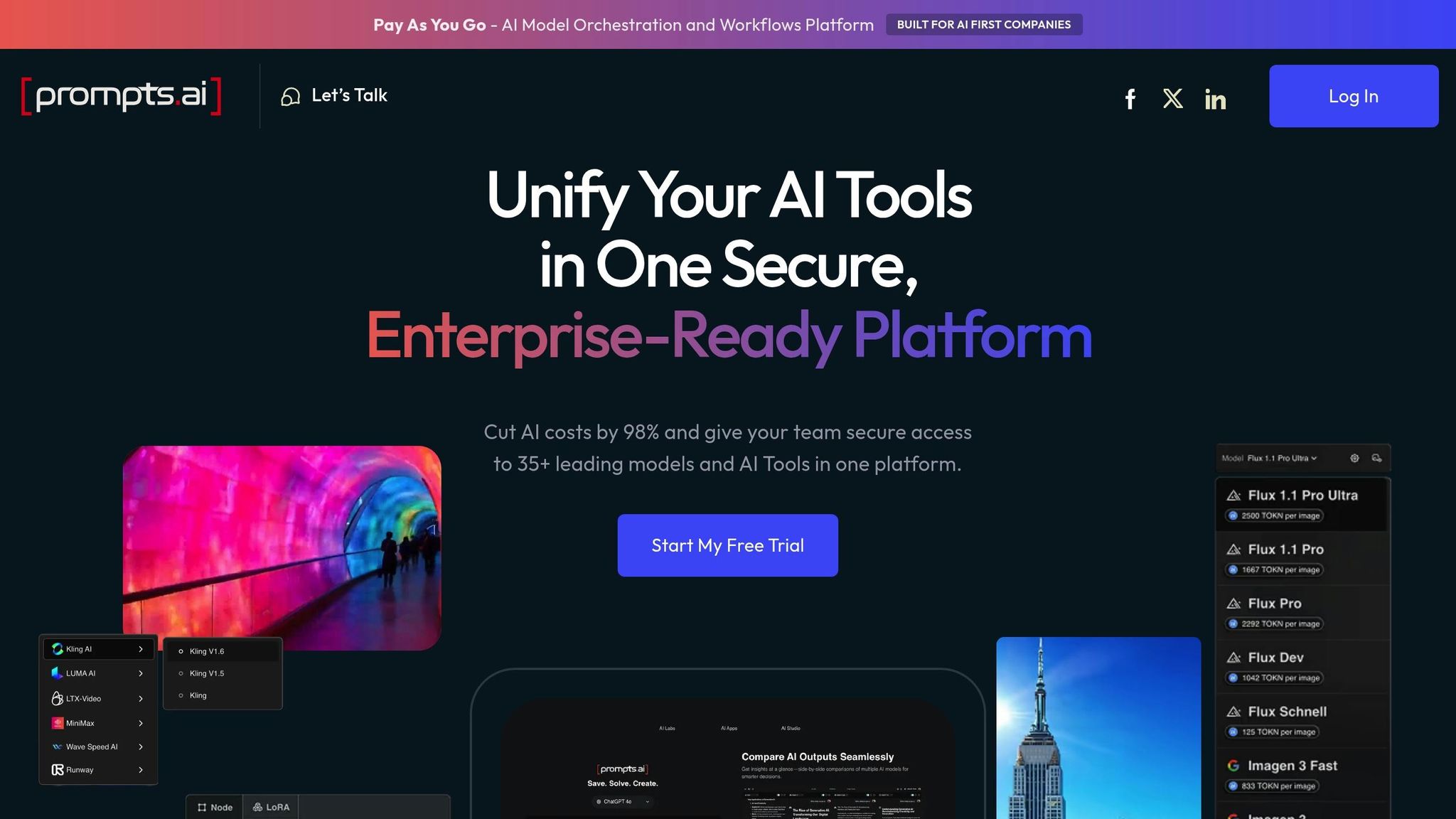
Prompts.ai serves as a centralized hub for managing and streamlining AI workflows, transforming scattered prompt experiments into production-ready systems. Rather than relying on disorganized notebooks or ChatGPT threads, it offers a unified workspace for versioning, testing, and monitoring prompts, ensuring they function as repeatable and auditable components. Below, we explore its standout features, including interoperability, orchestration, security, and cost management.
Prompts.ai simplifies access to over 35 leading AI models - such as GPT, Claude, LLaMA, and Gemini - through a single interface. This eliminates the hassle of juggling multiple subscriptions and API keys. Additionally, the platform integrates seamlessly with external tools like Slack, Gmail, and Trello, allowing teams to embed refined prompts directly into their automation workflows. For instance, in 2025, Johannes V., an AI Visual Director, used Prompts.ai to orchestrate a fictional Breitling promotional video. By chaining tools like Midjourney V7, Google DeepMind ImageFX, Flux 1, Kling AI, Luma AI, and Veo2, he demonstrated how the platform facilitates complex, multi-tool workflows.
Prompts.ai enables teams to compare models and manage prompt versions, making it easy to conduct A/B tests on different LLM configurations before deployment. If a model provider updates its software or changes pricing, teams can revert to a previously successful prompt version, avoiding performance issues. Architect June Chow shared in 2025 that Prompts.ai allowed her to bring intricate, dreamlike projects to life while testing various LLMs - a task that would have been tedious and prone to errors otherwise. The platform also supports defining and reusing prompts across teams, turning one-off experiments into standardized, reliable workflows.
Built to meet enterprise-grade compliance standards, Prompts.ai adheres to SOC 2 Type II, HIPAA, and GDPR requirements. It provides detailed audit trails, tracking every prompt modification and evaluation run - who made the change, when it was made, and its impact on performance. The platform began its SOC 2 Type II audit process on June 19, 2025, using Vanta for continuous monitoring of controls. Role-based workspaces further enhance security by restricting access to sensitive prompts, ensuring only authorized team members can view or edit them. This level of governance is critical as businesses scale their AI operations.
Prompts.ai helps teams monitor model usage, token costs, and evaluation results, making it easier to identify and eliminate inefficient prompts or expensive models. By running structured tests, teams can assess quality-versus-cost trade-offs, often finding that a less advanced model can meet their needs at a much lower price. Pricing for the platform starts at $99 per member per month for the Core tier, which includes 250,000 TOKN credits, and scales to $129 per member per month for the Elite tier with 1,000,000 TOKN credits. With usage-based billing, teams can convert fixed AI expenses into flexible, on-demand costs. By systematically testing and optimizing their workflows, businesses can reduce unnecessary API calls and significantly lower their monthly LLM spending.
General automation platforms bring together SaaS applications, data sources, and AI models to create unified systems. These tools enhance existing tech stacks by offering extensive libraries of pre-built connectors for thousands of business applications, including CRM, email, project management, and social media tools. With visual workflow builders and drag-and-drop interfaces, teams can integrate processes seamlessly across various tools. For those needing more customization, support for custom code and APIs provides additional flexibility.
Let’s explore how these platforms excel in interoperability, security, and cost management.
These platforms make it easier to connect and streamline data flow between systems. By leveraging pre-built integrations, users can skip the hassle of managing multiple API keys or writing repetitive code. For instance, visual workflow builders can automatically map and transfer data between applications, such as routing customer inquiries from Gmail into a CRM system while triggering an AI model to draft personalized responses. This setup transforms disconnected tools into smooth, interconnected workflows - no specialized engineering required.
Effective governance and security are key strengths of these platforms. Features like role-based access control (RBAC) ensure that sensitive workflows are limited to authorized users. Audit logs provide a detailed record of workflow changes, execution histories, and user actions, aiding compliance efforts. For businesses with strict data residency needs, many platforms offer deployment options such as Virtual Private Cloud (VPC), on-premise installations, or self-hosting. These capabilities allow organizations to maintain full control over data location and access, addressing both privacy and regulatory demands.
Cost structures for these platforms vary, with some charging per execution, others using credit-based systems, and some offering free tiers for smaller-scale use. Open-source options and self-hosting can help reduce expenses compared to fully managed cloud services. Execution-based pricing aligns costs with usage, and by monitoring logs, businesses can identify inefficiencies and cut unnecessary expenses. This adaptability makes these platforms an attractive choice for organizations of all sizes.
Enterprise workflow suites are designed for organizations that require centralized control over intricate AI operations. These platforms emphasize governance, security, and scalability, making them ideal for high-stakes environments. Unlike basic automation tools, enterprise suites integrate deeply with existing business systems, ensuring seamless operations and providing complete visibility into AI activities.
These suites leverage standardized interfaces and modular designs to connect AI models with current business systems. The emerging Model Context Protocol (MCP) simplifies integration by unifying interactions between large language models (LLMs) and enterprise systems. AI Gateways act as a centralized middleware, dynamically routing requests to the appropriate models. This approach eliminates the friction of disconnected systems, turning them into cohesive workflows. By reducing complexity, it also paves the way for enhanced security measures.
Enterprise workflow suites prioritize security and compliance. Role-Based Access Control (RBAC) ensures that only authorized personnel can create, modify, or execute workflows. These platforms adhere to stringent standards like SOC 2 Type II, HIPAA, and GDPR, safeguarding sensitive data and meeting regulatory requirements. Data is encrypted both in transit and at rest, while detailed audit logs track all workflow changes and user actions. This level of oversight is particularly critical in sectors like healthcare, finance, and legal services, where privacy is paramount.
Enterprise suites also excel in cost transparency and flexibility. They offer various deployment options - cloud, virtual private cloud (VPC), or on-premise - allowing organizations to balance data residency concerns with cost efficiency for large-scale operations. Pricing models often differ, with operations-based pricing being more economical for larger teams compared to user-based models. Some platforms even include premium large language models in their subscription plans, eliminating the need for separate API accounts and simplifying budget planning. This clarity helps finance teams directly connect AI expenditures to measurable business outcomes.
When selecting an AI workflow tool, it’s important to weigh the strengths and trade-offs of each option. Below is a quick comparison of key features and limitations for different tool types, helping you align your choice with your organization’s priorities.
| Tool Type | Key Advantages | Primary Limitations |
|---|---|---|
| Prompts.ai | Brings together over 35 AI models in one system; reduces AI costs by up to 98%; ensures compliance with SOC 2 Type II, HIPAA, and GDPR standards; offers TOKN Pooling for better resource management; allows side-by-side model comparisons; priced at $99–$129 per member/month for business plans | Specializes in AI-specific workflows, limiting its use for broader business process automation. |
| General Automation Platforms | Connects to thousands of non-AI applications; features user-friendly visual builders and quick setup | Limited integration with diverse AI models; often requires custom setup for AI tasks; lacks governance features tailored to AI; struggles with scaling complex AI workloads. |
| Enterprise Workflow Suites | Integrates deeply with core systems like CRM, ERP, and HR; offers strong security and compliance; scales effectively for large organizations; provides complete audit trails | Higher costs and longer deployment times; limited seamless access to external AI models; often requires extensive development to incorporate diverse AI services; scalability geared toward general processes rather than AI-specific needs. |
Your choice depends on what matters most - AI-focused orchestration, broad application connectivity, or comprehensive enterprise integration. This comparison highlights each tool type’s strategic strengths, helping you make an informed decision that aligns with your operational goals.
Note: Be cautious of incomplete or siloed data, as it can impact AI accuracy across all platforms.
Choosing the right AI workflow tool depends on your organization's scale and specific requirements. While general automation platforms provide quick, no-code integrations for smaller teams, enterprise suites cater to larger organizations with their focus on compliance and extensive integrations.
Prompts.ai stands out in the realm of AI-specific workflow management by bringing together multiple top-tier AI models within a secure and compliant ecosystem. It offers cost savings of up to 98%. For U.S.-based teams handling tasks like AI-driven content creation, model comparisons, or prompt orchestration, Prompts.ai eliminates the chaos of juggling multiple tools without the added complexity of broader enterprise platforms.
The platform empowers smaller teams to experiment with AI quickly while offering mid-sized organizations robust governance features and effective cost controls. Tools such as TOKN Pooling and detailed usage analytics transform one-off AI tasks into streamlined, repeatable processes.
For large enterprises, Prompts.ai is a go-to solution due to its seamless LLM interoperability and real-time financial operations capabilities, making it ideal for managing AI-intensive workflows and ensuring continuous compliance.
Ultimately, your choice should align with your operational scale, level of technical expertise, and whether your focus is on AI workflows or broader business process automation.
Prompts.ai streamlines AI workflows by offering a unified platform that integrates more than 35 leading AI models and tools. This secure solution allows organizations to cut costs by up to 98% while maintaining seamless integration, strict governance, and scalability for AI-powered operations.
Built with enterprise needs in mind, Prompts.ai simplifies even the most intricate workflows, making it easier to manage AI projects with efficiency and precision.
Prompts.ai is built to adhere to stringent compliance requirements, including GDPR and HIPAA, by focusing on data security and governance. The platform employs advanced encryption, strict access controls, and comprehensive auditing tools to safeguard sensitive information and ensure it is managed in accordance with legal standards.
Beyond security, Prompts.ai equips organizations with features that promote transparency and accountability. These tools simplify the process of aligning with regulatory frameworks while streamlining AI workflows for greater efficiency.
Prompts.ai slashes AI operational expenses by up to 98%, bringing together over 35 AI models and tools into one secure, enterprise-ready platform. Instead of juggling multiple tools, organizations gain a unified system that simplifies workflows while ensuring consistent oversight across operations.
This streamlined approach eliminates inefficiencies, allowing businesses to refine their AI processes, maintain control, and cut down on avoidable costs - all without compromising on performance or governance.