Pay As You Go - AI Model Orchestration and Workflows Platform



AI platforms are transforming enterprise workflows in 2026, enabling businesses to deploy autonomous agents that streamline operations, improve productivity, and ensure compliance. With the potential to contribute $2.6–$4.4 trillion annually to the global economy, these tools are no longer optional but essential for staying competitive.
Key takeaways:
This article reviews six leading AI platforms for enterprises in 2026, focusing on their ability to manage workflows, ensure governance, and scale effectively:
Quick Comparison:
| Platform | Strength | Limitation |
|---|---|---|
| prompts.ai | Multi-model access, cost visibility | None |
| AWS Bedrock AgentCore | AWS-native integration | Limited cross-cloud flexibility |
| Google Vertex AI | Google Cloud compatibility | Risk of vendor lock-in |
| Microsoft Azure AI | Microsoft ecosystem integration | Limited model flexibility |
| IBM watsonx Orchestrate | Hybrid/multi-cloud support | Complex pricing |
| Salesforce Agentforce | Built into Salesforce CRM | Add-on costs |
Choosing the right platform depends on your business’s infrastructure, regulatory needs, and budget. Let’s explore how these tools can help U.S. enterprises unlock the full potential of AI.

Enterprise AI Platform Comparison 2026: Features, Costs, and Limitations
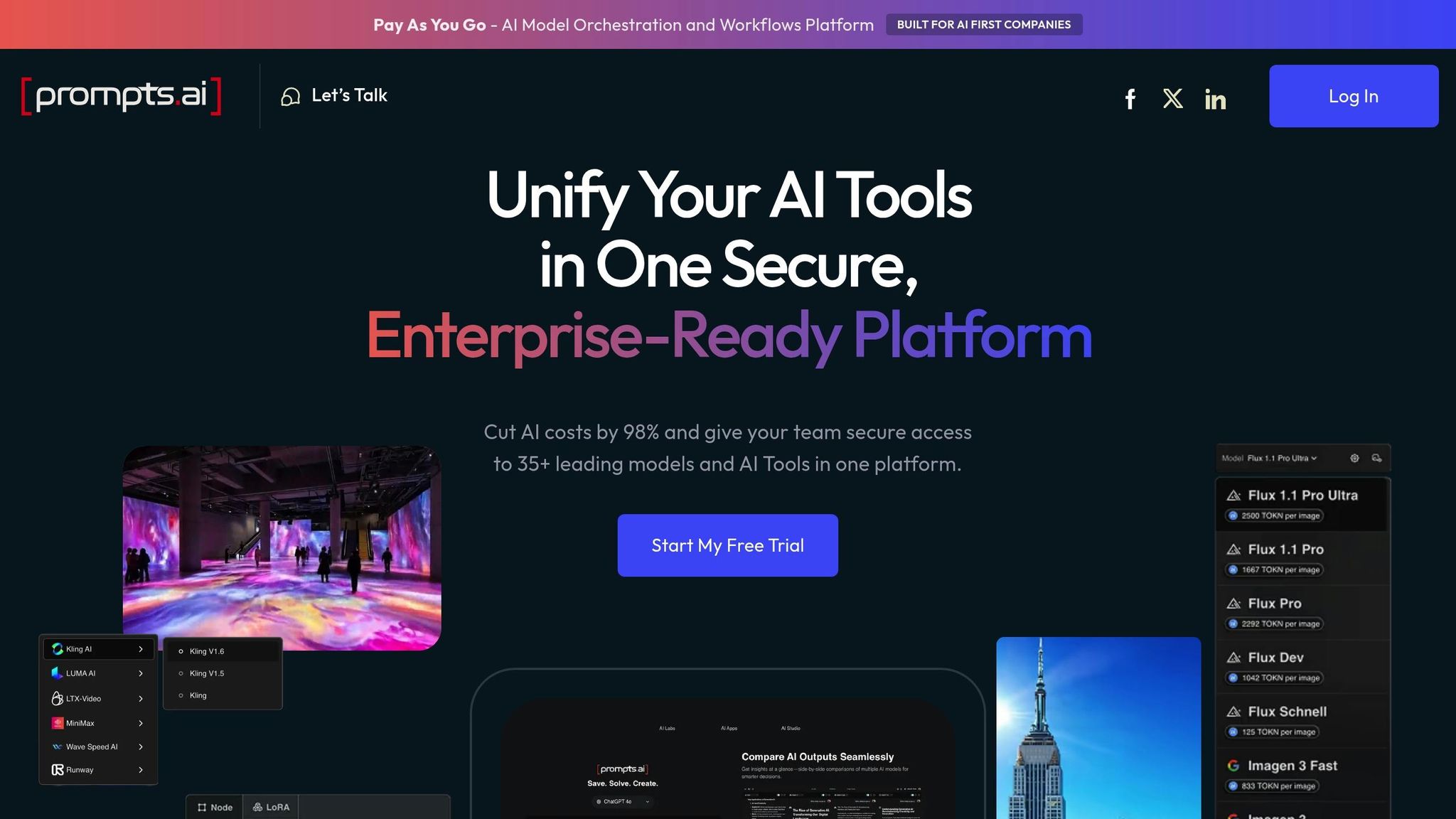
prompts.ai serves as an Intelligence Layer for enterprise AI, streamlining access to over 35 advanced large language models, including GPT, Claude, LLaMA, and Gemini, through a single, unified platform. Instead of managing multiple subscriptions and dashboards, businesses can seamlessly orchestrate workflows across these diverse AI tools while maintaining centralized oversight. The platform is built around four key priorities for U.S. enterprises: interoperability with existing systems, strong governance for compliance, scalability to support growth, and clear cost management. Let’s explore each of these pillars, starting with interoperability.
prompts.ai eliminates integration roadblocks with pre-built connectors for essential systems like CRM, ERP, ITSM, data warehouses, search engines, vector databases, APIs, and webhooks. This ensures AI agents can start interacting with enterprise systems immediately, bypassing the data silos that often hinder implementation. The platform also includes AI-Powered Integrations for popular tools like Slack, Gmail, and Trello, enabling teams to automate workflows across departments without needing custom development. It supports both SaaS and on-premises tools, making it adaptable to the complex IT environments common in large U.S. organizations. Alongside these integrations, the platform prioritizes security and compliance to ensure a seamless and protected experience.
Security and compliance are at the heart of prompts.ai's design. The platform adheres to industry-leading standards, including SOC 2 Type II, HIPAA, and GDPR, with continuous control monitoring provided by Vanta. On June 19, 2025, prompts.ai began its SOC 2 Type II audit, reinforcing its commitment to enterprise-grade security. Key governance features include role-based access control (RBAC), SSO/SAML integration, immutable audit logs, data residency options, private networking, key management systems (KMS), and human-in-the-loop approval processes. These tools give organizations the oversight and auditability they need, particularly in regulated industries. For full transparency, the platform’s Trust Center, accessible at https://trust.prompts.ai/, provides a comprehensive view of all AI interactions.
Designed to support enterprise growth, prompts.ai offers flexible deployment options, including cloud, private VPC, or on-premises setups. The platform ensures reliability with service-level agreements (SLAs), high availability (HA), disaster recovery (DR), and regional isolation, allowing it to handle increased workloads without performance issues. Its observability features - such as end-to-end traces, evaluations, versioning, and drift detection - provide the reliability needed for scaling from pilot projects to full-scale enterprise deployments. These capabilities ensure that businesses can expand their AI operations confidently and without interruption.
prompts.ai tackles the unpredictability of AI budgets with tools like per-run cost views, budget alerts, caching, and token optimization. Its TOKN Credits system provides straightforward, usage-based expense tracking. Pricing begins with a free tier for initial exploration, followed by the Creator plan at $25/month (250,000 TOKN Credits, 5 workspaces, 5 collaborators) and the Problem Solver plan at $99/month (500,000 TOKN Credits, unlimited workspaces, 99 collaborators). By consolidating over 35 separate tools into one platform, prompts.ai claims to reduce AI costs by 98%, giving enterprises the financial clarity they need to scale their AI initiatives with confidence.
AWS Bedrock AgentCore serves as an AWS-native orchestration layer, bringing advanced AI capabilities directly into AWS infrastructures. For businesses already rooted in AWS, this platform is a logical extension, seamlessly integrating with their existing cloud setup and enhancing their operational ecosystem.
The platform excels in native AWS integration, effortlessly connecting with services like S3, Lambda, and DynamoDB. However, this tight alignment comes with a trade-off - integrating with third-party tools or systems outside of AWS requires additional effort. The design strongly favors the AWS ecosystem, offering robust internal connectivity but limiting cross-cloud flexibility. This focus ensures a solid foundation for governance and scalability within AWS environments, though enterprises should consider their broader integration needs.
AWS Bedrock AgentCore adheres to AWS's high standards for security and compliance, utilizing AWS-native security protocols and policy-as-code to standardize governance across teams. Features like end-to-end traceability for prompts, tool calls, and outputs enhance debugging and accountability. Additionally, data residency options and private networking through VPC configurations cater to industries with strict regulatory requirements. The platform meets compliance standards such as SOC 2, ISO 27001, GDPR, and HIPAA, making it a strong choice for heavily regulated sectors in the U.S. These governance measures are further supported by the platform's scalability, adding to its appeal for enterprise use.
Leveraging AWS's infrastructure, Bedrock AgentCore is built to handle high-volume workloads and scale in tandem with enterprise growth. It supports every stage of AI workflows - from training to deployment and monitoring - while benefiting from AWS’s global reliability. This scalability allows organizations to deploy AI agents that adapt as demand increases, though setting up and managing the platform may require advanced AWS expertise.
The platform operates on a pay-as-you-go pricing model, with costs varying based on service and compute usage. While this flexible approach is beneficial for smaller workloads, enterprises should be cautious as expenses can rise quickly with higher compute demands. Close monitoring of usage is essential to manage costs effectively as AI operations grow in scale.
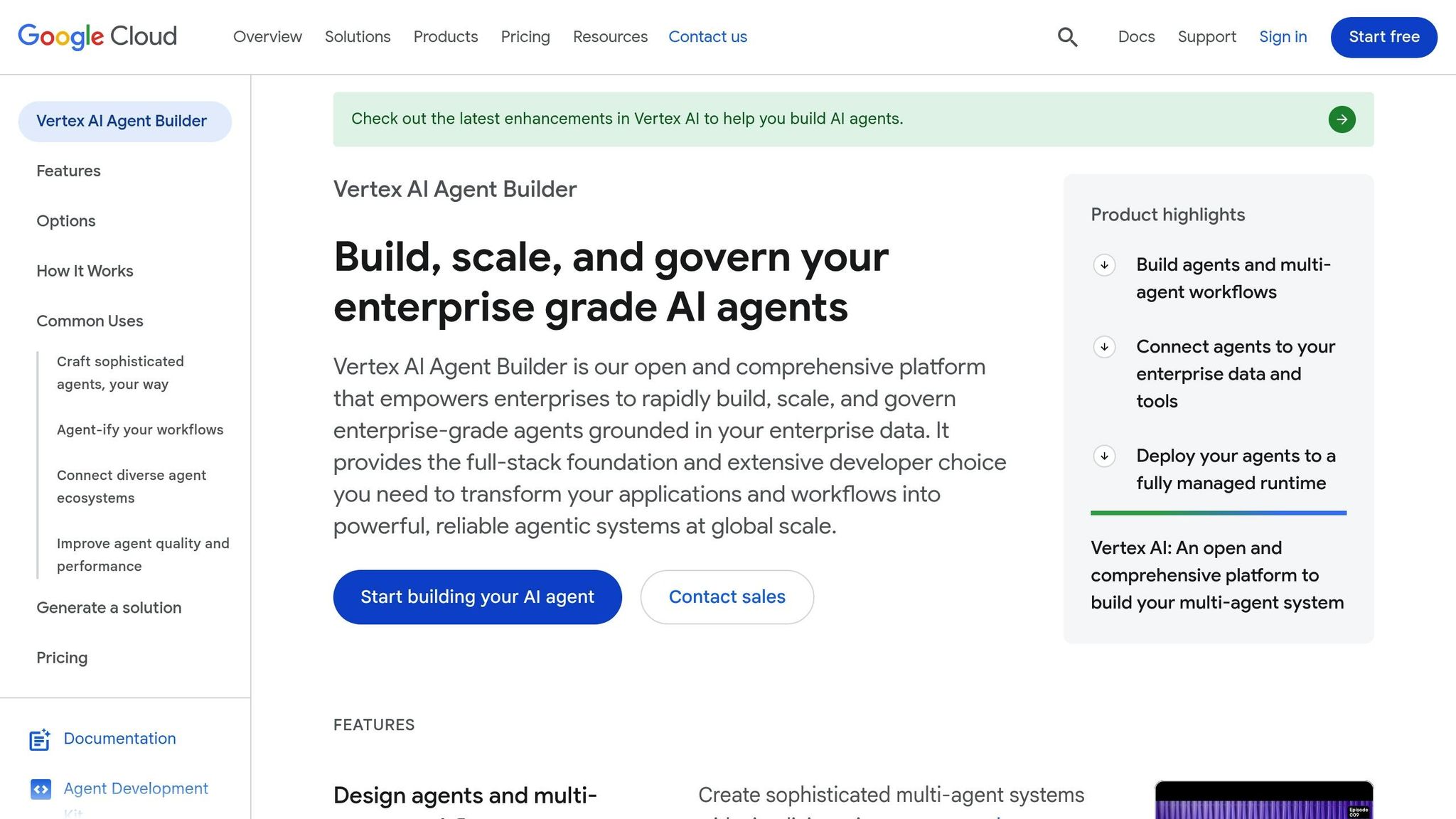
Google Vertex AI Agent Builder is a low-code platform designed to create, deploy, and manage AI agents. It integrates seamlessly with Google Cloud's AI and data services, making it an ideal choice for organizations already leveraging Google's cloud infrastructure. By focusing on integration within its ecosystem, Vertex AI aims to simplify enterprise workflows and enhance efficiency.
Vertex AI connects effortlessly with Google's AI ecosystem, including its data and analytics tools. It provides access to over 200 foundational models, such as Gemini, Veo, Imagen, and Chirp, which support multi-modal AI development. While this deep integration offers significant advantages, it also introduces a potential risk of vendor lock-in for organizations operating in multi-cloud environments. Businesses should carefully assess their long-term cloud strategies and integration requirements before committing to the platform.
The platform includes managed pipelines and MLOps features to help standardize AI governance processes. However, implementing these governance protocols may require expertise specific to Google Cloud Platform (GCP), which organizations should account for during planning.
Built on Google Cloud's robust infrastructure, Vertex AI is well-equipped to handle large-scale workflows and increasing data demands. Its unified machine learning platform supports tasks ranging from model training to deployment, with automated pipelines that simplify the entire lifecycle. This automation is particularly valuable for organizations managing numerous models and workflows simultaneously. Additionally, the platform's compatibility with various model types and integration with Google's data services ensures reliable performance as AI operations grow.
Vertex AI uses a consumption-based pricing model, where costs are determined by activities such as training, predictions, and model hosting. While this pricing structure adjusts with usage, it can become complex when managing multiple models. Furthermore, some advanced features may require specialized GCP expertise, which should be factored into both initial implementation and ongoing operational costs.
Microsoft Power Automate and Azure AI Agent Service bring enterprise-level automation and AI capabilities, seamlessly blending with Microsoft 365, Azure, Dynamics 365, and GitHub. Quickway Infosystems highlights this integration, stating, "With Microsoft integrating AI deeply across Windows, Office, Dynamics, GitHub, and Cloud services, Azure AI will continue to lead the enterprise AI software market heading into 2026". Let’s explore how these platforms stand out, starting with their ability to work across systems.
Power Automate provides a robust selection of prebuilt connectors, while Azure AI Services offers API connectors for accessing organizational data. Its low-code approach simplifies creating workflows that span multiple enterprise systems. Microsoft’s planned implementation of MCP servers will also allow external AI agents to integrate more effectively with its applications. These advancements enable agentic AI to directly query databases in widely used software like Salesforce, SAP, and Oracle, potentially reducing the reliance on multiple software licenses. This level of integration enhances cross-application data access and streamlines operations.
Security and compliance are central to the design of prompts.ai. The platform meets top-tier standards, including SOC 2 Type II, HIPAA, and GDPR, with ongoing control monitoring supported by Vanta. On June 19, 2025, prompts.ai initiated its SOC 2 Type II audit, reinforcing its dedication to secure operations. Key governance features include role-based access control (RBAC), SSO/SAML integration, immutable audit logs, data residency options, private networking, key management systems (KMS), and human-in-the-loop approval mechanisms. These tools provide organizations with the oversight and transparency they require, particularly in highly regulated sectors. For further details, the platform’s Trust Center, available at https://trust.prompts.ai/, offers a full breakdown of AI interactions.
Azure AI leverages Azure’s powerful cloud infrastructure to deliver seamless scalability, featuring high availability, defined SLAs, and regional isolation. With Azure AI Foundry, businesses can develop custom AI solutions tailored to their needs. Its pay-as-you-go pricing model ensures resources can scale dynamically in response to demand, making it a flexible option for growing enterprises.
Power Automate is priced at approximately $15 per user per month, while Azure AI Services follow a consumption-based pricing model. While this usage-driven approach offers flexibility, scaling Power Automate can lead to higher costs, and Azure AI’s consumption model requires diligent budget management. Organizations should actively monitor their usage and implement budget controls to keep expenses in check effectively.
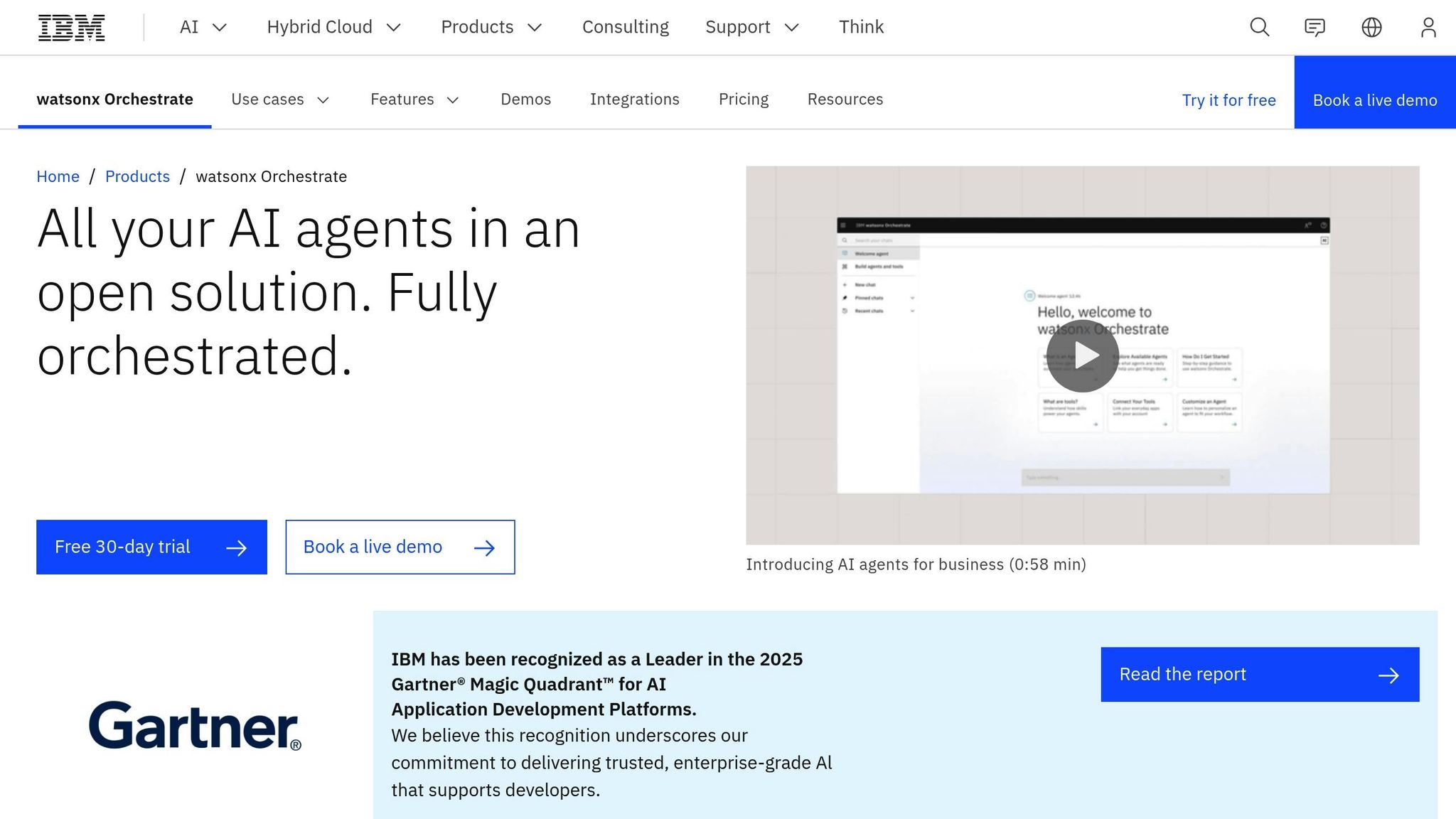
IBM watsonx Orchestrate stands at the heart of IBM's watsonx platform, combining cutting-edge AI capabilities with strong governance and scalability. Tailored for regulated industries and large-scale enterprises, it enables the creation of AI-powered workflows with a focus on compliance and efficiency.
With its modular AI architecture, watsonx Orchestrate is built to handle complex deployments, offering support for various AI models and runtimes. It’s designed to function seamlessly across hybrid and multi-cloud environments, whether deployed on IBM Cloud, OpenShift, or on-premises. This versatility ensures smooth integration with existing data sources and business applications. Such seamless compatibility enhances its governance capabilities, maintaining compliance and transparency throughout every phase of operation.
IBM watsonx provides a comprehensive suite of governance tools to manage the entire AI lifecycle. These include features for bias detection, drift monitoring, model explainability, and detailed audit trails. The platform complies with key regulatory standards such as ISO, NIST, GDPR, and HIPAA. Its governance framework ensures organizations can maintain transparency and accountability while scaling their AI initiatives responsibly.
Designed to meet the demands of large enterprises, watsonx Orchestrate supports intricate workflows and allows custom model training using private datasets. Its scalable architecture is built to handle substantial data volumes and evolving business needs. IBM emphasizes this strength:
IBM's strength lies in delivering trusted, explainable AI, which is crucial as organizations scale automation responsibly.
IBM watsonx uses a modular, usage-based pricing model under enterprise licensing. This approach allows organizations to pay only for the resources they utilize. However, predicting overall costs can sometimes be challenging due to the usage-based structure.
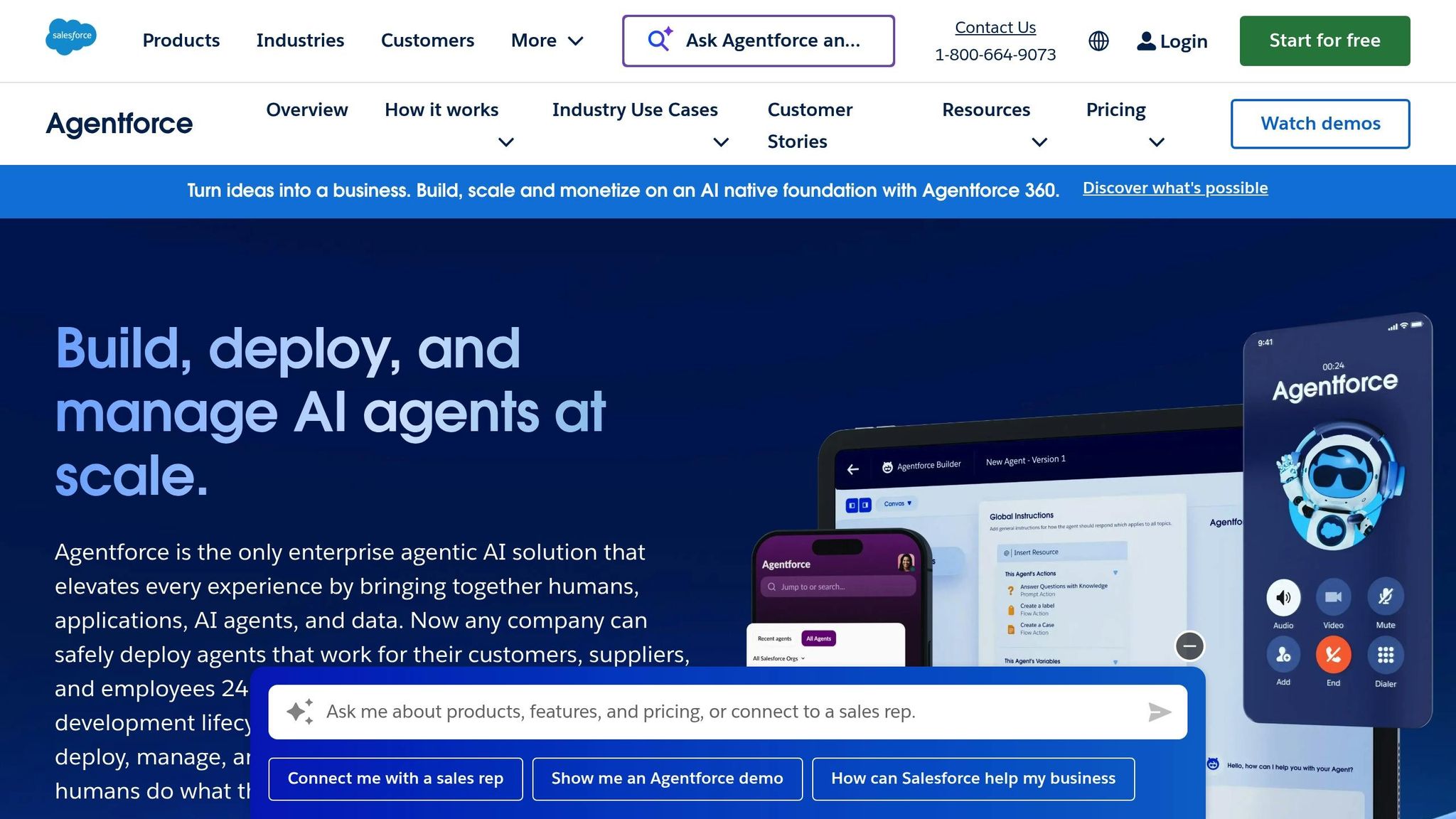
Salesforce Agentforce and Einstein Studio embed AI capabilities directly into the Salesforce ecosystem, providing a built-in solution that seamlessly integrates with existing CRM data. Einstein acts as Salesforce's AI engine, woven throughout all Salesforce clouds, while Agentforce focuses on creating autonomous AI agents capable of planning, reasoning, and executing tasks across sales, service, and operations. Let’s explore how these tools enhance integration, scalability, and cost clarity.
The platform's tight integration with Salesforce's CRM environment simplifies the process of connecting systems. Agentforce taps into various data sources using existing APIs and takes advantage of MuleSoft's pre-built connectors, which link to over 30 third-party systems. This setup enables businesses to expand AI capabilities beyond Salesforce while maintaining a cohesive workflow across their tech ecosystem. This strong integration supports real-time, scalable data processing.
Powered by Salesforce Data Cloud, the platform organizes CRM data into a flexible, scalable customer graph. Through a low-code interface, businesses can design industry-specific AI agents that can update Salesforce records, execute Flows, and initiate automations. Einstein Bots further streamline operations by handling routine customer service tasks, freeing human agents to focus on more complex challenges - all while ensuring real-time data access across the system.
Salesforce Einstein features and Agentforce Assistant are offered as optional add-ons to existing Salesforce subscriptions. While this modular approach allows businesses to pick and choose the features they need, the additional costs can add up for organizations leveraging multiple Salesforce AI tools.
When it comes to optimizing enterprise workflows, each platform brings its own set of advantages and challenges. Understanding these differences is vital for making informed decisions.
prompts.ai shines in its versatility, offering multi-model flexibility and precise cost control. It integrates seamlessly with CRMs, ERPs, data warehouses, and vector stores using SDKs and APIs. Additionally, its no-code builder can be extended with TypeScript or Python, making it ideal for complex, multi-system processes that require robust API integrations and enterprise-grade governance.
AWS Bedrock AgentCore delivers strong orchestration capabilities within the AWS ecosystem, integrating tightly with services like DynamoDB, S3, Lambda, and IAM. However, its focus on AWS services can limit its portability across other cloud environments[1, 14]. Google Vertex AI Agent Builder leverages its deep integration with Google Cloud and Workspace to create a unified intelligence layer but carries the risk of cloud lock-in for users heavily invested in Google’s ecosystem[1, 14]. Microsoft Power Automate and Azure AI Agent Service offer standout features for Microsoft 365 and Azure users, but their primary focus on the Microsoft stack may restrict flexibility when working with other models[1, 14]. IBM watsonx Orchestrate supports hybrid and multi-cloud environments, allowing deployment on IBM Cloud, OpenShift, or on-premises. However, its modular pricing structure can make cost estimation a tricky task. Salesforce Agentforce and Einstein Studio embed generative AI capabilities across Salesforce clouds and integrate with Salesforce Data Cloud, but advanced features often come with additional fees, driving up costs[2, 5].
Pricing models further distinguish these platforms. Transparency in costs is a significant consideration, especially as CFOs report that AI agents already account for 25% of total AI budgets. AWS, Google Cloud, and Microsoft Azure rely on consumption-based pricing, which can lead to unpredictable costs with high compute workloads. Microsoft Power Automate starts at approximately $15 per user per month, but token-based billing introduces variability. IBM's modular pricing approach adds complexity to budgeting, while Salesforce’s advanced AI features often require extra per-user fees. By 2026, organizations are expected to focus more on ROI, tracking metrics like accuracy, cost, and speed to evaluate AI projects across all business functions[15, 3].
The table below provides a side-by-side comparison of these platforms across key criteria:
| Platform | Interoperability | Scalability | Cost Transparency | Primary Limitation |
|---|---|---|---|---|
| prompts.ai | Integrates with CRMs, ERPs, data warehouses, and vector stores via SDKs and APIs | No-code builder extendable with TypeScript/Python; supports multi-cloud deployment | Pay-as-you-go TOKN credits with per-run cost visibility and budget caps | None |
| AWS Bedrock AgentCore | Tight integration with AWS services (DynamoDB, S3, Lambda, IAM) | Robust AWS-native orchestration | Usage-based pricing that can escalate with high compute workloads | AWS-centric; limited portability |
| Google Vertex AI Agent Builder | Deep integration with Google Cloud and Workspace | Unified intelligence layer leveraging GCP data and models | Consumption-based pricing; complexity in multi-model deployments | Google Cloud lock-in risk |
| Microsoft Power Automate & Azure AI Agent Service | Integration with Microsoft 365 and Azure | Seamless automation for CRM and ERP data | Starts at ~$15 per user/month; token-based billing can be unpredictable | Focus on the Microsoft stack; limited model flexibility |
| IBM watsonx Orchestrate | Supports integration across hybrid and multi-cloud environments (IBM Cloud, OpenShift, on-premises) | Supports multiple model types and runtimes | Modular pricing; cost estimation can be challenging | Complex pricing structure |
| Salesforce Agentforce & Einstein Studio | Native integration within the Salesforce ecosystem | Embedded generative AI with a low-code interface | AI features are often billed as add-ons, increasing overall costs | Add-on fees can accumulate; ecosystem-specific |
These insights highlight the trade-offs of each platform, helping enterprises navigate their options based on operational needs, cost structures, and long-term ROI goals.
Choosing the right AI solution for 2026 depends on your enterprise's specific needs, infrastructure, and budget. As businesses move from experimenting with AI to fully scaling its integration, the emphasis has shifted toward achieving measurable outcomes. For U.S. decision-makers, platforms that prioritize security, adaptability, and clear cost structures are essential.
Here’s a summary of key considerations when selecting the best AI platform:
For mid-sized and large enterprises, prompts.ai offers unmatched flexibility. The platform provides multi-model access, straightforward usage-based TOKN credits, and effortless integration, making it an excellent choice for handling complex workflows. Its no-code builder, which can be extended using TypeScript or Python, ensures a practical balance between ease of use and advanced technical capabilities.
In addition to flexibility, compliance with strict regulatory standards is non-negotiable for businesses in regulated industries. These sectors require platforms with robust features such as RBAC, SSO/SAML, immutable audit logs, data residency options, and adherence to standards like SOC 2, ISO 27001, GDPR, and HIPAA. Such governance tools are crucial for maintaining secure operations and reliable audit trails.
For organizations mindful of their budgets, evaluating pricing models is critical. While consumption-based pricing may lead to unexpected costs during periods of high compute demand, platforms with transparent, usage-based pricing and built-in cost controls empower CFOs to track key metrics like accuracy, speed, and cost efficiency across various business functions.
Ultimately, the ideal AI platform will align with your organization’s size, compliance needs, technology infrastructure, and long-term goals. Enterprises that prioritize interoperability, clear pricing, and multi-cloud flexibility will be well-prepared to scale their AI initiatives effectively throughout 2026 and beyond.
To integrate AI platforms effectively, businesses should aim for interoperable systems that easily align with their current infrastructure. Using standardized APIs plays a key role here, as they allow different platforms and tools to communicate consistently and efficiently.
Equally important is establishing robust data governance frameworks to safeguard sensitive information and ensure compliance with regulatory standards. By focusing on these strategies, organizations can tap into the benefits of AI while keeping their existing workflows intact.
Managing AI expenses in 2026 requires a sharp focus on scalable infrastructure, process automation, and efficient resource management. Businesses need to ensure AI models are deployed in a cost-conscious way, carefully track usage to eliminate waste, and consider multi-cloud solutions to maintain flexibility and avoid being tied to a single provider.
Regularly assessing AI performance and aligning projects with well-defined ROI targets is equally important. Using AI-driven tools for cost analysis and resource distribution can help companies streamline operations and maintain control over their budgets.
AI governance plays a key role in regulated industries, ensuring adherence to stringent legal and industry standards. It safeguards sensitive data, promotes transparency, and mitigates risks such as bias or harmful outputs - issues that can result in serious legal or reputational challenges.
When organizations adopt robust governance practices, they not only enhance trust and accountability but also ensure their AI systems align with ethical principles and operational objectives. This balance is critical for maintaining integrity while achieving business goals.