Pay As You Go - AI Model Orchestration and Workflows Platform



Multi-LLM platforms simplify AI cost management by providing a centralized interface to monitor token usage and expenses across multiple large language models (LLMs) like OpenAI, Anthropic, and Google Gemini. These tools eliminate the need for juggling multiple dashboards, offering real-time tracking, detailed cost breakdowns, and automated insights. By identifying inefficiencies and enabling smarter resource allocation, organizations can reduce operational costs by up to 60% while improving AI workflow performance.
| Platform | Token Tracking Features | Cost Attribution Tools | Multi-LLM Support | Unique Strengths |
|---|---|---|---|---|
| Prompts.ai | Real-time, 35+ LLMs | Business outcome-based | Centralized dashboard | Enterprise cost savings up to 98% |
| Braintrust | Nested spans, large-scale | Per trace, custom tagging | AI Proxy for routing | 10× productivity boost for dev teams |
| TrueFoundry | Latency, semantic caching | Public/private pricing | Intelligent routing | 30–60% cost reduction |
| Maxim AI | Detailed, hierarchical logs | Custom pricing structures | Bifrost API gateway | Ultra-fast, scalable API performance |
| Langfuse | SDKs, custom model settings | Tiered pricing, open-source | Multi-LLM integrations | Best for prompt debugging workflows |
Multi-LLM platforms deliver measurable ROI, from cutting costs on API calls to improving agent performance by 40–60%. Whether you're optimizing enterprise workflows or managing large-scale AI deployments, these tools provide the visibility and control needed to maximize efficiency and reduce expenses.

Multi-LLM Platform Comparison: Features, Costs, and ROI

Prompts.ai provides real-time tracking of token metrics across more than 35 leading LLMs, including GPT-5, Claude, LLaMA, Gemini, and Grok-4. With its integrated dashboard, teams can monitor which models, prompts, or workflows are driving costs. This detailed insight helps identify spending patterns and allows for adjustments that maximize cost efficiency. The platform also converts token data into clear, actionable cost metrics instantly.
The platform’s FinOps layer connects token usage to business outcomes with real-time cost breakdowns. Teams can see exactly how various departments or projects influence the AI budget, enabling accurate expense tracking without waiting for month-end reports. This feature simplifies financial oversight and ensures spending aligns with organizational goals.
Prompts.ai consolidates multiple LLMs into a single, secure interface. This setup makes it easy for teams to switch between models, compare their performance side by side, and route requests to the most cost-effective option - all without juggling multiple accounts or dashboards. The Pay-As-You-Go TOKN credit system ties costs directly to usage, offering flexibility and scalability for deployments.
Prompts.ai is particularly suited for enterprises managing intricate, multi-model workflows that require strict oversight and cost management. From creative agencies testing AI-driven solutions to Fortune 500 firms improving customer support, organizations benefit from centralized tracking, detailed audit trails, and the ability to cut AI software costs by as much as 98% compared to maintaining separate tools.
Braintrust simplifies tracking token usage by automatically logging details like prompts, cached data, completions, and reasoning tokens for every model call - no manual setup required. Using an AI Proxy that mimics an OpenAI-compatible API, it seamlessly routes calls to providers like OpenAI, Anthropic, and Google while capturing every request. For more intricate agent workflows, the platform provides nested spans that break down token usage and latency at every step, making it easier to pinpoint resource-heavy operations.
Its query engine, "Brainstore", can sift through millions of traces in seconds, filtering by token usage, latency, or errors. This makes it invaluable for analyzing trends in large-scale deployments. For example, Notion experienced a dramatic shift, increasing their issue resolution rate from 3 to 30 per day after adopting Braintrust - a 10x boost in development speed.
Braintrust calculates costs per trace using real-time model pricing and offers detailed spending insights by user, feature, model, or team, thanks to custom tagging. A key focus is on the "cost per successful interaction" metric, which helps teams align spending with business outcomes rather than just monitoring raw API costs. This level of detail allows organizations to pinpoint which features or user groups are driving expenses, enabling more precise optimization. The cost data integrates directly with real-time monitoring and alert systems for immediate action.
The platform includes log alerts that notify teams when specific thresholds or conditions are met. These alerts integrate with tools like Slack or webhooks for seamless notifications. For instance, teams can set triggers such as metrics.estimated_cost > 1.0 to catch costly API calls before they strain budgets. Alerts can also be filtered by specific models, allowing teams to compare cost efficiency across providers in real time.
Braintrust is ideal for teams developing production-level AI systems that require a robust feedback loop between monitoring and automated evaluations. The free tier supports 1 million trace spans and 10,000 scores per month, while the Pro plan is available for $249/month. Users have reported significant improvements in AI accuracy, jumping from below 40% to over 80% within weeks. This makes Braintrust a solid choice for organizations focused on balancing cost management with performance enhancements.
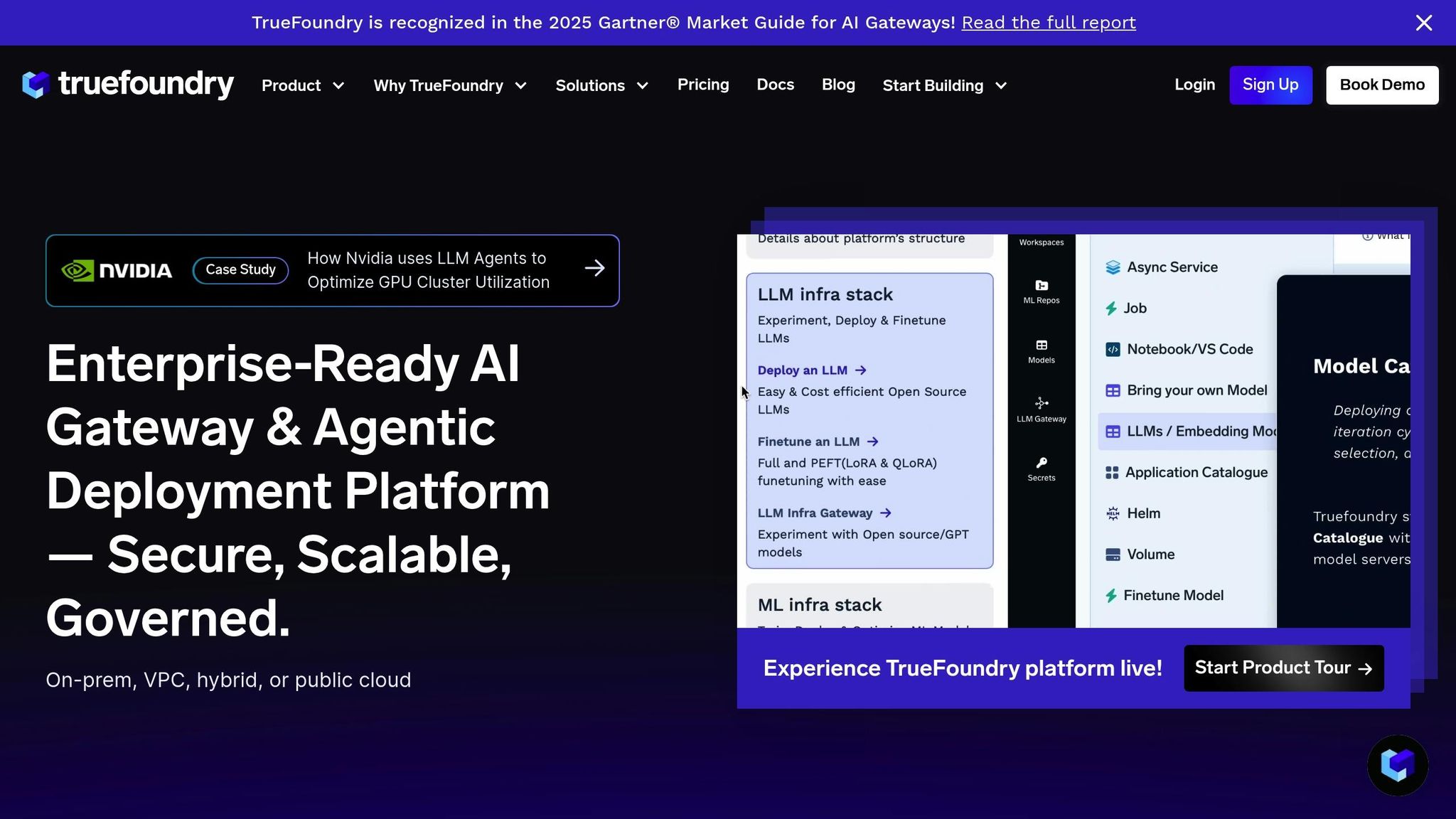
TrueFoundry's AI Gateway acts as a central proxy, automatically tracking input and output token counts for requests across more than 250 supported LLMs. It monitors key performance metrics like request latency, TTFS (Time to First Search), and ITL (Inference Time Latency) at P50, P90, and P99 percentiles. Despite its detailed tracking, it adds only 3–4ms of overhead while managing over 350 requests per second on a single vCPU. Metrics can be grouped by model, user, team, or custom tags, offering a clear view of token usage across AI systems. This level of transparency helps organizations accurately allocate costs.
Using the X-TFY-METADATA header, users can attach custom tags (e.g., customer_id, team_name, feature_name) to track costs across departments or implement custom pricing models. TrueFoundry supports both "Public Cost" (standard provider rates) and "Private Cost" (custom pricing for fine-tuned models or specific contracts). In May 2025, Aviso AI adopted TrueFoundry's cost management tools for their sales forecasting engine. By routing reasoning tasks to GPT-4 and data retrieval to Mixtral, they reduced forecasting latency by 45% and cut API costs by 30% across 5,000 sales teams.
TrueFoundry includes automated budget management tools that enforce hard caps, throttling or blocking requests when a budget limit is reached. This prevents unexpected overages from "runaway" workloads. Gateway-level rate limits can also be configured, such as capping a frontend team to 5,000 daily requests, ensuring resources are fairly distributed.
The platform’s unified API simplifies working with multiple models, integrating providers like OpenAI, Anthropic, and Mistral, along with self-hosted options. It enables intelligent routing based on factors like cost, latency, or task intent - sending simpler queries to lower-cost models while reserving more expensive ones for complex reasoning tasks. For instance, in May 2025, Neurobit used TrueFoundry to optimize clinical transcript processing. By routing extraction tasks to Mistral and summarization tasks to Claude, they achieved a 40% reduction in API costs and improved data accuracy by 20%. Additionally, the platform’s semantic caching can lower LLM API expenses by as much as 70% in certain enterprise scenarios.
TrueFoundry is particularly suited for enterprise-scale GenAI applications that demand detailed cost tracking, multi-tenant SaaS providers requiring customer-specific billing, and teams managing a mix of public APIs and self-hosted models. Organizations using the AI Gateway have reported overall inference cost reductions between 40% and 60%, with an average of 30% savings achieved through features like smart routing, batching, and budget controls.
Maxim AI takes multi-LLM orchestration to the next level with detailed token tracking that simplifies cost management. It monitors input, output, and total tokens across various levels - trace, generation, session, and repository - providing insights into multi-turn interaction patterns. Developers can also log specific metrics manually at the generation level, such as tokens_in, tokens_out, and latency metrics. An interactive dashboard offers visual charts with aggregation options like average, p50, p90, p95, and p99, helping users spot trends and identify any unusual token usage.
With Maxim AI, users can set up custom pricing structures tailored to match specific models, ensuring costs align with enterprise-negotiated rates instead of default provider pricing. Expenses can be tracked at two main levels: "Model Configs", which monitor costs for specific prompt/model combinations, and "Log Repositories", which group costs by project, environment, or department. Real-time alerts via Slack or PagerDuty notify users when token usage exceeds 1 million per hour or when daily costs surpass $100. This layered approach not only prevents budget overruns but also provides a clear view of spending patterns. Maxim AI further simplifies cost management by integrating seamlessly with multiple providers.
Maxim AI's Bifrost Gateway offers a unified OpenAI-compatible API that supports over 12 providers, including OpenAI, Anthropic, AWS Bedrock, Google Vertex, Azure, Cohere, Mistral, and Groq. Impressively, it adds just 11 microseconds of overhead at 5,000 requests per second, making it a fast, reliable choice for production environments. The gateway works as a drop-in replacement for existing API calls, requiring only a single line of code to switch. Additionally, its semantic caching feature reduces token usage by identifying and caching similar requests, eliminating unnecessary API calls.
Maxim AI stands out for enterprise teams scaling AI workloads and needing centralized control across multiple providers. In a 2026 test, an e-commerce assistant running on ten servers with 150 integrated tools demonstrated the platform's efficiency. By switching to Maxim AI's "Code Mode", per-query costs dropped from $3.20–$4.00 to $1.20–$1.80, while latency decreased from 18–25 seconds to 8–12 seconds. These improvements resulted in annual savings of $9,536 based on 1,000 daily scenarios. The platform is especially beneficial for organizations handling intricate workflows where input token costs from extensive tool schemas can quickly add up, making it an ideal choice for achieving cost-effective AI operations.
Langfuse offers detailed tracking of token usage, breaking it down into input, output, cached_tokens, audio_tokens, and image_tokens. This data is collected using SDKs and integrations like LangChain and LlamaIndex or through built-in tokenizers such as Tiktoken for GPT and Anthropic's tokenizer. For models where internal reasoning tokens are not exposed, direct ingestion is necessary. The Metrics API aggregates this token data by user, session, or prompt version, ensuring updates are delivered with minimal delay.
Langfuse calculates costs in USD for each usage type, allowing segmentation by userId, sessionId, tags, release, or version. This level of detail helps teams pinpoint which users or features are driving token consumption. The platform supports tiered pricing, automatically adjusting rates when models like Claude 3.5 Sonnet or Gemini 1.5 Pro exceed 200,000 input tokens in a single request. For custom or self-hosted models not covered by predefined settings, users can define their own models and pricing structures in the Project Settings. This flexibility ensures accurate cost tracking and helps teams manage expenses effectively across various workflows.
Langfuse provides predefined settings for OpenAI, Anthropic, and Google models, while also allowing for custom model definitions. It integrates with over 50 libraries and frameworks, including LangChain, LangGraph, LlamaIndex, and Pydantic AI, as well as gateways like LiteLLM and OpenRouter. These integrations enable the platform to directly capture cost data from gateways, removing the need for manual calculations. As an open-source and self-hostable platform, Langfuse gives teams full control over their observability data while also offering a managed Cloud version for those who prefer a hosted option.
Langfuse is especially useful for teams handling multi-step agent workflows that demand prompt debugging, usage-based billing, and cost comparison. The Daily Metrics API supports rate limiting, ensuring users stay within token budgets. By linking managed prompts with traces, Langfuse helps teams evaluate how specific prompt versions perform in real-world scenarios. This makes it an excellent choice for organizations managing complex, non-deterministic interactions across multiple LLMs with frequent updates to prompts.
This section provides a summary of the key advantages and trade-offs involved in managing token spends across various platforms, based on the detailed reviews above.
Each platform offers a unique approach to handling token spends across multiple large language models (LLMs), tailoring their features to meet different operational priorities.
Prompts.ai stands out with its unified interface that integrates over 35 leading LLMs. It includes built-in FinOps controls, offering real-time tracking and cost attribution for enterprise workflows. This setup enables organizations to centralize governance and significantly cut AI-related expenses.
Maxim AI focuses heavily on cost optimization with its hierarchical budget controls. It also employs semantic caching to reduce costs from repeated queries. However, as a newer platform, it is still in the process of building its community and refining certain features.
Braintrust, TrueFoundry, and Langfuse provide less comprehensive details on token tracking, particularly in areas like reporting granularity and integration capabilities. Organizations considering these platforms should conduct a closer evaluation to determine whether their token tracking and cost management features meet their specific operational needs.
These differences highlight the varied design philosophies and operational priorities among the platforms.
Ultimately, selecting the right solution comes down to your organization's priorities. Whether you value unified governance and cost transparency or prefer aggressive cost-saving measures and budget controls, understanding these trade-offs is crucial for optimizing multi-LLM workflows.
Choosing a multi-LLM platform that aligns with your goals and scale is essential for maximizing efficiency and return on investment (ROI). Multi-LLM strategies have demonstrated the ability to reduce operational costs by 60% compared to single-provider systems, making them a smart choice for long-term success.
For budget-conscious teams, features like pass-through pricing and dynamic routing can deliver significant savings. For example, a telecommunications company adopted a multi-model routing strategy, directing simple queries to lower-cost models and complex ones to GPT-5. This approach saved $2.1 million annually, reduced support costs by 60%, and cut the cost per query from $0.03 to $0.007 - a 76% reduction. By routing 80% of requests to less expensive models, they achieved outstanding cost efficiency.
Large-scale enterprises benefit from advanced observability and real-time logging. These tools can enhance agent performance by 40%–60%, while consistent model evaluation can drive improvements of 30%–50% within six months. For organizations managing millions of requests, automated evaluation and token-level cost tracking are key to avoiding vendor lock-in, which affects 42% of AI projects, by monitoring token expenditures in real time.
Teams that require complete control over their infrastructure often turn to open-source platforms. While these may involve higher initial setup efforts, they eliminate ongoing fees. Industries with strict regulations, such as healthcare and finance, should focus on SOC 2 compliance, VPC deployment, and detailed audit trails. These measures can prevent up to 87% of potential security incidents.
The financial benefits of selecting the right platform are undeniable. A Fortune 100 healthcare company reduced delivery times by 80% while cutting costs for individual use cases from $500,000–$1,000,000. Similarly, a financial institution lowered authorization costs from $2,200 to $9, saving $22 million annually. Matching platform capabilities to your specific needs can directly translate into measurable and impactful ROI.
Token usage directly affects your overall expenses, as both input and output tokens contribute to the total cost. By leveraging real-time tracking and cost management tools, you can monitor and adjust token consumption, helping to cut costs and allocate resources more effectively.
The fastest way to spot cost spikes in traces is through real-time token tracking combined with detailed cost breakdowns. By using observability tools, you can filter traces and set up run previews, making it easier to identify sudden increases in token usage. These tools simplify the process of detecting inefficiencies and keeping token spending under control.
To maintain strict budget control, leverage multi-LLM platforms equipped with token tracking and cost management tools. These platforms enable centralized monitoring of token usage across users, features, or teams, allowing you to establish clear usage limits. Automation tools, such as proxies or metadata tagging standards, can simplify cost attribution and enforce these limits effectively. This approach ensures financial oversight by setting firm caps and providing alerts when thresholds are approached.