Pay As You Go - AI Model Orchestration and Workflows Platform



<article>
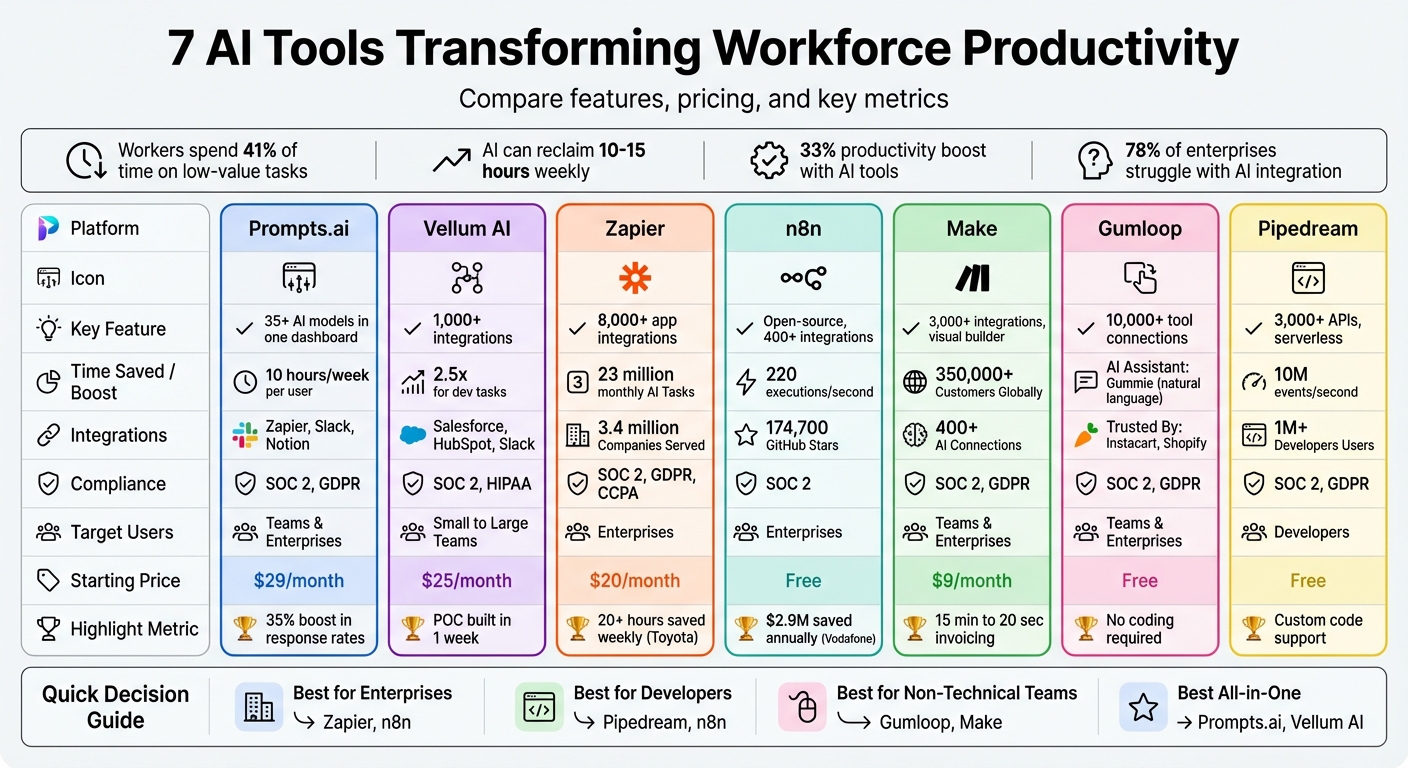
AI Workflow Automation Platforms Comparison: Features, Pricing, and Key Metrics
AI tools are transforming workplaces by automating repetitive tasks, saving time, and boosting productivity. Workers spend 41% of their time on low-value activities like data entry and inbox management, but AI can reclaim 10–15 hours weekly for more meaningful work. Teams using AI report a 33% productivity boost, with finance departments cutting workloads by 30% and customer support increasing efficiency by 50%.
However, 78% of enterprises struggle to integrate AI into their systems due to tool sprawl and lack of interoperability. The solution? Platforms that unify AI workflows, ensuring seamless integration across tools like Slack, Salesforce, and Notion. These solutions also offer enterprise-grade security, compliance, and governance features to keep data safe.
Here’s a breakdown of seven AI platforms reshaping how teams work:
| Platform | Key Features | Compliance Standards | Target Users | Pricing (Starting) |
|---|---|---|---|---|
| Prompts.ai | 35+ models, FinOps tracking | SOC 2, GDPR | Teams & Enterprises | $29/month |
| Vellum AI | 1,000+ integrations, VPC options | SOC 2, HIPAA | Small to Large Teams | $25/month |
| Zapier | 8,000+ apps, centralized access | SOC 2, GDPR, CCPA | Enterprises | $20/month |
| n8n | Open-source, 220 execs/second | SOC 2 | Enterprises | Free |
| Make | Visual builder, AI agents | SOC 2, GDPR | Teams & Enterprises | $9/month |
| Gumloop | Drag-and-drop, AI decision-making | SOC 2, GDPR | Teams & Enterprises | Free |
| Pipedream | Developer-focused, serverless | SOC 2, GDPR | Developers | Free |
These tools solve common challenges like disconnected workflows and time-consuming tasks. Start small by automating a single process and measure the impact. With AI, you can save time, reduce costs, and focus on what matters most.
</article>

Prompts.ai serves as an enterprise-grade AI orchestration platform, bringing together over 35 top-tier language models - including GPT-5, Claude, LLaMA, and Gemini - into a single, secure dashboard. This eliminates the hassle of juggling multiple subscriptions and reduces the need for constant context switching.
Prompts.ai works seamlessly with widely-used tools like Zapier, Slack, and Notion, embedding AI directly into everyday workflows. For instance, a marketing agency in the U.S. integrated Prompts.ai with HubSpot and Slack, achieving a 35% boost in response rates while saving 10 hours per week per team member by automating lead nurturing tasks. By connecting with your existing tools, the platform enhances efficiency and enables smooth, scalable deployments for teams of any size.
The platform is designed to scale effortlessly, accommodating everyone from individual users to large enterprises. It supports unlimited users and up to 1 million monthly prompts. Enterprise-level offerings include dedicated instances for industries with strict compliance needs and API access for high-volume operations. For example, a tech company using Prompts.ai across 200 employees reduced onboarding time by half, while mid-sized organizations with over 500 users cut AI setup times by 40%. Shared prompt libraries further streamline operations by allowing teams to create and deploy standardized workflows across the board.
Prompts.ai simplifies automation with AI-driven A/B testing and prompt chaining, making it easy to handle complex tasks. Marketing teams, for example, use chained prompts to pull data from Airtable via Zapier, generating over 100 content variants daily. Customer service teams automate personalized email responses, while developers use the platform to produce code snippets on demand. This no-code approach empowers non-technical staff to build advanced workflows, boosting overall productivity. At the same time, the platform prioritizes governance and compliance to ensure secure and efficient operations.
Prompts.ai includes comprehensive governance tools such as role-based access controls (RBAC), audit logs, and SOC 2 Type II compliance to meet GDPR and HIPAA standards. Finance teams benefit from centralized prompt approval processes, reducing the risks associated with shadow AI. Analytics tools track usage patterns and ROI, while a real-time FinOps layer provides transparency into token usage, cutting software costs by up to 98%. Teams have reported productivity improvements equivalent to a 25% increase, all while maintaining full control over sensitive data and ensuring compliance.
Vellum AI tackles a major hurdle in generative AI adoption: 95% of pilot projects fail to make it to production. Designed to simplify and accelerate this process, Vellum AI allows teams to collaboratively create AI agents that are ready for real-world deployment. With over 1,000 integrations - including Salesforce, HubSpot, Slack, Notion, and Google Workspace - the platform seamlessly connects AI capabilities to your existing tools, requiring no technical expertise.
Vellum AI is built for smooth integration across platforms. Using a "prompt-to-build" approach, it lets users describe tasks in plain English, automatically generating workflows and connections. This enables marketing teams to automate SEO content, sales teams to prepare demos, and support teams to manage tickets - all without writing a single line of code. Vellum's engineering team has reported a 2.5x boost in productivity by using AI agents for development tasks. The platform also supports advanced technical features like OpenAPI specifications, webhooks, and custom API nodes, enabling AI agents to work autonomously within enterprise ecosystems via TypeScript or Python SDKs.
Vellum AI is designed to grow with your needs. Starting at $25 per month for small teams, it offers scalable solutions for enterprises, including cloud-based, private VPC, and on-premise installations - even in air-gapped environments. The platform supports every stage of AI development, from rapid prototyping to full-scale production, with features like version control, staging environments, and instant rollbacks. By 2026, only 2% of organizations are expected to deploy AI agents at scale, but these tools could generate an estimated $450 billion in economic value by 2028, offering a major edge to early adopters.
Vellum's Workflows IDE is built for handling complex tasks, including loops, recursion, and parallel branch execution. Teams can set up event-driven triggers for scheduled or real-time workflows, while approval gates and review queues ensure critical human oversight. Pratik Bhat, Senior Product Manager, AI Product, shared:
"Vellum made it so much easier to quickly validate AI ideas and focus on the ones that matter most. The product team can build POCs with little to no assistance within a week!"
Security and compliance are central to Vellum AI. The platform includes enterprise-grade protections like Role-Based Access Control (RBAC), SSO/SAML/SCIM support, and secrets management. Immutable audit logs track every action, providing full transparency for debugging and compliance reporting. Vellum meets SOC 2, GDPR, and HIPAA standards and includes built-in tools for regression testing and model comparison, ensuring accuracy and compliance as AI transitions from experimental pilots to core operations. These features highlight Vellum AI's emphasis on secure and scalable automation for modern enterprises.
Zapier goes beyond simple app connections, serving over 3.4 million companies with nearly 8,000 app integrations and 500+ AI tools like ChatGPT, Claude, and Gemini. By bringing together your tech stack, it eliminates data silos. To date, the platform has powered more than 350 million AI tasks, with users currently running 23 million AI and agent-related tasks every month.
Zapier's Model Context Protocol (MCP) acts as a bridge, connecting AI platforms with over 30,000 app actions. This allows AI tools to seamlessly handle tasks like email triage, lead enrichment, document summarization, and managing multi-step workflows. With 99.99% uptime and an Enterprise SLA, Zapier ensures reliability for critical operations.
In 2024, Remote.com’s Head of IT and AI Automation, Marcus Saito, led a 3-person IT team that managed 580 active Zaps for 1,700 employees worldwide. Their automation efforts handled over 11 million tasks annually, with an AI-powered helpdesk resolving 28% of IT tickets. This saved the company approximately $500,000 in hiring costs and reclaimed 2,219 workdays per month. As Saito put it:
"Zapier makes our team of three feel like a team of ten."
Zapier’s enterprise features include centralized access management, granular permissions, SSO/SAML/SCIM support, and VPC peering for secure database connections. The platform complies with SOC 2 Type II, SOC 3, GDPR, and CCPA standards, offering full audit trails for workflow modifications.
Zapier also provides autonomous AI Agents capable of conducting research, accessing live data, and executing advanced tasks independently. For example, Spencer Siviglia, Director of Operations at Toyota of Orlando, used Zapier Agents to manage over 30,000 lead records, saving his team more than 20 hours per week. The Copilot feature enables users to create workflows with natural language, while tools like Paths, Filters, and Looping allow for advanced decision-making without requiring code.
At Vendasta, Marketing Operations Specialist Jacob Sirrs implemented an AI-driven lead enrichment system. This system captured leads from forms, enriched them with Apollo and Clay, and routed them to sales reps. The result? A $1 million increase in potential revenue and 282 reclaimed workdays per year. Sirrs explained:
"Because of automation, we've seen about a $1 million increase in potential revenue. Our reps can now focus purely on closing deals - not admin."
Zapier’s automation tools integrate seamlessly with broader workflow strategies, enhancing efficiency across teams and industries.
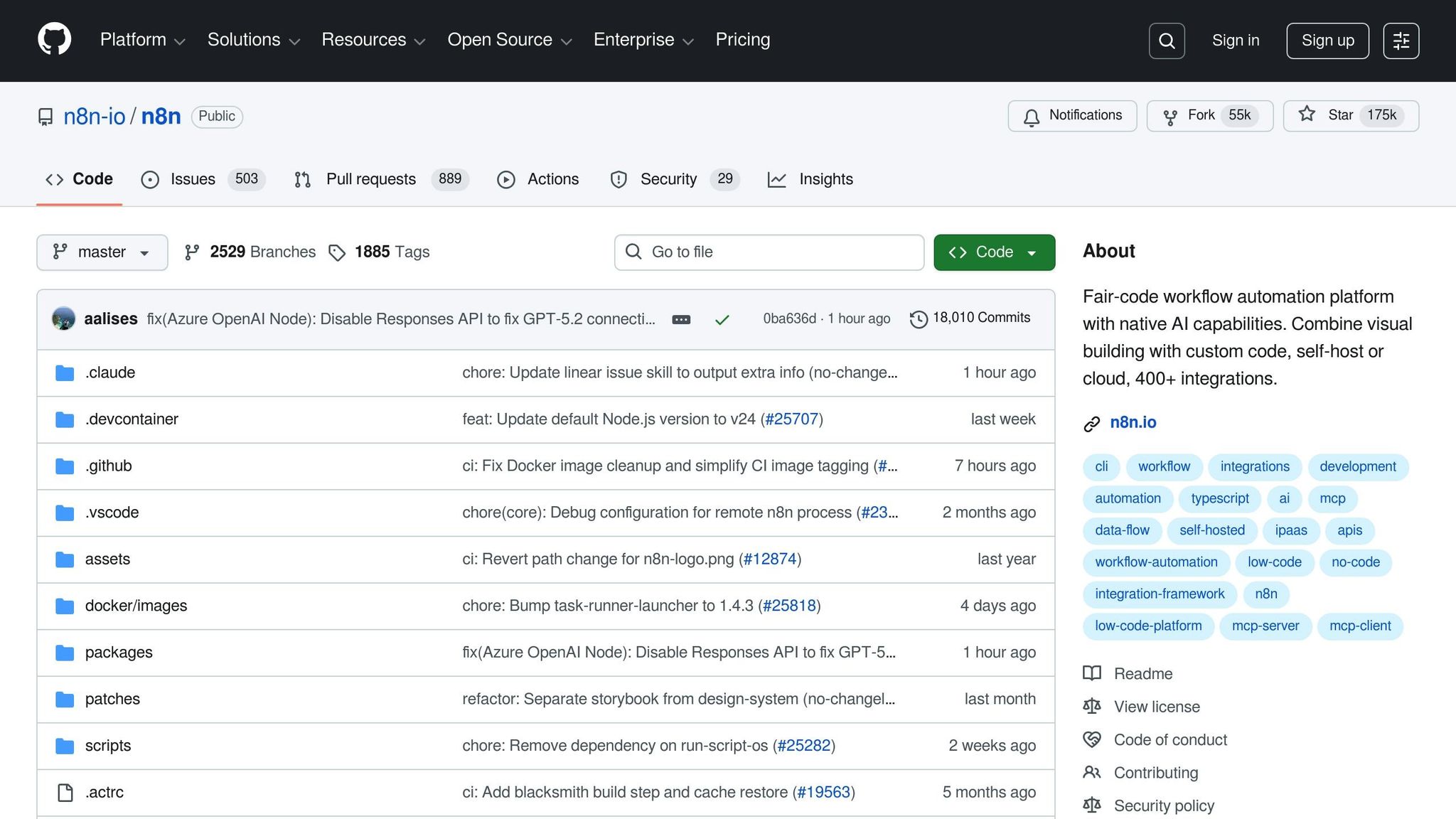
n8n demonstrates how AI-powered workflow tools can simplify processes and boost productivity in intricate work environments. This fair-code automation platform is relied upon by nearly 25% of Fortune 500 companies, combining an intuitive visual workflow builder with advanced technical flexibility. With over 174,700 stars on GitHub, it ranks among the most popular open-source automation projects. The platform offers 400+ pre-built integrations and 1,700+ workflow templates, helping teams deploy solutions faster.
n8n connects seamlessly to various systems using its native nodes, a universal HTTP Request node for REST APIs, and direct cURL integration. Teams can further customize workflows by incorporating JavaScript or Python code, with the option to import external libraries for added functionality. Additionally, the platform supports the Model Context Protocol (MCP), enabling it to function as an MCP server or trigger workflows from other AI systems.
At StepStone, Marketplace Tech Lead Luka Pilic used n8n to drastically speed up marketplace data integration, achieving a 25X improvement. What once required two weeks of manual coding was completed in just two hours. Pilic shared:
"We've sped up our integration of marketplace data sources by 25X. It takes a maximum of 2 hours to integrate APIs and transform data - speed that traditional coding cannot match." - Luka Pilic, Marketplace Tech Lead, StepStone
These adaptable integrations ensure reliable performance, even for large-scale operations.
n8n is built to scale effortlessly, making it suitable for both small teams and large enterprises. The platform can handle up to 220 workflow executions per second on a single instance and supports horizontal scaling through "Queue Mode" and multi-main instance configurations. Its enterprise-grade features include Role-Based Access Control (RBAC) for detailed permissions, SSO/SAML/LDAP integration, and secure secret management via tools like HashiCorp Vault, AWS Secrets Manager, and Azure Key Vault. The platform also meets SOC 2 compliance standards and provides audit logs with log streaming compatibility for tools like Datadog and Splunk.
For example, Delivery Hero saved 200 hours per month with a single IT Ops workflow designed by their Director of Global IT Service Delivery, Dennis Zahrt. Meanwhile, Vodafone transformed their threat intelligence processes with n8n, leading to savings of approximately $2.9 million.
n8n takes automation to the next level with features that empower teams to create highly efficient workflows. Its drag-and-drop interface supports advanced logic such as branching, looping, and filtering. The platform also includes "human-in-the-loop" (HITL) interventions, allowing for manual approvals before AI-driven actions proceed, ensuring control and safety. Teams can test workflows using real data and AI evaluations before deploying them, ensuring consistent performance at scale. For instance, SanctifAI created its first workflow in just 2 hours, completing the task 3X faster than coding Python controls for LangChain. This efficiency enabled product managers to build and test workflows directly, bypassing the need for developer input.
Make offers a visually-driven automation platform designed to empower teams across industries. Serving over 350,000 customers globally, it features 3,000+ pre-built app integrations and over 400 AI-specific connections. Its mind-map style interface enables users to design complex workflows without coding, making automation accessible to all departments. In 2024, AI usage within Make scenarios increased fourfold, highlighting the growing reliance on intelligent automation in workplaces.
These capabilities set Make apart as a standout option among AI workflow platforms.
Make connects effortlessly with leading AI providers, including OpenAI, Anthropic Claude, and Google Vertex AI, through its intuitive visual canvas. It also supports the Model Context Protocol (MCP), acting as a cloud-hosted MCP server to ensure scenarios can be accessed from any AI interface. This centralizes both internal and external automation processes. Teams can further customize workflows using Make's API and no-code toolkit, which allows integration with any public API or proprietary system. The platform's Make Grid feature maps out the entire automation landscape in real time, offering clear visibility into workflows, apps, and agents across an organization.
Make caters to a wide range of users, from individuals to large enterprises. It starts with a free plan offering 1,000 operations per month, while the Core plan begins at $9/month. For enterprise clients, Make provides VPN-only hosting, extended log retention, and ISO 27001 governance. Success stories include Celonis, which used Make AI Agents to cut annual expense auditing costs from $50,000 to just $150 in November 2025. Similarly, Stellantis &You UK saved 151 hours of administrative work within their first year of implementation in May 2025. The platform also prioritizes security, meeting GDPR and SOC 2 Type II standards, and using AES 256 encryption alongside TLS 1.2/1.3 for secure data handling.
Make's automation engine combines its visual workflow builder with AI Agents - goal-oriented automations powered by large language models capable of handling unstructured inputs. The platform includes Maia, a virtual assistant that helps users build and troubleshoot workflows using natural language. For added control, teams can implement "Human in the Loop" modules to review AI outputs before execution. In September 2025, Make AI Agents dramatically reduced invoicing time for farmers from 15 minutes to just 20 seconds. Andreas Stryz, CTO & Co-founder at FINN, shared:
"True citizen development in the entire company. Make is present in every department, empowering the company to offer a unique customer experience."
Make’s automation engine also includes advanced tools like routers, iterators, and aggregators for handling complex workflows with multiple branches. A visual debugger tracks execution at each node, ensuring clarity and precision. These features solidify Make’s reputation as a platform that empowers teams across various industries.
Gumloop provides an AI-driven automation platform that allows teams to create intelligent workflows without needing coding skills. Trusted by major organizations like Instacart and Shopify, its drag-and-drop interface blends traditional automation with AI-powered decision-making. This enables workflows to process unstructured data, such as emails and documents. The platform's "Gummie" AI assistant simplifies the process further by transforming natural language descriptions into fully functional workflows, removing technical barriers for users.
Gumloop's user-friendly design is complemented by extensive integration options. It includes 130 built-in connectors and connects to over 2,800 APIs and 10,000 tools via its hosted Model Context Protocol (MCP) server. Subscriptions come with premium AI models, eliminating the need for separate LLM API keys, though teams can still use their own proxies through AI Proxy support. Developers can trigger automations programmatically using full REST APIs and SDKs, while a browser extension allows workflows to launch directly from web pages. For more advanced needs, custom nodes enable data writing to any database, including Amazon RDS, ensuring compatibility with existing systems.
Gumloop is built to scale effortlessly, accommodating teams of all sizes. Its structure supports centralized control through Organizations and unlimited Workspaces for department-specific automations. Enterprise-grade features include auto-scaling infrastructure, parallelized execution, and reserved compute resources for high-demand tasks. The platform also supports advanced authentication methods like SSO, SAML, and SCIM. Pricing options range from a free plan with 2,000 monthly credits to the Solo plan at $37/month (10,000+ credits), the Team plan at $244/month (60,000+ credits and 10 seats), and tailored Enterprise pricing with VPC deployment options.
Gumloop separates automation into two key components: "Agents", which intelligently coordinate tools to complete tasks, and "Workflows", which automate these agents on schedules or triggers. The AI Router feature enhances decision-making by dynamically determining the next best step based on context. Additionally, sub-flows combine multiple workflows into streamlined, multi-step processes. As Fidji Simo, CEO of Instacart, noted:
"Gumloop has been critical in helping all teams at Instacart - including those without technical skills - adopt AI and automate their workflows, which has greatly improved our operational efficiency."
While driving automation, Gumloop prioritizes security and compliance. It adheres to SOC 2 and GDPR standards and offers detailed controls over AI model usage. Administrators can restrict specific providers, such as OpenAI or Anthropic, or block individual models across the organization to meet compliance needs. Custom user roles, like "Scope Control", allow for precise integration permissions - for instance, enabling Salesforce read access while disabling updates. The platform's "Incognito Mode" ensures sensitive workflows remain private by erasing all inputs, outputs, and intermediate steps in real-time. Additionally, comprehensive audit logging tracks every action across the dashboard and APIs, and custom data retention policies help align with internal compliance requirements.
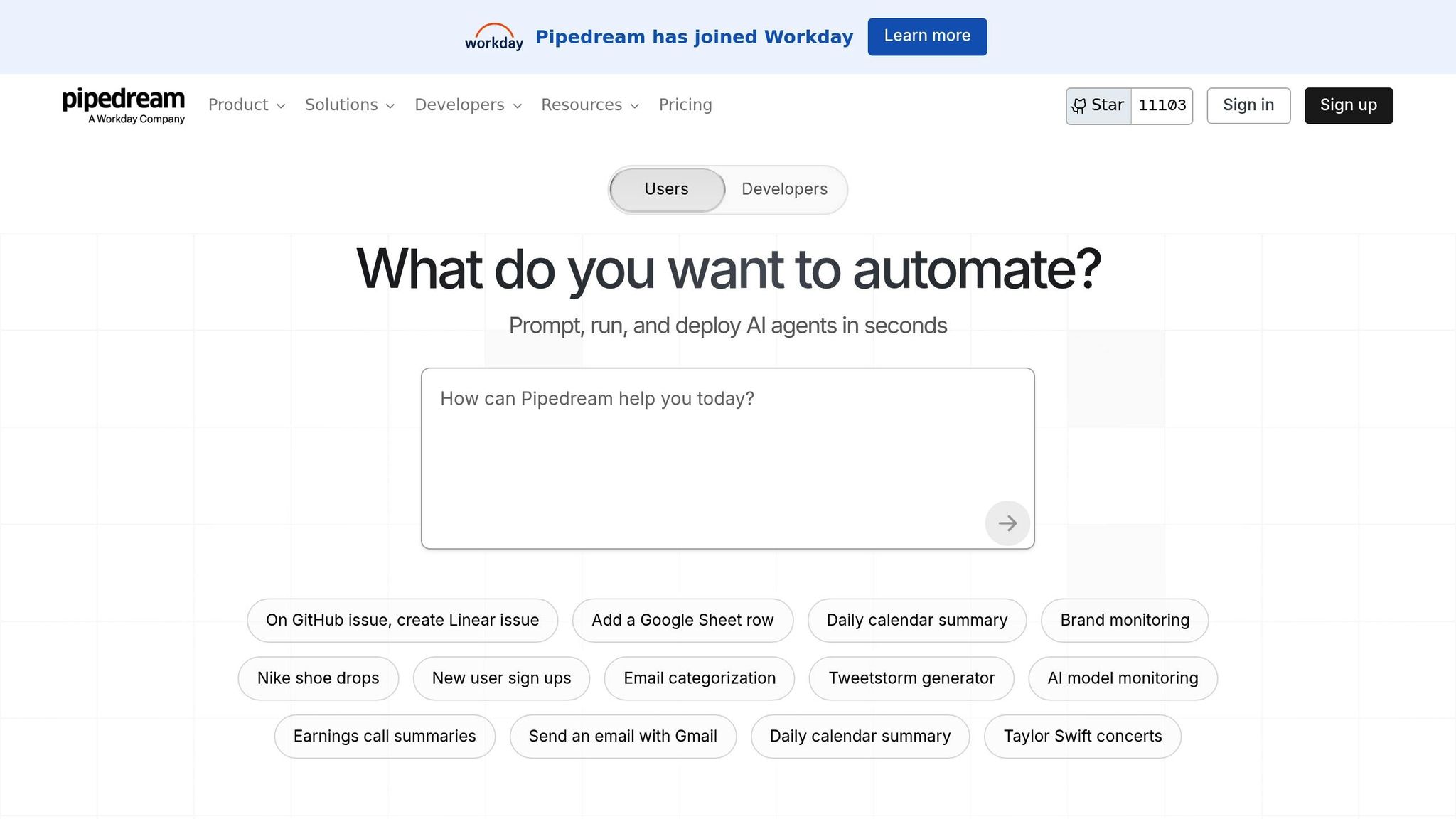
Pipedream stands out with its developer-focused approach to AI workflows, catering to over 1 million developers, from small startups to Fortune 500 companies. Processing billions of events annually - at rates exceeding 10 million events per second - this serverless workflow platform offers unmatched flexibility. Acquired by Workday in December 2025, Pipedream allows developers to write custom logic in Node.js, Python, Golang, or Bash at any workflow step, making it adaptable to virtually any API-enabled service.
The platform's strength lies in its seamless connectivity. With SDKs and pre-built actions for over 3,000 APIs, Pipedream eliminates the hassle of boilerplate authentication. Its Model Context Protocol (MCP) extends access to over 10,000 tools and 2,800 APIs, integrating smoothly with IDEs like Cursor and VSCode. Features like one-click OAuth, key-based authentication, and Pipedream Connect simplify integrations, allowing workflows to operate on behalf of end users while managing OAuth requirements for customer-facing applications. The source-available component registry on GitHub further empowers teams to tap into existing integrations effortlessly, streamlining automation workflows.
Pipedream excels in automation with event-driven workflows triggered by HTTP requests, updates in Google Sheets, or custom cron schedules. The "String.com" integration leverages natural language prompts to generate, edit, and debug code steps automatically. Developers can embed over 3,000 integrations directly into their applications or AI agents using Pipedream Connect. Advanced tools include AI-powered debugging, concurrency management, throttling, and persistent key-value stores for data management. Its credit-based pricing system is usage-driven: simple workflows consume 1–2 credits (one credit equals 30 seconds), while more complex workflows may require 4–8 credits. This makes it a flexible solution for businesses of all sizes.
Built on serverless infrastructure, Pipedream scales effortlessly without requiring manual server management. Teams can fine-tune memory allocation (default 256MB, scalable up to 1GB) and timeouts for data-heavy workflows, optimizing credit usage. Pricing options include a free plan (100 credits/month, 3 active workflows), Basic at $45/month (2,000 credits, 10 workflows), Advanced at $74/month (unlimited workflows), and Connect at $150/month (10,000 credits). Custom enterprise plans are also available, ensuring solutions that meet security and operational needs.
Pipedream prioritizes security and compliance, holding SOC 2 Type II and GDPR certifications. It employs AES-256 encryption and two-factor authentication, with additional enterprise features like HIPAA compliance, SAML SSO, SCIM provisioning, and detailed audit logging. Support for VPCs (Virtual Private Clouds) ensures isolated environments, while workspace-level permissions and environment-specific workflow executions provide granular access control. Concurrency management guarantees consistent performance, even under heavy workloads.
Here’s a breakdown of pricing models and scalability options based on the detailed reviews.
For individual users, free plans are ideal for basic automation needs in solo projects. Standard tiers, ranging from $20 to $45 per month, offer professional features such as increased workflow limits and more integration options. Premium plans, priced between $100 and $200 per month, cater to high-volume operations requiring advanced capabilities.
Prompts.ai introduces a flexible pay-as-you-go system using TOKN credits, aligning costs directly with usage. Personal plans are available at $0, $29, and $99 per month, while business plans cost $99 to $129 per member per month. These business plans include built-in FinOps tracking, which can potentially cut expenses by up to 98%.
Other platforms often rely on subscription fees or compute credit models, each tailored to the features they provide.
Scalability becomes increasingly important as teams expand. Unified platforms that consolidate model access, governance, and cost tracking help address challenges like tool sprawl and shadow AI. For larger deployments, enterprise-grade security and strong compliance measures are essential. As organizations adopt agentic AI - autonomous agents capable of managing complex workflows - platforms must support custom logic to enable cost-effective automation. This ensures teams can handle high-volume operations efficiently while improving productivity.
These pricing structures and scalability options are crafted to help teams optimize their AI-driven workflows as they grow.
The AI tools discussed in this article offer teams a straightforward way to streamline workflows, manage costs, and enhance collaboration. Whether it’s orchestration platforms that integrate your tech stack or autonomous agents that tackle complex tasks, these solutions directly address the challenges that slow down modern teams. On average, workers using generative AI save 5.4% of their work hours and experience a 33% boost in productivity during active use.
Controlling costs is just as critical as improving productivity. With 92% of companies planning to increase AI investments over the next three years, it’s essential to choose platforms that match spending to actual usage instead of locking teams into rigid subscription plans. Built-in FinOps tracking ensures organizations can avoid unexpected expenses and maximize the value of every dollar spent, setting the foundation for smarter, more effective AI adoption.
"The future of work isn't just about what AI can do - it's about what humans and AI can achieve together." - Yukun Liu, Suqing Wu, Mengqi Ruan, Siyu Chen, and Xiao-Yun Xie, Behavioral Scientists
Start by identifying bottlenecks in your workflows - like repetitive data entry, disconnected communication, or manual handoffs. Test one tool on a high-impact process and measure the results within 60–90 days. Clear usage guidelines will help your team experiment confidently while maintaining security and quality.
The transition from informal testing to full adoption is where the real transformation happens. Assess these tools based on your business goals, provide focused training, and adjust workflows to retain critical human oversight. By taking this integrated approach to workflow automation, your team can harness AI to save time and focus on strategic, creative work that drives your organization forward.
To select the best AI workflow tool for your team, it's important to align the choice with your specific needs and ensure it works smoothly with your current systems. Here are some key steps to guide you:
When beginning to automate workflows with AI, it's best to start with tasks that are repetitive, follow clear rules, and don’t involve sensitive or confidential information. Examples include handling routine updates, managing approvals, or performing data entry. Focusing on these straightforward processes reduces risks, helps teams gain trust in AI, and provides an opportunity to assess its effectiveness. Be sure to keep sensitive data out of the mix and always review AI-generated results for accuracy and security.
To keep AI costs under control and steer clear of shadow AI, consider using unified platforms that bring multiple models together while optimizing pay-as-you-go pricing. This approach helps eliminate redundant spending. You can further cut costs - by as much as 40% - by implementing strategies like right-sizing models, using caching to save resources, and enforcing governance measures such as quotas and access controls. Keeping a close eye on token usage is equally important to avoid unexpected cost surges and maintain full oversight of your AI operations.