Pay As You Go - AI Model Orchestration and Workflows Platform


AI business platforms are reshaping how companies automate tasks, reduce costs, and improve efficiency. This article compares Prompts.ai, Platform B, and Platform C based on integration, automation, and cost-effectiveness. Here's a quick summary:
Quick Comparison:
| Platform | Integration | Automation | Cost |
|---|---|---|---|
| Prompts.ai | 35+ AI models, API support | Custom workflows, LLM access | Pay-as-you-go, reduces costs 98% |
| Platform B | 2,500+ integrations | AI agents for tasks | Simplifies workflows, fixed plans |
| Platform C | CMS and marketing integrations | Automates content creation | Starts at $49/month |
Conclusion: Prompts.ai stands out for its flexibility, cost savings, and multi-model access, making it ideal for businesses looking to scale AI use effectively.
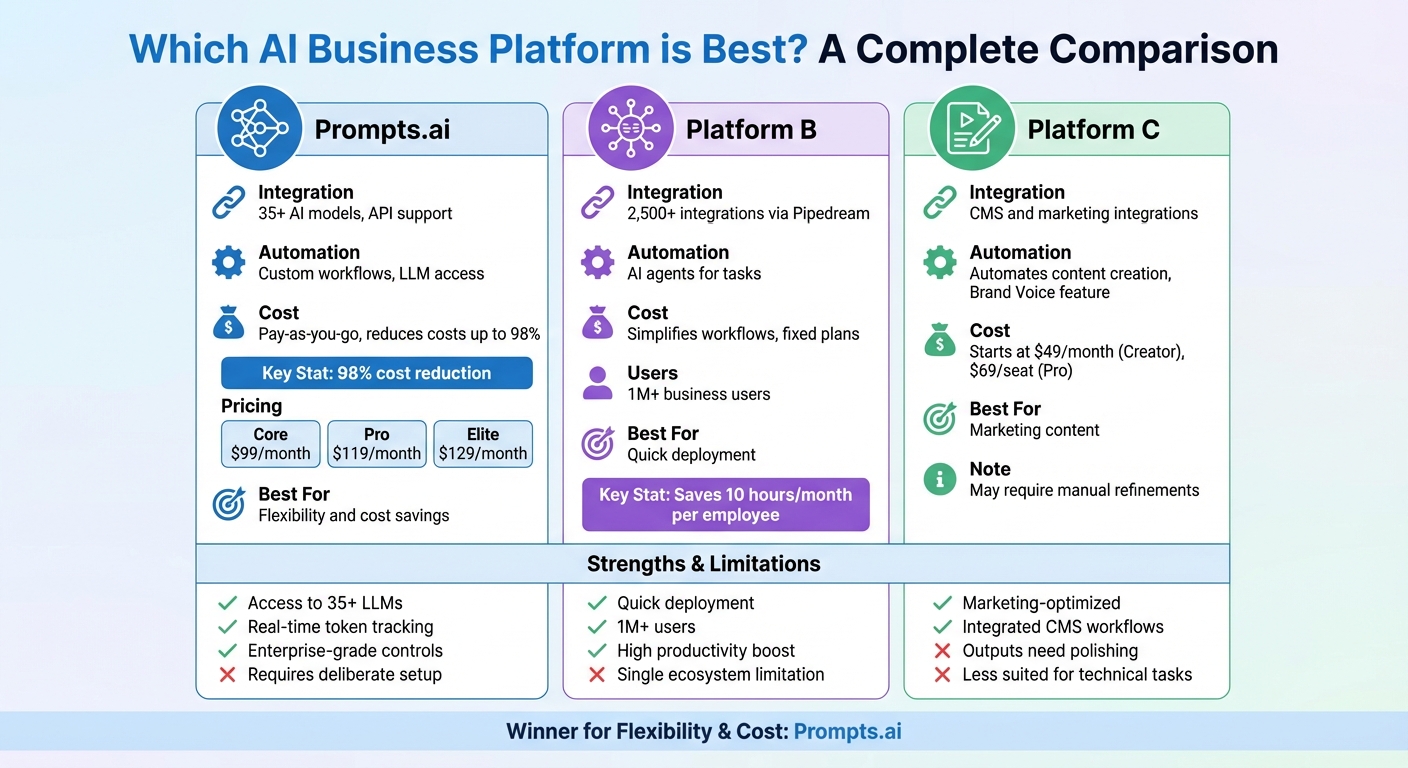
AI Business Platform Comparison: Prompts.ai vs Platform B vs Platform C
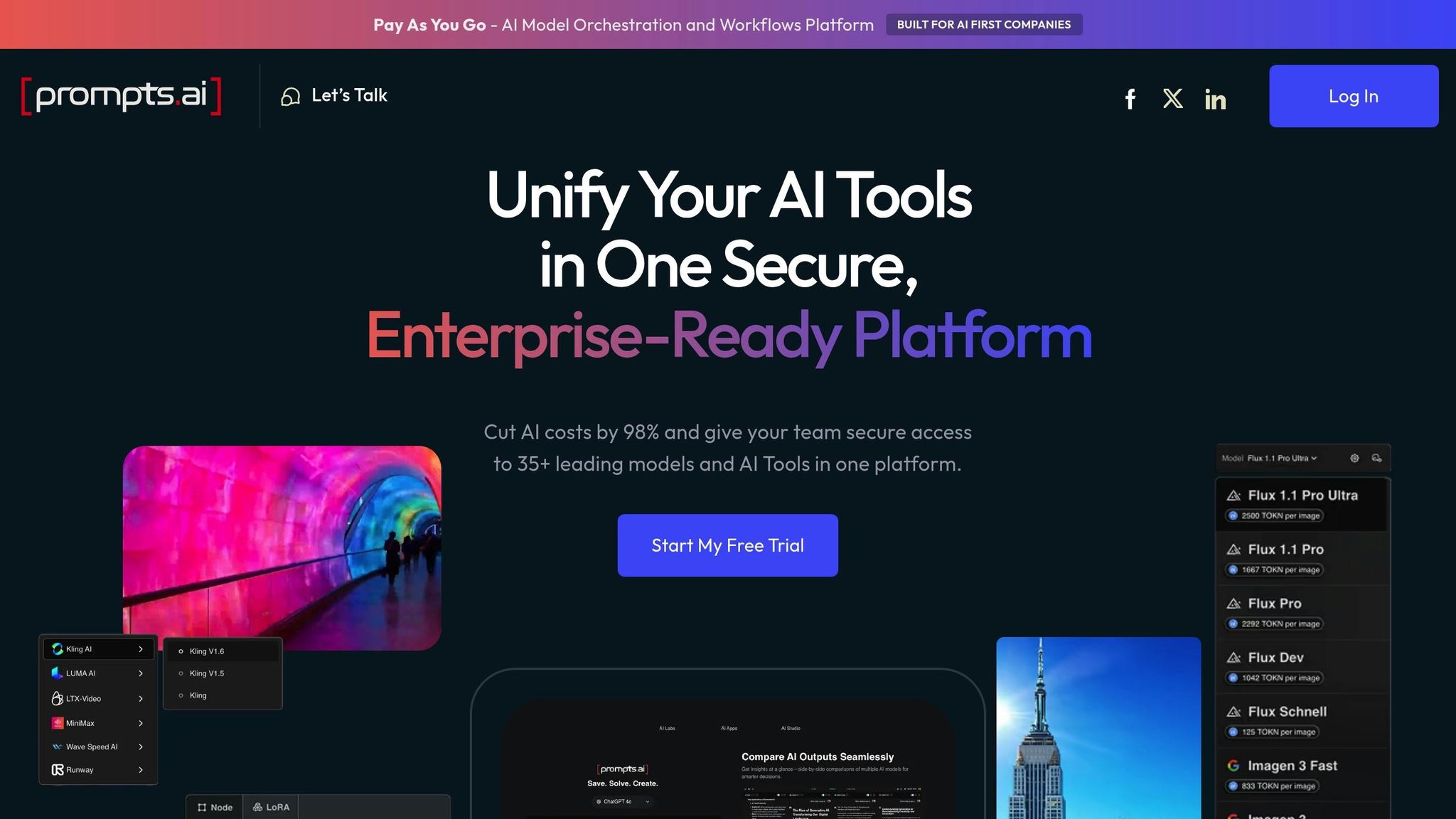
Prompts.ai simplifies the way businesses interact with AI by connecting to over 35 leading AI models and tools through one secure, centralized interface. By doing so, it eliminates the need to juggle multiple platforms. The platform integrates seamlessly with widely-used business tools like Slack, Gmail, and Trello, allowing teams to automate workflows without the hassle of switching between applications. This streamlined setup addresses the issue of tool sprawl, a challenge many US businesses face as it can lead to fragmented data and delays in decision-making.
To ensure smooth integration, Prompts.ai supports standard authentication methods such as OAuth and API keys, making it compatible with enterprise setups on AWS, Azure, or Google Cloud. Its Business AI plans - Core ($99/month), Pro ($119/month), and Elite ($129/month per member) - offer powerful workflows that sync customer records from CRMs, trigger actions in project management tools, and route data across departments, all without requiring custom coding.
Prompts.ai turns repetitive tasks into scalable, AI-powered processes that save time and resources. It offers pre-built workflows, branded as "Time Savers", while also allowing users to create custom automation flows without needing extensive engineering support. In 2025, Steven Simmons, CEO & Founder, shared his experience:
With Prompts.ai's LoRAs and workflows, he now completes renders and proposals in a single day - no more waiting, eliminating delays from hardware limitations.
Similarly, Frank Buscemi, CEO & CCO, has used the platform to streamline content creation and automate strategic workflows. This has freed his team to focus on higher-level goals while maintaining their creative edge. Users can also build AI Agents and train custom LoRA models to tackle tasks like lead qualification, ticket triage, proposal drafting, and contract reviews.
Prompts.ai provides a single interface to access leading language models, including GPT-5, Claude, LLaMA, Gemini, and Grok-4. This flexibility lets US businesses choose models tailored to their specific needs - whether for complex financial workflows requiring advanced reasoning or for high-volume customer communications that prioritize speed and cost-effectiveness. Additionally, the platform allows side-by-side comparisons of different LLMs, helping teams make informed decisions about the best model for each task.
Ar. June Chow, Architect, highlighted the benefits:
Comparing LLMs side by side on prompts.ai enables her to execute complex projects and explore innovative concepts.
This multi-model functionality supports a wide range of tasks, from AI-assisted document summarization and email drafting to policy analysis and customer support. All of this is backed by enterprise-grade security, meeting SOC 2 Type II, HIPAA, and GDPR compliance standards.
Prompts.ai claims to reduce AI costs by up to 98% and consolidate over 35 separate AI tools, cutting expenses by as much as 95%. The platform operates on a Pay As You Go TOKN credit system, which eliminates recurring fees and ensures that costs are tied directly to actual usage. For US businesses looking to maximize ROI, this means transforming fixed software costs into scalable, on-demand efficiency.
In 2025, Mohamed Sakr, Founder of The AI Business, shared how he used Prompts.ai's Time Savers to automate sales, marketing, and operations. This led to significant improvements in lead generation and overall productivity. With pricing options ranging from $0/month for exploratory users to $129/month per member for creative teams, Prompts.ai provides a transparent and predictable cost structure, making it easier for organizations to scale their AI initiatives.
Lindy connects businesses to an impressive network of 2,500 integrations through Pipedream, bringing together tools ranging from CRM systems to project management software. This allows U.S. companies to design complex automations without the hassle of switching between apps. For businesses with unique needs, Lindy also provides API access, enabling seamless connections to existing tech stacks across major cloud platforms. This extensive connectivity serves as a solid base for automating even the most intricate workflows.
With Lindy, multi-step processes are handled effortlessly by custom AI agents. These agents take on tasks like data entry and customer communication, simplifying operations while ensuring consistency in environments that handle large volumes of work.
While details about specific LLM integrations aren't outlined, Lindy's agent-based design hints at compatibility with language models. This likely enhances its automation capabilities across a variety of business functions.
Beyond its technical capabilities, Lindy delivers strong cost efficiency. By consolidating thousands of integrations into a single platform, it minimizes the time spent on manual tasks and reduces the reliance on multiple tools. This approach significantly improves operational efficiency.
Jasper connects seamlessly to existing systems through APIs and CMS integrations, making it easy for marketing teams to stay within their familiar workflows. Designed specifically with marketers in mind, these integrations ensure that teams can produce content aligned with their brand guidelines without unnecessary complexity or disruption to their processes.
Jasper streamlines marketing efforts by automating tasks like creating blogs, emails, product descriptions, SEO content, and social media posts. Its Brand Voice feature adapts to and maintains a company’s tone across all content, ensuring consistency. Collaboration tools, such as version control and commenting, further enhance team efficiency and quality control. As Omid G from MarketerMilk points out:
Jasper's natural language processing is perhaps best seen as a tool to create early drafts for later polishing by human copywriters.
Jasper’s pricing begins at $49 per month for the Creator plan, designed for single users, and $69 per seat per month for the Pro plan, which is tailored for team use. For businesses requiring advanced features like single sign-on, analytics, and greater administrative controls, custom pricing is available through the Business plan. While the platform excels in scalability and maintaining brand consistency, its outputs may still require final refinements by human editors, making it a strong choice for organizations focused on delivering polished, on-brand messaging.
Based on our evaluations, here’s a closer look at the strengths and limitations of each platform, particularly in terms of interoperability and workflow automation. Each option offers distinct advantages and trade-offs depending on specific business goals.
Prompts.ai is designed to simplify AI operations by consolidating access to over 35 LLMs within a single interface. Its built-in FinOps layer provides real-time tracking of token usage, enabling businesses to cut AI expenses by as much as 98% through a pay-as-you-go TOKN credit model. Additionally, features like the Prompt Engineer Certification program and expertly crafted workflows make it easier to onboard teams of any size. However, organizations preferring a vendor-managed, plug-and-play solution may find the platform’s flexibility requires more hands-on configuration.
Platform B stands out for its quick deployment, already serving over 1 million business users. According to Microsoft, its Copilot feature can save employees an average of 10 hours per month on repetitive tasks, making it a strong choice for teams aiming to boost productivity immediately. On the flip side, its reliance on a single ecosystem may pose challenges for businesses requiring integrations with additional models or custom functionalities.
Platform C excels in content creation, thanks to its integrated CMS capabilities, which streamline marketing workflows. However, outputs might need some human refinement, and its focus on marketing could limit its usefulness for highly technical or analytical tasks.
Here’s a summary of the platforms’ strengths and limitations:
| Platform | Key Strengths | Primary Limitations |
|---|---|---|
| Prompts.ai | Access to 35+ LLMs; real-time token tracking; cost reductions; pay-as-you-go pricing; enterprise-grade controls | Requires deliberate setup |
| Platform B | Quick deployment; serves 1M+ users; boosts productivity significantly | Limited flexibility due to reliance on a single ecosystem |
| Platform C | Optimized for marketing with integrated content workflows | Outputs may need human polishing; less suited for technical tasks |
Selecting the right AI business platform comes down to aligning its capabilities with your organization's unique requirements - whether that's seamless integration with enterprise systems or support for creative and analytical workflows.
Prompts.ai emerges as a compelling choice for businesses prioritizing flexibility and cost efficiency. Its unified platform addresses common pain points like tool overload and unpredictable expenses. With the pay-as-you-go TOKN credit system, organizations can reduce AI costs by up to 98%, offering a scalable solution for expanding AI operations without breaking the budget.
What sets Prompts.ai apart is its robust integration features and dedicated FinOps layer, ensuring your AI strategy evolves alongside advancements in technology. This approach eliminates the risk of being tied to one ecosystem or needing a complete tool overhaul. Such flexibility is particularly beneficial for businesses exploring various AI models for tasks like content creation or in-depth technical analysis.
For enterprises aiming to maximize returns, Prompts.ai delivers a comprehensive platform that combines access to multiple models, enterprise-level governance, and clear cost management. This aligns perfectly with the broader goal of creating interoperable workflows and integrating seamlessly with diverse AI tools, offering the infrastructure needed for efficient and scalable AI deployment.
Prompts.ai enables businesses to slash AI expenses by up to 98% through its all-in-one platform, which integrates more than 35 top AI models and tools. By bringing everything together in one place, it eliminates the hassle of juggling multiple disconnected tools, streamlining processes and cutting down on wasted time and resources.
The platform goes a step further by intelligently managing resource allocation, ensuring you’re only charged for what you actually use. All of this is delivered with enterprise-level security and the ability to scale, making it a smart and budget-friendly choice for companies of any size.
Prompts.ai transforms workflow automation by providing secure access to more than 35 top AI models and tools all in one place. This eliminates the hassle of managing multiple platforms, cutting down on complexity and freeing up valuable time.
With Prompts.ai, businesses can realize up to 98% savings on AI-related expenses while building scalable and efficient workflows designed for enterprise demands. Its emphasis on integration and compatibility ensures your operations stay streamlined and prepared for what’s next.
Prompts.ai offers a streamlined way to integrate with a diverse array of AI models and business tools, all through a secure, unified platform. With access to over 35 cutting-edge AI models, including GPT, Claude, LLaMA, and Gemini, users can manage everything from one convenient interface.
The platform is designed to simplify complex workflows by enabling orchestration, automation, and governance across various AI systems. This makes it easier for businesses to efficiently deploy and oversee models such as Stability AI, Google Vertex AI, OpenAI, Meta, Anthropic, Cohere, and Flux AI, all within a scalable and cohesive ecosystem.