Pay As You Go - AI Model Orchestration and Workflows Platform



AI orchestration simplifies managing complex workflows by unifying tools, models, and data for seamless integration and scalability. Without it, organizations face high costs, fragmented systems, and inefficiencies. By automating tasks, ensuring governance, and optimizing resources, orchestration transforms isolated AI efforts into coordinated, cost-effective solutions.
Key Benefits:
Platforms like Prompts.ai consolidate access to 35+ leading models (e.g., GPT, Claude), enabling teams to compare performance, manage costs, and enforce governance - all from one interface. Whether you're piloting AI or scaling across departments, orchestration ensures reliable, scalable, and efficient AI operations.
AI orchestration refers to the organized and automated management of various AI components - such as models, data pipelines, infrastructure, and AI agents - working together seamlessly across different systems and environments. Think of it like a conductor leading an orchestra, ensuring every instrument plays in harmony to deliver a unified performance.
Rather than managing AI models as separate entities, orchestration connects systems and services, enabling them to share context and align with broader business goals. Technologies like APIs, cloud platforms, large language model frameworks, and vector databases make this integration possible, creating a more fluid and context-aware AI ecosystem.
For enterprises, AI orchestration transforms scattered AI tools into a single, cohesive platform. Instead of navigating disconnected applications, teams can streamline data flows, cutting down inefficiencies and eliminating the need for manual data transfers between isolated systems.
The market for AI orchestration platforms is booming, with projections estimating it will reach $48.7 billion by 2034, growing at an annual rate of 23.7%. Organizations adopting orchestration report workflow improvements of 20–30% and see returns on investment (ROI) ranging from 300% to 800% within the first year.
"The teams struggling most aren't those without AI tools; they're the ones drowning in them. The solution isn't fewer tools; it's smarter orchestration."
- Omar, Strategic Problem-Solver, Euryka AI
Below, we’ll explore the essential components that make AI orchestration a game-changer for managing your AI ecosystem.
AI orchestration relies on four main elements that work together to create a seamless system:
Mid-to-large enterprises often face challenges that AI orchestration is uniquely equipped to solve. The widespread use of disconnected AI tools can lead to "tool sprawl", resulting in brand inconsistencies, fragmented workflows, and integration hurdles. Employees may waste valuable time manually transferring data between systems, losing essential context along the way.
Operating in silos also increases compliance risks, making it harder to enforce consistent policies for data privacy, security, and regulatory standards. AI orchestration addresses these issues by streamlining integration and centralizing oversight, reducing vulnerabilities.
Operational inefficiencies, such as excessive manual oversight and performance monitoring, can further hinder innovation. By automating the AI lifecycle - from development to monitoring - organizations can ensure consistent performance, avoid model drift, and adopt modular architectures that allow for easy updates or replacements without disrupting existing workflows.
Additionally, AI orchestration empowers teams with self-service capabilities. Automating repetitive tasks and enabling on-demand access to environments and workloads helps businesses scale from isolated AI experiments to comprehensive, organization-wide solutions.
Scaling AI operations involves more than just increasing capacity - it's about smartly managing resources to handle growth effectively. AI orchestration brings together models, tools, and workflows, streamlining deployment, integration, and governance. This coordination ensures that AI systems can scale efficiently while maintaining security and reliability. By dynamically allocating resources as needs shift, orchestration platforms keep operations running smoothly and adapt to changing priorities.
According to Gartner, over 90% of CIOs identify cost as a key obstacle to AI success. AI orchestration addresses this challenge by reducing inefficiencies, curbing resource sprawl, and maximizing value. Automating the entire AI lifecycle - from data input to ongoing monitoring - removes manual tasks, ensures consistent processes, and scales workflows effortlessly as demands grow. This approach not only simplifies operations but also delivers measurable improvements in cost management and performance.
AI orchestration enhances scalability by optimizing computing power, storage, and human resources. Tasks are scheduled effectively, reusable components are leveraged, and workflows are automated, all of which contribute to better system performance. Instead of relying on fixed infrastructure that often sits idle during low-demand periods, orchestration platforms support cloud and hybrid environments. This allows businesses to scale computing capacity as needed, avoiding unnecessary hardware expenses.
The benefits go beyond infrastructure. Orchestration enables organizations to seamlessly integrate new AI tools and models into existing workflows, keeping up with technological advancements. This adaptability allows businesses to experiment with new models, data sources, or algorithms without significant operational risks. Modular architectures further enhance this flexibility by breaking down systems into independent components. These modules can be updated individually, reducing vendor lock-in and ensuring smooth communication between various tools.
Uncontrolled AI spending can quickly derail even the most promising projects. AI orchestration tackles this issue by implementing real-time monitoring and dynamic resource allocation. This ensures that computational costs are kept in check while optimizing model performance, system health, and resource usage.
Efficient collaboration and centralized governance are critical for scaling AI across an organization. Managing complex AI ecosystems with isolated models can lead to inefficiencies and compliance risks. AI orchestration solves this by integrating diverse models - such as language models, computer vision systems, and conversational AI - into a unified framework. This approach keeps AI systems organized, compliant, and aligned with overarching business objectives.
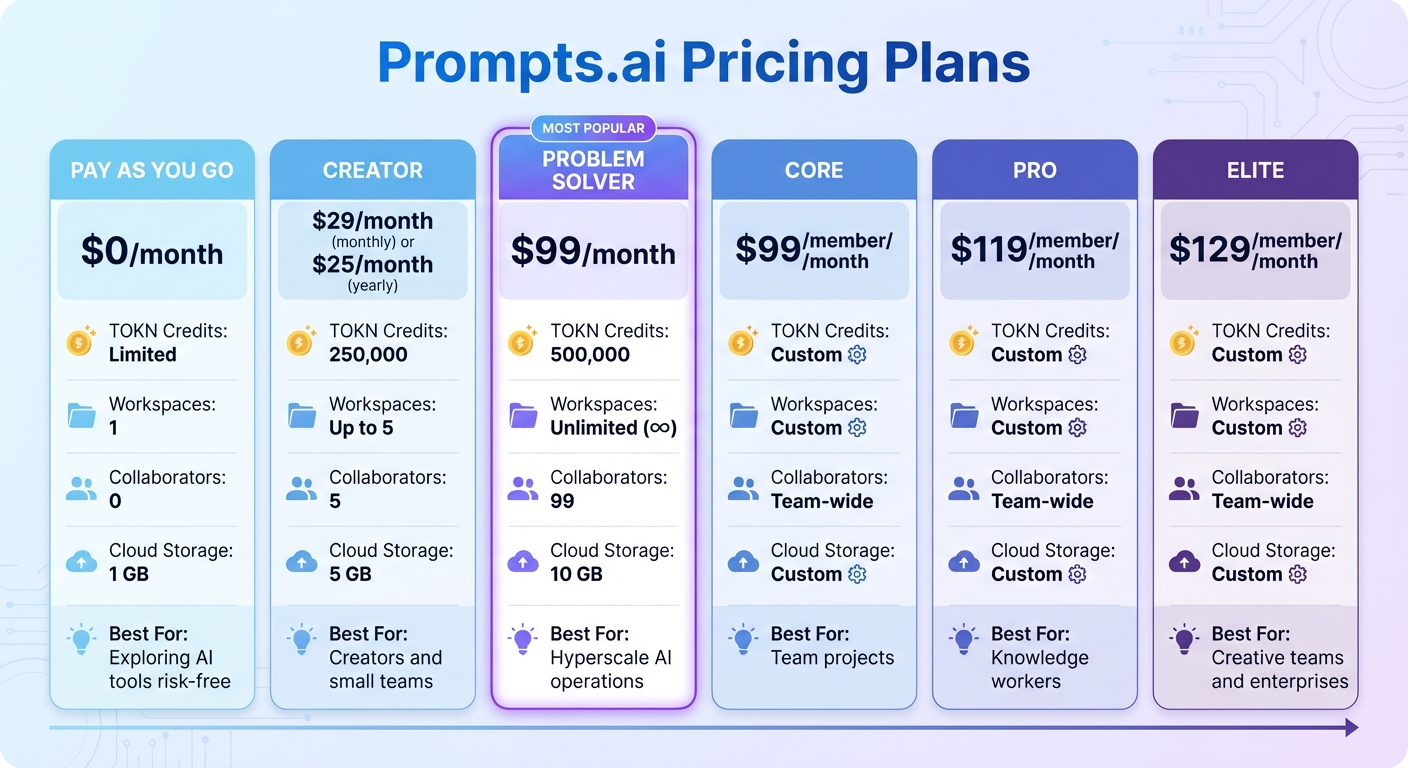
Prompts.ai Pricing Plans Comparison: Features and Costs
Prompts.ai takes the complexity out of managing AI workflows, offering a streamlined solution for organizations aiming to scale their AI operations effectively.
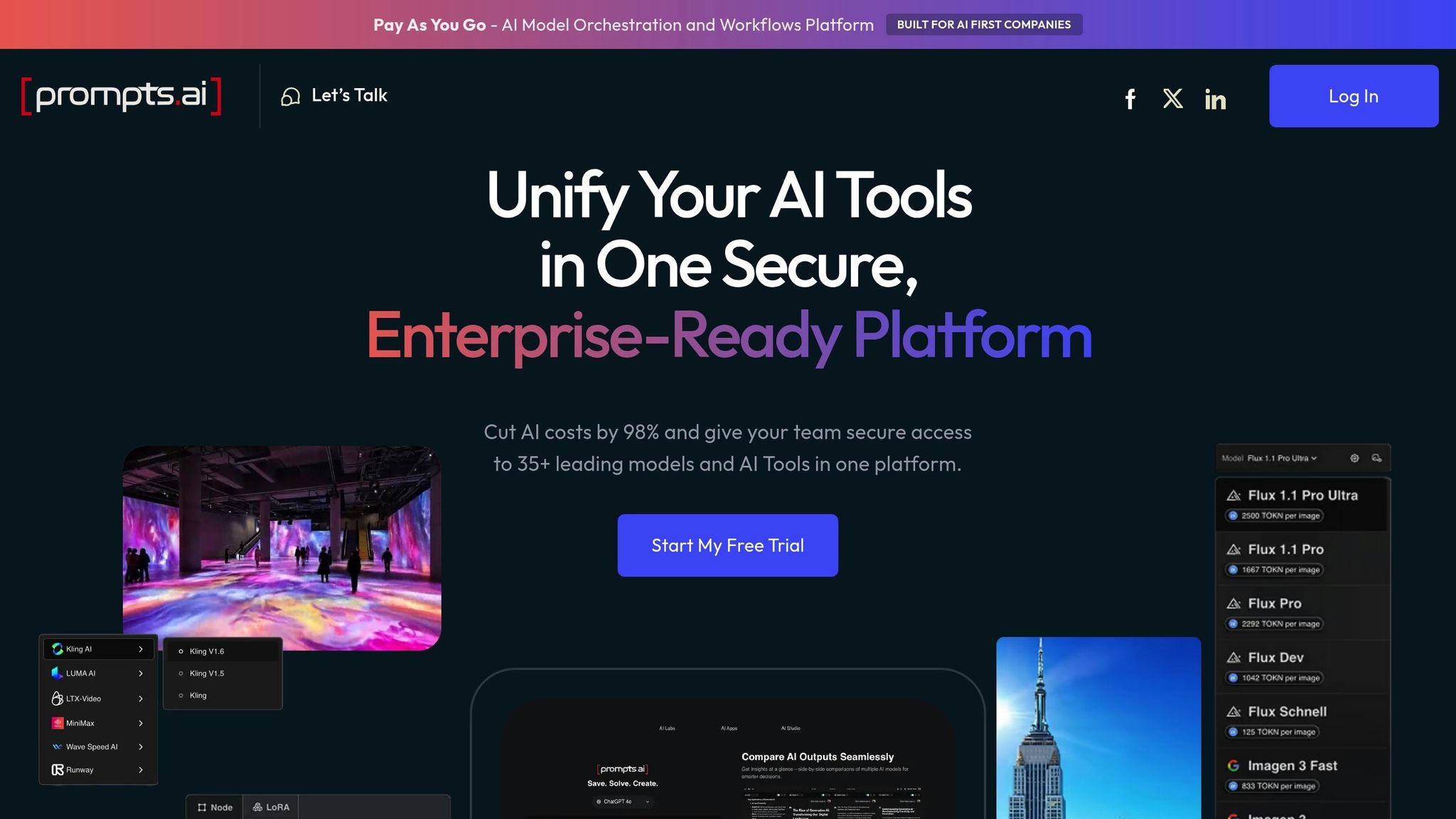
At its core, Prompts.ai is an AI orchestration platform that consolidates access to over 35 leading language models - such as GPT, Claude, LLaMA, and Gemini - into one secure and easy-to-use interface. Forget juggling multiple vendor accounts, API keys, or billing systems. With Prompts.ai, you can route traffic, compare model performance, and manage governance all from a single control panel. This unified approach simplifies operations and can cut AI costs by up to 98%, replacing scattered subscriptions with a system that tracks every token and workflow.
The platform acts as a central hub, allowing seamless integration of various models without the need to rewrite applications. Organizations can set routing rules to optimize costs - sending simpler tasks to lower-cost models and reserving more complex queries for advanced ones. A/B testing tools make it easy to compare latency, cost, and quality across different models, ensuring teams can adapt quickly to new advancements while avoiding vendor lock-in.
Prompts.ai provides a unified API for managing multiple models, enabling teams to register providers, switch between versions, and compare outputs without the hassle of additional integrations. Its prompt workflows allow users to chain prompts, tools, and APIs into automated processes that scale effortlessly.
Governance is at the heart of Prompts.ai, with built-in policies for model usage, data access, and role-based permissions. Real-time FinOps tracking offers detailed cost insights - broken down by user, team, workflow, and model - displayed in U.S. dollars (e.g., $1,250.50). Performance dashboards present key metrics like accuracy, latency, usage volume, and failure rates, helping teams fine-tune quality and efficiency.
The platform also integrates seamlessly with tools like Slack, Gmail, and Trello, enabling teams to connect workflows to their existing systems in seconds without disrupting daily operations.
These features pave the way for pricing plans tailored to meet a variety of organizational needs.
Prompts.ai offers flexible plans designed for individuals and businesses of all sizes:
| Plan | Price (USD) | TOKN Credits | Workspaces | Collaborators | Cloud Storage | Best For |
|---|---|---|---|---|---|---|
| Pay As You Go | $0/month | Limited | 1 | 0 | 1 GB | Exploring AI tools risk-free |
| Creator | $29/month (monthly) $25/month (yearly) |
250,000 | Up to 5 | 5 | 5 GB | Creators and small teams |
| Problem Solver | $99/month | 500,000 | Unlimited | 99 | 10 GB | Hyperscale AI operations |
| Core | $99/member/month | Custom | Custom | Team-wide | Custom | Team projects |
| Pro | $119/member/month | Custom | Custom | Team-wide | Custom | Knowledge workers |
| Elite | $129/member/month | Custom | Custom | Team-wide | Custom | Creative teams and enterprises |
The Pay As You Go plan is perfect for individuals experimenting with workflows, while the Creator plan is ideal for power users managing multiple prompts. For businesses, the Core, Pro, and Elite plans offer advanced features such as analytics, team management tools, enhanced SLAs, and enterprise-level options like SSO/SAML and volume discounts. Organizations can estimate their monthly usage - considering requests, tokens, active users, and compliance needs - to select the plan that fits their requirements.
Prompts.ai is designed with governance and compliance in mind, addressing the regulatory and risk concerns critical for U.S. enterprises. Its secure workflows include encryption in transit and at rest, role-based access control, and environment segregation (dev/test/prod). The platform also ensures the secure handling of personally identifiable information (PII), supporting compliance with regulations such as HIPAA for healthcare and SOX for finance.
Policy-based controls allow organizations to enforce data retention limits, restrict certain datasets to specific models, and require approvals for high-risk workflows. Audit trails provide detailed logs of prompt usage, timing, model details, and outputs, ensuring accountability. Prompts.ai aligns with frameworks like SOC 2 Type II, HIPAA, and GDPR. The company began its SOC 2 Type 2 audit process on June 19, 2025, with continuous monitoring through Vanta.
Prompts.ai has received an average user rating of 4.8 out of 5 and is recognized by GenAI.Works as a leading platform for enterprise problem-solving and automation.
Architect Ar. June Chow shared, "comparing different LLM side by side on Prompts.ai allows her to bring complex projects to life while exploring innovative, dreamlike concepts." Steven Simmons, CEO & Founder, added, "with Prompts.ai's LoRAs and workflows, he now completes renders and proposals in a single day - no more waiting, no more stressing over hardware upgrades."
Scaling AI workflows effectively calls for careful cost management, strong collaboration, and consistent performance evaluation. By adopting these strategies, organizations can transform Prompts.ai into a powerful tool for growth, avoiding unnecessary expenses or fragmented efforts.
Managing costs starts with visibility. Use centralized dashboards to track AI spending by workspace, project, model provider, and department, all reported in U.S. dollars. Align these reports with daily, weekly, or monthly financial cycles, enabling finance teams to reconcile AI expenses alongside broader cloud and SaaS budgets. To avoid budget surprises, set monthly spending caps for projects and teams, with automated alerts triggered at 75%, 90%, and 100% thresholds. This approach ensures flexibility for critical usage spikes while keeping finances in check.
Efficiency comes from tailoring model usage to the task. Assign simpler tasks - like data formatting, classification, or extraction - to smaller, more affordable models. Save the more advanced models for complex reasoning that justifies their higher token costs. Streamline prompts by eliminating redundant instructions, tightening context windows, and caching reusable system messages to reduce token consumption. Prompts.ai's A/B testing tools make it easy to compare different prompt or model setups for the same workflow, helping you measure cost per successful outcome and make informed decisions.
Once costs are under control, collaboration becomes the next step to boost workflow efficiency.
Collaboration is key to scaling AI workflows. Instead of starting from scratch, explore Prompts.ai's community for pre-vetted prompt templates and workflow blueprints tailored to common use cases like IT help desk responses, HR FAQs, sales email drafts, or knowledge searches. Build internal libraries of these community-sourced prompts, ensuring they are reviewed by in-house experts for security, tone, and compliance. Promote these as the go-to starting points for new projects.
Assign clear roles within your team: business leaders define objectives, prompt engineers design workflows, IT teams handle integrations, and finance oversees budgets. Create shared workspaces for major business areas like "Customer Support Automation" or "Sales Enablement", enabling cross-department collaboration while maintaining proper access controls. Regular biweekly sessions allow teams to review performance metrics, cost trends, and user feedback, ensuring priorities are aligned and potential issues are addressed early.
Set clear key performance indicators (KPIs) such as success rate, response time, escalation rate, and user satisfaction, and monitor these metrics over time. Tie these technical KPIs to business outcomes - for example, reducing average handling times for IT tickets, improving first-contact resolution rates, or increasing revenue per automated sales interaction. These insights help determine whether a workflow deserves further investment or needs adjustments.
Keep a close eye on performance during high-demand periods, such as Monday mornings or busy holiday seasons in the U.S., to identify scalability limits and adjust concurrency settings as needed. If metrics show issues like higher error rates or slower response times, use Prompts.ai's version history and evaluation tools to pinpoint and resolve problems. Adopt a structured change management process to review, test, and document updates to prompts, workflows, or model routing. Develop evaluation suites with test cases and expected outcomes for critical workflows, and rerun them after every change to catch potential regressions early.
Scaling AI operations doesn't have to mean juggling disconnected tools, unpredictable expenses, or compliance headaches. AI orchestration simplifies the chaos, turning fragmented pilots into enterprise-wide workflows that evolve alongside your business. By unifying models, data pipelines, and governance, orchestration platforms break down silos, streamline deployment and scaling, and tie AI investments directly to measurable business outcomes.
The future of AI adoption is clear. Gartner estimates that over 33% of daily operational decisions will be autonomously handled by intelligent agents by 2028, a sharp rise from almost none in 2024. Similarly, Capgemini predicts a 48% surge in AI agent projects within the average organization by 2025. Companies leveraging orchestration and automation already report 30–50% reductions in deployment times and the ability to implement multi-model pipelines up to 5× faster compared to manual processes. These efficiencies lead to quicker results, reduced costs, and the flexibility to experiment and scale new use cases without overhauling existing infrastructure.
Prompts.ai brings these advantages together in one comprehensive platform. With access to over 35 top-tier AI models, real-time FinOps dashboards for tracking costs in U.S. dollars, centralized compliance tools, and a collaborative network of prompt engineers, Prompts.ai transforms fixed AI costs into scalable, on-demand solutions. Whether you're piloting a single workflow or deploying AI across multiple departments, the platform's modular design and enterprise-level controls make it easy to add models, users, and teams - while keeping costs predictable.
Using Prompts.ai as your orchestration hub simplifies the process of embedding AI into your strategic operations. To maximize the benefits, align orchestration with your business objectives, adopt a phased rollout (assess, pilot, scale), prioritize governance from the start, and encourage collaboration between IT, data teams, and business leaders. By integrating cost tracking, performance monitoring, and compliance into every workflow, you transform AI from a series of disconnected experiments into a strategic asset that drives real competitive advantage. In a world where success hinges not on the number of AI models you deploy, but on how effectively you manage them, Prompts.ai equips your organization to scale with confidence, precision, and measurable results.
AI orchestration enables businesses to grow by efficiently managing and integrating complex workflows across various AI models and systems. It ensures resources are allocated dynamically, allowing organizations to handle increasing workloads without sacrificing performance or efficiency.
By automating routine tasks and optimizing how resources are used, AI orchestration cuts operational costs and reduces the reliance on manual processes. This approach speeds up solution deployment, improves model management, and ensures consistent, reliable outcomes - all while keeping costs under control.
AI orchestration solutions are built around three core elements that work in harmony to simplify workflows and enhance operational efficiency:
Together, these elements enable organizations to handle complex processes with ease, scale operations, and achieve better performance.
Prompts.ai provides a secure, enterprise-ready platform that prioritizes governance and compliance. It’s built to help organizations enforce internal policies, manage access effectively, and adhere to strict security protocols.
With seamless integration into your existing systems, the platform simplifies centralized oversight of AI tools and models. This ensures transparency and accountability, making it easier for organizations to meet regulatory standards while maintaining confidence in their AI-powered operations.