Pay As You Go - AI Model Orchestration and Workflows Platform



AI workflows are evolving. By 2026, 75% of enterprises will integrate generative AI, making prompt engineering a key business need. Mature prompt management boosts efficiency, enabling teams to deliver AI features up to 4× faster, reduce deployment time by 60%, and avoid higher costs by 30–50%.
Here are the top platforms driving this transformation:
Each platform addresses unique needs, from compliance to collaboration, enabling teams to scale AI efficiently.
Quick Comparison
| Platform | Best For | Key Features | Cost Optimization | Integration Options |
|---|---|---|---|---|
| prompts.ai | Enterprises, creative teams | Unified model access, governance, LoRA tools | TOKN credits; up to 98% savings | 35+ LLMs, Slack, Gmail, API |
| LangChain | AI engineers, Python teams | Multi-step agents, LangSmith debugging | Free tier; managed cloud | 1,000+ integrations, SDK |
| PromptLayer | Cross-functional teams | Visual CMS, A/B testing, observability | Free plan; Pro at $50/month | Model-agnostic middleware |
| OpenPrompt | NLP researchers, SaaS teams | Modular framework, structured workflows | Free under MIT license | Hugging Face, 50ms latency |
Choose based on your team’s structure, goals, and integration needs.

AI Prompt Engineering Platforms Comparison 2026: Features, Costs & Best Use Cases
Prompts.ai is a robust platform designed to bring over 35 AI models - like GPT, Claude, LLaMA, and Gemini - into one secure and unified system. It simplifies operations by replacing dozens of disconnected tools in less than 10 minutes and can reduce AI-related costs by up to 98%.
This platform is ideal for creative professionals and enterprise teams. For instance, Steven Simmons, CEO & Founder, uses its LoRAs and automated workflows to complete renders and proposals in just one day. The Business Core plan, priced at $99 per member per month, focuses on compliance monitoring and governance for knowledge workers. Frank Buscemi, CEO & CCO, leverages it to streamline strategy workflows, allowing teams to focus on more critical, high-level tasks.
Prompts.ai offers a side-by-side LLM comparison tool, increasing productivity by 10× by enabling users to test multiple models simultaneously, sparking new design ideas. The integrated Image Studio allows for LoRA training and supports custom creative workflows. Since June 19, 2025, the platform has adhered to SOC 2 Type 2, HIPAA, and GDPR standards, making it suitable for regulated industries.
The platform seamlessly integrates with tools like Slack, Gmail, and Trello, ensuring automated task management around the clock. Its Interoperable Workflows maintain smooth processes even when switching between models, eliminating the hassle of managing multiple accounts or API keys. These integrations provide a foundation for flexible and efficient cost management.
Prompts.ai operates on a TOKN credit system. Personal plans start at $0 (Pay As You Go) and go up to $29 per month for 250,000 credits. Business plans begin at $99 per member monthly, featuring TOKN pooling. The Elite tier, priced at $129 per member monthly, includes 1,000,000 credits and offers a 10% discount for annual billing.
LangChain has become a global leader in AI tools, boasting 90 million monthly downloads and 100,000 GitHub stars. It focuses on "agent engineering", advancing beyond basic prompt design to manage complex, multi-step tasks with precision through specialized context handling.
LangChain is designed for AI engineering teams working in Python and TypeScript, as well as enterprises needing solutions that meet compliance standards. Companies like Replit, Clay, Rippling, Cloudflare, and Workday use LangChain for advanced agent development. In January 2026, major telecom companies and a global hiring startup adopted LangChain to improve customer service and streamline onboarding processes.
LangChain supports over 1,000 integrations with models, tools, and databases, maintaining flexibility through its framework-agnostic design. It integrates seamlessly with platforms like OpenAI, Anthropic, CrewAI, Vercel AI SDK, and Pydantic AI. Features like dynamic prompt templates with runtime variables and an "open and neutral" design ensure developers can switch models or tools without reworking their core applications. Built on LangGraph, LangChain agents include options for persistence, "rewind" functionality, and human-in-the-loop steps for manual approvals. These integrations enable cost-effective and flexible deployments.
LangChain's framework is open-source and free under the MIT license. The LangSmith free plan allows for 5,000 traces per month to support debugging and monitoring needs. For growing teams, the Plus tier offers managed cloud infrastructure, while Enterprise tiers provide Hybrid and Self-hosted options for organizations with strict data residency requirements. LangSmith also adheres to HIPAA, SOC 2 Type 2, and GDPR compliance standards, making it a trusted choice for industries like healthcare and finance.
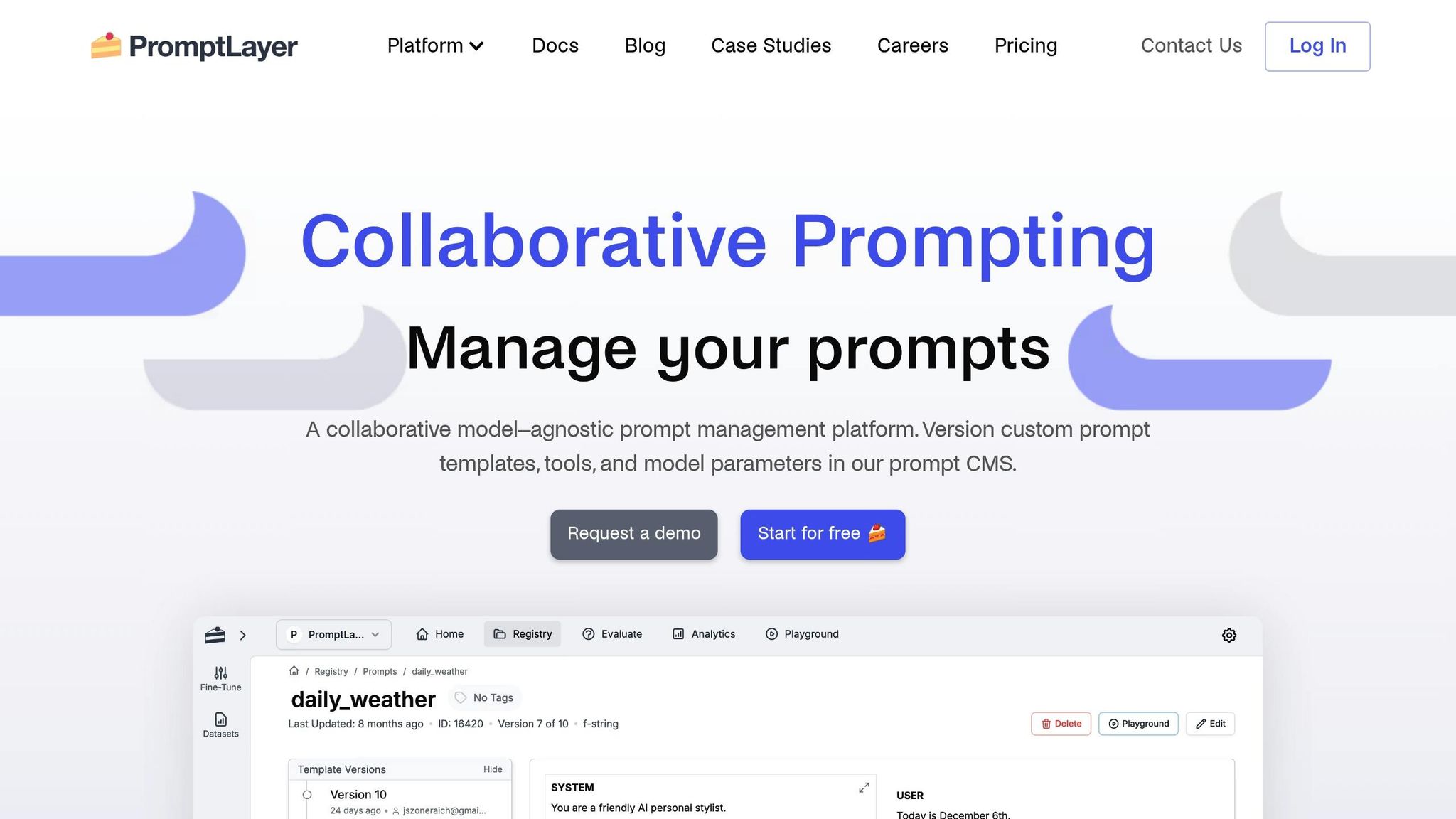
PromptLayer is a platform designed to simplify prompt management, bridging the gap between technical and non-technical teams. It caters to the growing need for agile AI workflows by enabling domain experts - like marketers, curriculum designers, clinicians, and writers - to refine prompts independently, without relying on engineering teams. With SOC 2 Type 2 compliance, it’s a reliable choice for organizations dealing with sensitive data.
PromptLayer is built for a wide range of users, including machine learning engineers, product managers, legal professionals, and content creators. By allowing non-technical users to focus on prompt refinement while engineers handle infrastructure, it fosters collaboration across teams. Companies such as Gorgias, ParentLab, Speak, and NoRedInk have adopted the platform to streamline their AI workflows. For example, NoRedInk, which supports 60% of U.S. school districts, leveraged PromptLayer’s evaluation tools to generate over a million AI-assisted student grades. This collaboration between curriculum designers and engineers ensured high-quality feedback for educators, demonstrating how the platform supports diverse needs.
PromptLayer offers a range of tools designed to improve prompt iteration and workflow efficiency:
gpt-4-vision-preview and offers flexible string parsing using "f-string" and "jinja2" templates for handling complex JSON scenarios."We iterate prompts dozens of times daily. It would be impossible to do this in a SAFE way without PromptLayer." - Victor Duprez, Director of Engineering, Gorgias
These features integrate seamlessly into existing workflows, ensuring smooth and consistent operations.
PromptLayer functions as model-agnostic middleware, sitting between application code and various LLM providers. It supports platforms like OpenAI, Anthropic (Claude), Google (Gemini), AWS Bedrock, Mistral, Cohere, Grok (xAI), and Deepseek. The platform also integrates with LangChain, supports the Model Context Protocol (MCP) for agent-based tasks, and is compatible with OpenTelemetry (OTEL) for observability. Access is available through Python/JS SDKs or a REST API, and enterprise customers can opt for on-premises deployment to meet strict data residency requirements.
PromptLayer includes usage analytics to monitor costs, latency, and token usage across models and prompt versions. This allows teams to identify inefficiencies before full-scale deployment.
At Speak, AI Product Lead Seung Jae Cha noted that PromptLayer reduced months of work to just a week, significantly cutting both time and costs. These features highlight the platform’s ability to deliver efficient and cost-conscious prompt engineering solutions.
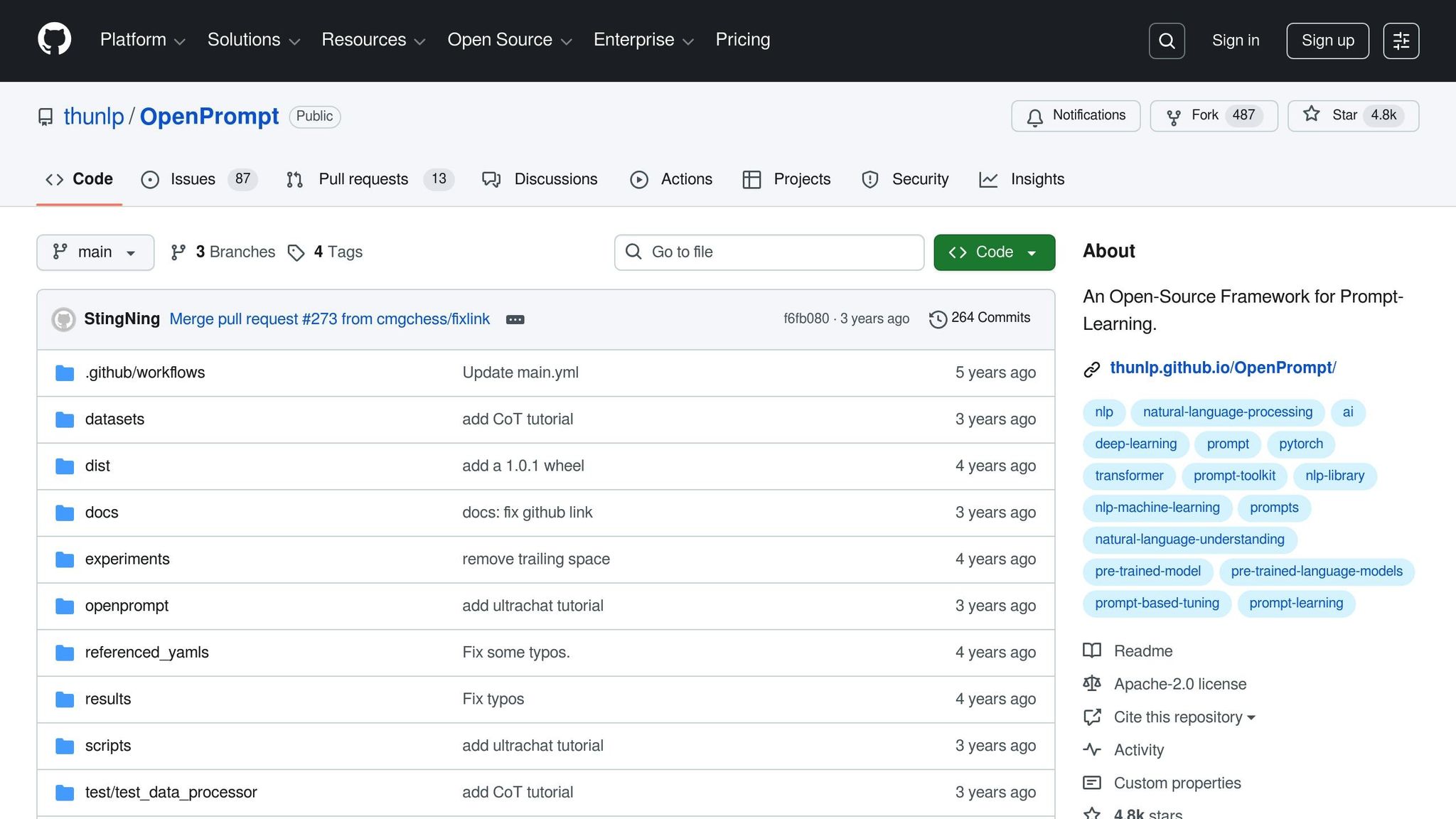
OpenPrompt takes a methodical approach to prompt engineering, treating it as a structured science rather than relying on guesswork. Originally created by THUNLP as an open-source research framework, it has since grown into a practical tool for teams looking to establish consistent, repeatable workflows for prompts. With over 3,993 stars on GitHub and 251 research citations, it bridges the gap between academic depth and practical usability.
OpenPrompt is designed for NLP researchers, AI engineering teams, and technical content strategists who need precise control over prompt updates. It’s especially useful for software development teams and SaaS companies aiming to separate prompt updates from code deployment cycles. For product leads and content strategists, the platform offers a straightforward visual interface, enabling them to refine AI behavior without requiring advanced coding skills. This structured approach to prompt management reflects the growing demand for disciplined AI workflows. Industries like research, academia, and content production benefit from the framework’s modular design, which supports rigorous evaluations and systematic development.
OpenPrompt relies on a four-layer architecture that processes user intent through an Intent Classifier, Structure Framework Selector, PromptIR™ Generator, and Final Prompt Constructor. Its PromptIR™ system transforms unstructured prompts into structured elements like roles, goals, contexts, constraints, and processes. This creates a centralized, consistent source of truth that can be deployed across multiple LLM providers, including OpenAI, Anthropic, and Qwen. The framework also supports provider-specific optimizations, allowing outputs to be tailored to formats like "GPT Style" (imperative, numbered lists) or "Claude Style" (collaborative, conversational flow). Teams can map intents to cognitive frameworks such as Chain of Thought (CoT), MECE, or SCQA for improved reliability. Additional features include version control with visual diffs, regression testing suites, and real-time multiplayer collaboration, making it a powerful tool for teams working on complex integrations.
Built as a PyTorch-based, model-agnostic framework, OpenPrompt works seamlessly with Masked Language Models (MLM), Autoregressive Models (LM), and Sequence-to-Sequence (Seq2Seq) architectures. It integrates directly with Hugging Face Transformers, enabling teams to incorporate pre-trained models into existing NLP workflows effortlessly. OpenPrompt supports major providers like OpenAI, Anthropic, Google Gemini, Mistral AI, Meta Llama, Groq, and Cohere through a single, unified interface. Developers can access the platform via a TypeScript SDK or a high-performance API, ensuring latency under 50ms and 99.9% uptime. Its modular design allows for flexible experimentation by letting users mix and match different PLMs, templates, and verbalizers.
OpenPrompt is released under the MIT License, making it free to use and modify for commercial purposes. The platform supports parameter-efficient prompt-only tuning, which updates only the prompt-related parameters rather than the entire model, significantly cutting computational costs. Teams have reported reducing iteration times by 40% by moving away from manual, spreadsheet-based prompt management. Pricing options include a Hobby plan at $0/month with 5 private prompts and 5,000 API calls, and a Pro plan at $20/month for 20 private prompts and 10,000 API calls. Enterprise teams can opt for custom pricing, which includes unlimited API access, SSO integration, and role-based access control. These features make it easier to scale deployments while keeping costs under control.
The benefits of each platform depend on factors like technical expertise, workflow demands, and budget constraints.
LangChain stands out for creating multi-step agent workflows with detailed execution insights. However, its reliance on manual dataset preparation can slow down production timelines. The table below highlights key comparisons.
PromptLayer simplifies prompt iteration with its visual CMS and Git-style version control, empowering domain experts to fine-tune AI behavior without needing engineers. On the downside, it lacks advanced tools for testing and deployment, particularly for orchestrating complex multi-agent systems.
Here’s a quick comparison of the platforms across critical aspects:
| Platform | Target Audience | Integration Capability | Cost Optimization | Main Features |
|---|---|---|---|---|
| prompts.ai | Enterprises & cross-functional teams | High (35+ LLMs, SDK, API) | Pay-as-you-go TOKN credits; up to 98% cost reduction | Unified model access, real-time FinOps, prompt workflows, compliance controls |
| LangChain | LangChain developers & AI engineers | High (Native LangChain, SDK) | Free tier; manual dataset curation required | Multi-step chains, autonomous agents, comprehensive tracing |
| PromptLayer | Cross-functional teams & domain experts | Moderate (REST API) | Free plan available; Pro at $50/month per user | Visual prompt registry, version control, no-code iteration |
Choosing the right platform hinges on your team's structure, expertise, and production goals. For engineering-heavy teams working on intricate, multi-step workflows, LangChain stands out with its modular design and support for autonomous agents. On the other hand, cross-functional teams that involve non-technical members might find visual interfaces more suitable. Platforms like prompts.ai offer access to over 35 leading large language models alongside real-time FinOps cost controls, while PromptLayer simplifies version control to reduce engineering delays.
In enterprise production settings, having a thorough evaluation framework and compliance certifications is critical. For organizations in regulated industries, prompts.ai's SOC 2 compliance and pay-as-you-go TOKN credits can significantly cut AI software expenses - up to 98% in some cases.
Integration capabilities also play a crucial role in a platform's success. Matching a platform's integration options, such as SDK support or compatibility with existing tools, to your workflow's maturity level is vital. Early-stage projects benefit from easy-to-use, low-barrier setups, whereas production-grade systems demand a more rigorous approach with strong evaluation and observability features.
Prompt engineering is the art of designing and refining prompts - the instructions given to large language models (LLMs) - to ensure they produce accurate and relevant results. This skill is crucial in AI workflows, as it directly impacts the quality and reliability of outputs, making AI-driven applications more effective.
The process includes techniques like iterative testing, adjusting for context, and fine-tuning prompts to minimize issues such as irrelevant answers or hallucinated information. Well-crafted prompts empower AI systems to handle a range of tasks, from content creation and data analysis to decision-making, boosting efficiency while reducing operational costs.
Mastering prompt engineering allows businesses and professionals to maximize the capabilities of AI models, simplifying workflows and delivering scalable, high-quality solutions.
Platforms like prompts.ai help businesses cut down on AI deployment costs by simplifying model management, automating key workflows, and offering real-time cost tracking. By bringing together multiple AI models - such as GPT-4, Claude, and Gemini - into a single, secure platform, they remove the hassle of managing separate systems. This consolidation not only reduces tool-related expenses but also eliminates inefficiencies tied to juggling multiple platforms.
These platforms also fine-tune prompt performance, which reduces the number of iterations required and conserves computational resources. With real-time cost monitoring, businesses can keep a close eye on spending, avoid exceeding budgets, and scale their AI workflows with confidence. Together, these features make it easier for organizations to implement AI systems efficiently while staying within budget.
When choosing an AI prompt engineering platform, businesses should focus on features that boost productivity, support collaboration, and ensure dependable performance. Tools for version control and team collaboration are particularly important, as they help track prompt changes, compare results, and enable smooth teamwork across teams.
Equally critical are automated testing and evaluation metrics, which help maintain prompt quality, reduce errors, and ensure consistent performance in production. Real-time monitoring is another key feature, allowing businesses to keep an eye on AI outputs, quickly identify issues, and maintain optimal performance levels.
To ensure seamless integration, look for platforms that work well with existing workflows, CI/CD pipelines, and observability tools. Additional features like multi-model support, cost tracking, and enterprise-level security are essential for scaling operations while staying compliant with industry standards. By prioritizing these capabilities, businesses can optimize their workflows, refine prompt performance, and achieve dependable AI-driven results.