Pay As You Go - AI Model Orchestration and Workflows Platform



Selecting the right AI platform is critical for balancing performance, cost, and scalability. Whether you're a solo developer or managing enterprise-level operations, this guide breaks down five top platforms - Prompts.ai, Google Cloud AI, Microsoft Azure AI, Amazon SageMaker, and IBM Watson Studio. Each offers unique tools, pricing models, and security features tailored to different needs. Here's what you need to know:
These platforms excel in key areas like cost flexibility, security compliance, and integration with large language models (LLMs). To choose the best fit, consider your project’s scale, budget, and specific requirements.
Quick Comparison:
| Platform | Model Access | Pricing Highlights | Security Features | Best For |
|---|---|---|---|---|
| Prompts.ai | 35+ models, unified UI | $29/month Creator Plan | SOC 2, ISO 27001, HIPAA | Small teams, startups |
| Google Cloud AI | 200+ models via Vertex | Pay-as-you-go, up to 57% off | Secure AI Framework (SAIF) | Enterprises, flexible scaling |
| Azure AI | 1,900+ models | Token-based, Batch API savings | 100+ compliance certifications | Broad industry applications |
| SageMaker | 150+ models, JumpStart | AI Savings Plans, 64% savings | VPC, PrivateLink, FIPS 140-3 | Large-scale training |
| Watson Studio | Granite models, APIs | $1,050/month Standard Plan | SOC 2, HIPAA, multicloud | Multicloud, enterprise teams |
Each platform offers unique strengths, from cost-saving plans to advanced security and scalability. Evaluate your priorities and test features to find the best match for your next AI project.

AI Platform Comparison: Features, Pricing, and Best Use Cases

Prompts.ai simplifies the process of working with multiple AI models. Instead of juggling various subscriptions and platforms, it provides access to over 35 top-tier AI models - including GPT, Claude, LLaMA, and Gemini - through a single, unified dashboard. This allows users to compare models side by side without the hassle of switching between tabs or managing multiple API keys.
The platform features a side-by-side comparison tool that lets you test the same prompt across several models at once. Architect June Chow highlights how this feature speeds up evaluation and encourages innovation. It takes the uncertainty out of choosing the right model for tasks like code generation, creative writing, or data analysis. Additionally, you can integrate these models with tools like Slack, Gmail, and Trello, transforming one-off experiments into repeatable workflows for your team.
Prompts.ai offers pricing plans tailored to various needs. The free Pay As You Go plan includes limited TOKN credits for testing the platform. For $29 per month, the Creator plan provides 250,000 TOKN credits and 5GB of storage. The Problem Solver plan, at $99 per month, offers 500,000 TOKN credits. Business plans start at $99 per member per month with the Core tier. By consolidating tools and sharing TOKN credits, organizations can cut AI costs by up to 98%. This cost reduction supports the platform's focus on enterprise-grade security.
Higher-tier plans, such as Business Core and above, include robust compliance and governance tools. These features allow you to monitor and audit all AI interactions across your organization, ensuring security and adherence to regulatory standards - an essential capability for businesses in highly regulated industries.
Prompts.ai is designed for easy scaling. Setup takes less than 10 minutes, and adding new workspaces, collaborators, or models doesn’t require major infrastructure changes.
"With Prompts.ai's LoRAs and workflows, he now completes renders and proposals in a single day - eliminating hardware upgrade delays." - Steven Simmons, CEO & Founder
The Business Elite plan is perfect for larger teams, offering unlimited collaborators and 1,000,000 TOKN credits per month. It’s ideal for everyone, from solo developers to Fortune 500 companies managing thousands of AI interactions daily.

Google Cloud AI revolves around Vertex AI, a platform that gives users access to more than 200 foundation models through its Model Garden. These include a mix of first-party, third-party, and open-source options like Gemini 3 and Llama 3.2, offering flexibility to choose models tailored to specific tasks without being tied to a single provider.
Vertex AI Studio acts as a central hub for experimenting with and refining generative AI models. It supports prototyping across text, image, video, and code while allowing adjustments to parameters before scaling up. Advanced customization is possible through methods like feedback loops and fine-tuning. Features like grounding and RAG ensure LLM outputs are tethered to real-time data from sources like Google Search or enterprise data stored in BigQuery or Cloud Storage, minimizing inaccuracies. For example, Snap saw a 2.5x boost in U.S. engagement for its "My AI" chatbot after utilizing Gemini's multimodal capabilities.
Google Cloud AI uses a pay-as-you-go pricing model, with Vertex AI billing in 30-second increments for training and predictions, and general VM instances charging per second. By opting for Committed Use Discounts, users can save up to 57% on one- or three-year commitments. For workloads that aren't time-sensitive, Spot VMs offer savings of up to 80% compared to on-demand rates. New customers receive $300 in free credits, while startups can qualify for up to $350,000 through the Google for Startups Cloud Program. Pricing for Gemini 3 text and chat generation starts at an affordable $0.0001 per 1,000 characters. These cost options are paired with strong security measures to ensure safe deployments.
Google's Secure AI Framework (SAIF) is built around six key principles for protection. Model Armor helps prevent injection attacks and data leaks by screening prompts and responses. Users can enhance security further with Customer-Managed Encryption Keys (CMEK) for data at rest and VPC Service Controls to set up secure boundaries that block data exfiltration.
"The accuracy of Google Cloud's generative AI solution and practicality of the Vertex AI Platform gives us the confidence we needed to implement this cutting-edge technology into the heart of our business." - Abdol Moabery, CEO, GA Telesis
Vertex AI combines secure and cost-effective features with MLOps tools like Model Registry, Vertex AI Pipelines (starting at $0.03 per run), and Model Monitoring to streamline operations. The Vertex AI Agent Builder enables users to create enterprise-level AI agents through no-code or low-code interfaces, simplifying the management of complex business tasks. With infrastructure powered by Google-designed TPUs and NVIDIA Grace Blackwell 200 GPUs, the platform ensures seamless scaling as organizational needs expand.
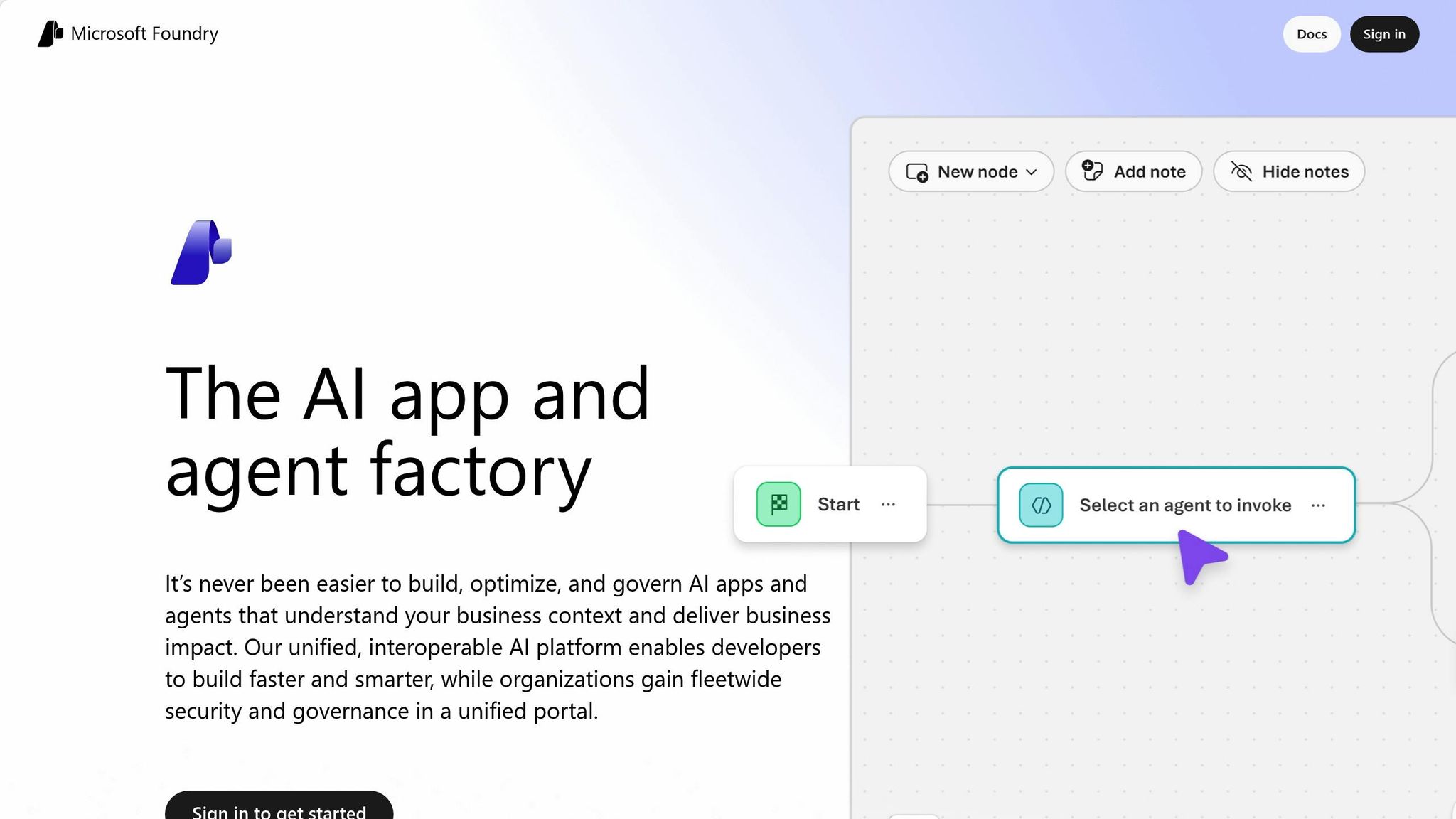
Microsoft Azure AI focuses on its Unified Model Catalog, offering access to over 1,900 models from top providers like OpenAI, Anthropic, and Meta. This extensive library lets developers find models tailored to their needs. The Prompt Flow Orchestration tool simplifies connecting LLMs, prompts, and Python tools through an intuitive visual graph, making debugging and workflow iteration more straightforward. With Retrieval-Augmented Generation (RAG), models can retrieve answers from proprietary data, while the Foundry Agent Service allows teams to create AI agents for automating complex business tasks while keeping human oversight in decision-making.
Azure AI supports three deployment options - Serverless API, Provisioned Throughput, and Managed Compute - allowing users to align deployment with their workflow scale. For instance, in February 2026, healthcare tech company healow reported cutting U.S. clinician administrative tasks nearly in half by using Azure OpenAI. Their solution, Sunoh.ai, automates notetaking during patient exams, saving clinicians up to two hours daily. Similarly, legal tech firm Harvey used Azure OpenAI reasoning models to help law firms streamline research and case management. E-commerce platform Carvana developed an AI-driven conversation analysis tool to improve customer service quality. Azure AI’s adaptability ensures it meets diverse industry needs.
Azure AI's pricing structure is designed to align with various usage scenarios, offering pay-as-you-go rates based on token usage. For example, GPT-5.2 Global starts at $1.75 per 1 million input tokens and $14.00 per 1 million output tokens. For non-urgent tasks, the Batch API provides cost savings by delivering responses within 24 hours. For predictable workloads, Provisioned Throughput Units (PTUs) are available starting at $260 monthly per PTU for models like GPT-5.2. High-volume users can benefit from the Microsoft Agent pre-purchase plan, which offers up to 15% discounts for purchasing 500,000 Agent Commit Units. For compute-intensive tasks, Reserved Virtual Machine Instances offer discounts of 62–72% with one- or three-year commitments. Additionally, new users receive $200 in credits to explore Azure AI services for 30 days.
Microsoft prioritizes security with a team of 34,000 engineers dedicated to safeguarding its platform. Azure holds over 100 compliance certifications, including more than 50 tailored to specific regions and countries. Customer data, including prompts and completions, is never used to train foundation models without explicit consent. Data encryption at rest uses AES-256 by default, with the option for Customer Managed Keys (CMK) for added control. The platform supports deployment into private Virtual Networks (VNet) and enables private access points through Azure Private Link, allowing users to disable public network access entirely. Real-time content filtering (Guardrails) prevents harmful outputs, such as hate speech or jailbreak attempts. The Azure OpenAI Service guarantees 99.9% availability through its service-level agreement.
Azure AI integrates seamlessly with Microsoft Entra ID, offering granular access control via Azure Role-Based Access Control (RBAC) and Managed Identities, which eliminate the need for hard-coded credentials. Its Prompt Flow feature includes a "variants" option, enabling teams to test and compare multiple prompt versions side-by-side before deployment. For organizations with strict data residency requirements, data processing can be confined to specific geographies, such as the United States or European Union. The Foundry Agent Service empowers teams to design enterprise-grade AI agents using visual tools, while intelligent contact center automation with Azure OpenAI can cut post-call work by as much as 50%.
Amazon SageMaker offers SageMaker JumpStart, a centralized hub designed for effortless deployment and fine-tuning of over 150 foundation models from providers like Meta, Hugging Face, and Stability AI. Its Unified Studio brings together data processing, SQL analytics, and AI model development in one environment, supported by Amazon Q Developer for natural language coding. For large-scale training, SageMaker HyperPod accelerates training times by up to 40% through automated cluster management, while its distributed training libraries handle models with hundreds of billions of parameters. These tools simplify integration into enterprise workflows.
SageMaker's Inference Optimization Toolkit enhances generative AI workflows with features like speculative decoding, quantization, and compilation, improving cost-performance. AWS scientists achieved 176 teraflops per GPU (56.4% of the theoretical peak) while training a 1.06-trillion-parameter model using SageMaker's sharded data parallelism. The platform also supported training a 175-billion-parameter model across 920 NVIDIA A100 GPUs, showcasing its capability for large-scale applications.
For multi-node LLM training, developers can rely on Elastic Fabric Adapter (EFA) and NVIDIA GPUDirectRDMA to ensure efficient inter-machine communication. Additionally, SageMaker Clarify helps evaluate and compare foundation models by analyzing metrics such as accuracy, robustness, toxicity, and bias.
SageMaker uses a pay-as-you-go pricing structure, offering Real-Time, Serverless, Asynchronous, and Batch Transform modes. With AI Savings Plans, users can reduce costs by up to 64%. The Inference Recommender optimizes instance types and configurations through load testing, helping to avoid over-provisioning. New customers receive up to $200 in AWS credits and free tier access, including 250 hours of sc.t3.medium instance usage for the first two months. Multi-model endpoints allow multiple models to share resources, boosting cost-effectiveness and ROI.
SageMaker ensures secure operations with Amazon VPC and AWS PrivateLink, while its "Internet-Free Mode" prevents containers from accessing the internet. All data and model artifacts are encrypted both in transit and at rest, with TLS 1.2 required for API calls (TLS 1.3 recommended). The platform supports FIPS 140-3 validated cryptographic modules for high-security needs and complies with standards like SOC, ISO, PCI DSS, and HIPAA. The SageMaker Role Manager simplifies permission management, allowing administrators to set up ML personas with pre-built IAM policies in minutes.
SageMaker's Model Dashboard offers a consolidated view for tracking deployed models and identifying issues like data drift or bias. Model Cards streamline and standardize model documentation. Companies like NatWest Group have reported that SageMaker improved user access to tools, cutting the time required by about 50%. Toyota Motor North America (TMNA) is leveraging SageMaker to unify and manage data across its operations, including connected cars, sales, manufacturing, and supply chains. The platform's Training Warm Pools keep infrastructure ready between jobs, significantly speeding up parameter searches and scaling experiments.
IBM's watsonx.ai Studio brings together traditional machine learning and generative AI in a single platform. With tools like the Prompt Lab, users can experiment with Granite models and open-source options, while the Tuning Studio refines prompts and foundation models to meet specific business goals. The platform’s AutoAI for RAG simplifies retrieval-augmented generation, linking large language models (LLMs) to enterprise data for more precise results. Additionally, integration with watsonx.governance ensures transparency and automated monitoring throughout the AI lifecycle, from development to deployment.
Watson Studio supports multicloud model deployment using REST APIs, giving users access to pre-trained text analysis models in over 20 languages through the Watson NLP Premium Environment. For example, during the US Open, the platform processed 7 million data points in real time. IBM has highlighted the platform’s efficiency, noting a 40% reduction in time spent creating Red Hat Ansible Playbooks with generative AI, while Dun & Bradstreet clients reported saving more than 10% of the time needed to evaluate supplier risk. This level of integration ensures reliable performance across a variety of enterprise environments.
The platform simplifies pricing with Capacity Unit Hours (CUH) for compute and Resource Units (RU) for inferencing (1,000 tokens = 1 RU). A free Lite plan offers 10 CUH monthly and 300,000 tokens, ideal for individual developers. The Standard plan, priced at $1,050 per month, includes 2,500 CUH, with additional usage billed at $0.42 per CUH. IBM Granite models are available at rates ranging from $0.06 to $0.60 per million tokens, while third-party models like Llama-3-2-1b start at $0.10 per million tokens. Organizations using the platform have reported improvements in model accuracy between 15% and 30%.
The platform ensures security across five levels: Network, Enterprise, Account, Data, and Collaborator. Data is encrypted both at-rest and in-motion, and personally identifiable information is removed from all sources, including backups, within 30 days of a deletion request. Certified under SOC2 in most regions and offering HIPAA compliance through a dedicated $1,800 monthly plan in the Dallas region, Watsonx.ai meets stringent security standards. Additionally, project metadata is stored in a three-node Cloudant Enterprise cluster distributed across multiple locations, ensuring disaster resilience. Automated validation tools further reduce model monitoring efforts by 35% to 50%.
Watson Studio organizes work through Projects, providing collaborative spaces for data scientists and engineers to manage assets like datasets, scripts, models, and tools such as Jupyter Notebooks and RStudio. Administrators can assign role-based permissions (Viewer, Editor, Admin) to team members, ensuring efficient collaboration. For instance, Vodafone achieved a 99% faster turnaround time for journey testing using IBM AI tools. Serving over 100 million users across 20 industries, the Watson suite demonstrates its ability to scale from individual developers to enterprise-level operations, meeting the need for secure and scalable AI workflows.
When comparing these five platforms, notable differences emerge in pricing, security features, and scalability. Each platform caters to a range of needs, from startups with tight budgets to enterprises with strict regulatory requirements.
Pricing structures show significant variation. Prompts.ai uses a pay-as-you-go TOKN credit system, aligning costs directly with usage. Microsoft Azure AI adopts a token-based billing model, where output tokens are priced 3–8× higher than input tokens - an approach common in the industry. Many platforms also offer caching discounts for repeated prompts, with potential savings of up to 50%, and even greater reductions through manual caching.
Security and compliance features are robust across all platforms but differ in their specific certifications. Prompts.ai meets high standards with SOC 2 Type II and ISO 27001 certifications, along with GDPR and HIPAA compliance. It also offers a self-hostable version for organizations with stringent data residency needs. Similarly, Google Cloud AI, Microsoft Azure AI, Amazon SageMaker, and IBM Watson Studio provide strong security measures tailored to enterprise requirements.
LLM integration capabilities highlight unique strengths. Prompts.ai provides unified access to over 35 leading models, such as GPT-5, Claude, LLaMA, and Gemini, all within a secure interface that supports side-by-side performance comparisons. Google Cloud AI focuses on its native 2M token context window via Gemini 3.0 Pro, ideal for processing large documents efficiently. Microsoft Azure AI integrates seamlessly with OpenAI models and offers batch processing discounts for non-urgent tasks. Amazon SageMaker delivers flexible deployment with pre-built algorithms, while IBM Watson Studio supports multicloud deployments and advanced API integrations. These integration features play a key role in ensuring platforms can handle diverse project needs effectively.
Scalability options vary widely. Prompts.ai’s pay-as-you-go model allows teams to scale quickly without minimum commitments, adding users and models in minutes. Google Cloud AI and Microsoft Azure AI provide auto-scaling infrastructure, while Amazon SageMaker is designed to support both early-stage prototypes and large-scale production environments.
Ultimately, choosing the right platform depends on your priorities - whether it’s unified model access, cost transparency, extended context handling, compliance standards, or scalable infrastructure. Evaluating these features will help you identify the best fit for your AI project.
Selecting the right AI platform involves carefully weighing factors like workflow efficiency, cost management, and operational needs. The platforms discussed in this article each offer distinct advantages - whether it's access to over 35 models, built-in cloud infrastructure, adaptable deployment options, or compatibility with multi-cloud setups. These considerations provide a framework for understanding how costs and integration shape overall success.
Financial transparency is equally critical. Clear pricing structures help avoid surprises, especially since integration challenges often slow down AI adoption. Multi-model orchestration can trim operational expenses by 30–50%, routing simpler tasks to more affordable models while reserving premium ones for complex problem-solving.
Integration capabilities are another key factor. With only 28% of enterprise applications currently interconnected, selecting a platform that integrates smoothly with your existing tools - like CRM systems, collaboration software, or databases - can eliminate data silos and save countless hours of manual work. Notably, businesses using specialized AI development platforms report a 40% faster time-to-market compared to building solutions from scratch.
Your team’s technical, security, and scalability needs should also guide your choice. Whether you require no-code tools for quick prototyping or code-first frameworks for complete control, setting governance protocols early and prioritizing platforms with strong audit capabilities can help you focus on high-impact, low-risk projects.
To make the best decision, test platforms against your specific workflows, check their ecosystem compatibility, and evaluate model flexibility and monitoring features. Platforms that offer unified model access can speed up deployment, simplify integration, and reduce tool sprawl. The right choice will not only streamline your operations but also position your organization for sustainable progress.