Pay As You Go - AI Model Orchestration and Workflows Platform



AI workflow platforms are transforming how businesses handle complex tasks. With 88% of organizations using AI, only 2% are expected to scale AI agents fully by 2026, highlighting the challenges of generative AI adoption. This article evaluates the top AI workflow platforms of 2026, focusing on their features, pricing, and suitability for different users. Whether you're a business professional or a developer, these platforms offer tools to streamline your workflows.
| Platform | Best For | Key Strength | Key Weakness | Starting Price |
|---|---|---|---|---|
| Prompts.ai | Enterprise orchestration | Unified access to 35+ LLMs | Newer platform | $99/member/month |
| Vellum AI | Hybrid teams | Prompt-based agent creation | Rapid evolution | $25/month |
| Zapier | Non-technical users | 8,000+ integrations | Expensive at scale | ~$20/month |
| Gumloop | Visual builders | Intuitive natural language tools | Limited advanced features | Varies |
| n8n | Technical users | Self-hosting, execution pricing | Steep learning curve | ~$20/month |
| Make | Ops teams | Visual interface, routing options | Heavy UI for simple tasks | ~$9/month |
| Pipedream | Developers | Code-level control, NPM support | Not user-friendly for non-tech | ~$29/month |
| Workato | Enterprises | Governance, security features | Premium pricing, setup complexity | Custom pricing |
These platforms cater to diverse needs, from non-technical teams seeking simplicity to enterprises prioritizing governance. Choose based on your team's expertise, budget, and workflow requirements.
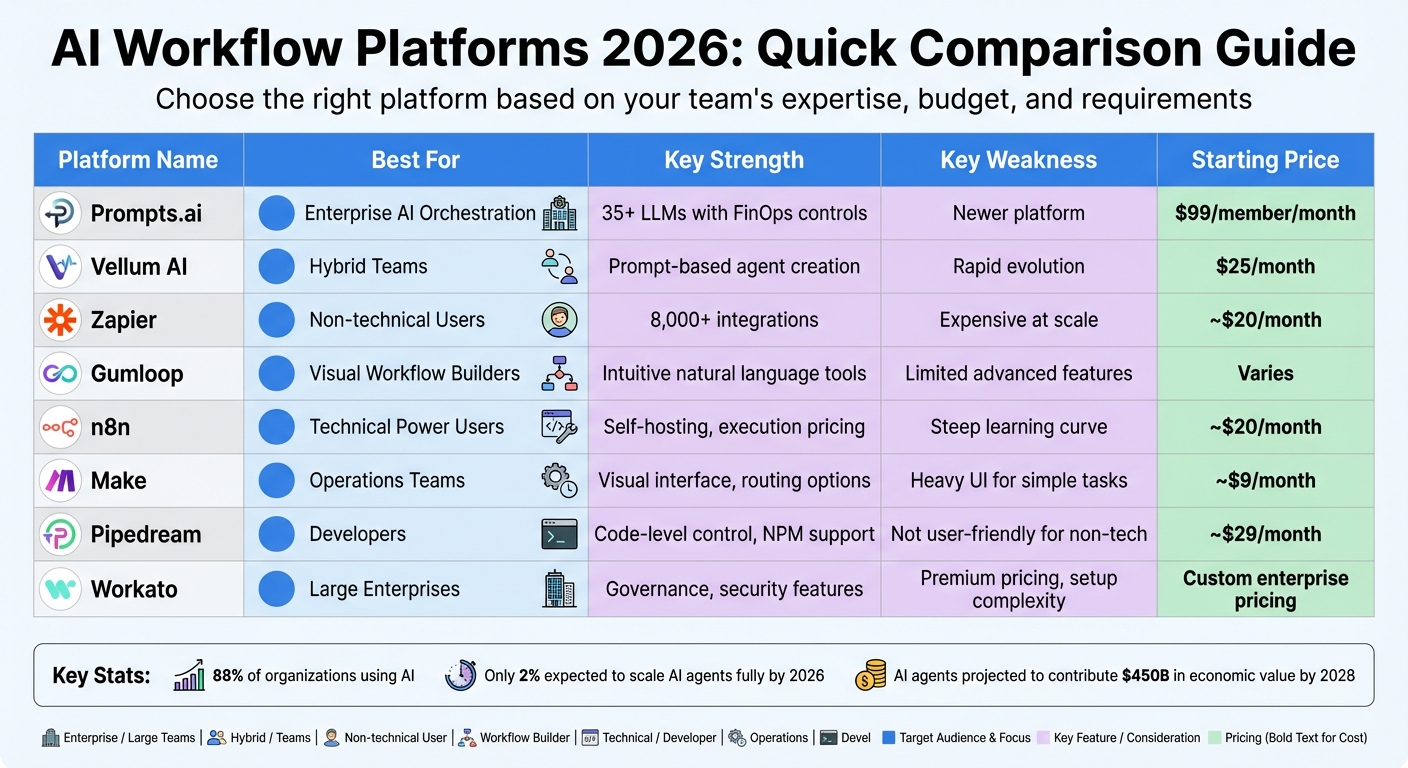
AI Workflow Platforms Comparison 2026: Features, Pricing and Best Use Cases
Prompts.ai is an enterprise-level AI orchestration platform designed to bring together 35 of the most advanced models, such as GPT-5, Claude, LLaMA, Gemini, Grok-4, Flux Pro, and Kling, all within a single, secure interface. Created by Emmy Award-winning Creative Director Steven P. Simmons, the platform addresses common challenges like juggling multiple subscriptions, inconsistent oversight, and unpredictable expenses that often arise when managing diverse AI services. Below is an overview of its standout features, including integration, automation, scalability, and cost management.
Prompts.ai simplifies access to 35 advanced models through a single interface, eliminating the need for separate accounts or billing systems. Teams can easily switch between models within the same workflow and compare their performance side by side. A built-in FinOps layer tracks token usage, assigns costs to specific projects or departments, and delivers real-time insights into spending - features that are often missing in standalone solutions.
The platform boosts productivity with its "Time Saver" prompt templates, crafted by expert prompt engineers, and multi-step workflows tailored for various tasks. Additionally, Prompts.ai offers a Prompt Engineer Certification program, empowering team members to design and refine AI-powered processes that align with their organization's needs. By sharing proven workflows and strategies across industries like Fortune 500 companies, creative agencies, and research institutions, the platform fosters faster and more effective AI adoption.
Prompts.ai prioritizes security and compliance in every workflow. With enterprise-grade governance tools and detailed audit trails, companies can enforce data-handling policies, limit model access based on roles, and maintain oversight of sensitive data. The platform is designed for rapid growth - whether adding new models, users, or teams, it can scale in minutes. This scalability is paired with a flexible, usage-based pricing model that adapts to evolving organizational needs.
Prompts.ai consolidates access to leading language models, removing the need for multiple subscriptions. Its pricing operates on a pay-as-you-go TOKN credit system, with no recurring fees for the base platform. For personal users, the plans include:
For businesses, tailored plans are available to meet organizational demands, offering:
each tier providing advanced governance options and priority support.
Vellum AI is an orchestration platform built to deploy large-scale AI agents and workflows for enterprise use. It addresses the common challenges where many generative AI pilots fall short, offering the governance, testing, and deployment tools needed to move prototypes into full production. With its natural language Agent Builder, users can define tasks in plain English, while engineers can enhance functionality using robust TypeScript and Python SDKs. This user-friendly design promotes seamless integration, automation, and scalability.
Vellum simplifies AI integration by connecting to multiple LLMs - including OpenAI, Anthropic, and Google - through a single orchestration layer. This flexibility lets teams switch between models without the hassle of rebuilding workflows. The platform supports connectors for CRM, ERP, and ITSM systems, along with retrieval-augmented generation (RAG) tools like vector databases and document retrieval pipelines. Its "Control Flow" graph execution allows for sophisticated logic, such as parallel processing, looping, and streaming, by enabling any node to reference outputs from upstream nodes or global inputs. Workflows are modular, making it easy to reuse them as individual nodes in larger systems.
Vellum takes automation to the next level with its built-in evaluation suites, which replace manual testing with automated regression checks on prompt and model variants.
Pratik Bhat, Senior Product Manager at AI Product, shared: "Vellum made it so much easier to quickly validate AI ideas and focus on the ones that matter most. The product team can build POCs with little to no assistance within a week!"
The platform offers a visual canvas that allows non-technical users to create workflows using drag-and-drop functionality, while engineers can add custom nodes and API-based extensions. For workflows requiring oversight, human-in-the-loop approval gates pause automation until a reviewer steps in, making the platform ideal for industries like finance, healthcare, and legal services where compliance is critical.
Vellum is designed to meet the needs of enterprises with flexible deployment options, including cloud, private VPC, or on-premises setups - even in air-gapped environments. It supports RBAC, SSO/SAML, SCIM provisioning, and immutable audit logs to ensure compliance with standards like SOC 2, GDPR, and HIPAA. Additionally, its end-to-end tracing provides granular insights into latency, token usage, and costs at the node level.
Max Bryan, VP of Technology and Design, remarked: "We accelerated our 9-month timeline by 2x and achieved bulletproof accuracy with our virtual assistant. Vellum has been instrumental in making our data actionable and reliable."
Vellum’s credit-based pricing model ensures cost efficiency by charging credits only for creating or editing agents, not for workflow execution. The platform offers four pricing tiers:
Workflow runtime is included at no additional cost, enabling businesses to scale execution without worrying about rising expenses. This is particularly valuable as AI agents are expected to contribute $450 billion in economic value by 2028.
Zapier takes automation to a new level, connecting a vast ecosystem of 8,000 applications and multiple AI models like GPT-4o, Claude, Gemini, and Azure OpenAI. With over 350 million AI tasks already completed and more than 23 million AI tasks automated each month, the platform is a powerhouse for streamlining workflows. Its standout feature, the Model Context Protocol (MCP), enables seamless integration between AI platforms and thousands of apps, letting AI models execute 30,000+ pre-built actions directly within their interfaces.
Zapier supports nearly 500 AI-specific app integrations, connecting users to platforms like ChatGPT, Claude, Gemini, and Perplexity. Beyond basic trigger-action workflows, Zapier offers advanced tools such as visual workflow mapping (Canvas), database management (Tables), and custom UI creation (Interfaces). The "AI by Zapier" feature makes it easy to use large language models in workflows without needing to handle separate API keys. Impressively, 87% of the Cloud 100 companies and 3.4 million businesses worldwide rely on Zapier for automation.
One example of Zapier's impact is an AI-powered lead enrichment system that generated $1 million in potential revenue and saved 282 working days annually.
"Because of automation, we've seen about a $1 million increase in potential revenue. Our reps can now focus purely on closing deals - not admin." - Jacob Sirrs, Marketing Operations Specialist, Vendasta
These capabilities highlight Zapier's extensive integration options and its ability to deliver meaningful results.
Zapier introduces autonomous AI Agents, which can reason, search for up-to-date information, and execute complex multi-step workflows - far beyond traditional rule-based systems. The platform also includes human-in-the-loop controls, such as Slack-based approval actions, allowing teams to review AI-generated content before it moves forward. For more technical tasks, users can execute Python functions directly within Zaps, utilizing tools like Pandas and NumPy for advanced data analysis.
For instance, an IT helpdesk automation powered by Zapier resolved 28% of support tickets, saving over 2,200 manual workdays each month and reducing hiring costs by approximately $500,000.
"Zapier makes our team of three feel like a team of ten." - Marcus Saito, Head of IT and AI Automation, Remote.com
These features make Zapier a versatile tool for organizations looking to optimize their AI workflows.
Zapier’s pricing is based on a task-based model, charging only for successful actions. Triggers and polling don’t count toward the task limit, and tools like Filters, Paths, Formatter, Tables, and Forms are included without additional cost. The platform offers four pricing tiers:
For businesses that exceed their monthly task limits, a pay-per-task option is available at 1.25x the base task cost.
In one case, Premiere Property Group, with 1,300 agents, used Zapier Forms and Tables to automate agent onboarding and marketing processes, saving $115,000 annually by eliminating manual tasks. This pricing approach allows businesses to scale their AI-driven workflows efficiently and affordably.
Gumloop leverages Large Language Models (LLMs) as reasoning engines to process unstructured data and support decision-making. With 125 native nodes for popular apps like Salesforce, HubSpot, Notion, Slack, and Google Sheets, and its Model Context Protocol (MCP), the platform connects users to over 10,000 tools and 2,800 APIs.
Gumloop simplifies integration with a natural language-driven approach. Using MCP, users can describe actions in plain language - like "Retrieve last five emails from Gmail" - and the platform automatically generates the necessary code and logic. It supports flexible AI model routing, enabling seamless switching between GPT-4o, Claude 3.7 Sonnet, and Gemini within a single workflow for optimal task performance. Developers can also create custom nodes using JavaScript or Python, with built-in scaffolding to streamline proprietary API integration. A Chrome extension enhances browser-based integration, allowing users to scrape data or capture screenshots directly for AI workflows.
These features make Gumloop a powerful tool for advancing workflow automation.
The "Gummie" AI assistant builds workflows from natural language prompts, tailoring solutions to user needs. Gumloop differentiates between "Agents" (AI assistants that use tools to complete tasks) and "Flows" (automated environments that run on schedules, in bulk, or triggered by events).
In 2024, Instacart's legal team implemented a no-code solution using Gumloop to automate legal request sorting and paperwork, cutting 80% of manual labor hours. Similarly, Shopify employs Gumloop to summarize meeting notes, automate SEO editorial tasks, and monitor brand sentiment through social listening agents.
"Gumloop has been critical in helping all teams at Instacart - including those without technical skills - adopt AI and automate their workflows, which has greatly improved our operational efficiency." - Fidji Simo, CEO, Instacart
Gumloop is designed to handle large-scale operations with features like auto-scaling, parallelized execution, and reserved compute power. It adheres to SOC 2 and GDPR compliance and offers Virtual Private Cloud (VPC) deployments for enterprises needing isolated environments. The "Organizations" feature provides centralized governance, allowing admins to manage users, integrations, and security settings across domains. Granular access controls enable the creation of custom user roles, including the ability to "Deny-List Nodes" for specific actions. Privacy Mode ensures no data is retained during execution, while custom retention policies align with compliance needs. With AI Proxy Support, organizations can route AI activity through their own proxy endpoints, maintaining full observability and using their own API keys.
"Gumloop wins time back across an org. It puts the tools into the hands of people who understand a task and lets them completely automate it away." - Bryant Chou, Co-Founder, Webflow
These enterprise-focused features are complemented by flexible pricing options.
Gumloop uses a credit-based pricing system with four tiers:
Users appreciate Gumloop's integrated tools, such as web scraping and video transcription, which eliminate the need for additional subscriptions. However, some find the credit-based model less predictable compared to task-based pricing structures.
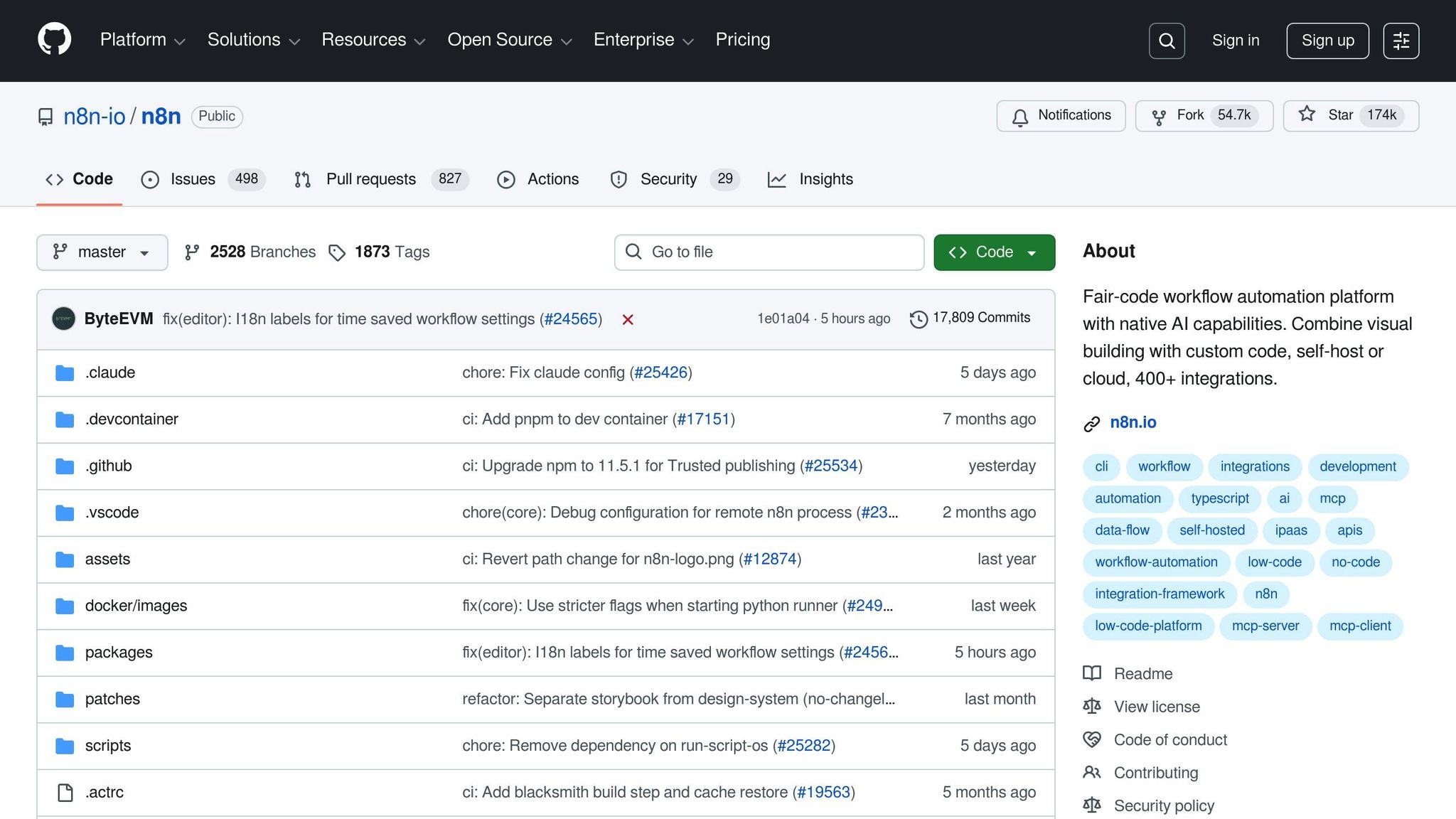
n8n stands out for its fair-code approach and extensive integration options, enabling powerful AI-driven workflow automation. Operating under a "fair-code" model, it features a visual, node-based editor that connects to over 500 integrations, APIs, and AI models, allowing users to create intricate workflows. With more than 172K GitHub stars, it ranks as one of the most popular open-source automation tools. The platform also supports self-hosting, giving users full control over their data and avoiding vendor lock-in. Additionally, it offers access to over 1,700 pre-built workflow templates to streamline setup.
n8n's HTTP Request node can connect to any REST API and even import cURL commands for faster setup. Developers can customize workflows further by incorporating JavaScript or Python code directly into nodes, providing precise control over data processing. For AI-related tasks, n8n includes built-in nodes for leading LLM providers like OpenAI, Anthropic, and Google, as well as support for local models through Ollama. It also integrates the Model Context Protocol (MCP), allowing workflows to function as MCP servers or connect to external MCP tools. Capable of handling up to 220 workflow executions per second, n8n is well-suited for operations requiring high throughput.
In 2025, Luka Pilic, Marketplace Tech Lead at StepStone, highlighted how n8n accelerated API integration tasks, reducing two weeks of work to just two hours - a 25x improvement.
"It takes me no more than two hours to connect APIs and transform data. You can't do this that fast in code." - Luka Pilic, Marketplace Tech Lead, StepStone
These integration capabilities form the backbone of n8n's advanced AI automation features.
n8n includes a built-in AI agent builder that uses Large Language Models to manage tools, retrieve information, and perform multi-step tasks autonomously. Powered by LangChain, this feature allows users to create modular AI applications that seamlessly integrate into existing workflows. Retrieval-Augmented Generation (RAG) enables agents to query proprietary knowledge bases via vector databases like Pinecone, ensuring responses are accurate and data-specific. Agents can decide autonomously which tools to use - whether querying databases, calling APIs, or running custom code - to handle complex tasks. For additional control, the platform’s "Human-in-the-Loop" (HITL) nodes allow manual approval steps before critical actions are executed, ensuring reliability in edge cases.
In 2025, Dennis Zahrt, Director of Global IT Service Delivery at Delivery Hero, implemented a user management workflow with n8n that saved the company 200 hours per month.
"We have seen drastic efficiency improvements since we started using n8n for user management. It's incredibly powerful, but also simple to use." - Dennis Zahrt, Director of Global IT Service Delivery, Delivery Hero
These AI capabilities enable businesses to automate complex processes while maintaining oversight.
n8n supports horizontal scaling through queue mode and multi-instance setups, using Redis to handle traffic surges and ensure failover protection. The platform is SOC 2 Type II audited and includes enterprise-grade features such as SSO (SAML, LDAP), 2FA, and integration with secret managers like HashiCorp Vault, AWS Secrets Manager, and Azure Key Vault. It also offers fine-grained RBAC, isolated project environments, and Git-based version control, allowing teams to synchronize changes across development, staging, and production environments. Currently, 25% of Fortune 500 companies rely on n8n for critical AI workflows.
In 2025, Vodafone transformed its threat intelligence processes with n8n, achieving savings of £2.2 million.
"n8n did everything we wanted, all in one tool. It allows us to work smarter rather than harder." - Vodafone
This scalability ensures n8n can handle enterprise-level demands while maintaining efficiency.
n8n uses an execution-based pricing model with four tiers. The Community Edition is free for self-hosting and includes unlimited workflows and executions. The Cloud Starter plan costs $20/month for 2,500 successful workflow executions, while the Cloud Pro plan is priced at $50/month for 10,000 executions. The Enterprise plan offers custom pricing for 50,000+ executions and adds features like SSO, enhanced RBAC, and SOC 2 compliance. Unlike pricing models that charge per task or step, n8n charges per successful workflow execution, regardless of the number of nodes involved. This approach makes it cost-efficient for handling complex, multi-step workflows. Users have reported saving over $500 per month after switching to n8n, which holds a 4.9/5 rating on G2.
This pricing model ensures that n8n remains an economical choice for businesses seeking advanced automation without sacrificing flexibility.
Make continues to stand out as a platform designed for simplifying AI workflows through a visual, drag-and-drop interface. Its canvas allows users to map out complex, multi-step processes, clearly illustrating data flow and decision points to make debugging and refinement easier. With over 3,000 app integrations - including OpenAI, Anthropic Claude, Google Vertex AI, Azure OpenAI, Perplexity AI, and DeepSeek AI - Make connects seamlessly to nearly any AI service or API. Trusted by more than 350,000 customers, the platform boasts an impressive 99.9% uptime and has received high user ratings, with 4.8/5 on Capterra and 4.7/5 on G2.
Make's HTTP module and webhooks make it possible to connect to any public API, while its built-in iterators and aggregators handle bulk data with ease. For example, with one scenario run, an iterator can process 50 orders from a single webhook as individual operations. Make also offers native modules for leading LLM providers, supports the Model Context Protocol via a cloud-hosted server, and includes no-code tools like "Make AI Tools" for tasks like categorization and summarization. Additionally, "Make AI Agents" provide real-time automation that can adapt, reason, and make decisions.
In May 2025, Stellantis &You UK leveraged Make's AI features, saving 151 hours of non-value-added work in just 12 months. Similarly, in July 2025, Celonis reported that Make's visual automation capabilities allowed them to create business system integrations five times faster.
"Make drives unprecedented efficiency within our business in ways we never imagined. It's having an extra employee (or 10) for a fraction of the cost." - Cayden Phipps, COO, Shop Accelerator Martech
These integration capabilities make Make a powerful tool for scalable enterprise automation.
Make prioritizes security and compliance, holding SOC 2 Type II and GDPR certifications. Its Enterprise plan includes advanced features like SSO, multi-factor authentication, audit logs, and the beta feature Make Grid, which provides a detailed view of an organization’s automation ecosystem. For customers with specific data privacy needs, European data storage options are available within EU regions. Currently, more than 50% of Make Enterprise customers incorporate AI into their workflows. Businesses can also purchase Make through the AWS Marketplace, using AWS credits to offset automation costs.
In September 2025, FranklinCovey adopted Make to streamline internal processes, saving the company hundreds of thousands of dollars and freeing up significant staff time.
"True citizen development in the entire company. Make is present in every department, empowering the company to offer a unique customer experience." - Andreas Stryz, CTO & Co-founder, FINN
These features make Make a reliable choice for enterprises seeking scalable and secure automation.
Make uses an operations-based pricing model, charging per module execution rather than per workflow completion. The platform offers several plans:
Additional operations can be purchased at around $1 per 1,000 operations, and annual billing reduces costs by about 15% compared to monthly plans. This pricing structure is ideal for businesses managing complex, multi-branch workflows, as it ensures they only pay for the operations they use, without unnecessary expenses for unused steps.
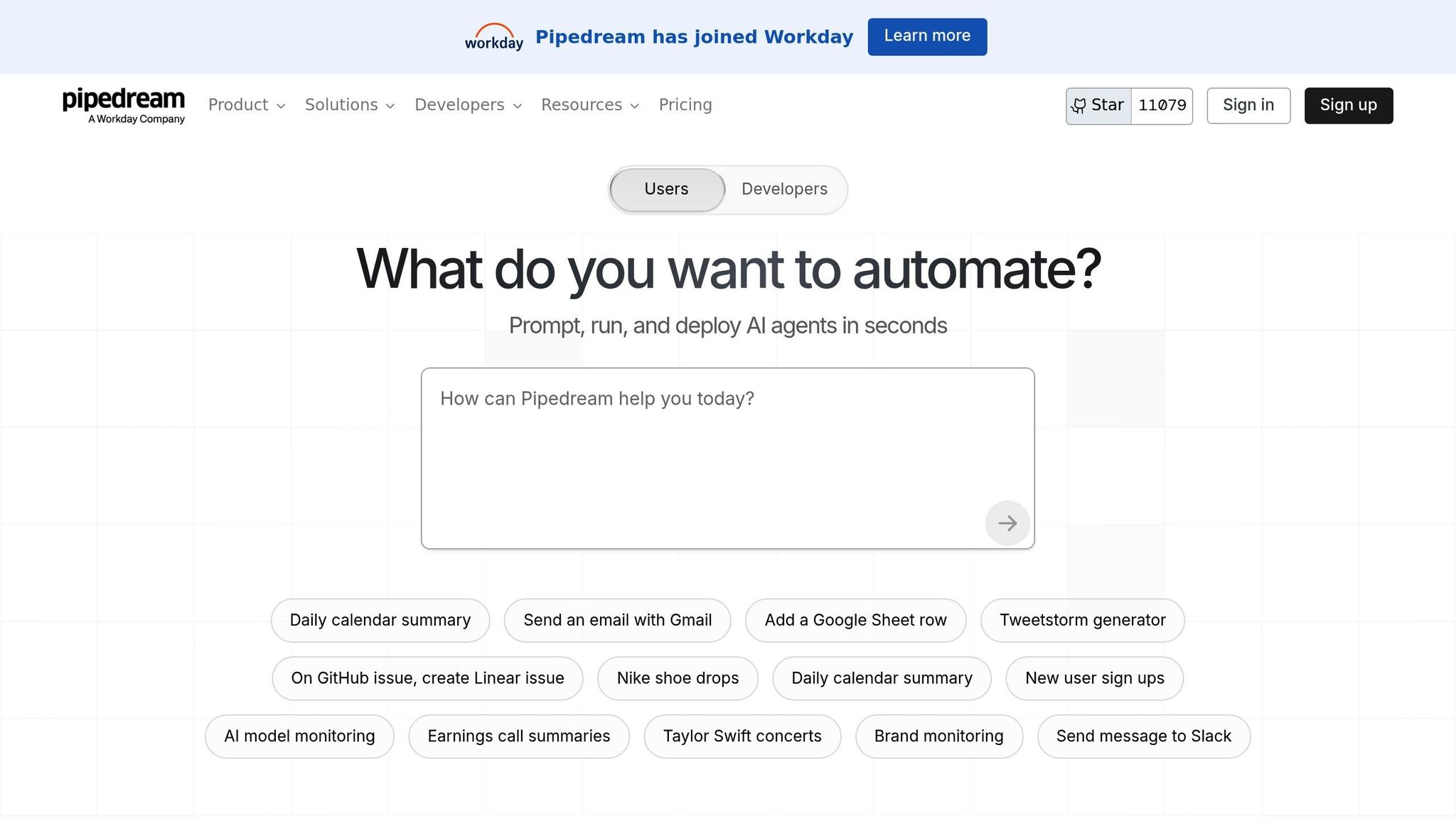
Pipedream simplifies AI workflow automation for developers, blending the adaptability of code with the ease of no-code tools. Trusted by over 1,000,000 developers, including teams at startups and Fortune 500 companies, it connects with more than 3,000 APIs and offers 10,000+ pre-built triggers and actions. Its robust infrastructure handles billions of events and supports data pipelines capable of processing over 10,000,000 events per second (EPS). Since its acquisition by Workday, Pipedream has expanded its role in enterprise automation.
Pipedream makes API integration seamless by managing OAuth and key-based authentication for over 3,000 APIs, removing the hassle of credential storage and refresh logic. Developers can choose from pre-built actions for routine tasks or write custom scripts in Node.js, Python, Golang, or Bash. The platform's Model Context Protocol (MCP) server allows AI agents to tap into a registry of over 10,000 tools, enabling direct interaction with services like Slack, GitHub, Linear, and Gmail. To ensure compatibility, it provides documentation through llms.txt and a dedicated Docs MCP server, supporting tools such as ChatGPT, Claude, Cursor, and VSCode (as of October 2025). These capabilities empower developers to build efficient, AI-driven workflows.
Pipedream integrates with String.com to enable users to create, edit, and debug workflows using natural language prompts. If a workflow step encounters an issue, the "Debug with AI" feature offers instant suggestions to resolve code or configuration errors. Its parallel branching functionality allows multiple language model queries to run simultaneously, cutting down execution time for complex processes. Additionally, the source-available component registry on GitHub enables users to contribute to or customize integration building blocks.
Pipedream employs a credit-based pricing system, charging 1 credit per 30 seconds of execution at 256MB RAM, rather than counting workflow steps.
Pipedream is SOC 2 Type II compliant and boasts an impressive 4.9/5 star rating on G2, reflecting its reliability and user satisfaction.
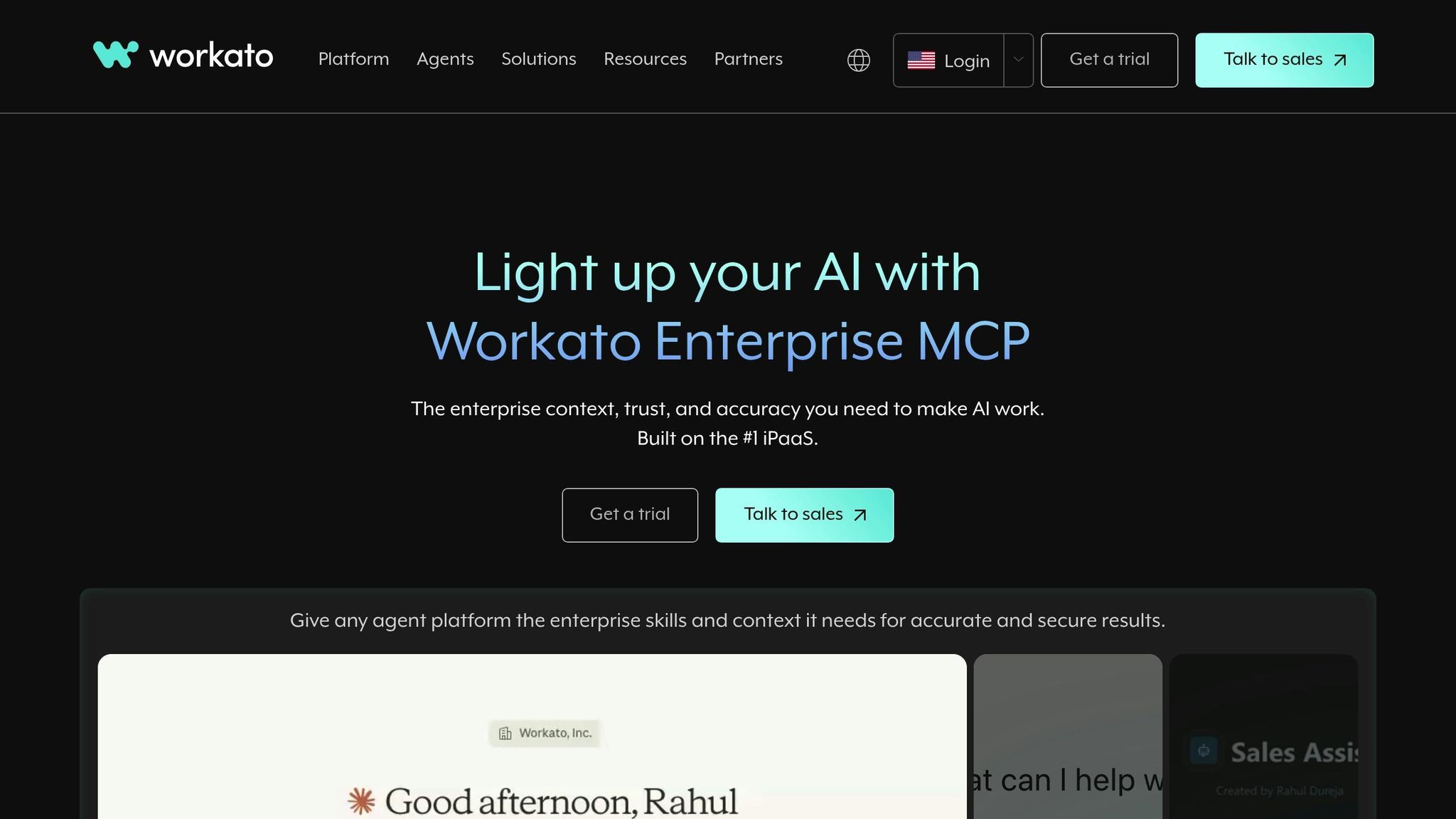
Workato stands out for its focus on seamless integration and scalability in managing AI workflows. The platform offers enterprise-grade automation with over 1,200 pre-built connectors and access to 10,000+ APIs, covering SaaS tools, legacy systems, and on-premises solutions. Workato ensures 99.9% uptime, performs zero-downtime upgrades, and implemented 775 updates last year. Trusted by half of the Fortune 500, Workato prioritizes security and governance, earning recognition as a Leader in the 2025 Gartner Magic Quadrant for iPaaS and as the #1 iPaaS by customers on G2.
Workato's Universal Connectors make it easy to work with protocols like HTTP, OpenAPI, GraphQL, and SOAP, enabling custom triggers and actions for web services not already covered by its pre-built options. The platform bridges modern SaaS tools like Salesforce and Workday with legacy systems such as SAP, ServiceNow, and mainframes, as well as SFTP. For AI workflows, Workato offers native integrations with OpenAI, Claude, and Llama, enabling the processing of unstructured data from documents, media, and transcripts. Its MCP support allows LLMs to access enterprise data, transforming integrations into AI-ready tools. These capabilities set the stage for advanced automation and seamless connectivity across enterprises.
Workato's AI Copilots simplify complex tasks by generating multi-step logic, suggesting field mappings, creating detailed transformations, and streamlining custom API development. Prebuilt Workato Genies act as AI agents designed for specific tasks, such as HR onboarding, Sales CPQ, and IT password resets. The platform also features Workato AIRO™, an AI solution architect that provides real-time diagnostics and optimization tips for automation teams. Through Agent Studio, users can design and deploy enterprise-grade agents that work across systems and teams to handle multi-step workflows efficiently.
These AI-driven tools, combined with Workato's scalable architecture, make it a robust choice for demanding enterprise needs.
Workato's architecture is built for scalability, featuring a cloud-native and serverless design that supports auto-scaling and elastic performance without requiring manual adjustments. Enterprise-grade controls include RBAC, hourly key rotation, BYOK, and immutable audit trails, along with certifications like SOC 2 Type II, ISO 27001, PCI DSS, and GDPR compliance. An example of its scalability is Atlassian's ERP transformation, which was completed 40% faster than planned - in just 9 months instead of 15. This project involved managing over 1,000 business requirements, 2,800 ERP test cases, and deploying 73+ new integrations, all powered by Workato.
"We have to do things with less people…We have way more people with their hands on the keyboard integrating [with Workato] than we would have ever had with another iPaaS platform." - Darren Owsley, CTO, Gonzaga
Workato's pricing model is designed to optimize costs while delivering value. Customers report development speeds that are 6X faster and total cost reductions of 53% compared to traditional solutions. For instance, ThredUp achieved a 53% lower total cost of ownership (TCO) and 5-6X faster development speeds after switching to Workato. AI features like AI by Workato and Copilots are available through an AI feature addendum and specific pricing plans. The platform has received high praise, with a 4.9/5 rating for product capabilities and 5/5 for deployment and support experiences on Gartner Peer Insights, where 100% of customers recommend Workato for its value, pricing, and partnership approach.
This section builds on the feature breakdowns to spotlight the strengths and weaknesses of each platform, helping you decide which one aligns best with your team's needs and budget.
When it comes to AI workflow platforms, the choice often hinges on technical expertise and cost considerations. Zapier excels with its extensive ecosystem of over 8,000 pre-built integrations, making it a go-to for non-technical users or "Citizen Automators" who need quick SaaS connections. However, its activity-based pricing can become expensive for high-frequency AI loops, especially beyond 50,000 monthly executions.
n8n offers execution-based pricing, keeping costs manageable for large-scale operations once the initial infrastructure is in place. With native LangChain integration and the ability to handle up to 220 workflow executions per second on a single instance, it’s a strong choice for technical users. That said, its steep learning curve and self-managed environment may pose challenges for less experienced teams.
Make balances usability with advanced functionality, offering a visual-first interface and sophisticated routing options. Its Maia AI feature simplifies workflow creation by generating complex graphs from conversational prompts, making it particularly appealing for operations teams managing intricate processes.
Pipedream targets developers by providing code-level control with support for JavaScript, TypeScript, Python, and NPM integration. However, it’s not designed with non-technical users in mind.
For those who prefer visual tools, Gumloop provides an intuitive interface, though it lacks some of the advanced features found in other platforms. On the other hand, Vellum AI is tailored for hybrid teams using a prompt-first approach to agent creation. Its rapid evolution, however, may require teams to frequently update their skills to keep pace.
Workato stands out as an enterprise-grade solution, offering robust governance and security features to meet stringent compliance and SLA demands. Its premium pricing and complex setup make it better suited for large organizations rather than smaller teams or mid-sized businesses.
"The 2026 orchestration landscape has crystallized into clear categories. Zapier Agents serves Citizen Automators but gets expensive for AI loops. n8n serves Technical Power Users with native LangChain integration and self-hosting." - Digital Applied
Observability has become a crucial factor in platform selection. Tools like n8n, with its LangSmith integration, and LangGraph Studio provide advanced debugging features, allowing teams to identify why an agent failed - a critical capability given that 95% of generative AI pilots fail to reach production. For industries requiring strict data sovereignty, n8n’s self-hosting option supports compliance with standards like HIPAA and GDPR. In contrast, cloud-only platforms like Zapier and Make may face challenges with data residency requirements. The choice becomes clear: start with Zapier for speed-to-market, shift to n8n for large-scale operations, and opt for Workato when enterprise-level governance is a priority.
Below is a quick comparison of the platforms:
| Platform | Best For | Key Strength | Key Weakness | Starting Price |
|---|---|---|---|---|
| prompts.ai | Enterprise AI Orchestration | 35+ LLMs with FinOps controls | Newer platform | $99/member/month |
| Vellum AI | Hybrid Teams | Prompt-based agent creation | Rapid evolution | $25/month |
| Zapier | Non-technical Users | 8,000+ integrations | Expensive at scale | ~$20/month |
| Gumloop | Visual Workflow Builders | Intuitive interface | Limited advanced features | Varies |
| n8n | Technical Power Users | Self-hostable, execution pricing | Steeper learning curve | ~$20/month |
| Make | Ops Teams | Advanced routing, Maia AI | Heavy UI for simple tasks | ~$9/month |
| Pipedream | Developers | Code-level control, NPM support | Not for non-technical users | ~$29/month |
| Workato | Large Enterprises | Governance and security | Premium pricing, complex setup | Enterprise pricing |
Selecting the right AI workflow platform depends on three main factors: your team's technical expertise, your budget, and your governance needs. By 2026, the market has clearly segmented based on these considerations, helping teams make more informed decisions.
For non-technical teams, platforms with extensive integrations offer quick results, though activity-based pricing can lead to higher costs as usage scales.
Technical teams gain the advantage of execution-based pricing and self-hosting options, which help manage expenses while ensuring data compliance.
Enterprise organizations often require advanced governance features like robust role-based access control (RBAC) and detailed audit trails. For businesses scaling AI workflows, prompts.ai provides unified access to top LLMs with built-in financial controls, starting at $99 per member per month. It’s an excellent choice for those seeking both model flexibility and clear cost structures.
Scaling AI workflows also requires strong observability and efficient debugging tools. Features like AI debugging and time-travel capabilities distinguish production-ready systems from early-stage prototypes. Starting with single-agent workflows can demonstrate value before moving to multi-agent systems, which tend to increase debugging complexity and API latency.
For developers, platforms supporting JavaScript, TypeScript, and Python offer greater code-level control. Meanwhile, visual workflow builders can rely on natural-language tools to create intricate workflows without diving into code.
Industries with strict regulations should focus on platforms offering VPC or on-premise deployment to ensure compliance with data residency requirements.
To select the best AI workflow platform, focus on key aspects such as integration, scalability, and security. Choose a platform that consolidates various AI models, provides real-time cost monitoring, and improves ease of use. Assess your team’s technical skills - some platforms demand coding knowledge, while others are designed to be more intuitive. Align the platform's features with your specific goals to streamline processes and manage expenses efficiently.
Task-based pricing charges you for every individual task or operation completed, making it ideal for straightforward, smaller-scale needs. Execution-based pricing, on the other hand, bills for the complete execution of workflows, offering a more comprehensive approach. Credit-based pricing introduces a system where credits are used up as tasks or workflows run, providing flexibility to scale as needed. Each model serves different workflow demands, so selecting the right one depends on your specific usage patterns and objectives.
Prompts.ai is designed to address compliance and data residency needs effectively. It offers secure data handling, automated compliance checks, and detailed audit trails to ensure organizations meet regulatory standards. With support for major regulations like GDPR, HIPAA, and SOC 2 Type II, the platform provides a dependable solution for businesses focused on maintaining regulatory alignment.