Pay As You Go - AI Model Orchestration and Workflows Platform



The rise of no-code AI workflow platforms is transforming how businesses automate tasks. By 2026, 84% of organizations are already using no-code tools, driving productivity gains of over 60% and reducing build times by up to 90%. These platforms allow teams to design workflows without coding, leveraging advanced AI models for smarter automation. Key players include:
Each platform offers unique benefits, from cost control to extensive integrations, making it easier for enterprises to streamline operations without relying on IT teams.
| Platform | AI Model Access | Key Feature | Starting Price |
|---|---|---|---|
| Prompts.ai | 35+ LLMs (e.g., GPT-5, Claude) | Unified AI orchestration | $0/month (PAYG) |
| Zapier AI | GPT, Claude, Gemini, 8,000+ apps | Task-based automation | $19.99/month |
| Make | ChatGPT, Claude, Gemini, Mistral | Visual flowchart-style workflows | $9/month |
These platforms empower teams to automate processes faster while maintaining control over costs and data security.

AI Workflow Platform Comparison: Features, Pricing & Capabilities
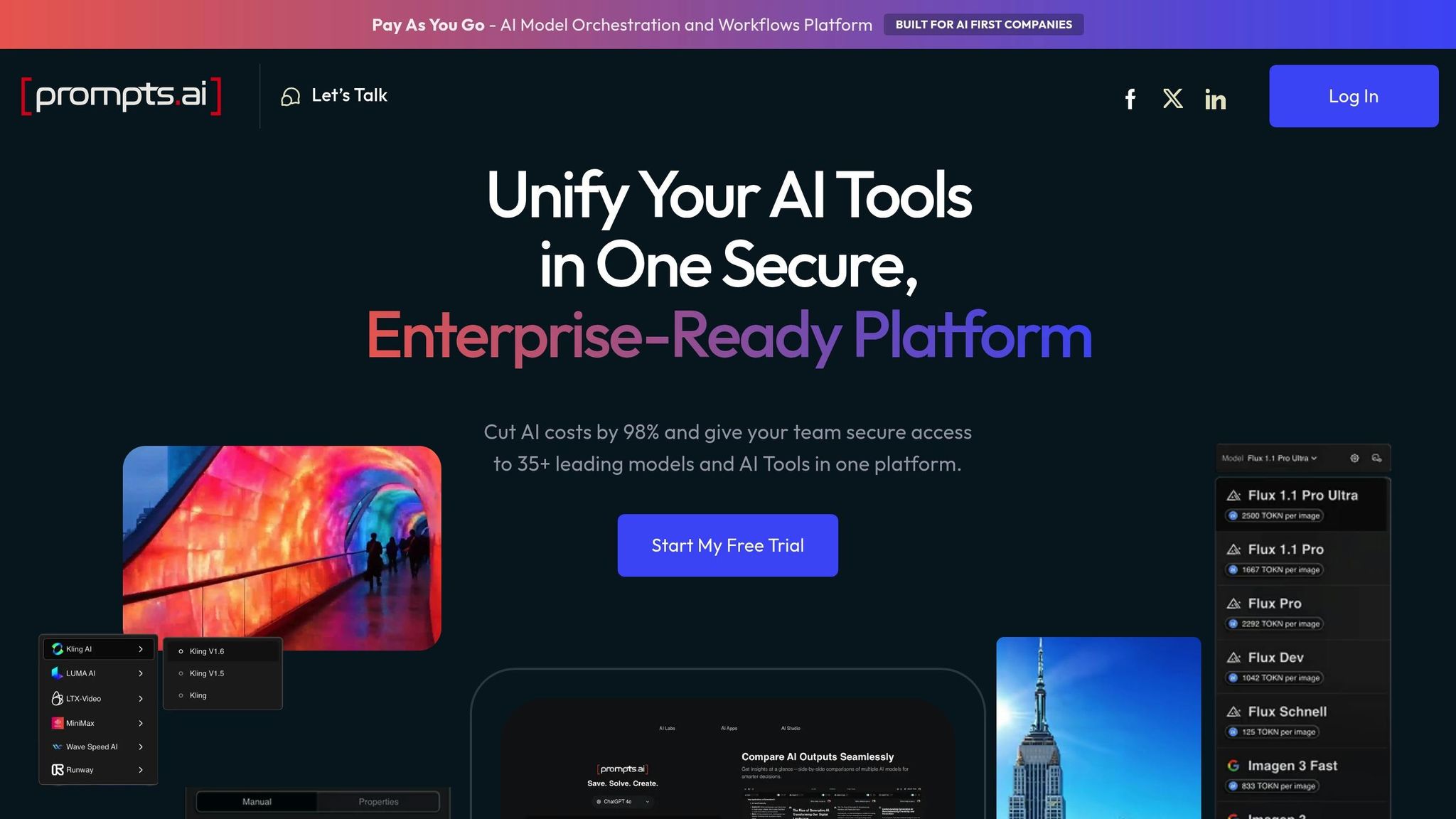
Prompts.ai is a robust AI orchestration platform designed for enterprises, combining over 35 leading language models - including GPT-5, Claude, LLaMA, and Gemini - into a single, secure interface. It eliminates the hassle of managing multiple AI tools while offering the governance and cost controls necessary for organizations to scale effectively. By unifying workflows from start to finish, it streamlines the entire process, from brainstorming to execution.
With "Prompt-to-Build" technology, users can describe their desired workflows in plain English, and the platform transforms these descriptions into fully deployable systems - no coding required. Prompts.ai incorporates AI-native orchestration with features like semantic routing and tool-calling, all accessible through drag-and-drop blocks. This allows AI models to reason independently and make decisions based on context.
The platform supports no-code automation, making it accessible to both non-technical users and developers. Users can quickly create AI workflows by simply outlining their needs. For more complex use cases, the visual canvas and optional TypeScript or Python SDKs allow for custom nodes and scripts, ensuring workflows are adaptable and production-ready.
Prompts.ai prioritizes security and compliance with features like role-based access control, detailed audit logs, and segregated environments for development, staging, and production. Built-in secrets management ensures workflows remain secure, addressing enterprise concerns around handling sensitive and proprietary data.
The platform uses a pay-as-you-go TOKN credit system, aligning costs with actual usage. Business plans begin at $99 per member/month for the Core tier and $129 per member/month for the Elite tier. Combined with real-time FinOps cost controls, this pricing model helps organizations reduce AI software expenses by up to 98%, while maintaining complete oversight of spending across models and teams.
Zapier AI seamlessly combines artificial intelligence with workflow automation, connecting nearly 8,000 apps. Its AI by Zapier tool enables users to integrate AI steps directly into workflows without the hassle of managing separate API accounts. It supports models from OpenAI (GPT), Anthropic (Claude), Google (Gemini), and Azure OpenAI. Using the Model Context Protocol (MCP), external AI tools like ChatGPT and Claude can activate over 30,000 actions across Zapier's extensive app ecosystem.
Zapier AI gives users access to multiple large language models, such as GPT-4o, Claude, and Gemini 2.0 Flash, some of which are available for free without requiring API keys. The platform also supports Knowledge Sources, which integrate company-specific data from tools like Google Drive, Notion, and Confluence, ensuring AI outputs stay aligned with internal information. For more complex tasks, Zapier Agents tackle multi-step research projects, while Zapier Chatbots handle customer-facing interactions using live data. These features make workflows more adaptable and tailored to specific needs.
Zapier offers three ways to create workflows: building from scratch, using quick action templates for common tasks like summarizing or data extraction, or reusing saved prompts. An "Improve Prompt" feature helps fine-tune instructions, while Global Variables allow users to store and reuse values, such as brand names, across multiple workflows. For advanced customization, Zapier Functions let users embed Python code directly into no-code workflows. For example, Remote's IT team combines tools like Okta, ChatGPT, and Zapier Tables to resolve 28% of 1,100 monthly tickets, saving over 600 hours each month.
Zapier offers flexible pricing to meet various business needs. The Free tier includes 100 tasks per month and 2-step workflows. Paid plans begin at $19.99 per month, covering 750 tasks, while the Professional plan adds multi-step workflows and unlimited premium apps. The Team plan, priced at $69 per month, supports up to 25 users, shared connections, and SAML SSO. For larger organizations, the Enterprise plan shifts to annual task limits, simplifying budgeting. If monthly task limits are exceeded, pay-per-task billing applies at 1.25× the base rate. Success stories include Arden Insurance Services, which saved over $500,000 annually through automation, and Vendasta, which reclaimed $1 million in potential revenue by eliminating 282 days of manual work each year.
Enterprise plans offer advanced governance tools, such as detailed permissions and audit logs. An observability dashboard monitors automation health and pinpoints bottlenecks. Additionally, Zapier Tables and Interfaces are included in all plans, and their native triggers and actions don’t count toward monthly task limits. This feature gives teams more flexibility to manage data without impacting their automation budgets.
Make offers a visual canvas editor that lets users design workflows as flowcharts. This drag-and-drop interface provides a clear view of entire automations, making it easier to identify bottlenecks and understand complex data flows. With connections to over 2,000 native apps, 99.9% availability, and response times under 200 milliseconds, Make serves a diverse user base of 350,000 active customers, ranging from freelancers to Fortune 500 companies. Its visual approach to no-code automation stands out among similar platforms.
Make integrates with leading AI models like ChatGPT, DALL-E, Claude, Gemini, Perplexity AI, DeepSeek AI, and Mistral AI. In 2025, it introduced Make AI Agents, which allow users to create goal-driven agents using natural language prompts. These agents can make real-time decisions and coordinate tools seamlessly. The platform also features a cloud-hosted Model Context Protocol (MCP) server, enabling external AI interfaces like Claude to directly access automation scenarios. For those who prefer not to write prompts, Make AI Tools offer pre-designed modules for tasks such as summarization, categorization, and sentiment analysis.
The platform’s visual editor supports advanced logic with tools like Routers, Iterators, and Aggregators. The Maia AI Builder translates natural language instructions into functional workflows, while If-Else and Merge modules simplify branching logic. Built-in error handling features - Break, Resume, Commit, and Ignore - ensure workflows continue running even when issues arise. Users can also set up handlers to manage AI errors, such as hallucinations or failures, by logging them in a database or notifying team members for manual review. These tools make it easier to design and manage intricate workflows with precision.
"Make really helped us to scale our operations, take the friction out of our processes, reduce costs, and relieved our support team." - Philipp Weidenbach, Head of Operations, Teleclinic
Make charges based on operations. The Free tier includes 1,000 operations per month, 2 active scenarios, and 15-minute intervals. Paid plans start at $9 per month for 10,000 operations, with the Core plan offering unlimited scenarios and 1-minute intervals. The Pro plan ($16 per month) adds priority execution and full-text log search, while the Teams plan ($29 per month) includes team roles and shared templates. Enterprise plans offer custom pricing, along with features like SSO, audit logs, and overage protection. Additional operations cost approximately $1 per 1,000 operations, and Make is often noted for being up to 10 times cheaper than comparable platforms for handling high-volume workflows.
Make prioritizes security with SOC 2 Type II and ISO 27001 certifications, GDPR compliance, and data centers in both the EU and US. Enterprise plans include extras like SSO, audit logs, and 24/7 priority support. The platform’s Make Grid feature offers a visual health map of an organization’s automation ecosystem, enabling teams to monitor performance and spending across numerous active workflows. This ensures both operational transparency and efficiency.
This section highlights the core strengths and trade-offs of the platforms discussed, offering a clear comparison to guide your automation solution choice.
Prompts.ai stands out for its ability to centralize access to over 35 advanced language models within a secure interface. Its built-in FinOps layer provides real-time cost tracking down to the token level, helping teams manage expenses effectively. The pay-as-you-go TOKN credit system ties costs directly to usage, eliminating recurring subscription fees. However, while it excels in AI orchestration, teams with heavy SaaS integration needs might require additional tools to complement its capabilities.
On the other hand, Zapier AI shines with its extensive integration ecosystem, supporting over 8,000 apps. Designed for non-technical users, its interface simplifies automation for diverse workflows. For example, in 2025, the European real-estate CRM SweepBright handled 27 million tasks monthly on Zapier Enterprise, showcasing its capacity for large-scale operations. That said, its task-based pricing model can result in unpredictable costs as workflow volumes grow.
Make offers a compelling alternative with its visual editor and operations-based pricing. Its flowchart-style editor appeals to visual thinkers, while pricing starts at $9 per month for 10,000 operations, often providing better value for multi-step workflows. Security is robust, with SOC 2 Type II and ISO 27001 certifications. However, Make's enterprise features, such as role-based access controls and secret management, are less comprehensive compared to some competitors.
| Platform | AI Model Access | Customization | Starting Price | Security Standards |
|---|---|---|---|---|
| Prompts.ai | 35+ LLMs (e.g., GPT-5, Claude, Gemini, LLaMA) | Prompt workflows, FinOps tools | $0/month (PAYG) | Enterprise-grade governance |
| Zapier AI | Bring-your-own API key for various LLMs | 8,000+ app integrations | $19.99/month | SOC 2 Type II, GDPR |
| Make | ChatGPT, Claude, Gemini, Mistral AI, DeepSeek | Visual editor, AI Agents | $9/month | SOC 2 Type II, ISO 27001 |
Each platform has its own pricing model and focus. Zapier's task-based billing can lead to fluctuating costs, while Make's operations-based pricing often benefits complex workflows. Prompts.ai's TOKN system ensures precise budget control without fixed fees. These differences are crucial for businesses aiming to optimize AI-driven workflows while balancing cost, flexibility, and scalability.
For organizations seeking centralized access to over 35 language models while maintaining precise control over costs, Prompts.ai stands out as the go-to solution. Its ability to scale seamlessly with evolving business needs is supported by the flexible pay-as-you-go TOKN system, which eliminates recurring subscription fees. Real-time cost tracking ensures teams can manage expenses predictably, preventing budget surprises.
Prompts.ai also excels in enterprise-grade governance, offering features like role-based access control, detailed audit logs, and dedicated environments for development, staging, and production. Built-in secrets management ensures sensitive workflows remain secure, making it an excellent fit for handling proprietary data. These tools provide strong oversight without adding infrastructure complexity, meeting the compliance standards modern enterprises require.
As the no-code AI market grows at an estimated 31–38% annually and is expected to hit $25 billion by 2030, Prompts.ai delivers the scalability, ease of use, and cost transparency necessary to keep pace with this rapid evolution. Its unified platform redefines how teams build and deploy AI workflows, enabling both technical and non-technical users to solve business challenges efficiently, without relying on engineering resources.
No-code AI workflow platforms make automation accessible by enabling users to design and manage workflows without any programming skills. With user-friendly features like drag-and-drop interfaces and pre-built templates, these tools streamline the process, cutting down on the time spent coding or troubleshooting.
Development becomes faster with built-in options for testing, monitoring, and debugging, which allow users to quickly spot and fix issues. Many platforms also leverage AI to adjust and refine workflows in real-time, helping businesses automate tasks more quickly and achieve better outcomes. This approach allows teams to focus on creativity and strategy, leaving behind the challenges of building and scaling automation from scratch.
Prompts.ai incorporates robust security features to ensure sensitive data remains protected throughout its AI workflow platform. It employs advanced encryption protocols to secure data both while it's stored and during transmission, providing continuous protection.
The platform also utilizes role-based access controls (RBAC), enabling administrators to assign tailored permissions to users. This limits access to critical information and system functions, reducing potential risks. Moreover, detailed audit logs meticulously record user actions and system updates, promoting accountability and aiding in compliance efforts.
Prompts.ai further underscores its dedication to security through certifications like AIRTP+, which showcase its adherence to stringent security standards. Together, these measures create a secure and dependable environment for handling sensitive data and streamlining workflows efficiently.
The TOKN credit system on Prompts.ai provides a flexible, pay-as-you-go option for accessing more than 35 AI models. Instead of committing to fixed pricing, you only pay for the services you use, making it adaptable to businesses of any size.
With real-time cost tracking, you can easily monitor usage and spending, offering complete visibility into your expenses. This approach is perfect for individuals and businesses seeking a tailored and budget-friendly way to streamline workflows.