Pay As You Go - AI Model Orchestration and Workflows Platform



In 2026, managing AI prompts is no longer an afterthought - it’s a core part of building scalable, efficient AI systems. With 75% of enterprises expected to adopt generative AI, tools that simplify prompt workflows are essential to staying competitive. The best platforms today streamline prompt management across multiple models, reduce costs, and improve collaboration between teams. Here’s a quick rundown of the top tools:
These tools help teams ship AI features faster, reduce operational costs, and manage the growing complexity of multi-model workflows. Whether you’re a startup or a large enterprise, adopting one of these platforms can save time and resources while improving AI outcomes.
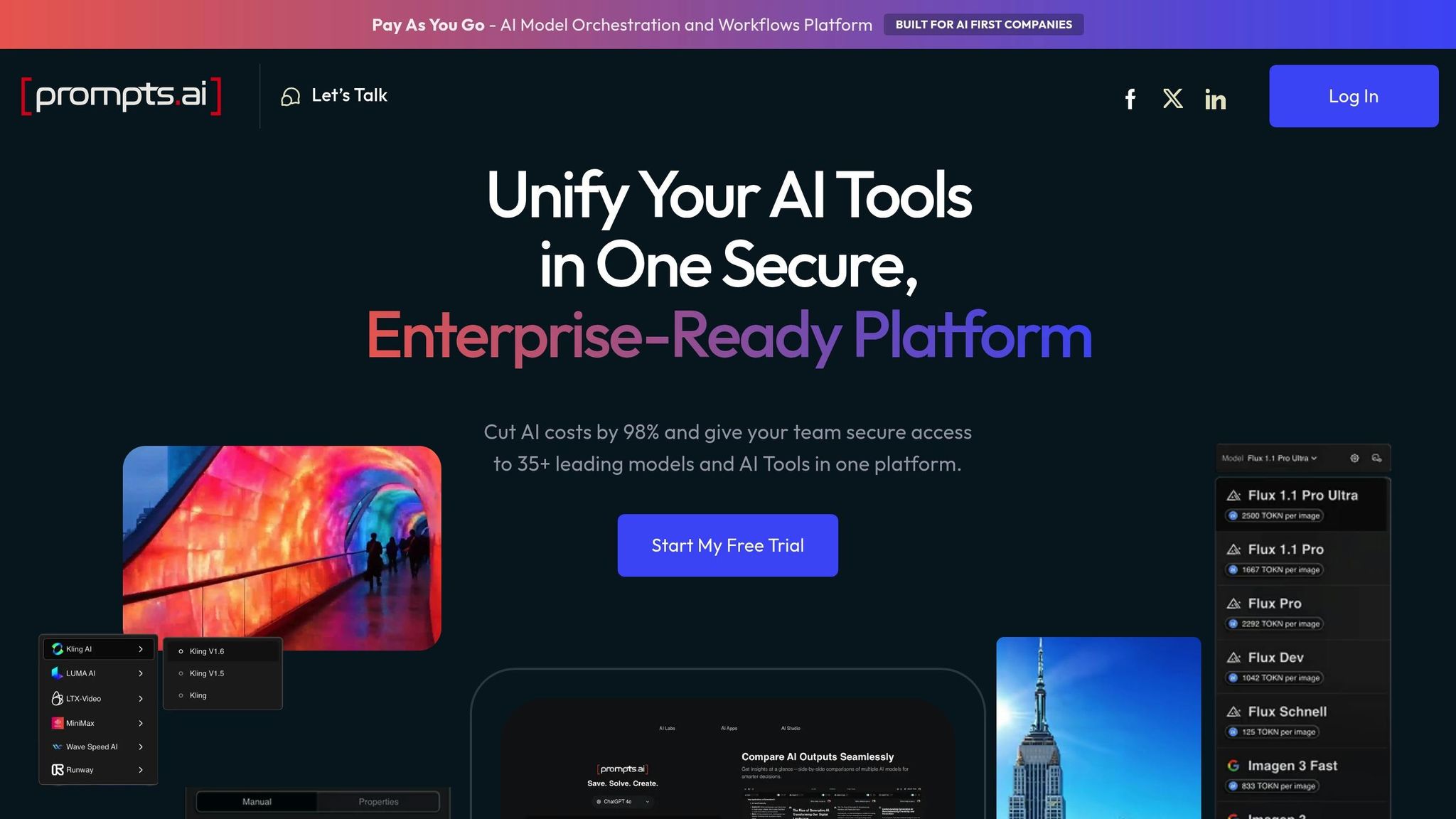
Prompts.ai is a platform designed to tackle the challenges of modern prompt engineering. It brings together 35+ large language models (LLMs) - such as GPT-5, Claude, LLaMA, Gemini, and Grok-4 - into a single, cohesive interface tailored for enterprise-level operations. Below is an overview of its standout features.
A key aspect of prompt efficiency lies in the ability to seamlessly integrate with various models. The platform's Bifrost Gateway serves as the backbone for multi-model access, offering unified connectivity to over 12 AI providers through a single OpenAI-compatible API. This setup supports major providers like OpenAI, Anthropic, AWS Bedrock, and Google Vertex. To ensure reliability, the system incorporates automatic failover and load balancing, enabling uninterrupted operations even when switching between providers. Teams can easily transition across models without needing to rewrite integration code, eliminating the risk of being locked into a single provider.
Prompts.ai places a strong emphasis on cost management. With its semantic caching feature, the platform reuses similar responses to reduce redundant processing. Additionally, the integrated FinOps layer monitors token usage in real time, linking expenses directly to business objectives. This proactive approach allows organizations to spot cost-saving opportunities as they arise, avoiding unexpected budget overruns at the end of the month.
The platform seamlessly integrates with GitHub Actions, enabling environment-specific deployment workflows. Teams can leverage features like version control, automated testing, and tailored deployments for different environments. By automating these processes, the platform removes the delays and risks associated with manual handoffs, ensuring a smoother transition from experimentation to production for AI features.
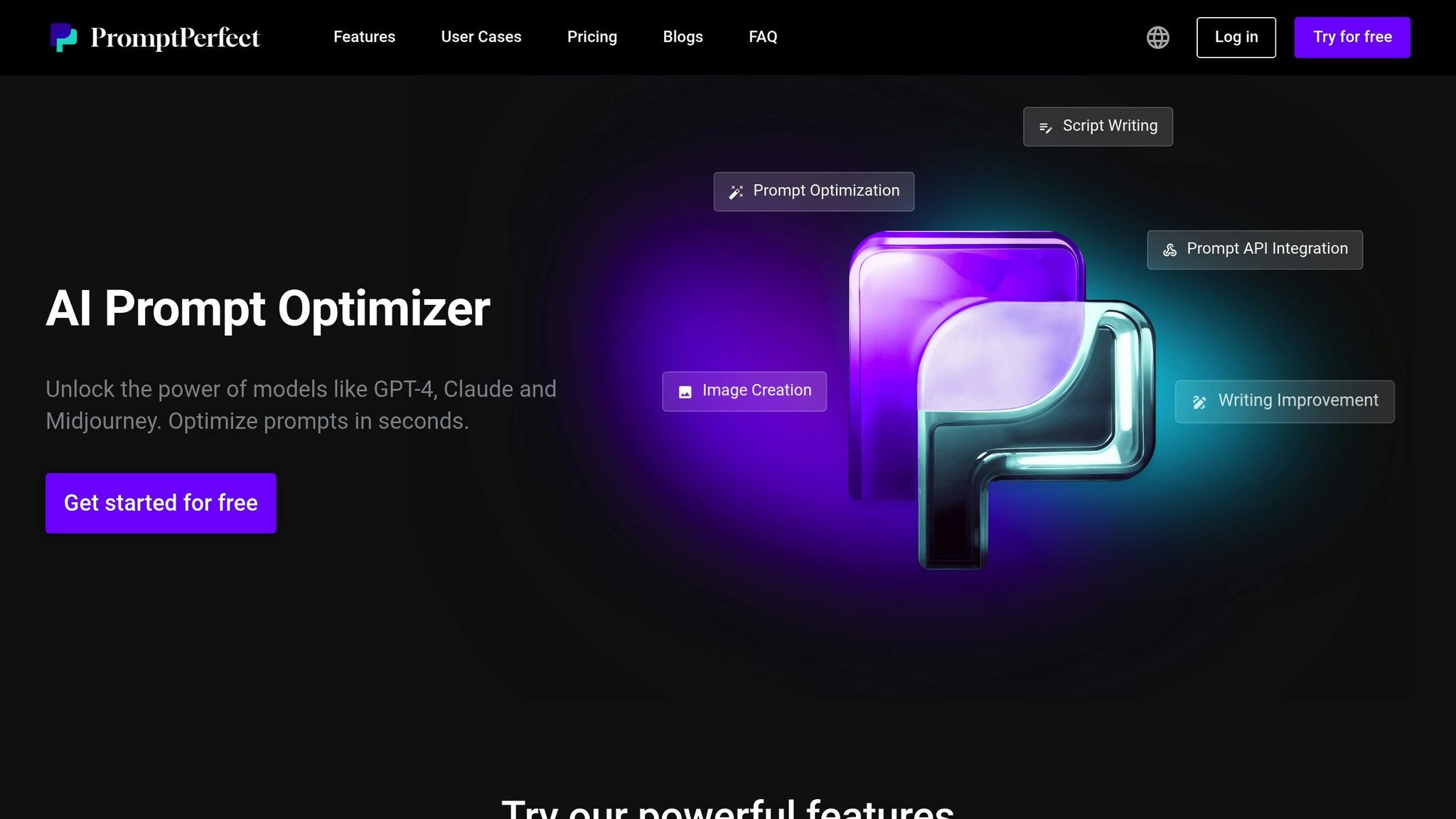
PromptPerfect uses AI-driven reinforcement learning to refine prompts, tailoring them to meet goals such as clarity, precision, and brevity. This tool is especially helpful for content creators, marketers, and developers who need quick, effective prompt adjustments. It integrates smoothly into advanced AI workflows, making it a valuable addition to any development pipeline.
The platform works with a wide range of models, including OpenAI's GPT-4, Anthropic's Claude, and image generators like DALL-E, Midjourney, and Stable Diffusion. Its side-by-side model comparison feature allows users to evaluate responses across models, helping identify the most effective option for their needs. Beyond text-based models, PromptPerfect also supports prompts for various media types, offering flexibility and cost savings. Additionally, it enables multilingual prompt optimization, ensuring the intent remains intact across different languages.
PromptPerfect includes features designed to manage costs effectively. Its multi-model comparison helps users find the most budget-friendly model that still delivers the desired quality. By using reinforcement learning to optimize prompt length, the platform reduces token usage, which directly cuts API expenses. Automation further minimizes trial-and-error efforts, saving both development time and money. This streamlined process ensures fewer iterations and more predictable costs during the prompt engineering phase.
LangChain Hub serves as a centralized platform for discovering, sharing, and managing prompts tailored to various large language models. It combines tools like version control, collaborative features, and deployment automation into a single workflow, specifically designed for prompt engineers. By focusing on seamless integration and cost-conscious solutions, LangChain Hub strengthens workflows while encouraging community engagement.
The platform's SDK enables users to integrate prompts across environments such as OpenAI, Anthropic, CrewAI, Vercel AI SDK, and Pydantic AI. With the ability to filter community-created prompts by specific models, use cases, or creators, users can ensure compatibility with their target LLMs. The LangSmith Playground further simplifies development by allowing prompts to be tested across various models like OpenAI and Anthropic within a single interface. Prompts are stored in a standardized template format and can be accessed through stable tags like prod or staging, making it easy to incorporate them into code regardless of the model being used. These features address the industry's growing need for streamlined prompt management and complement similar integrations seen in earlier platforms, creating a cohesive multi-model experience.
LangChain Hub also integrates seamlessly with GitHub and CI/CD pipelines, introducing automatic synchronization to simplify deployment processes. Users can set up webhooks that trigger actions like CI/CD pipeline initiation or prompt synchronization with GitHub repositories whenever a prompt is committed. Using commit tags such as prod or staging, users can update prompts without needing to redeploy code. This setup also allows for one-click rollbacks or updates by reassigning tags to different commits directly through the Hub interface, offering flexibility and control over prompt management.
The Public Prompt Hub acts as a searchable directory where users can explore, download, and fork prompts contributed by the community. Social discovery features, like sorting by favorites, views, or downloads, help users find high-quality prompts quickly. Forking allows users to adapt public prompts for their own needs, fostering iterative development and improvement. These community-driven tools mirror the automation benefits discussed earlier, emphasizing the value of collaboration. The platform has received a 4.5/5 rating on recommend.ai (based on 3,210 reviews), with users praising its extensive prompt library and ease of sharing. As Ethan Mollick aptly stated in a LangChain announcement:
Now is the time for grimoires... prompt libraries that encode the expertise of their best practices into forms that anyone can use.
OpenAI Playground Pro simplifies the process of developing and deploying prompts. Central to its design is the Prompt ID system, which secures published drafts while allowing ongoing improvements without disrupting live applications. This approach ensures flexibility in deployment and supports advanced cost management.
The Optimize tool is designed to identify and fix prompt inconsistencies before deployment, helping to minimize token waste. By integrating built-in Evals, teams can directly connect evaluations to prompts, catching potential issues during testing rather than in production. As highlighted by the OpenAI Help Center:
Re-run your linked Eval every time you publish - catching issues early is far cheaper than fixing them in production.
The platform also includes side-by-side comparison tools, enabling teams to visually analyze different prompt versions and choose the most efficient one before deployment. With OpenAI rolling out updates roughly every three days, these features are essential for keeping costs predictable and manageable.
The Prompt ID acts as a permanent reference, always pointing to the latest version of a prompt. This allows instant updates without requiring full CI/CD deployments. Developers can also pin specific versions for governance, ensuring greater control. The decoupled update system enables teams to modify prompts in the Playground and deploy changes instantly, simplifying the complexities of managing multi-agent AI systems. Additionally, one-click rollbacks make version control effortless.
Variables defined using {variable} syntax integrate smoothly with the Responses API and Agents SDK, ensuring the tested template performs exactly as expected in production. The platform’s project-level organization aligns with team structures, making it easier for engineers to manage and locate production-ready prompts. Clear folder naming conventions help reduce duplicate testing and inefficiencies.
Integration with OpenAI's Frontier enterprise platform further extends functionality, allowing interoperability across various clouds and execution environments. By supporting open standards, the platform eliminates the need for replatforming, reinforcing its role in streamlining prompt engineering workflows.

PromptLayer serves as a centralized system for logging every API interaction between your application and LLM providers. By creating a unified registry for multi-model workflows, it has become a leading choice for prompt management and collaboration as of early 2026.
Prompt engineering often requires smooth transitions between models, and PromptLayer's Prompt CMS simplifies this process. It stores templates that developers can access programmatically via an SDK. This setup allows model switching or prompt logic updates through an intuitive visual dashboard - no need to redeploy code. Non-technical team members can tweak prompts in real time, with those updates instantly reflected in production. Additionally, the platform offers batch testing capabilities, enabling regression and backtesting of prompts across various models.
PromptLayer doesn’t just streamline workflows - it also helps manage costs effectively. By monitoring cost and latency trends across features and models, it provides insights into resource usage. Logged request histories are enriched with metadata and tags, making it easy to pinpoint high-cost or slow requests. Each API call is versioned and tracked, allowing users to evaluate cost-performance ratios for different providers. This makes it easier to determine which models offer the best balance of performance and value for specific tasks.
PromptLayer seamlessly integrates with existing deployment pipelines, offering features like release labels and webhook-driven caching. Developers can use labels (e.g., "prod" or "staging") within the SDK to update prompt templates via the visual dashboard, with changes taking effect immediately - no application code redeployment required. For high-traffic scenarios, webhook-driven caching ensures updates to local caches or databases whenever a prompt template is modified. This reduces latency while maintaining reliability. For more intricate workflows, the platform provides managed agent infrastructure that coordinates model communications and triggers deployments through APIs.

Comparison of Top 5 Prompt Engineering Tools for 2026: Features, Pricing, and Best Use Cases
When selecting a prompt engineering tool, your decision will likely depend on factors like team size, budget, and technical needs. The platforms reviewed here offer a variety of pricing models, ranging from free options to custom plans tailored for large enterprises. Below is a breakdown of pricing structures, cost management features, and interoperability capabilities.
Prompts.ai uses a pay-as-you-go TOKN credit system, with business plans starting at $99 per member per month for the Core tier and $129 per member per month for the Elite plan. This model avoids recurring fees while granting access to over 35 LLMs, integrated FinOps cost tracking, and enterprise-level governance tools. PromptPerfect, on the other hand, caters to individual creators and small teams, offering paid plans that focus on optimizing prompts across models like GPT-4 and Claude. LangChain Hub, available through LangSmith, provides a free tier with additional pricing options for larger organizations working within the LangChain ecosystem. OpenAI Playground Pro sticks to a usage-based, pay-per-token billing system, making it better suited for prototyping rather than large-scale operations. Lastly, PromptLayer employs a freemium model, with paid tiers offering Git-style versioning and cost-per-prompt analytics, ideal for smaller teams or early-stage projects.
From a cost management perspective, each platform brings unique tools to the table. Prompts.ai offers real-time cost tracking across multiple LLMs, making it easier for teams to scale without losing financial oversight. PromptPerfect leverages reinforcement learning to optimize prompts, reducing token usage and saving on API costs. LangChain Hub integrates token usage monitoring within its pricing tiers, while OpenAI Playground Pro provides clear visibility into token costs via its usage-based model. PromptLayer focuses on tracking costs and latency for each version of a prompt, allowing teams to evaluate the cost-performance balance across providers.
Interoperability is another area where these platforms differ. Prompts.ai connects to over 35 LLMs through one unified interface, eliminating the hassle of managing multiple API keys and billing accounts. PromptLayer uses model-agnostic templates, enabling smooth transitions between providers without rewriting logic. LangSmith offers built-in instrumentation for LangChain and LangGraph applications, while OpenAI Playground Pro provides direct access to OpenAI model parameters. For enterprises, platforms like Prompts.ai stand out with centralized governance, SOC 2 compliance, and advanced cost monitoring, which help avoid prompt sprawl and unexpected charges in large-scale AI deployments.
Here’s a quick comparison of the key features:
| Tool | Starting Price | Best For | Key FinOps Feature | Interoperability Strength |
|---|---|---|---|---|
| Prompts.ai | $99/member/month (Core) | Medium to Large Enterprises | Real-time cost tracking across multiple LLMs | Unified access to 35+ LLMs, including GPT-5, Claude, LLaMA, Gemini |
| PromptPerfect | Paid plans | Small Teams & Individuals | Automated multi-model optimization | Supports GPT-4, Claude, and other major models |
| LangChain Hub | Free tier + Tiered pricing | Medium Teams using LangChain | Token usage tracking and monitoring | Native LangChain/LangGraph integration |
| OpenAI Playground Pro | Usage-based billing | Prototyping & Experimentation | Direct token cost visibility | Direct access to OpenAI model parameters |
| PromptLayer | Freemium model | Small to Medium Teams | Cost and latency tracking per version | Model-agnostic prompt templates |
For smaller teams with tight budgets, PromptLayer's freemium tier offers a solid starting point. Medium-sized teams can benefit from LangChain Hub's tiered pricing, which balances debugging features with manageable costs. For large enterprises, Prompts.ai provides centralized governance, compliance certifications, and scalable AI management, all without hidden fees.
Choosing the right prompt management tool can redefine how organizations deploy AI. As generative AI adoption is expected to reach 75% of enterprises by 2026, moving from static, hardcoded prompts to a systematic, scalable approach is no longer optional - it’s essential.
Organizations that implement mature prompt management practices see faster results, with structured version control cutting deployment times significantly. While each platform discussed here caters to unique needs, they all tackle the same challenge: eliminating bottlenecks in AI development.
Hardcoded prompts can take days to adjust, but dedicated tools allow updates in minutes. This empowers product managers, domain experts, and designers to iterate independently, speeding up development cycles and cutting costs. Moreover, these tools help avoid expensive mistakes. Without systematic evaluation, teams face higher regression rates and risk inflating operational costs by 30–50% due to inefficient token usage. Features like real-time cost tracking, automated testing, and production observability replace guesswork with actionable insights, ensuring data-driven decisions.
Whether you’re launching your first AI feature or managing a complex ecosystem of prompts across multiple models, the right tools bring order to potential chaos. By integrating agile prompt management with real-time cost analysis, these platforms provide the precision and performance needed to meet the demands of 2026’s AI landscape. For teams looking to scale operations while maintaining enterprise-level governance and seamless access to large language models, Prompts.ai offers the agility and oversight required to succeed.
Prompts.ai brings distinct benefits to enterprises focused on prompt engineering. By centralizing access to over 35 top-tier large language models (LLMs), such as GPT-4, Claude, and Gemini, the platform allows users to manage multiple models seamlessly from one location. This integration not only simplifies workflows but also eliminates the hassle of juggling multiple tools, leading to greater efficiency.
The platform also addresses cost concerns with real-time tracking of expenses and token usage, offering the potential to reduce AI operational costs by as much as 98%. On top of that, it prioritizes enterprise-level security, governance, and compliance, ensuring all prompt management aligns with company policies and standards.
To further streamline processes, Prompts.ai includes features like prompt version control and structured testing. These tools enable teams to consistently develop, test, and deploy prompts with precision. Its ability to scale and integrate with existing systems makes it a powerful choice for organizations aiming to boost productivity, control expenses, and uphold rigorous standards in their AI initiatives.
Real-time cost optimization in prompt engineering tools relies on smart features like dynamic prompt routing, token usage tracking, and cost monitoring. These tools evaluate workflows on the fly, directing simpler tasks to more affordable models and tweaking prompt complexity to reduce costs.
By actively tracking token consumption and model expenses, these platforms help avoid surprise charges and maintain effective budget control. This is particularly crucial for high-volume AI operations, where token-based pricing can escalate rapidly. With integrated cost tracking and optimization, teams can expand their workflows efficiently while keeping expenses in check.
Interoperability with various AI models is crucial for smooth prompt management, as it enables teams to integrate and oversee multiple large language models (LLMs) within a unified workflow. With advanced systems like GPT-5, Claude, Gemini, and LLaMA becoming more prevalent, managing each model separately can quickly become inefficient and time-draining.
Leveraging tools that work across multiple LLMs allows organizations to choose the most suitable model for specific tasks, simplify processes, and lower operational costs. This strategy promotes consistency, makes better use of resources, and eases deployment, keeping teams efficient and prepared in the fast-changing AI landscape.