Pay As You Go - AI Model Orchestration and Workflows Platform



Managing workflows securely is critical for modern businesses. This article compares two leading AI platforms - Prompts.ai and Standard Enterprise Platforms - designed to enhance productivity while maintaining strict security. Here's what you need to know:
Key Takeaway: Choose Prompts.ai for efficiency and affordability, or opt for Standard Enterprise Platforms if your priority is advanced security for sensitive data.
| Feature | Prompts.ai | Standard Enterprise Platforms |
|---|---|---|
| Security | SOC 2, GDPR, HIPAA compliance | Vaultless tokenization, PII redaction |
| Workflow Tools | 35+ AI models, unified interface | Zero Trust architecture, hybrid cloud support |
| Cost | $99–$129/month (per member) | Free Developer Edition; scalable pricing |
| Best For | Teams seeking cost savings and ease of use | Industries requiring strict data protection |
Make the right choice by evaluating your organization's security needs, budget, and operational goals.

Prompts.ai vs Standard Enterprise Platforms: Feature and Pricing Comparison
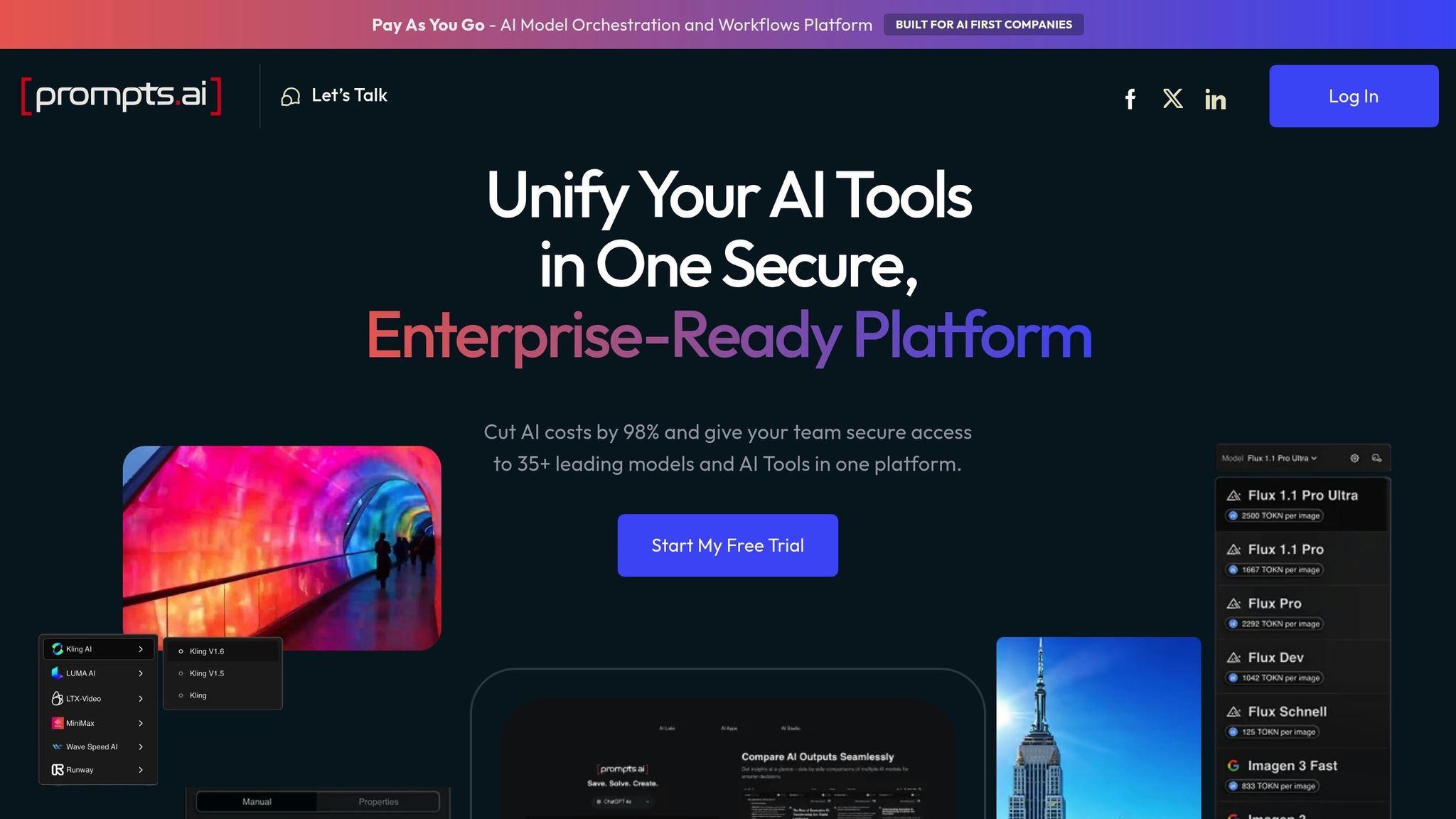
Prompts.ai prioritizes security at every level, adhering to stringent standards such as SOC 2 Type II, HIPAA, and GDPR. The platform began its SOC 2 Type II audit on June 19, 2025, and ensures ongoing control monitoring through Vanta. By offering centralized governance, Prompts.ai provides full visibility and auditability of all AI interactions, allowing compliance teams to track every prompt and response. A dedicated Trust Center, accessible at trust.prompts.ai, showcases real-time security updates, policies, and compliance measures, giving security officers immediate access to critical protection details. This commitment to security is the backbone of all Prompts.ai features, from workflow management to cost optimization.
Prompts.ai's robust security framework supports seamless workflow orchestration. The platform connects users to over 35 AI models through a secure, unified interface, simplifying tasks like rendering, proposal creation, sales automation, and cross-department operations. Steven Simmons, CEO and Founder, highlights its transformative impact:
"With Prompts.ai's LoRAs and workflows, he now completes renders and proposals in a single day - no more waiting, no more stressing over hardware upgrades."
By turning one-off tasks into scalable, repeatable workflows, Prompts.ai drives efficiency across teams. Mohamed Sakr, Founder of The AI Business, emphasizes this benefit:
"Instead of wasting time configuring it, he uses Time Savers to automate sales, marketing, and operations, helping companies generate leads, boost productivity, and grow faster with AI-driven strategies."
This streamlined approach not only improves productivity but also supports cost-effective operations.
Prompts.ai delivers significant cost savings through its TOKN credit system, which eliminates recurring per-task charges. Pricing starts at $99 per member per month for 250,000 TOKN credits under the Business plan. The Pro tier, at $119, provides 500,000 credits, while the Elite plan costs $129 and includes 1,000,000 credits. For individuals, plans begin at $29 per month. By consolidating over 35 separate AI tools into a single platform, Prompts.ai claims to reduce AI costs by up to 98%. This makes enterprise-grade AI accessible to smaller teams without compromising on security or compliance. The cost model integrates seamlessly with enterprise systems, enhancing affordability and efficiency.
Prompts.ai integrates effortlessly with popular enterprise tools like Slack, Gmail, and Trello, enabling automated, cross-platform workflows. Business and enterprise tiers include "Interoperable Workflows", which connect various AI models and internal systems for smooth operations. Teams can deploy the platform in under 10 minutes, replacing fragmented tools and significantly increasing productivity. Higher-tier plans also offer features like TOKN Pooling and Storage Pooling, allowing organizations to manage resources effectively across users and departments. This level of interoperability ensures that teams can work smarter and faster, all within one cohesive system.
Standard enterprise platforms prioritize safeguarding data from ingestion to output using advanced, data-focused security measures. One standout feature is vaultless tokenization, a high-speed approach that protects sensitive information while maintaining its usability. This ensures that the data remains functional for analytics and operations without revealing actual values.
In addition, AI semantic guardrails are integrated to automatically detect and redact sensitive content in real-time, preventing the exposure of personally identifiable information (PII) in both prompts and outputs generated by AI. These platforms also utilize machine learning classifiers to identify sensitive data types, such as PII, protected health information (PHI), and financial records. Steve Etchelecu, Solution Architect, emphasizes the importance of this protection:
"Protecting our customer's PII data is essential. Protegrity tokenization accelerates our secure transformation while enabling advanced analytics with protected data".
With strong security as a foundation, enterprise platforms implement Zero Trust architectures using Kubernetes alongside Terraform and Helm. This ensures secure, automated updates across systems. Centralized policy management enables consistent enforcement of rules for redaction, masking, and encryption, spanning hybrid cloud setups, on-premises environments, and AI model pipelines.
Every discovery and tokenization action is meticulously logged in OpenSearch, offering a complete data trail from source to model output. This logging capability supports compliance with standards like SOC 2 and HIPAA, making it easier for organizations to meet stringent regulatory requirements.
To accommodate varying needs, these platforms provide flexible pricing options. The Developer Edition is free and designed for notebooks and CI/CD pipelines. The Team Edition caters to departmental workloads, offering local policy control, while the Enterprise Edition includes service-level agreements (SLAs), hardware security module (HSM) key management, and hybrid entitlement features.
Designed to work seamlessly across diverse systems, these platforms are framework- and hyperscaler-agnostic. They support native connectors to both modern data platforms and legacy systems, allowing organizations to integrate security without overhauling existing infrastructure.
Additionally, all protection and policy events can be exported to enterprise Security Information and Event Management (SIEM) systems, ensuring full transparency and readiness for audits. This extensive connectivity underscores the platform’s focus on secure and smooth integration within enterprise ecosystems.
Weighing the trade-offs can help ensure your investments align with your security and operational needs.
Prompts.ai brings together over 35 leading large language models into a single, secure interface. Its pay-as-you-go TOKN credit system eliminates recurring subscription fees, offering potential savings of up to 98% on AI software costs. The platform also provides real-time FinOps controls and transparent governance, giving users clear insights into usage, spending, and performance. However, while it excels at streamlining AI orchestration and cost management, it’s not designed to deliver advanced, data-centric security features like tokenization or sensitive data classification. For organizations prioritizing these capabilities, traditional enterprise platforms may be a better fit.
Standard Enterprise Platforms focus heavily on data security. For instance, tools like the Protegrity AI Enterprise Edition offer features such as high-speed vaultless tokenization that maintains data formats for analytics, centralized policy management with distributed enforcement across various environments, and advanced discovery and classification to identify sensitive information before it enters AI workflows. On the downside, these platforms often involve tiered deployment models, starting with free Developer Editions and scaling up to more comprehensive plans. This approach may demand a higher upfront investment and greater technical expertise.
Cost structures also set these two approaches apart. Prompts.ai offers per-member monthly plans ranging from $99 to $129, tied directly to usage. In contrast, Standard Enterprise Platforms typically start with free options but incur additional infrastructure costs as needs grow. Choosing between these tools means balancing the efficiency of AI orchestration with the level of data-centric security required to meet your workflow management goals.
Selecting the right AI tool depends on your organization's unique priorities. Each platform has its strengths, whether you're focusing on cost savings, operational efficiency, or robust security measures.
For teams prioritizing cost management and streamlined AI orchestration, Prompts.ai stands out. With transparent FinOps controls and no recurring subscription fees, it offers a pay-as-you-go system using TOKN credits, reducing AI costs by up to 98%. This makes it an excellent choice for organizations seeking consolidated AI tools, predictable pricing, and quick deployment without the need for extensive infrastructure investments.
However, if your workflows involve highly sensitive data and demand advanced protection measures - such as tokenization, real-time monitoring, and automated data classification - a Standard Enterprise Platform may be a better fit. These platforms cater to industries like healthcare, finance, or government, where stringent data protection and compliance are non-negotiable.
When making your decision, weigh your security requirements, budget, and technical resources. Prompts.ai offers predictable per-member pricing, ranging from $99 to $129 per month, which scales with usage. On the other hand, enterprise security platforms often require specialized IT expertise to manage deployment across hybrid multicloud environments. Carefully assess your current security framework, financial constraints, and workflow intricacies to determine the platform that best supports your secure workflow management objectives.
Prompts.ai prioritizes secure workflow management through advanced, built-in security protocols. Your data is protected with encryption both during transmission and while stored, ensuring sensitive information remains secure. The platform also employs role-based access controls (RBAC), granting access only to authorized individuals for specific workflows.
For added transparency, every action is recorded in immutable audit trails, offering a clear record of who accessed what and when. Prompts.ai aligns with top industry standards, including AIRTP+ and SOC 2, underscoring its dedication to data privacy and security. These robust measures make it a dependable solution for securely managing sensitive AI workflows.
Prompts.ai operates on a pay-as-you-go TOKN credit system, allowing you to pay solely for the AI resources you utilize. This flexible pricing structure helps cut unnecessary costs and ensures full transparency with real-time cost tracking.
By adopting this model, businesses can reduce AI model usage expenses by up to 98%, offering a smart and budget-friendly option for managing secure workflows.
AI-powered workflow management tools bring immense value to industries dealing with sensitive data, strict regulations, and complex, high-volume operations. In financial services and banking, they play a crucial role by enabling real-time analytics and ensuring robust oversight. Similarly, the healthcare sector depends on these tools to safeguard patient privacy, maintain security, and streamline operations - all while meeting stringent regulatory requirements.
Other industries, including government agencies, insurance, telecommunications, and energy, also benefit from secure automation. These tools improve efficiency, ensure compliance with industry-specific standards, and unify processes while safeguarding critical information across various systems.