Pay As You Go - AI Model Orchestration and Workflows Platform


Save time, cut costs, and simplify AI workflows - this guide explores five AI tools designed to automate tasks, reduce expenses, and boost productivity for businesses of any size. From managing support tickets to automating sales processes, these platforms deliver measurable results. For example, Remote saved $500,000 annually by automating IT ticket resolutions, while Vendasta recovered $1 million in lost revenue through AI-enhanced lead enrichment.
Here’s a quick overview of the tools covered:
Each platform balances cost, features, and ease of use. Whether you’re a solo creator or a large enterprise, this article helps you find the right tool to streamline your operations and achieve more with AI.

AI Workflow Tools Comparison: Features, Pricing & Best Use Cases
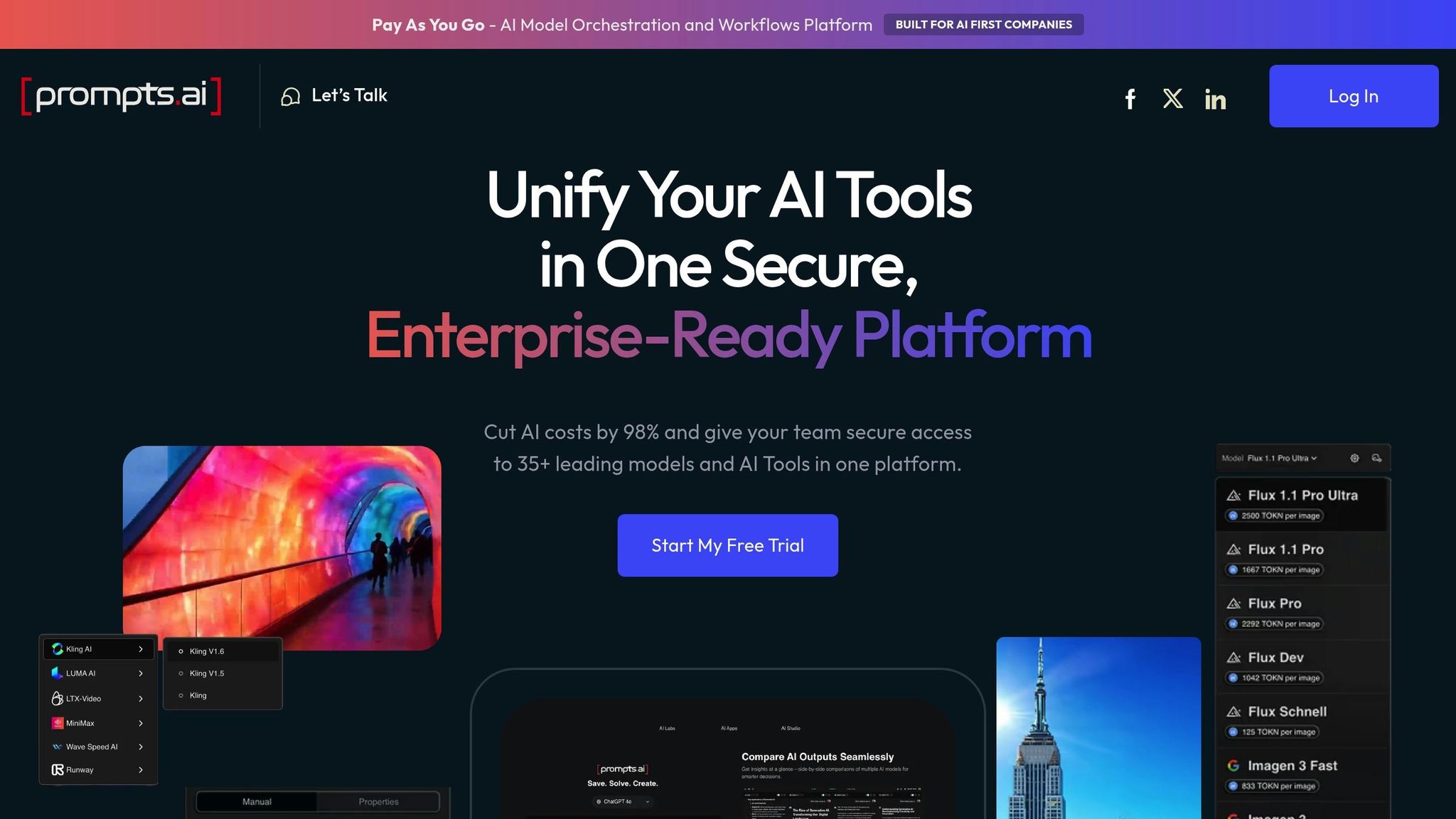
Prompts.ai operates on a TOKN credit system, allowing users to access over 35 top-tier AI models, including GPT-5, Claude, LLaMA, and Gemini. This system transforms fixed software expenses into flexible, on-demand spending, with the company claiming that organizations can reduce AI costs by up to 98%.
The pricing tiers cater to a variety of needs:
These options make it easier for non-technical teams to adopt and scale AI solutions without incurring excessive costs. Steven Simmons, CEO & Founder, highlights how Prompts.ai has streamlined his work, enabling him to complete architectural renders and proposals in a single day instead of weeks. By consolidating tools into one platform, users save on hardware upgrades, vendor management, training, and additional security measures.
Prompts.ai is designed to integrate effortlessly with popular business tools like Slack, Gmail, and Trello. This allows teams to automate workflows without leaving their existing tech stack. The platform’s "Interoperable Workflows" feature - available with Business and Pro plans - ensures smooth data flow across AI models and connected apps, preventing data silos.
A standout feature is its side-by-side comparison tool, which lets users test outputs from models like GPT, Claude, and Gemini before committing TOKN credits to larger tasks. Architect Ar. June Chow uses this capability to evaluate models for complex projects, selecting the one that best fits each task to bring her innovative designs to life.
Prompts.ai supports around-the-clock automation, turning one-off tasks into scalable workflows. Pre-built templates, branded as Time Savers, simplify automation for sales, marketing, and operations. Mohamed Sakr, Founder of The AI Business, uses these templates to generate leads and boost productivity without the need for manual setup. Similarly, Frank Buscemi, CEO & CCO, leverages the platform to streamline content creation and strategy, allowing his team to focus on high-level priorities while maintaining quality.
The platform’s practical applications include drafting personalized emails, organizing support tickets, and summarizing analytics for executive reviews. Additionally, its FinOps layer provides visibility into token usage, tying spending directly to business results and enabling teams to manage costs more effectively.
Prompts.ai prioritizes security and compliance, aligning with SOC 2 Type II, HIPAA, and GDPR standards. The SOC 2 Type II audit began on June 19, 2025, underscoring the platform’s commitment to robust security practices. Key features include role-based access control, separation of environments (e.g., staging vs. production), and full audit logs for workflow runs. Teams can configure workflows to exclude sensitive fields from external models, enforce review steps for specific automations, and maintain detailed records for audits - critical for U.S. businesses handling regulated data.
The real-time Trust Center (trust.prompts.ai) offers transparency into the platform’s security posture, allowing compliance teams to verify controls before deployment. These measures ensure sensitive data stays protected while enabling teams to innovate with confidence.
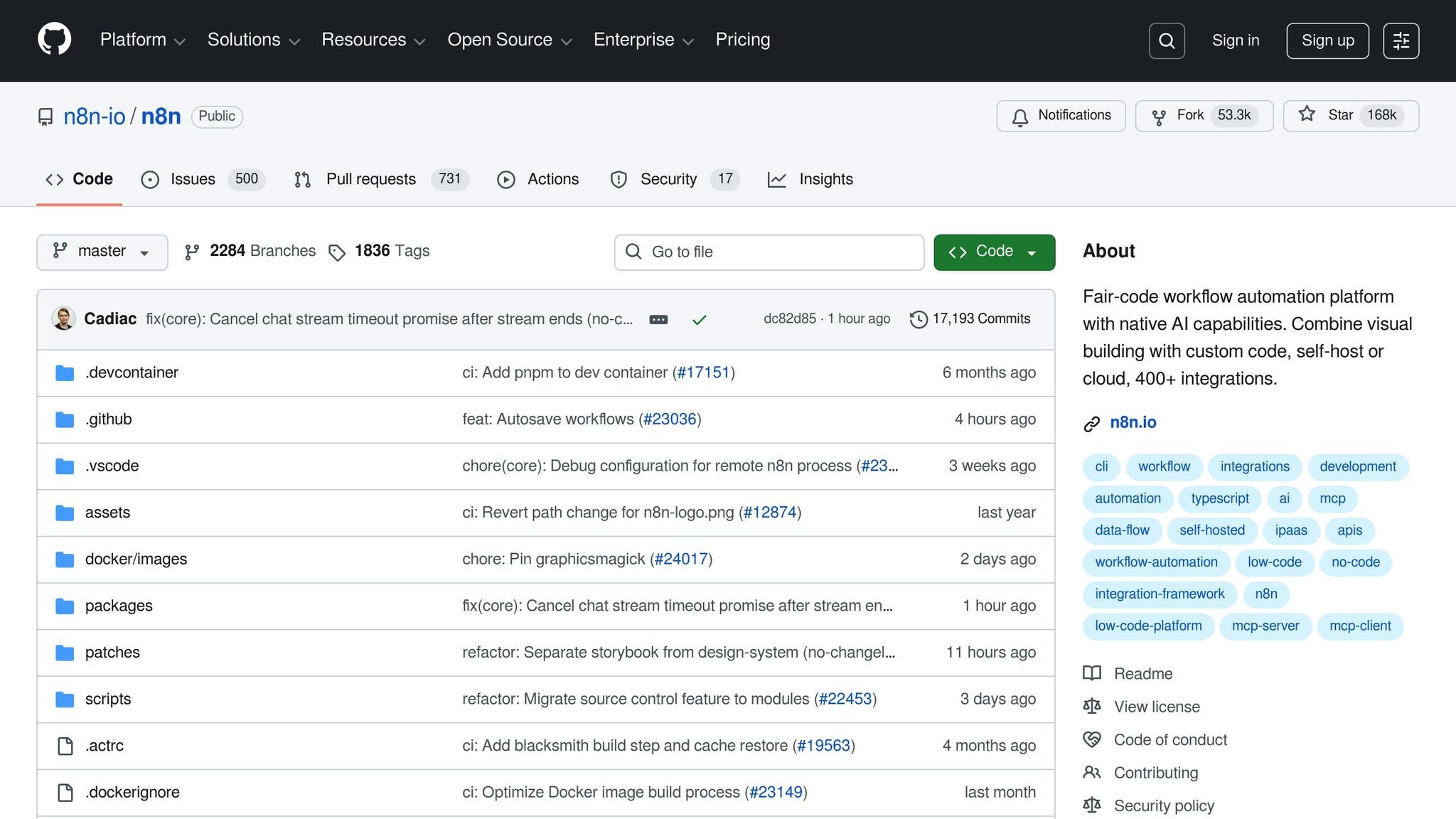
n8n uses an execution-based billing model, allowing unlimited steps, loops, and data processing within a workflow at a fixed cost. This means you can process thousands of records in a single loop for the same price as a simple two-step workflow [15,21].
The platform offers several pricing options. The Community Edition is free for self-hosted deployments, with no limits on executions or workflows. For managed cloud hosting, the Starter plan costs $24 per month (billed annually) and includes 2,500 executions and 50 AI credits. The Pro plan is priced at $60 per month (billed annually) and offers 10,000 executions with 150 AI credits. For organizations needing advanced features like single sign-on and version control, the Business plan is available for $800 per month (billed annually) and provides 40,000 executions. Early-stage startups with fewer than 20 employees and under $6 million in funding can receive a 50% discount on the Business plan [15,19]. This pricing structure supports scaling operations while managing costs effectively.
n8n integrates with over 400 applications through its intuitive drag-and-drop nodes, allowing seamless connections to popular business tools without requiring code. Its HTTP Request node simplifies API integrations, even enabling users to paste cURL commands for quick setup [15,18]. For technical teams, n8n offers flexibility through the Code node, supporting custom JavaScript or Python scripts. Self-hosted users can further expand functionality by incorporating npm packages [16,18]. Additionally, built-in AI nodes and LangChain support make it easy to integrate language models or create multi-step AI agents directly within workflows.
In 2024, Luka Pilic, Marketplace Tech Lead at StepStone, shared how his team reduced a two-week integration project to just two hours using n8n to connect marketplace data APIs.
"It takes me 2 hours max to connect up APIs and transform the data we need. You can't do this that fast in code."
- Luka Pilic, Marketplace Tech Lead, StepStone
n8n’s automation features are built to handle high-volume operations efficiently. A single instance can execute up to 220 workflows per second, making it well-suited for demanding automation tasks. The platform also provides over 1,700 pre-built workflow templates to help users quickly implement common automation scenarios [16,18]. Workflows can be triggered in various ways, including webhooks, app events, scheduled cron jobs, or event streams.
The execution-based pricing model makes n8n especially cost-effective for data-heavy tasks. Since loops don’t incur additional charges, users can sync thousands of records or process large datasets without worrying about escalating costs. For example, Dennis Zahrt, Director of Global IT Service Delivery at Delivery Hero, used a single ITOps workflow for user management, saving his company 200 hours every month in 2024.
"We have seen drastic efficiency improvements since we started using n8n for user management. It's powerful yet simple."
- Dennis Zahrt, Director of Global IT Service Delivery, Delivery Hero
n8n prioritizes security and governance, offering SOC 2 compliance and integration with encrypted secret stores like AWS Secrets Manager, Azure Key Vault, and HashiCorp Vault [16,18]. Enterprise users can securely retrieve credentials from these systems without storing them directly in n8n. The platform also supports SSO with SAML and LDAP, as well as role-based access control to manage team permissions. For organizations with strict data sovereignty requirements, n8n’s self-hosting option allows air-gapped operations on private networks, ensuring sensitive data remains entirely within the organization’s infrastructure [15,18].
Zapier operates on a task-based billing model, charging only for completed tasks. The platform doesn’t count polling activities or unused triggers toward your task limits, and advanced features like Filters, Paths, and Formatter are included for free.
The Free plan provides 100 tasks per month, unlimited Zaps, access to Tables and Interfaces, and AI Copilot assistance. For $19.99 per month (billed annually), the Professional plan offers 750 tasks, multi-step Zaps, and access to premium apps. The Team plan, designed for up to 25 users, costs $69 per month (billed annually) and includes shared app connections. For larger organizations, the Enterprise plan offers custom pricing alongside advanced administrative controls. If you exceed your task allowance, additional tasks are billed at 1.25× the base rate.
Companies across industries have reported significant savings with Zapier’s task-based approach. For example, a real estate firm and a remote IT team have both benefited from this model, which pairs cost efficiency with robust integration capabilities to streamline automation.
Zapier boasts the largest integration ecosystem in the automation market, connecting with over 8,000 apps. For apps without native integrations, the platform offers Webhooks on its Professional plan, enabling users to connect virtually any app through its API. Additionally, the Model Context Protocol ensures secure actions by external AI platforms.
In 2025, Vendasta combined Zapier with ChatGPT and lead enrichment tools to automate their sales processes. Jacob Sirrs, Marketing Operations Specialist at Vendasta, highlighted the impact:
"Because of automation, we've seen about a $1 million increase in potential revenue. Our reps can now focus purely on closing deals - not admin." - Jacob Sirrs, Marketing Operations Specialist, Vendasta.
This expansive integration network makes Zapier especially appealing for businesses aiming to simplify operations without breaking the bank. By connecting thousands of tools, Zapier transforms complex workflows into efficient, automated processes.
Zapier has grown beyond its origins as a simple app-to-app connector, evolving into a platform that integrates workflows, databases, forms, and AI assistants. One standout feature is Zapier Copilot, an AI assistant that helps users create and troubleshoot workflows through natural language prompts, making automation accessible even for those without technical expertise. Over 3.4 million companies rely on Zapier, and more than 1 million actively use its AI-focused features.
For example, a prominent sports team leveraged Zapier to cut down a 50-hour feedback process to just 3 hours.
"Zapier makes our team of three feel like a team of ten." - Marcus Saito, Head of IT and AI Automation, Remote.
Zapier prioritizes security and compliance, holding SOC 2 Type II and SOC 3 certifications while adhering to GDPR and CCPA standards. The platform employs AES-256 encryption for data at rest and ensures 99.99% uptime for critical workflows. Enterprise users gain access to additional features such as role-based permissions, audit logs, centralized monitoring of AI interactions, and Domain Capture, which restricts access to specific apps or actions.
Make stands out as a budget-friendly tool designed to streamline workflow automation while keeping costs under control. The platform operates on a credit-based pricing model, where each workflow action deducts one credit. This system, introduced on August 27, 2025, was designed to better align with resource usage, particularly for AI-driven features.
The Free plan offers 1,000 credits per month, access to over 3,000 apps, and beta-stage AI Agents, though workflows can only execute every 15 minutes. For $9 per month, the Core plan provides 10,000 credits, unlimited active workflows, and 1-minute execution intervals. The Pro plan, priced at $16 monthly, adds features like priority execution and custom variables. Meanwhile, the Teams plan at $29 per month includes shared templates and team roles. For businesses with larger needs, Enterprise pricing is tailored and includes perks like 24/7 support and the ability to handle files up to 1,000 MB.
Credits are deducted for every step in a workflow, including internal logic, polling triggers, and even failed runs. This structure differs from task-based pricing and can lead to higher costs for workflows with frequent actions or errors. To minimize credit usage, it's advisable to use webhooks instead of polling triggers whenever possible.
In December 2024, GoJob adopted Make and integrated AI tools, achieving a 50% boost in annual net revenue. Similarly, FranklinCovey automated key business processes with Make in September 2025, saving hundreds of thousands of dollars and reclaiming hundreds of staff hours.
Make's transparent pricing is complemented by its extensive integration capabilities. The platform connects with over 3,000 pre-built apps and offers more than 30,000 actions. It also supports custom app creation for any API, universal webhooks, and HTTP requests, making it possible to link with niche or proprietary systems. An on-premises agent further enhances security by enabling access to local networks, including essential systems like SAP.
The platform includes 400+ AI app integrations, supporting models such as OpenAI's ChatGPT-5, Anthropic Claude, and Google Vertex AI. Using the Model Context Protocol (MCP), Make centralizes and simplifies connections between services. Users can also integrate their own AI API keys to manage costs for heavy AI workloads, while reserving Make credits for standard automations.
In March 2025, #makeitfuture leveraged Make to automate AI-driven support processes, achieving a threefold increase in resolution rates.
Make offers a wide range of automation features, going beyond basic app-to-app connections. Its drag-and-drop builder allows users to visually map out workflows in real time. Advanced tools like AI Agents (currently in beta) adapt to changing conditions using reasoning, rather than relying solely on rigid if-then rules.
The Make Grid feature provides a visual overview of all automation processes, making it easier to track dependencies and troubleshoot issues. For instance, ChargeGuru, which manages over 500 workflows through Make, reported 60% faster debugging after implementing Make Grid. Additionally, an AI Content Extractor enables users to pull structured data from PDFs, images, and audio files up to 500 MB directly into workflows.
Businesses have seen notable improvements with Make's tools. Wemolo experienced a 7x boost in project management efficiency after adopting its visual orchestration features. Cayden Phipps, COO at Shop Accelerator Martech, shared:
"Make drives unprecedented efficiency within our business in ways we never imagined. It's having an extra employee (or 10) for a fraction of the cost."
Make prioritizes security and compliance, holding SOC 2 Type II and GDPR certifications, with two-factor authentication available across all plans. Enterprise users benefit from additional features like Single Sign-On (SSO) via OAuth2 or SAML2, SCIM for user provisioning, and detailed audit logs to track user activity. Data transfer scales efficiently, with 5 GB included for every 10,000 monthly credits.
For organizations with heightened security needs, the Enterprise plan offers domain claiming and 24/7 support. This robust security framework ensures sensitive data remains protected while enabling efficient automation across various departments.
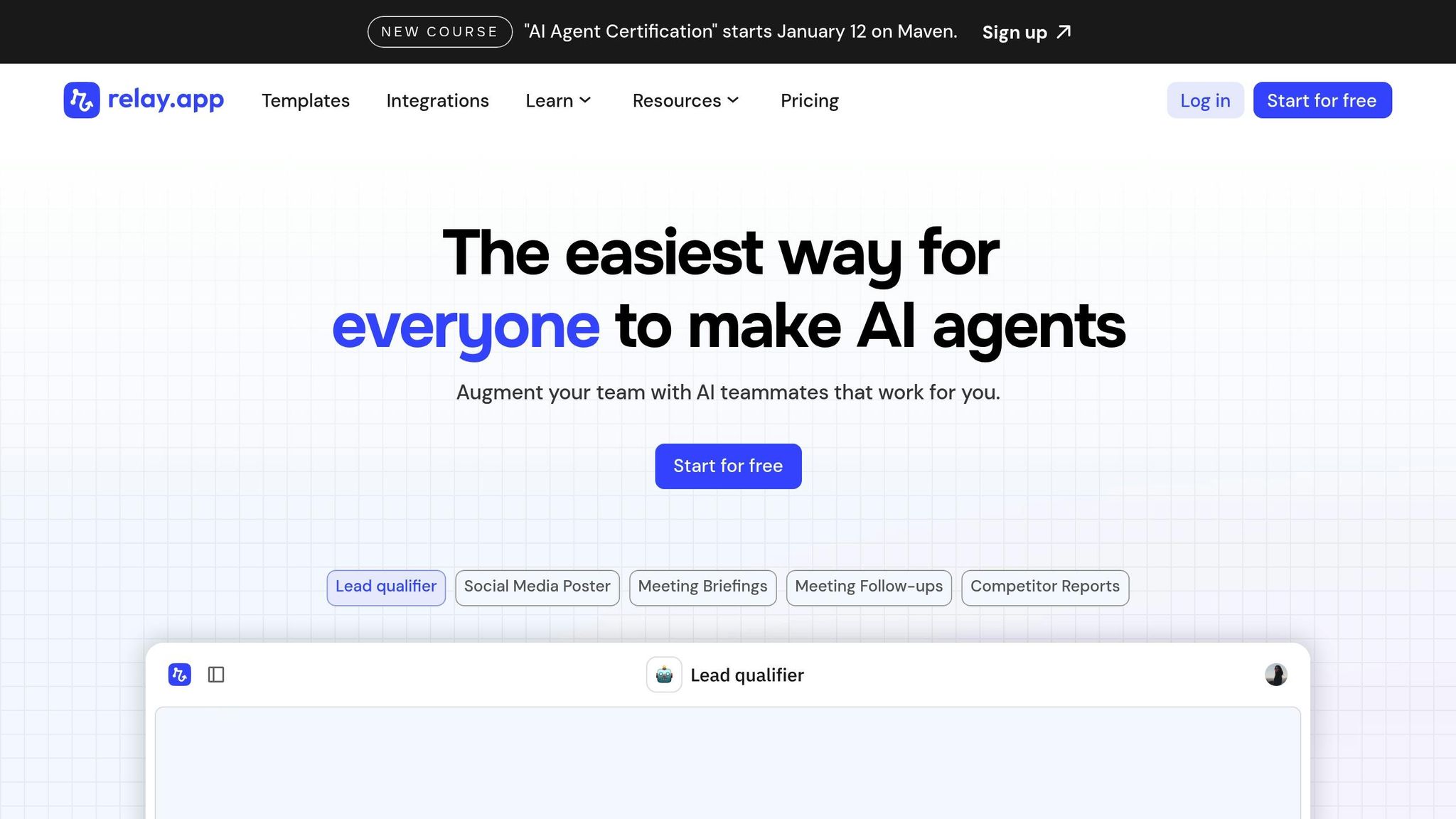
Relay.app bridges the gap between automation and human oversight by incorporating pauses in workflows for approvals or manual input, creating a human-in-the-loop system. This thoughtful approach ensures that automation is balanced with necessary human judgment, complementing other platforms in the automation space. The platform offers a Free plan with 200 steps and 500 AI credits per month, ideal for individuals experimenting with automation concepts. For more advanced needs, the Professional plan costs $19 per month, providing 750 steps and 5,000 AI credits, while the Team plan, priced at $69 per month, supports up to 10 users, offering 2,000 steps, 5,000 AI credits, and shared workspace features.
Relay.app’s pricing model is designed with fairness in mind - users are charged only for completed actions, meaning background checks don’t count against the monthly step limit. Credits are allocated based on the complexity of operations, ensuring users pay strictly for what they use. For those handling extensive AI tasks, Relay.app allows integration with personal OpenAI or Anthropic API accounts, enabling users to bypass credit limits altogether. Benjamin Borowski, Founder of Retactic, highlighted the platform's thoughtful design:
"Relay's human-in-the-loop model significantly enhances workflow efficiency. Not only is this the best designed UI for automation building on the market, they've really thought about how not everything can be automated."
Relay.app stands out with its extensive integration options, connecting seamlessly with over 100 third-party tools like Salesforce, HubSpot, Jira, and Slack. Its "linked objects" feature simplifies data access by linking related information - such as CRM contacts - without requiring multiple API calls. The platform also supports various AI models, including GPT-4o, Claude 3.5, and Gemini 1.5 Pro, enabling users to toggle between providers within a single workflow. For advanced customization, Relay.app offers webhook triggers and HTTP request capabilities, making it adaptable to unique business needs.
Relay.app’s approach to automation combines efficiency with flexibility. It offers three tiers of AI automation: built-in actions for tasks like summarization, custom prompts with structured outputs, and Mini AI Agents that autonomously choose actions. Its batch triggers allow workflows to process multiple tasks simultaneously, such as managing spreadsheet rows or addressing open Jira tickets in bulk. Eva Zivanovic from ZikiDoesNotion praised this feature:
"What makes them unique on the market is their Human-In-The-Loop functionality... [it] allows your company to add intermediate manual steps that can add unique judgment, context, and perspective."
Relay.app also prioritizes security and governance, making it a reliable choice for teams with strict compliance needs. Its Enterprise plan includes SOC2 and GDPR compliance, custom usage limits, and priority support. Across all plans, users benefit from shared workflows and collaborative live editing, while the Team plan introduces multiplayer roles, dynamically assigning tasks to team members during workflow execution. These features ensure that Relay.app not only enhances automation but also maintains the oversight and security organizations require.
Here’s a breakdown of the strengths and trade-offs of each platform, based on their features and use cases.
Zapier stands out with its extensive library of over 8,000 integrations and enterprise-grade security, making it a dependable choice for organizations requiring scalability. However, its action-based billing model can strain smaller budgets, even with its impressive 99.99% uptime and widespread adoption.
prompts.ai consolidates premium LLMs like GPT-5, Claude, and Gemini into a single subscription, eliminating the need for separate API keys. This streamlined approach is especially beneficial for teams focusing on automation rather than managing infrastructure. As Fidji Simo, CEO of Instacart, shared:
"Gumloop has been critical in helping all teams at Instacart - including those without technical skills - adopt AI and automate their workflows".
That said, as a newer entrant to the market, its support resources and community engagement are still evolving.
For technical teams, n8n offers a compelling option with its self-hosting capabilities, providing complete control over infrastructure and security. With over 5,000 community-created templates, it simplifies development. However, self-hosting requires dedicated IT resources for maintenance and updates. For those with the technical expertise, its Starter plan at $24/month for 2,500 executions offers strong value.
Make appeals to budget-conscious users, offering over 7,500 pre-built templates and a visual canvas for building complex workflows. Its Core plan, priced at $10.59/month, makes it a cost-effective choice for indie developers and small teams. However, the platform’s steep learning curve and credit-based billing for each trigger check can lead to unpredictable costs. Users have also noted that its error-handling capabilities could be more robust.
Lastly, Relay.app focuses on simplicity, featuring a human-in-the-loop model and an intuitive interface. It has earned a 4.9/5 rating on G2, reflecting its ease of use. The Professional plan, starting at $27/month, is ideal for individuals and small teams prioritizing straightforward automation. However, its smaller integration library may require the use of webhooks or custom HTTP requests for less-common apps. For those valuing ease of use over a wide range of integrations, Relay.app is a solid choice.
| Tool | Key Strength | Key Weakness | Best For | Starting Price |
|---|---|---|---|---|
| prompts.ai | Built-in LLMs; no API keys needed | Smaller support team | AI-native workflows | $37/mo (Solo) |
| n8n | Self-hosting; 5,000+ templates | Requires technical knowledge | Technical teams | $24/mo (Starter) |
| Zapier | 8,000+ integrations; SOC 2/3 security | Can become expensive at scale | Enterprise reliability | $19.99/mo (Pro) |
| Make | Budget-friendly; complex logic | Steep learning curve | Indie builders | $10.59/mo (Core) |
| Relay.app | Low learning curve | Limited integrations | Simple automation | $27/mo (Professional) |
This comparison outlines the key factors to consider when selecting the right platform, balancing cost, complexity, and specific operational needs.
Selecting the right AI workflow tool depends on your team's expertise, budget, and specific needs. Here's a breakdown to help you decide:
To make the best choice, align your platform with your operational goals. Solo creators can take advantage of free tiers from Make and Zapier. Startups with engineering resources might gravitate toward n8n's self-hosting capabilities. Mid-size companies will benefit from prompts.ai's unified access to top-tier LLMs and strong compliance features. Whether your focus is connecting apps or orchestrating AI agents, choose a tool that scales with your team and enhances your workflow efficiency.
Prompts.ai slashes AI costs by giving you access to over 35 AI models on a pay-as-you-go platform. Forget juggling multiple subscriptions - here, you only pay for what you actually use.
The platform includes real-time cost tracking, making it easy for businesses and individuals to keep tabs on their spending and adjust as needed. By combining tools into one system and using a usage-based billing model, Prompts.ai ensures you save money without compromising on productivity.
Prompts.ai places a strong emphasis on security and compliance, ensuring sensitive data is well-protected within its AI-driven workflows. The platform aligns with major privacy standards such as GDPR, HIPAA, and SOC 2, reflecting its commitment to maintaining high-level data protection.
Key features include secure data handling, automated compliance checks, and detailed audit logs. These tools allow businesses to safeguard confidential information, stay compliant with regulations, and gain complete transparency for governance and reporting purposes.
The TOKN credit system serves as prompts.ai's flexible, pay-as-you-go currency, designed to simplify how you access AI capacity. When you purchase TOKN credits - say, $100 worth - each model deducts a small, pre-set fraction of your balance in real time. This provides clear insight into your spending, ensuring you always know where your budget stands.
TOKN credits are compatible with all 35+ models on the platform, allowing you to switch effortlessly between options like GPT-4, Claude, or Llama without dealing with separate pricing structures. Your usage and remaining balance are conveniently displayed on a unified dashboard, streamlining cost tracking for both individuals and teams. Pricing adapts to your needs, ranging from $0 to $129 per member per month, based on how much you use.