Pay As You Go7 天免费试用;无需信用卡



AI workflow platforms are reshaping enterprise operations, enabling businesses to automate tasks, manage multiple AI models, and improve efficiency. By 2026, these tools will play a key role in 25% of enterprise processes, up from just 3% in 2025. Here are five platforms leading the charge:
| Platform | Audience | Key Feature | Starting Price |
|---|---|---|---|
| Prompts.ai | FinOps/Ops Teams | Multi-model orchestration | $99/member/month |
| n8n | Developers | Self-hosting, execution-based | $20/month |
| Zapier | Non-technical Users | 8,000+ integrations | $19.99/month |
| Vellum AI | AI Developers | Model evaluations, SDK tools | $25/month |
| Workato | Enterprise IT Teams | 1,200+ enterprise connectors | Custom pricing |
These platforms cater to diverse needs, from cost management to large-scale enterprise integrations. Dive in to discover which one fits your workflow goals.
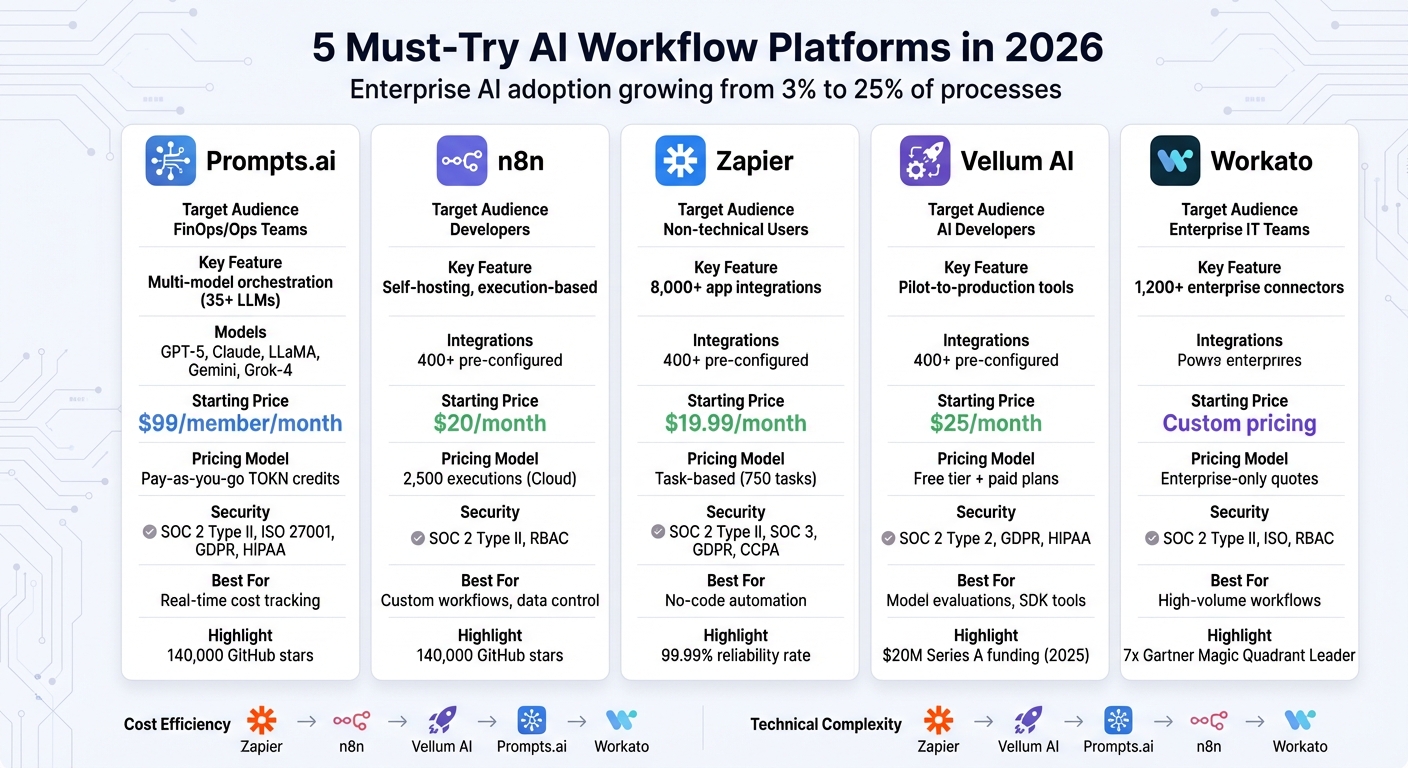
AI Workflow Platforms 2026: Feature and Pricing Comparison
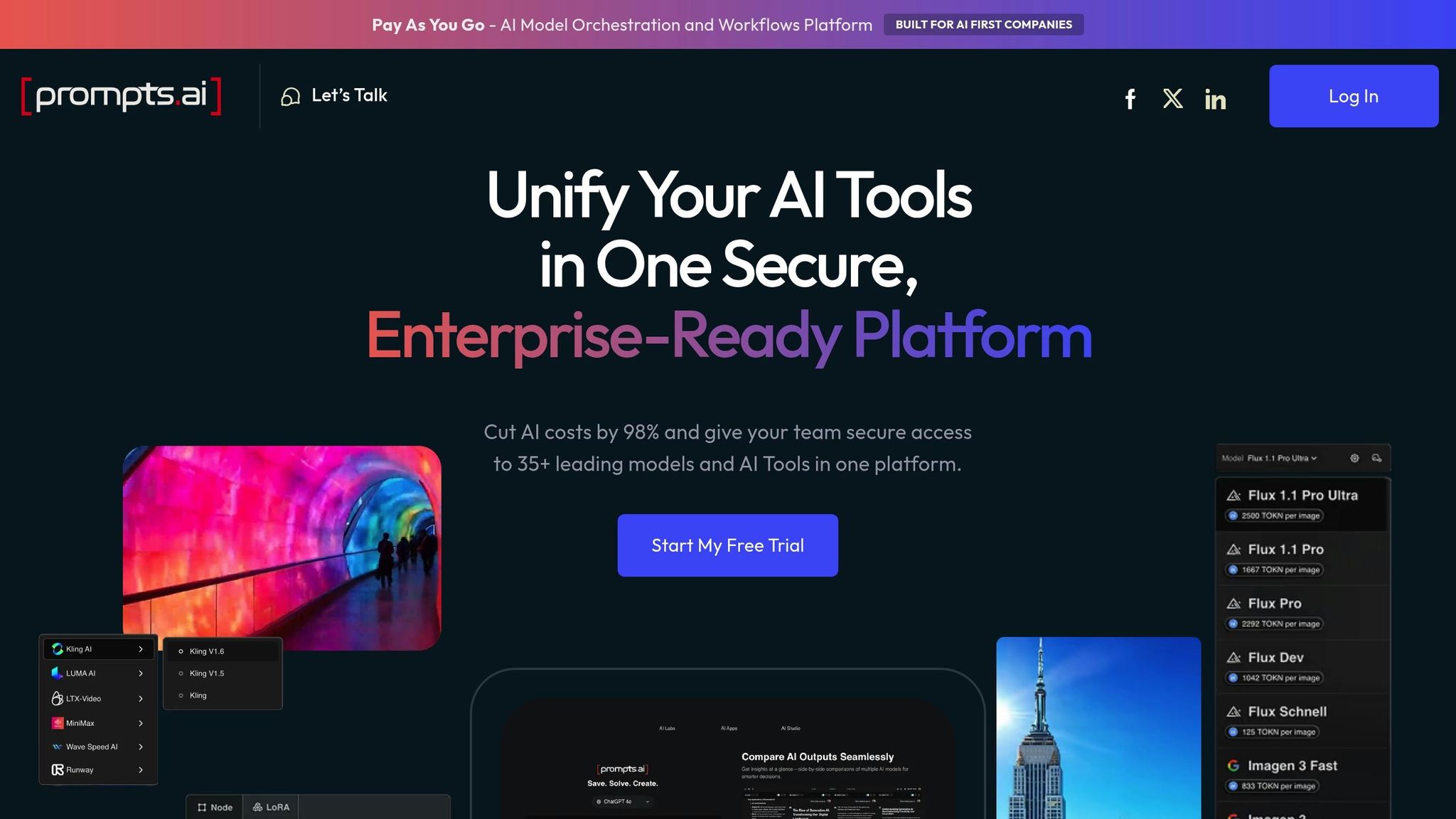
Prompts.ai is an enterprise-grade AI orchestration platform that brings together over 35 top-tier large language models (LLMs) - including GPT-5, Claude, LLaMA, Gemini, Grok-4, and Flux Pro - into one secure and centralized interface. This platform simplifies AI management by eliminating the need for juggling multiple subscriptions, enabling teams to create and automate workflows with ease.
Prompts.ai ensures smooth integration across models, giving users the freedom to switch between LLMs mid-workflow or compare their performance in real time. For example, a customer service team could use a cost-efficient model for routine queries while assigning complex issues to a more advanced option - all within a single workflow. This flexibility allows businesses to incorporate new AI advancements without overhauling their existing systems.
Security and compliance are at the heart of Prompts.ai. The platform adheres to SOC 2 Type II, ISO 27001, GDPR, and HIPAA standards, safeguarding sensitive data throughout every AI interaction. Administrators can implement role-based access controls to specify who can use particular models and workflows, while detailed audit logs track every prompt, response, and model call. This level of accountability is especially vital for industries like healthcare and finance, where compliance and transparency are non-negotiable.
Thanks to its modular architecture, Prompts.ai easily scales to meet the needs of any team. Whether it’s a small creative agency using AI for image generation or a Fortune 500 enterprise managing thousands of customer interactions daily, the platform adapts effortlessly. Teams can start with straightforward workflows and expand to intricate, multi-step processes that integrate models, APIs, and logic. Adding new users, models, or templates is a quick process, taking minutes rather than months.
Prompts.ai’s pay-as-you-go TOKN credit system eliminates the hassle of recurring subscription fees, aligning costs directly with usage. Real-time tracking of token consumption provides clear insights into spending across teams and projects, helping organizations identify high-value workflows and opportunities to substitute costlier models with budget-friendly alternatives without compromising quality. Plans start at $99 per member per month for the Core tier, with the Elite plan - ideal for creative teams needing advanced features - available at $129 per member monthly.
Up next, learn how n8n builds on this streamlined approach to AI-powered workflows.
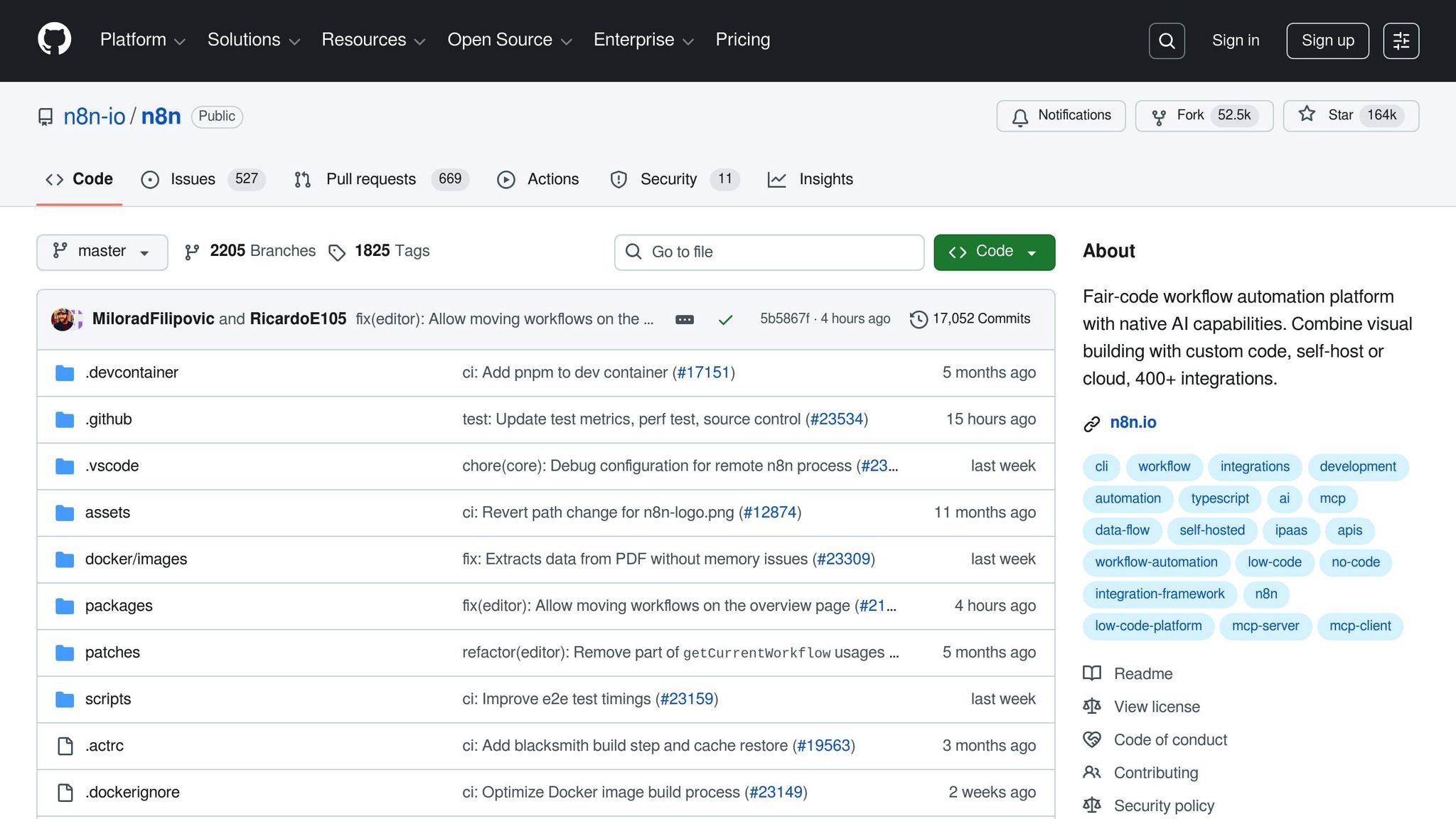
n8n is an open-source workflow automation platform designed with a developer-first approach and self-hosting capabilities. Backed by a community-driven fair-code model, it allows organizations to run workflows on their own infrastructure, ensuring complete control over data. With an impressive 140,000 GitHub stars, n8n has established itself as a trusted tool for automation.
Let’s dive into how n8n’s AI integrations streamline workflows.
n8n offers native AI nodes compatible with leading LLM providers like OpenAI, Anthropic, Google Gemini, Cohere, and Hugging Face. These integrations make it easy to embed AI functionality directly into workflows. Built on LangChain, the platform supports advanced AI features such as memory, chaining, and autonomous agents. For example, in 2025, SanctifAI implemented n8n to manage tasks for over 400 employees, achieving a 3X faster workflow launch within just two hours. This efficiency enabled product managers to independently build and test AI workflows, minimizing reliance on limited engineering resources.
Additionally, n8n supports the Model Context Protocol (MCP), enabling seamless interaction between external AI systems and its workflows. Users can blend deterministic logic - like if/then branches and loops - with AI-driven reasoning. The platform also integrates with vector databases such as Pinecone, Qdrant, and Weaviate, making it ideal for Retrieval-Augmented Generation pipelines.
For industries with strict regulations, n8n’s self-hosting option provides a secure environment where sensitive data, API credentials, and business logic remain within the corporate network. The platform meets SOC 2 Type II compliance standards and undergoes yearly third-party security audits. Enterprise plans include advanced features like Single Sign-On (SAML and LDAP) and Role-Based Access Control, offering precise permission management. Furthermore, n8n integrates with tools like AWS Secrets Manager, Google Cloud Secret Manager, Azure Key Vault, and HashiCorp Vault to securely handle API keys.
n8n is built for scalability, capable of executing up to 220 workflows per second on a single instance. Its "Queue Mode" uses Redis to distribute workflow tasks across multiple worker nodes, allowing for horizontal scaling. With over 400 pre-configured integrations and more than 4,000 starter templates, the platform is versatile enough to handle everything from small projects to enterprise-level operations.
n8n’s pricing is based on successful workflow executions, which can reduce costs by up to 80% for complex, multi-step workflows. The Community Edition is free for personal and internal business use, offering a budget-friendly option for smaller teams. Cloud plans start at $20/month (billed annually) for 2,500 executions, while the Cloud Pro plan costs $50/month for 10,000 executions. For larger organizations, custom Enterprise pricing includes advanced features like SSO, log streaming, and dedicated SLAs, ensuring tailored solutions for specific needs.
Zapier is an automation platform that connects over 8,000 apps, enabling the automation of more than 800,000 daily tasks with an impressive 99.99% reliability rate.
Zapier provides various ways to integrate AI into workflows. Its "AI by Zapier" feature allows users to access leading large language models - such as ChatGPT, Claude, Gemini, and Perplexity - without the hassle of managing API keys. For those requiring more advanced options, the platform offers over 500 AI-specific tools. Additionally, the Model Context Protocol facilitates effortless integration between external AI platforms and Zapier’s 30,000+ actions, eliminating the need for custom API development. Zapier Agents act as autonomous assistants, capable of conducting research, accessing internal knowledge bases, and executing complex, multi-step tasks.
For instance, in 2025, Popl, a digital business card company, implemented over 100 Zapier workflows to handle hundreds of daily inbound leads. By leveraging OpenAI for email triage and spam filtering, they automated lead enrichment and routed leads to sales teams based on company size and region. This approach saved Popl $20,000 annually.
With these robust integration options, Zapier strengthens its platform with top-tier compliance measures.
Zapier adheres to enterprise-grade security standards, including SOC 2 Type II, SOC 3, GDPR, and CCPA compliance. The Admin Center, introduced in December 2025, provides centralized management for security settings, approval workflows, and member oversight. Enterprise customers are automatically excluded from having their data used to train AI models, while other users can opt out manually. Additional security features include SAML-based Single Sign-On (SSO), SCIM for automated user provisioning, Two-Factor Authentication (2FA), and IP allowlisting.
To ensure sensitive AI outputs are handled securely, Zapier implements human-in-the-loop controls. For example, the "Guest Reviewers" feature allows external stakeholders to participate in approval workflows via secure links, without requiring full workspace access. Users frequently express high confidence in Zapier’s data security practices.
Beyond its secure operations, Zapier is designed to scale with organizations of any size.
Zapier's platform supports businesses ranging from small teams to large enterprises. For example, Remote, a company with 1,700 employees managed by a three-person IT team, used Zapier to automate 28% of its 1,100 monthly IT tickets. By integrating tools like Slack, Okta, and ChatGPT, they saved over 600 hours each month. Marcus Saito, Head of IT and AI Automation at Remote, shared:
"Zapier makes our team of three feel like a team of ten."
Zapier’s execution model also exempts triggers and built-in tools from task limits. For organizations with high-volume needs, a pay-as-you-go billing option - priced at 1.25 times the base task rate - ensures workflows continue uninterrupted.
These scalable features, combined with flexible execution models, deliver measurable efficiencies for businesses of all sizes.
Zapier’s pricing structure becomes more economical as usage grows. The Free plan includes 100 tasks per month and supports basic two-step workflows. The Professional plan, starting at $19.99 per month (billed annually), unlocks multi-step workflows, conditional logic, and premium app integrations. For larger teams, the Team plan begins at $69 per month (billed annually), offering 2,000 tasks and access for up to 25 users. Enterprise plans provide custom pricing, unlimited users, VPC Peering for secure internal data access, and advanced audit logs.
For example, ActiveCampaign built an AI-powered onboarding system using Zapier. By using webhooks to tag users by language and automatically enrolling them in tailored webinar sessions, they achieved a 440% increase in webinar attendance and reduced early-stage churn by 15%.
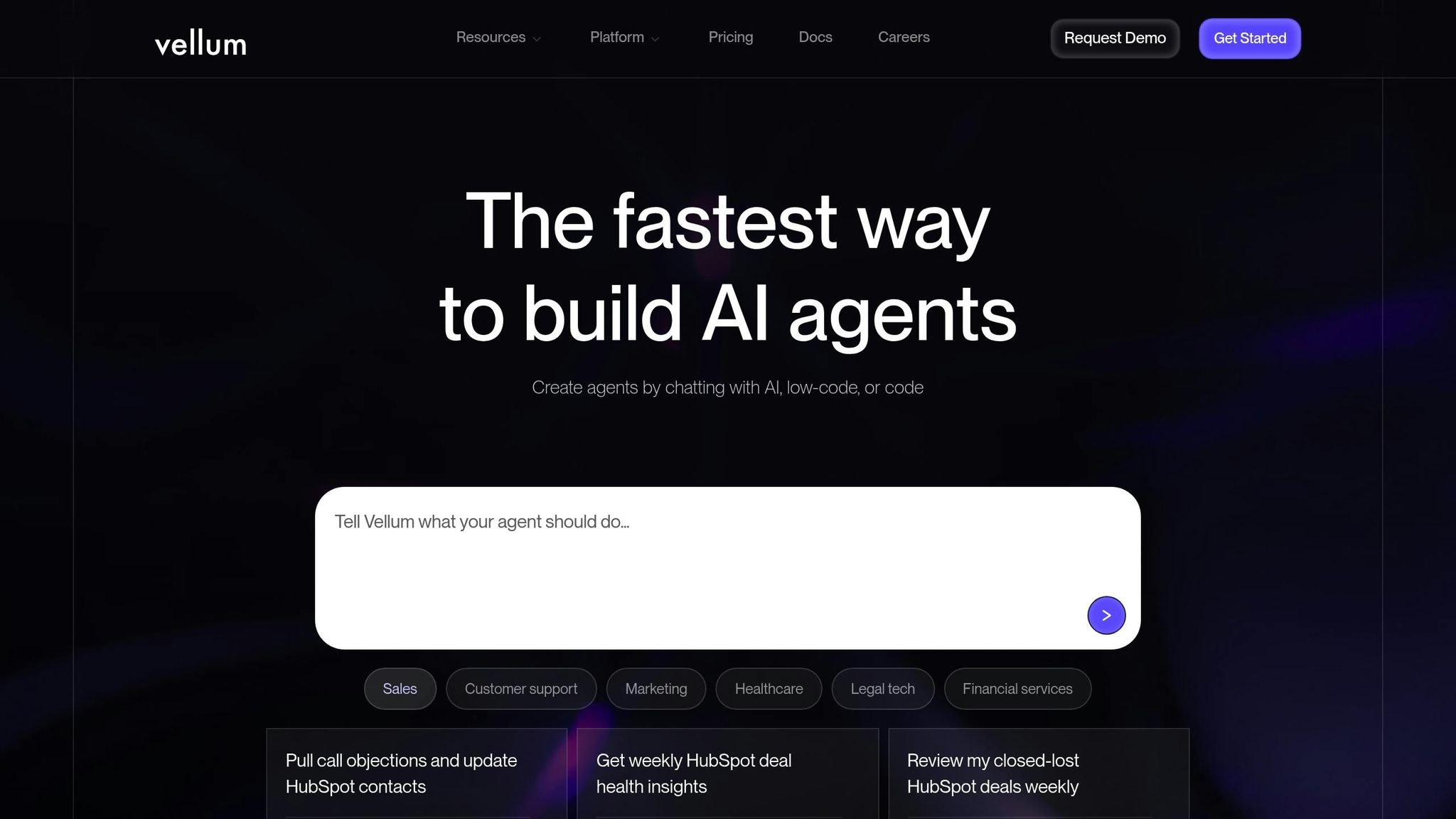
Vellum AI bridges the gap between AI experimentation and production. In July 2025, the company secured $20 million in Series A funding, addressing a key industry problem: 95% of generative AI pilots fail to transition into production due to infrastructure challenges. Vellum AI simplifies this process by combining deployment readiness with cutting-edge design, making it a vital part of the growing AI automation ecosystem.
Vellum's provider-agnostic setup allows seamless integration of models from OpenAI, Anthropic, Google, and others into a single workflow - eliminating the need for separate API integrations [26, 28]. Its low-code Visual Graph Builder lets users orchestrate LLM calls, write custom code (Python/TypeScript), and configure logic functions like loops and parallelism [26, 27].
One notable feature is the simultaneous model comparison, enabling teams to evaluate various LLMs based on quality, cost, and latency. The platform's Workflows SDK also offers bi-directional synchronization, allowing developers to fine-tune workflows in code while empowering non-technical users to iterate on prompts through a visual interface [26, 29]. Adam Daigian, Product Lead at Miri Health, shared:
"Vellum Workflows give us the opportunity to really tailor different parts of our product to the end users' needs without having to invest in tons of custom development, which has dramatically decreased our time to market."
Once workflows are optimized, they can be deployed across any model or provider with a single click, creating scalable inference endpoints ready for production. This ease of integration sets the stage for robust security and operational oversight.
Vellum ensures enterprise-grade data protection, meeting compliance standards like SOC 2 Type 2, GDPR, and HIPAA [28, 31]. Its governance framework includes RBAC (Role-Based Access Control), seamless SSO/SCIM integration, and immutable audit trails designed for rapid rollbacks and real-time monitoring [28, 31]. For workflows requiring extra caution, human-in-the-loop approval gates allow reviewers to pause and assess processes before they proceed [28, 31].
Versioning and one-click rollback options help prevent issues during production updates [26, 28]. Deployment flexibility includes cloud, private VPC, and air-gapped on-premise environments, catering to strict data residency requirements [28, 31]. Additionally, Vellum offers comprehensive observability, tracking every input, output, and decision made by AI agents, with node-level insights into latency and costs [26, 29].
Vellum’s Map Nodes enable parallel iterations over lists, making high-volume batch processing more efficient. Its modular architecture allows workflows to function as reusable "sub-workflows", seamlessly integrating into larger systems [27, 28]. Max Bryan, VP of Technology and Design, remarked:
"We halved our 9-month timeline and achieved decisive accuracy with our virtual assistant. Vellum has been instrumental in making our data actionable and reliable."
The platform’s Agent Builder further speeds up development by using natural language prompts to generate workflows in just minutes, significantly cutting down on engineering time [27, 30]. Pratik Bhat, Senior Product Manager at an AI product company, noted:
"The product team can build POCs with little to no assistance within a week."
Vellum’s model-agnostic routing helps businesses optimize costs by assigning lower-cost models to simpler tasks, such as categorization, while reserving more advanced models for complex operations [26, 33]. The platform provides detailed insights into token usage, latency, and model calls, along with budget caps and automatic throttling to prevent overspending.
Pricing options include a Free Tier, a $25 per month plan, and custom Enterprise packages, making it accessible to teams of all sizes [28, 30, 31]. This flexible pricing structure, combined with its technical capabilities, positions Vellum AI as an essential tool for enterprises navigating the AI landscape in 2026.
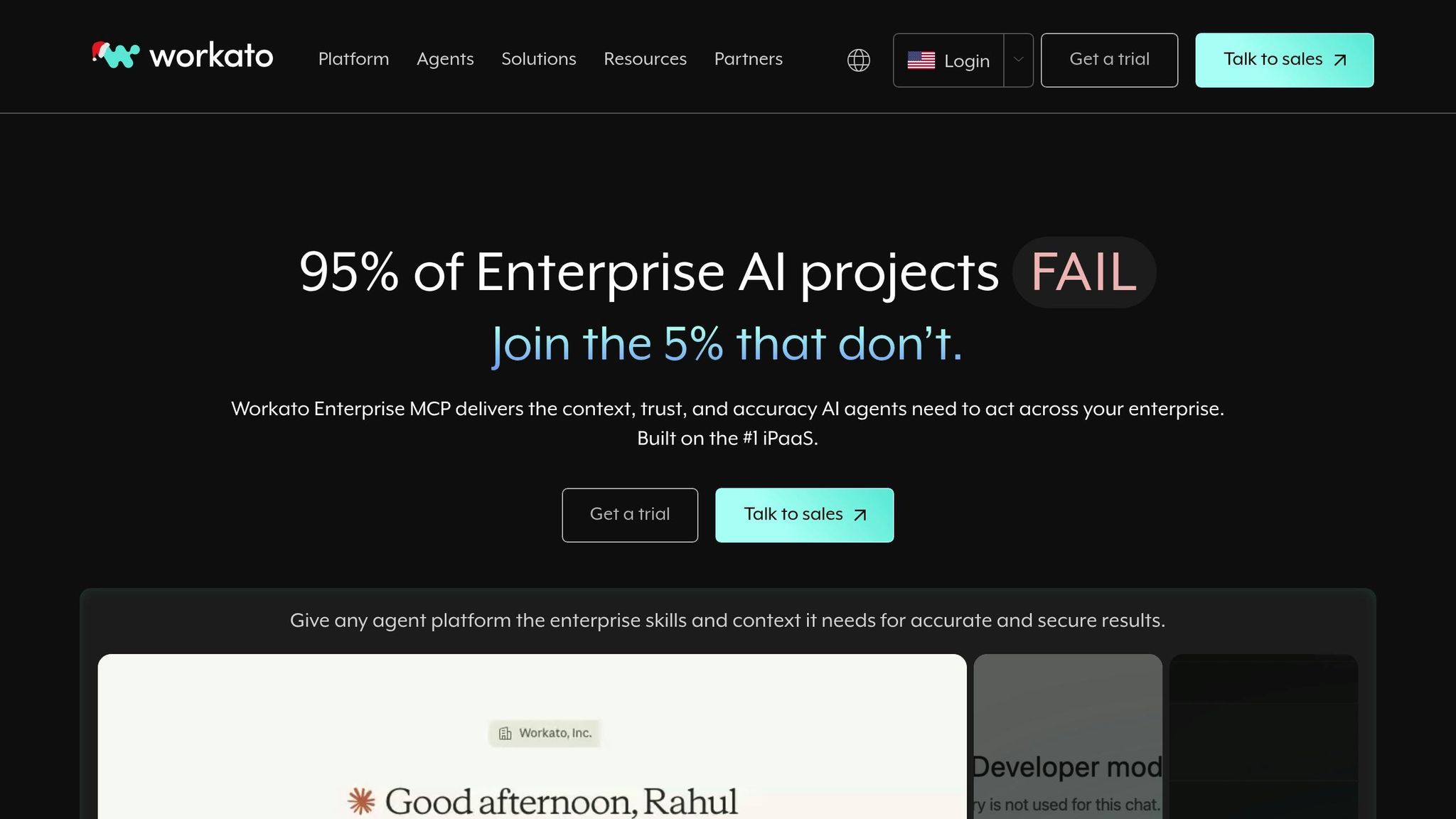
Workato stands out as an enterprise-grade integration platform tailored for organizations managing intricate, high-volume workflows. Recognized as a Leader in the 2025 Gartner® Magic Quadrant™ for Integration Platform as a Service (iPaaS) for the seventh year in a row, Workato offers access to over 1,200 prebuilt connectors. This makes it a key player for businesses looking to scale AI adoption while addressing the challenges of complex integrations.
Let’s explore how Workato leverages LLM interoperability to simplify these workflows.
Workato's Agent Studio provides a low-code environment for building AI agents that integrate seamlessly with large language models (LLMs), knowledge bases, and enterprise-specific skills. The Agent Orchestrator ensures smooth coordination of workflows across a variety of agents, including those from SaaS vendors like Salesforce and Workday, platform providers like Microsoft and Google, and custom-built agents via LangChain. This is achieved through support for the Model Context Protocol, enabling secure, standardized access to over 635,000 enterprise skills within the Workato community.
The AI by Workato Connector comes with preconfigured actions - such as summarization, translation, and data analysis - powered by Anthropic's Sonnet 4 and OpenAI's GPT-4o mini models. By transforming existing workflows into reusable "skills", Workato ensures consistent execution while maintaining both operational memory and transactional accuracy.
Workato prioritizes security and compliance with features like Agent Auth™, which enforces role-based data access. This, combined with the Sandbox testing environment, allows for human-in-the-loop reviews, particularly for workflows that require regulatory oversight. The platform meets SOC 2 Type II and ISO standards, ensuring all actions are auditable and reversible. Administrators can also limit AI agents to a predefined set of approved skills.
Additionally, the AI by Workato Connector supports data residency requirements by processing data within the same region as the source data center in both the US and EMEA. Importantly, user data is never used for training purposes.
Workato’s architecture is built to handle high-throughput environments, scaling effortlessly through its Recipes, which link complex business logic with AI-powered decisions. Features like built-in memory, rollback options, and error-handling mechanisms safeguard the integrity of transactions, even in the most demanding workflows. Mohit Rao, Head of Intelligent Automation, highlighted this approach:
"Business users have organically started using Workato. Once we identify those business users, we elevate them to be champions to empower other teams or other people, and use them to get the next wave of scale."
The platform’s Performance Copilot further enhances scalability by offering AI-driven suggestions to optimize recipes based on cost, performance, security, and quality. This combination of scalability and intelligent optimization tools makes Workato a valuable asset for IT teams and enterprises seeking reliable governance across departments.
Workato employs an enterprise-focused pricing model based on task volume, advanced connector usage, and user count. The AI by Workato Connector has rate limits of 60 requests per minute for direct customers and 10 requests per minute for embedded partners. AI features, including Copilot, are available under specific pricing plans, which require signing an AI feature addendum. For tailored enterprise pricing, businesses are encouraged to contact Workato directly.
Choosing the right AI workflow platform depends on your team's expertise, budget, and governance priorities. Prompts.ai stands out with real-time cost controls tailored for FinOps, while Zapier provides an easy-to-use, no-code interface ideal for beginners.
The table below highlights the audience, features, pricing, and security of each platform. For instance, n8n offers predictable pricing with charges based on workflow executions, while Zapier uses a task-based model where each action is counted separately. Workato is designed for enterprise IT teams, offering centralized governance and guaranteed SLAs, whereas Vellum AI focuses on helping developers transition AI pilots into production with built-in evaluations and versioning capabilities.
Here’s a quick side-by-side comparison to help you identify the platform that matches your needs:
| Platform | Primary Audience | Key Differentiation | Pricing Model | Governance & Security |
|---|---|---|---|---|
| Prompts.ai | FinOps/Ops Teams | Real-time cost controls for AI spend management | Pay-As-You-Go TOKN credits; Business plans start at $99/member/month | Cost governance and real-time spend tracking |
| n8n | Developers / Technical Teams | Source-available, self-hosting, custom nodes in JavaScript/Python | Free self-hosted; Cloud starts at $20/month for 2,500 executions | SOC 2, RBAC, AWS/GCP/Azure Vault secret management |
| Zapier | Non-technical Beginners | 8,000+ integrations, no-code UI, "Interfaces" and "Tables" | Free tier (100 tasks); Pro starts at $19.99/month for 750 tasks | Fully managed environment, individual workflow secrets |
| Vellum AI | AI Developers & Production Teams | Native evaluations, versioning, TypeScript/Python SDKs | Free tier available; Enterprise pricing via sales | VPC/On-prem deployment, native evaluations, versioning |
| Workato | Enterprise IT Professionals | 1,200+ enterprise connectors, prebuilt "Genies", centralized governance | Enterprise-only; custom quotes based on tasks and users | SOC 2 Type II, RBAC, guaranteed SLAs |
Each platform offers distinct advantages: n8n provides flexibility for developers with its customizable templates and code options, while Zapier is perfect for non-technical users seeking simplicity with its drag-and-drop interface. Enterprises looking for strong compliance and governance often turn to Workato. Meanwhile, for teams aiming to manage AI costs effectively, Prompts.ai delivers unmatched transparency with its integrated cost tracking tools. Use this comparison to find the platform that aligns best with your operational goals.
The shifting landscape of AI workflows calls for platforms that align with diverse operational priorities. By 2026, Prompts.ai stands out with real-time FinOps controls and seamless access to over 35 leading language models, offering a unified ecosystem to meet various needs.
For developers, n8n provides execution-based pricing starting at $20 per month for 2,500 executions, a model that helped Delivery Hero save 200 hours each month. Non-technical users benefit from Zapier's extensive library of 8,000+ integrations at $19.99 per month. Meanwhile, enterprises can rely on Workato for its SOC 2 Type II certification and role-based access, ensuring compliance and security.
Platforms like n8n, with unlimited-step workflows, often prove more economical compared to credit-per-step pricing models. As AI-enabled workflows are projected to grow from 3% to 25% of all enterprise processes by the end of 2025, selecting a platform that adapts to your organization's growth is crucial. Whether you're a developer, a business user, or part of an enterprise team, there are tailored solutions to meet your specific needs in this dynamic AI landscape. Choose the platform that aligns with your goals and scales with your ambitions.
AI workflow platforms bring a new level of simplicity and efficiency to businesses by combining multiple large language models and automation tools into a single, cohesive system. With everything in one place, companies no longer need to juggle multiple subscriptions or APIs. This streamlined approach can drastically cut costs - potentially slashing AI-related expenses by up to 98% - while delivering up to 10× improvements in productivity. A pay-as-you-go credit system adds another layer of control, allowing businesses to track usage in real time and avoid surprise charges.
These platforms also make operations smoother with intuitive drag-and-drop workflow builders, seamlessly integrating AI-driven decision-making into existing systems. Automated tasks such as data enrichment, routing, and real-time analysis help eliminate repetitive manual work, saving time and reducing operational costs. On top of that, robust governance tools, including SOC 2 Type II compliance and role-based access controls, ensure workflows adhere to critical regulations like HIPAA and GDPR. This makes it easier for enterprises to adopt AI securely and at scale.
Prompts.ai places a strong focus on security and compliance, ensuring your AI workflows remain safe and dependable. Data is safeguarded through encryption - both during transit and at rest - while role-based access controls manage permissions, restricting access to authorized users only. Every action on the platform is meticulously recorded in immutable audit trails, creating a searchable log ideal for audits or internal reviews.
When it comes to compliance, Prompts.ai holds certifications like SOC 2 Type II and the AIRTP+ certification, demonstrating its expertise in AI security. The platform is also equipped to handle major data privacy regulations, including GDPR and HIPAA, with features like built-in policy checks and automated compliance reporting. These measures allow organizations to confidently expand their AI initiatives while staying aligned with industry-standard security and regulatory demands.
Prompts.ai provides a range of pricing options to meet various needs, offering three primary tiers: a free starter plan designed for individuals and small teams, a professional plan with a fixed monthly fee in USD for those requiring higher usage, and an enterprise plan featuring custom pricing tailored to the needs of larger organizations. Customers can opt for annual billing at a discounted rate or stick with the flexibility of monthly payments.
The platform also employs a credit-based system for API calls and model usage, allowing expenses to adjust based on your activity. To help new users get acquainted with the platform, a free trial is available. All pricing is displayed in USD (e.g., $49/month), ensuring clarity for U.S.-based customers when calculating costs and comparing plans.