Pay As You Go7 天免费试用;无需信用卡
获取我的免费试用版
December 22, 2025

Increasingly Popular Platforms For Prompt Engineering In AI

Chief Executive Officer

December 23, 2025

Prompt engineering is the key to unlocking better AI performance, cost savings, and efficiency. This article breaks down three leading platforms - Prompts.ai, OpenAI Playground, and LangChain - used to manage and optimize prompts for large language models (LLMs). Each platform offers unique tools for improving workflows, reducing costs, and scaling operations.

Key Takeaways:

  • Prompts.ai: Best for enterprises needing multi-model orchestration, cost tracking, and advanced prompt management tools.
  • OpenAI Playground: Ideal for quick testing and prototyping within the OpenAI ecosystem.
  • LangChain: Designed for complex workflows, multi-provider setups, and advanced integrations.

Benefits:

  • Cost Savings: Reduce AI costs by up to 75% with features like prompt caching and batch evaluations.
  • Scalability: Manage growing AI workflows with tools like versioning, metadata tagging, and centralized dashboards.
  • Flexibility: Access 35+ LLMs, including OpenAI, Anthropic, and Google, with modular frameworks and reusable templates.

Quick Comparison:

Platform Best For Key Features Cost Management Tools Scalability Features
Prompts.ai Enterprise orchestration Visual Prompt CMS, 35+ LLMs, regression tests Usage analytics, batch testing Metadata tagging, Workspaces
OpenAI Playground Quick prototyping Dynamic placeholders, Prompt ID system Model-specific optimizations Version history, Prompt IDs
LangChain Complex workflows, multi-LLM Chains, RAG, LangSmith Spend analysis via LangSmith Modular task decomposition

These platforms cater to different needs, from simple testing to enterprise-grade workflows, helping teams streamline AI operations and achieve consistent results.

Comparison of Top 3 Prompt Engineering Platforms: Features, Pricing, and Best Use Cases

Comparison of Top 3 Prompt Engineering Platforms: Features, Pricing, and Best Use Cases

1. prompts.ai

prompts.ai

LLM Integration

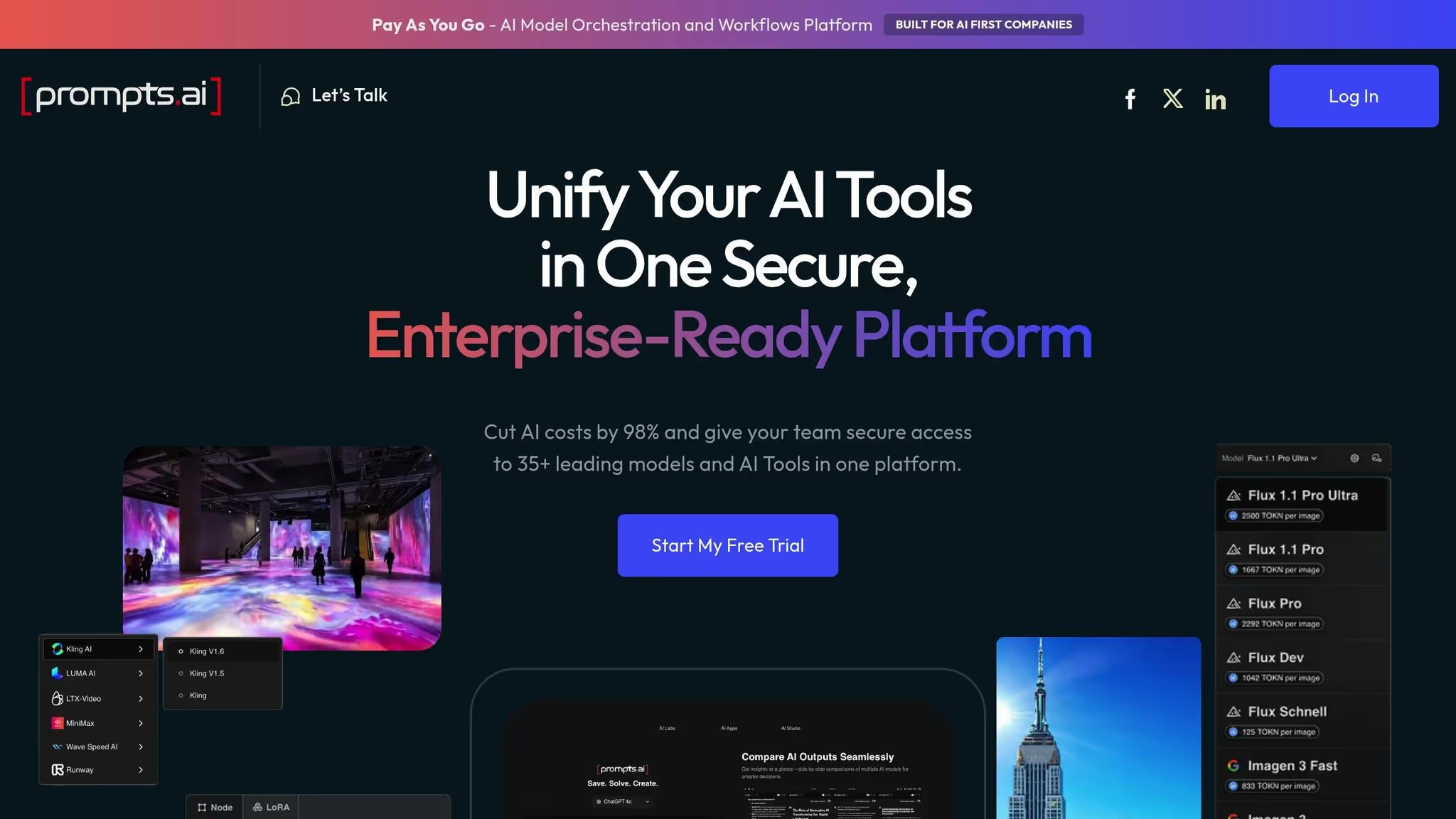
Prompts.ai acts as a bridge between your application code and large language model (LLM) APIs, offering a robust system for tracking and optimizing interactions. Every request is logged and enriched with metadata, giving you advanced tracking capabilities. The platform includes a visual Prompt CMS, allowing teams to create, version, and manage prompt templates independently of the core application code. This separation ensures that prompt logic remains flexible and easy to update.

A built-in Playground further enhances usability by letting users replay and debug past requests directly within the dashboard. It also supports OpenAI function calling for testing purposes, a feature not available in OpenAI's native playground. Beyond OpenAI models, the system accommodates custom models, fine-tuned versions, and dedicated OpenAI instances, along with over 35 leading LLMs. Teams can even batch-run prompts against sample datasets, enabling regression tests and backtesting of new iterations to ensure prompt reliability before deployment. These tools help streamline workflows and prevent production issues.

Cost Efficiency

Prompts.ai offers detailed usage analytics to help teams monitor and control LLM-related spending. Features like batch evaluations and regression testing ensure that inefficient prompts don’t waste valuable tokens in live environments. Pricing is structured to suit a range of needs, starting at $0 for 5,000 monthly requests with 7-day log retention. The Pro plan, at $50 per user per month, includes 100,000 requests and unlimited log retention. For larger organizations, custom enterprise pricing is available, featuring SOC 2 compliance and dedicated evaluation resources.

Scalability

Designed for production-ready environments, prompts.ai scales effortlessly to meet the demands of expanding AI workflows. Features like built-in versioning and metadata tagging make rollbacks straightforward, while advanced search tools and Workspaces promote collaboration across teams. Whether you’re an engineer, content writer, or legal professional, the platform ensures smooth cross-functional teamwork without disrupting your application’s performance.

Community and Support

Prompts.ai ensures users have multiple ways to access support, including a dedicated Discord channel, email, and updates via Twitter. Enterprise customers gain additional benefits, such as a shared Slack channel for direct communication with the support team, ensuring prompt and efficient assistance.

2. OpenAI Playground

OpenAI Playground

LLM Integration

The OpenAI Playground provides a centralized environment to test and experiment with various models, including GPT-3.5, GPT-4, GPT-5, and reasoning models like o3. It offers three distinct modes: Chat for conversational AI, Assistants for API tasks involving code execution, and Complete for legacy text completion.

A standout feature is the Prompt ID system, which allows developers to reference the latest production-ready prompts while working on drafts. This approach minimizes disruptions caused by changes during testing. To streamline prompt development, the platform includes dynamic placeholders (e.g., {{variable}}) and an Optimize tool, which automatically fixes inconsistencies and ensures output formats meet requirements.

Users can compare outputs from different prompt versions side-by-side and utilize integrated Evals to conduct manual tests and monitor results. This modular setup equips teams to handle complex workflows with efficiency and scalability.

Cost Efficiency

Choosing the right model is critical for cost management. Reasoning models are generally more expensive than standard GPT models, and larger models often come with higher costs compared to their smaller "mini" or "nano" versions. To cut expenses, prompt caching can reduce latency by up to 80% and operational costs by as much as 75%. Placing commonly used content at the beginning of prompts can further optimize performance.

For better stability and predictable budgeting, it's recommended to pin applications to specific model snapshots (e.g., gpt-4.1-2025-04-14) rather than relying on the latest dynamic versions. As OpenAI emphasizes, "Catching issues early is far cheaper than fixing them in production".

Scalability

The Playground organizes prompts at the project level, enabling teams to share, manage, and reuse prompt assets through a centralized dashboard. Version history with one-click rollback ensures teams can iterate confidently without sacrificing stability. Additionally, folder structures keep workflows organized and make prompt retrieval straightforward as projects grow.

The Prompt ID system also supports programmatic scalability by allowing downstream tools, APIs, and SDKs to call unique prompt identifiers. This setup enables updates without requiring changes to integration code and accommodates diverse, instance-specific inputs across multiple workflows using a single prompt template. These capabilities position the platform as an effective solution for managing AI-driven workflows efficiently.

3. LangChain

LangChain

LLM Integration

LangChain offers a standardized API that seamlessly connects with major providers like OpenAI, Anthropic, and Google, making it easier for developers to switch between models without overhauling their code. With the init_chat_model method, developers can quickly initialize and transition between providers with minimal adjustments.

The framework uses prompt templates featuring dynamic variables (e.g., {{variable_name}}) to ensure consistent query formatting. These templates support formats like f-string and mustache. As highlighted in LangChain's documentation:

"The power of prompts comes from the ability to use variables in your prompt. You can use variables to add dynamic content to your prompt".

LangChain’s Chains serve as the backbone of its workflow system, linking automated actions like input formatting, data retrieval, and LLM calls. Its memory module tracks interactions, enabling both basic recall of recent exchanges and more advanced historical analysis through integrations with over 10 databases. For more sophisticated use cases, LangChain supports Retrieval Augmented Generation (RAG), allowing LLMs to access proprietary or domain-specific data without requiring costly retraining.

These features make LangChain versatile, catering to both straightforward and intricate operational demands.

Scalability

LangChain is designed to scale complex workflows effectively. Through modular task decomposition, it breaks AI tasks into smaller, manageable steps, enabling smoother execution. For advanced use cases, developers can leverage LangGraph, a low-level orchestration framework that supports durable processes and human-in-the-loop interactions, ensuring controlled latency and reliability.

The LangSmith platform simplifies prompt management by using commit tags like :prod or :staging, enabling teams to update prompt versions without redeploying code. Integration with tools like webhooks allows for automatic synchronization with GitHub repositories or triggering CI/CD pipelines whenever prompt commits are made. This streamlined architecture reduces deployment friction, making it easier for teams to expand their AI capabilities. Logan Kilpatrick, Lead Product for Google AI Studio, explains:

"Langchain also provides a model agnostic toolset that enables companies and developers to explore multiple LLM offerings and test what works best for their use cases".

Community and Support

As an open-source project, LangChain has gained impressive traction, boasting over 51,000 stars on GitHub and receiving more than 1,000,000 downloads per month. Its core repository has attracted contributions from 1,000 developers.

The LangChain Hub acts as a public repository for discovering and sharing community-created prompts, accessible via unique Hub handles. Tools like Polly, an AI assistant in the Prompt Playground, assist users in refining prompts, generating tools, and designing output schemas. Meanwhile, the Prompt Canvas provides an interactive space for iterating on long prompts, complete with a "diff" slider to compare changes across versions.

Teams benefit from collaboration features in LangSmith, such as shared workspaces with commit history, version tagging, and preserved prompt records. The LangChain YouTube channel, with 163,000 subscribers, offers video tutorials on prompt engineering and related techniques. Companies like Rakuten, Cisco, and Moody's rely on LangChain for critical business workflows.

Advantages and Disadvantages

Each platform brings its own strengths and limitations, catering to different needs and preferences depending on the use case.

OpenAI Playground simplifies prompt testing with built-in tools that streamline revisions. However, its functionality is tied exclusively to the OpenAI ecosystem, requiring manual evaluation for results. This makes it a good choice for teams heavily invested in OpenAI models but less practical for workflows involving multiple providers.

LangChain (LangSmith) stands out with its extensive support for multiple providers and advanced tool integrations, such as the Model Context Protocol (MCP), which connects external systems seamlessly. The LangChain Hub is another highlight, offering access to a library of community-created prompts, saving developers the effort of starting from scratch. That said, its versatility comes with added complexity and a focus on an SDK-driven approach. Deployment options are flexible, accommodating cloud, hybrid, and self-hosted setups - an essential feature for enterprises with strict data residency policies.

PromptLayer prioritizes cross-functional collaboration with a user-friendly visual dashboard and robust debugging tools. However, users must maintain external accounts with LLM providers. According to its documentation, PromptLayer is described as "the most popular platform for prompt management, collaboration, and evaluation". It also offers quick support through its active Discord community, facilitating real-time troubleshooting.

When it comes to pricing, each platform takes a different approach: OpenAI employs usage-based token pricing, LangSmith offers tiered deployment plans, and PromptLayer provides tools for analyzing and managing spending. These pricing structures influence not only cost but also how users engage with and support each platform.

Community involvement also varies: PromptLayer fosters real-time interaction via Discord, OpenAI benefits from its expansive ecosystem, including the OpenAI Cookbook, and LangChain emphasizes collaborative development through GitHub and the LangChain Hub.

Conclusion

Let's wrap up with a comparison of the platforms discussed.

Prompts.ai stands out as a robust solution for enterprises, offering orchestration across 35+ models, integrated FinOps tools, and advanced tracking of LLM interactions. Its visual Prompt CMS makes managing prompts straightforward, letting teams version and update templates without touching application code. By centralizing workflows, the platform fosters collaboration across teams while giving developers control via its SDK. For businesses needing detailed oversight and cost management, Prompts.ai is a production-ready option.

On the other hand, OpenAI Playground shines in scenarios focused on individual testing and quick prototyping. Its simplicity and accessibility make it ideal for exploring model capabilities with minimal setup.

LangChain paired with LangSmith delivers powerful multi-step workflows and detailed observability. With compliance standards like HIPAA, SOC 2 Type 2, and GDPR, it’s built for enterprise-grade production needs and works seamlessly across frameworks.

Similarly, Prompts.ai simplifies prompt management with a user-friendly visual dashboard, making it easy for non-technical teams to collaborate. At the same time, its SDK ensures developers retain control over the process.

Choosing the right platform depends on your team’s technical expertise, security needs, and whether your focus is on single-model experimentation or orchestrating multiple providers.

FAQs

What is prompt engineering, and why does it matter for AI performance?

Prompt engineering involves creating and fine-tuning the textual instructions, or prompts, that direct large language models (LLMs) to produce accurate and relevant responses. A well-designed prompt sets the stage by providing clear context, detailed instructions, and specific examples, enabling the AI to better understand the task at hand and deliver more precise outcomes.

This process plays a critical role in enhancing AI performance, as it influences the quality, efficiency, and consistency of the model's outputs. Thoughtfully crafted prompts can minimize errors, ensure results align with intended objectives, and make token usage more efficient - ultimately reducing costs and improving response times. By honing the skill of prompt engineering, users can harness the full capabilities of AI systems for a wide range of applications, including content creation, automation, and decision-making.

How does Prompts.ai help reduce AI costs and simplify workflows?

Prompts.ai dramatically reduces AI expenses by automatically directing tasks to the most cost-efficient model. Its intelligent model-selection engine seamlessly transitions from high-end options like GPT-4 to more budget-friendly alternatives when appropriate, helping businesses cut AI-related costs by up to 98%. A real-time cost dashboard provides clear visibility into token usage, displayed in dollars (e.g., $12,345.67), and enables administrators to set spending limits, ensuring financial control and preventing unexpected overages.

Beyond cost savings, Prompts.ai streamlines AI workflows with a unified platform that supports 35+ large language models. It offers pre-built templates, orchestration tools, and centralized management features for prompt creation, version tracking, and compliance monitoring. By eliminating the need for custom integrations, this platform speeds up development while ensuring all prompts meet enterprise-level standards.

What makes LangChain a powerful tool for building complex AI workflows?

LangChain is an open-source framework built to streamline the development of advanced AI workflows. It operates with modular components such as Agents for decision-making, Tools for executing specific tasks, and Memory for retaining context throughout interactions. These elements empower developers to design flexible and dynamic pipelines, eliminating the need for rigid, hard-coded scripts.

A key highlight of LangChain is LangGraph, which introduces capabilities like branching, looping, and conditional logic. This allows workflows to move beyond basic linear sequences, tackling more complex and nuanced tasks. Complementing this is LangSmith, an integrated platform designed for monitoring, debugging, and managing datasets, ensuring efficient development and fine-tuning of AI systems. Together, these features make LangChain a powerful solution for turning simple prompts into scalable, high-performing AI applications.

Related Blog Posts

SaaSSaaS
Quote

Streamline your workflow, achieve more

Richard Thomas