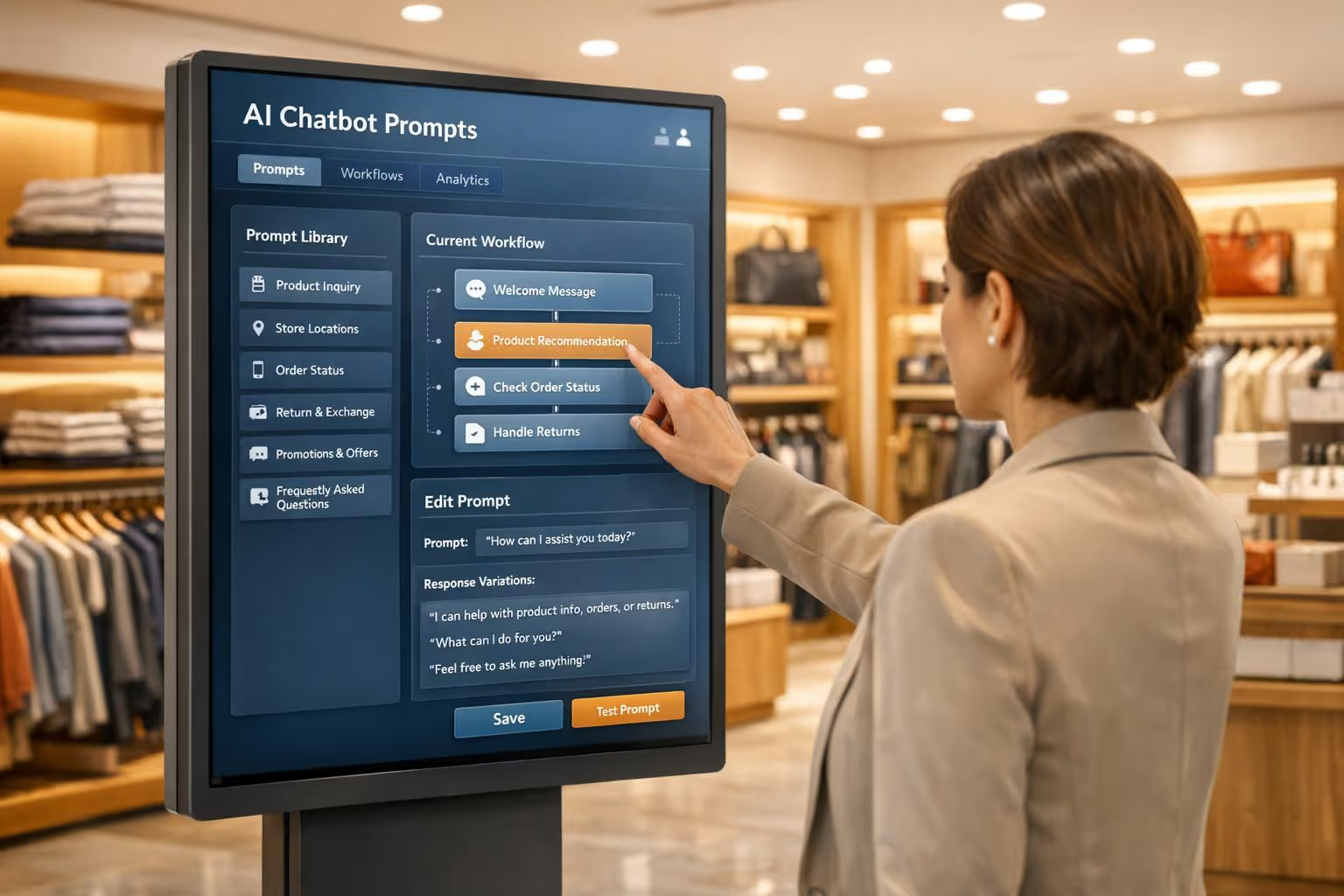
AI chatbots are transforming retail operations by automating customer service, driving sales, and improving efficiency. Providers like Prompts.ai, Provider X, and Provider Y offer tailored solutions to meet the unique demands of retail businesses. Here's what you need to know:
Key Stats:
Quick Tip: Choose a provider based on your goals - whether it’s cutting costs, improving customer experience, or scaling operations. Monitor metrics like unresolved chats, AI-driven conversions, and time saved to measure success.

Prompts.ai tackles common challenges in retail with its specialized multi-agent system. The platform utilizes distinct LLM agents to handle complaints, exchanges, and returns, ensuring each process is efficient and focused. These agents collect essential retail details - such as order numbers, product names, exchange sizes, and refund preferences - to streamline resolutions.
Real-time verification processes, like check_order_available, confirm order validity instantly. For example, the Product Exchange Agent collects three key details: the order number, the item to be exchanged, and the new size. Similarly, the Return Agent checks return conditions and gathers the reason for return along with the preferred refund method (store credit or original payment). Each interaction wraps up with a confirmation step, summarizing the request for accuracy - for instance, "You would like to exchange the black shirt from order number 12345 for a size L. Is that correct?" This ensures clarity before processing.
These capabilities set the stage for smooth and efficient AI-powered workflows.
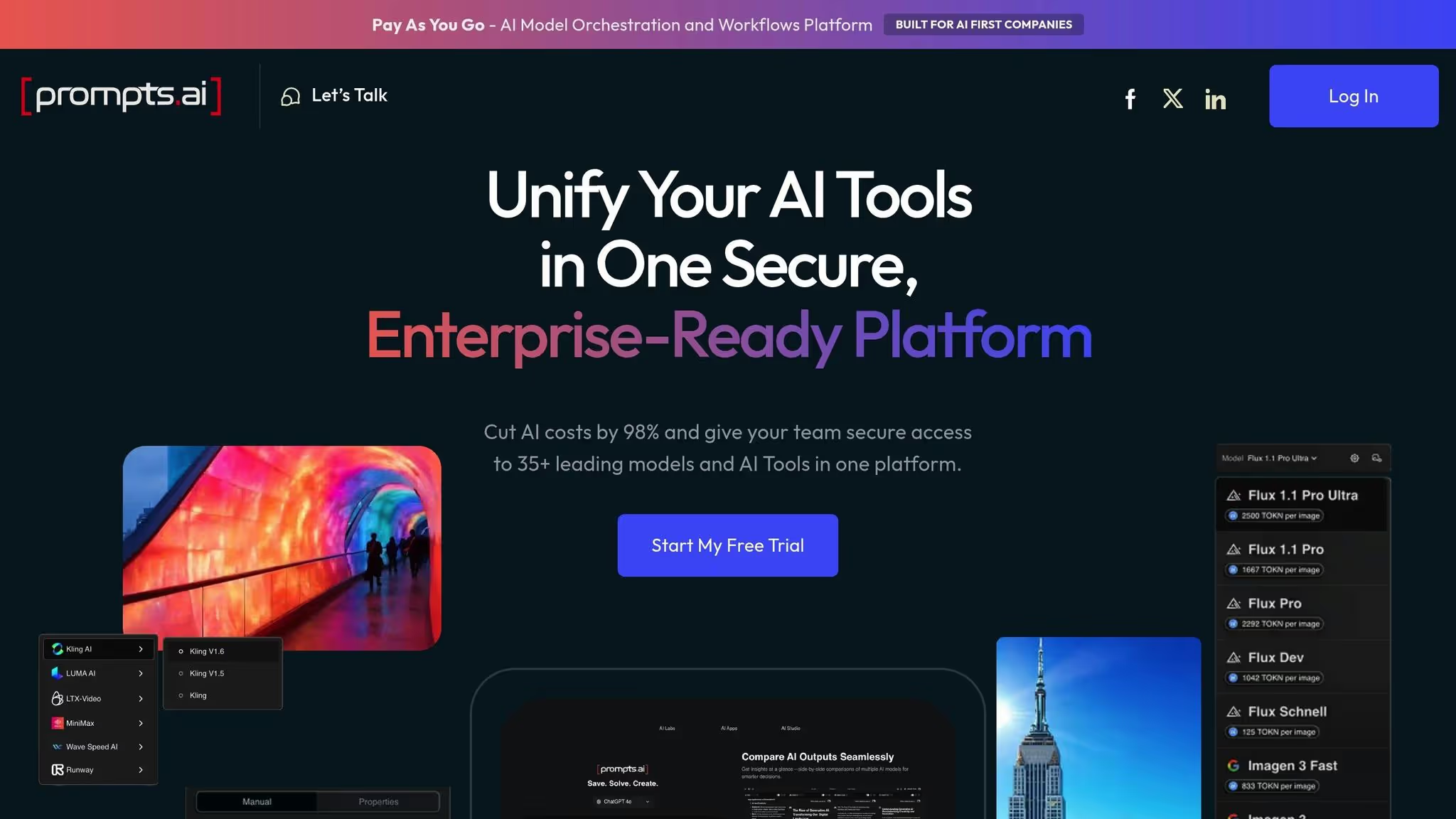
Prompts.ai connects users to over 35 top AI models - including GPT, Claude, LLaMA, and Gemini - through a single, unified interface, eliminating the hassle of managing multiple tools. Retailers can design custom AI agents and workflows that work seamlessly across devices. The platform includes a side-by-side model comparison feature, helping users identify the most accurate model for tasks like generating product descriptions or analyzing customer sentiment. Additionally, integrations with tools like Slack, Gmail, and Trello enhance communication and project management automation. Acting as an "Intelligence Layer", Prompts.ai anchors AI workflows in company-specific data and policies for tailored results.
Steven Simmons, CEO & Founder, shared his experience: "With Prompts.ai's LoRAs and workflows, he now completes renders and proposals in a single day - no more waiting, no more stressing over hardware upgrades".
These orchestrated workflows integrate seamlessly within cost and compliance frameworks.
Prompts.ai simplifies AI spending with its TOKN credit system, replacing scattered subscription costs with a centralized model. Pricing starts at $99 per member/month, offering 250,000 TOKN credits, and scales up to $129 per member/month for 1,000,000 TOKN credits. The platform claims to reduce AI costs by up to 98% compared to managing multiple tool subscriptions. Advanced features like Usage Analytics and Compliance Monitoring, available in Business and Enterprise plans, allow retailers to track expenses and ensure adherence to internal data policies.
Prompts.ai centralizes governance for all AI models, offering complete visibility and auditability. It adheres to strict security standards, including SOC 2 Type II, HIPAA, and GDPR, to protect both retailer and consumer data. The company initiated its SOC 2 Type 2 audit process on June 19, 2025 and uses Vanta for continuous monitoring. A real-time Trust Center ensures transparency regarding the platform's security measures. This setup provides retailers with detailed audit trails for every AI interaction, helping them meet regulatory requirements with confidence.
Provider X taps into unified CRM data to craft marketing content tailored to individual shoppers. This includes personalized emails, exclusive offers, and product descriptions, all designed based on customer behavior patterns. If customer engagement begins to dip, the system identifies trends and automatically triggers offers to re-engage those shoppers.
The platform also features a conversational site search powered by natural language processing and voice recognition. This allows customers to describe what they're looking for in their own words, making it easier and faster to find the right products.
These capabilities lay the groundwork for a more dynamic and responsive workflow environment.
Moving beyond traditional, rigid chatbot decision trees, Provider X uses a more advanced dynamic logic system. This approach allows the platform to interpret customer intent and respond to complex requests in real time. For instance, it can handle multiple tasks at once - like verifying VIP status while simultaneously retrieving return policies - ensuring all necessary details are gathered before delivering a response.
The platform integrates seamlessly with over 100 ecommerce tools through automated "Actions." This connectivity empowers retailers to create workflows that cover everything from inventory management to customer service and sales operations. By pulling data from various systems and automating tasks, the AI eliminates the need for manual intervention.
Provider X includes a "Flow Builder" for designing custom conversational paths and an automation builder with triggers to speed up response times. The platform relies on AI agents trained to manage support scenarios, using intent models to address common retail inquiries like order tracking, returns, and refunds. Oversight is centralized in the "Agent Workspace", which offers full visibility into all AI-driven interactions.
Provider Y sets itself apart by catering specifically to the needs of ecommerce businesses, offering tools and features tailored for retail operations.
With proprietary prompt engineering designed for ecommerce, Provider Y excels at delivering brand-aligned communication. Its system has been trained on millions of retail scenarios, spanning everything from high-end fashion to everyday goods. This extensive training allows it to adapt its language to match each retailer's unique identity. By integrating brand-specific context directly into prompts, it ensures that businesses can maintain a distinct and consistent voice across customer interactions.
Provider Y leverages advanced agentic logic to understand customer intent in real time. This capability enables it to perform multiple tasks simultaneously, such as verifying VIP status, checking loyalty points, and determining location, before crafting a comprehensive response. Additionally, the platform seamlessly integrates with third-party tools, automating workflows across inventory management systems, customer databases, and support platforms. This interconnected approach streamlines operations and enhances efficiency.
Provider Y offers a straightforward pay-as-you-go pricing structure, charging based on metered API requests without requiring any minimum commitments. For businesses looking to explore its capabilities, a free tier is available, allowing up to 10,000 text-based and 5,000 speech-based requests. This flexibility makes it easier for retailers to evaluate the platform before committing to larger-scale usage.
AI Chatbot Providers for Retail: Feature and Pricing Comparison
This comparison sheds light on how each provider’s features align with retail priorities, ranging from cost efficiency to maintaining brand consistency.
Here’s a breakdown of the key advantages and trade-offs for each provider:
Prompts.ai brings together 35+ top-tier models into a unified platform. Its real-time TOKN tracking simplifies cost management, and enterprise-grade governance ensures data security. With a pay-as-you-go TOKN credit system, retailers only pay for the resources they use. However, new teams might encounter a learning curve when navigating the wide range of models and identifying the best fit for specific use cases.
Provider X excels in utilizing store data, offering real-time order tracking and product previews directly within chat interfaces. Its support for 20 languages and image-text fusion capabilities makes it especially useful for retailers catering to diverse audiences or managing visually-driven product catalogs.
Provider Y focuses on retail-specific needs through proprietary prompt engineering designed for millions of e-commerce scenarios. Its agentic logic allows it to handle multiple tasks simultaneously, such as verifying VIP status and checking loyalty points before responding. Integration with over 100 third-party tools enables seamless automation of workflows across inventory management and customer support systems.
While these providers offer impressive capabilities, general-purpose models often face challenges like hallucinations - confidently delivering incorrect product details or unrealistic shipping promises - a problem noted by 43% of marketers. Additionally, managing context can be tricky, as large product catalogs or lengthy support conversations may exceed token limits. Retailers must weigh these technical challenges, including hallucination risks and token constraints, against their operational goals. These insights provide a foundation for selecting the right solution based on your retail needs.
Choose an AI prompt solution tailored to your retail needs. For businesses juggling complex customer service workflows across multiple channels, specialized chatbots equipped with visual builders and human-in-the-loop features can handle up to 98% of support queries while ensuring your brand's voice remains consistent.
Looking beyond quick setups, advanced chatbots provide comprehensive support that drives measurable results. For instance, in 2025, 85% of US retail businesses reported increased profit margins thanks to AI. Conversational AI has been shown to cut cost-per-contact by 23.5% and increase revenue by an average of 4%. These outcomes are a direct result of implementing effective prompt solutions strategically.
Retailers aiming for higher conversion rates should focus on prompts that enable personalized product recommendations, while those prioritizing operational efficiency will benefit from automated FAQ handling and inventory forecasting.
Start by integrating with live data to ensure seamless functionality. Use few-shot prompting with 2–3 examples of your brand's tone to maintain consistency. Implement risk-aware prompting with clear fallback instructions, such as, "If the inquiry isn't covered, provide this link", to minimize errors. Monitor key metrics like unresolved chat rates, conversions from AI recommendations, and time saved on manual tasks to evaluate ROI effectively. These steps are essential for meeting growing consumer expectations.
"Having an AI assistant that can help you understand how to set up, refine, and experiment with strategies - and interpret the results - is a massive power-up."
– Alex Pilon, Senior Developer, Shopify
Keep in mind that 72% of consumers expect immediate service, and 64% are willing to spend more if their issues are resolved on the same channel. The right AI provider turns these expectations into opportunities by delivering fast, accurate, and personalized responses.
AI chatbots act like virtual sales associates, ready to assist shoppers anytime, day or night. They respond instantly to questions, suggest products, and even manage purchases without delay. By tapping into live inventory data and customer profiles, these bots offer up-to-the-minute stock updates, tailored recommendations, and smooth checkout experiences, turning casual visitors into loyal buyers.
Using generative-AI prompts, these chatbots provide precise, context-aware answers to a variety of customer queries - whether it's about shipping details or navigating return policies. This not only speeds up issue resolution but also reduces repetitive tasks, enhancing overall customer satisfaction. By handling routine requests, AI chatbots free up human agents to focus on more complex issues, delivering quicker service, cutting operational costs, and ensuring a cohesive brand experience designed for the retail world.
When selecting an AI prompt provider for retail chatbots, it's important to focus on solutions tailored to retail-specific needs, such as product recommendations, checkout assistance, and inventory queries. This ensures the chatbot delivers precise, brand-aligned responses without requiring significant adjustments.
Flexible pricing is a must - opt for transparent plans that can scale during high-demand periods, like holiday shopping seasons, while also accommodating long-term business growth. Additionally, seamless integration with key systems like POS, CRM, and e-commerce platforms is essential for smooth operations and consistent customer experiences.
Equally important is robust data security to meet U.S. privacy regulations, dependable performance during peak traffic, and ongoing support to keep prompts aligned with your evolving business needs. Choosing a provider that excels in these areas can help your chatbot drive better customer engagement and increase sales effectively.
Retailers can gauge the effectiveness of their AI chatbot by analyzing key performance indicators (KPIs) that highlight both financial outcomes and customer satisfaction. On the revenue side, metrics such as conversion rate, average order value (AOV), cart abandonment reduction, and overall sales lift from AI-powered recommendations provide a direct link between chatbot performance and business growth.
Operationally, metrics like cost per interaction, first-contact resolution rate, and average handling time offer insights into how well the chatbot optimizes costs and improves workflow efficiency. To understand customer satisfaction, tracking indicators such as customer satisfaction score (CSAT), Net Promoter Score (NPS), and chat sentiment reveals how effectively the chatbot meets user expectations. By combining these insights, retailers can clearly assess the chatbot’s impact on profitability and customer engagement.