In 2025, AI workflow platforms are essential for organizations aiming to scale AI initiatives effectively. With 95% of generative AI pilots failing to reach production, businesses face challenges like fragmented tools, hidden costs, and governance issues. The right platform can reduce deployment timelines from months to days, while the wrong choice can lead to inefficiency and costly rebuilds.
This article reviews six leading platforms - Azure Machine Learning, Google Vertex AI, Amazon SageMaker, Prompts.ai, UiPath, and Automation Anywhere - each catering to different needs. Key considerations include integration, cost efficiency, scalability, and features.
Quick Takeaways:
| Platform | Integration | Cost Efficiency | AI Features | Scalability |
|---|---|---|---|---|
| Azure Machine Learning | Strong Microsoft integration | Compute costs can rise | AutoML, customizable models | Enterprise-grade |
| Google Vertex AI | Unified with Google Cloud | Unpredictable pricing | Flexible models, built-in tools | Large-scale operations |
| Amazon SageMaker | AWS ecosystem compatibility | Complex pricing | Full ML lifecycle tools | Scales dynamically |
| Prompts.ai | Cloud-neutral, multi-model | Predictable TOKN credits | Access to 35+ LLMs, FinOps controls | Easy to scale |
| UiPath | RPA-focused integrations | Costly bot licenses | Document processing, low-code tools | Department-wide automation |
| Automation Anywhere | Human-AI process blending | Reduces manual effort | Reasoning AI agents, prebuilt tasks | Enterprise-wide |
Each platform has strengths tailored to specific goals. For AI model development, Azure, Google, and Amazon excel. Prompts.ai simplifies multi-model orchestration with predictable costs. UiPath and Automation Anywhere focus on automating business processes. Your choice depends on your organization’s priorities, technical expertise, and scale of operations.

Azure Machine Learning serves as a robust AI framework designed for organizations with intricate data and technical needs. It provides customizable models, API access, and seamless integration across cloud environments, offering technical teams greater command over their AI deployments. Let’s take a closer look at how its integration features contribute to improving workflow efficiency.
One standout feature of Azure Machine Learning is its seamless integration within the Microsoft ecosystem. Through Microsoft Power Automate, users gain native connectivity to Microsoft 365 and Dynamics services, simplifying the creation of AI-driven workflows. However, its performance with non-Microsoft integrations tends to be less effective, which may limit its appeal for teams relying on diverse software stacks.
Azure Machine Learning is built to meet the complex technical and data demands of large-scale enterprises. It stands alongside platforms like Google Vertex and Amazon Bedrock, showcasing its ability to support advanced AI projects. This scalability positions it as a strong option among the top platforms reviewed, particularly for organizations requiring enterprise-level solutions.

Google Vertex AI is designed to meet the needs of enterprises with highly skilled technical teams and vast data resources. It provides flexible models, API access, and seamless cloud integrations to streamline complex AI deployments and operations.
Google Vertex AI enhances existing infrastructure by acting as an orchestration layer within an organization’s ecosystem. This layer supports essential services like single sign-on (SSO), unified security standards, consistent data connectivity, and automated DevOps tools for monitoring and management. These features allow technical teams to integrate various tools efficiently, ensuring secure and standardized workflows for both AI and data operations.
Vertex AI stands out for its ability to adapt to specific enterprise needs while scaling to support large-scale operations. Teams can customize AI models to fit unique requirements and use API access to embed AI functionalities into current applications. Built for enterprise-level demands, the platform is equipped to handle sophisticated AI projects and extensive data workloads, making it a reliable choice for advanced technical environments.

Amazon SageMaker provides a robust platform designed to help data scientists and machine learning (ML) engineers build, train, and deploy models on a large scale. It balances flexibility with infrastructure control, making it a go-to solution for professionals managing complex workflows.
SageMaker equips users with a complete toolkit for the entire ML lifecycle. It includes built-in algorithms, customizable pre-trained models, and compatibility with popular frameworks like TensorFlow, PyTorch, and scikit-learn. For those who prefer a familiar environment, SageMaker supports notebook-based workflows, offering an intuitive workspace.
One of its standout features, SageMaker Autopilot, simplifies the model-building process. This AutoML tool analyzes datasets, selects suitable algorithms, and generates model candidates - all with minimal coding. Users retain full transparency by reviewing and customizing the generated code to meet specific needs.
SageMaker Studio serves as a centralized hub for ML development. This visual interface consolidates tools for collaboration, version control, and experiment tracking. Additional features, such as data labeling services, streamline the preparation of training datasets, while model monitoring tools identify data drift and performance issues in production. These capabilities integrate seamlessly within SageMaker’s ecosystem, creating an efficient and user-friendly environment.
SageMaker is tightly integrated with the broader AWS ecosystem, making it easy to connect ML workflows to existing cloud infrastructure. For example, it works seamlessly with Amazon S3 for data storage, AWS Lambda for serverless computing, and Amazon CloudWatch for monitoring and logging. These native connections simplify data transfer, authentication, and overall management.
The platform supports various deployment methods, including real-time endpoints for live predictions, batch transforms for processing large datasets, and multi-model endpoints for sharing infrastructure. Developers can also use APIs to embed ML capabilities directly into their applications, enabling real-time predictions within custom software solutions.
SageMaker is built to scale dynamically, ensuring that ML workflows remain efficient as demands grow. The platform automatically adjusts compute resources to match workload requirements, whether you're training models or serving predictions. Distributed computing across multiple instances reduces training times significantly, with support for both CPU and GPU instances to optimize performance.
When it comes to deployment, SageMaker uses managed endpoints that scale automatically based on traffic. Teams can conduct A/B testing to compare different model versions and roll out updates incrementally. For edge computing, SageMaker Edge Manager enables ML inference on IoT devices and mobile applications, even without a constant cloud connection.
SageMaker Pipelines adds another layer of efficiency by automating the entire ML workflow - from data preparation to model deployment. These pipelines ensure reproducibility, maintain compliance through audit trails, and support automated retraining to keep models up to date. This end-to-end automation helps teams focus on innovation while maintaining operational excellence.

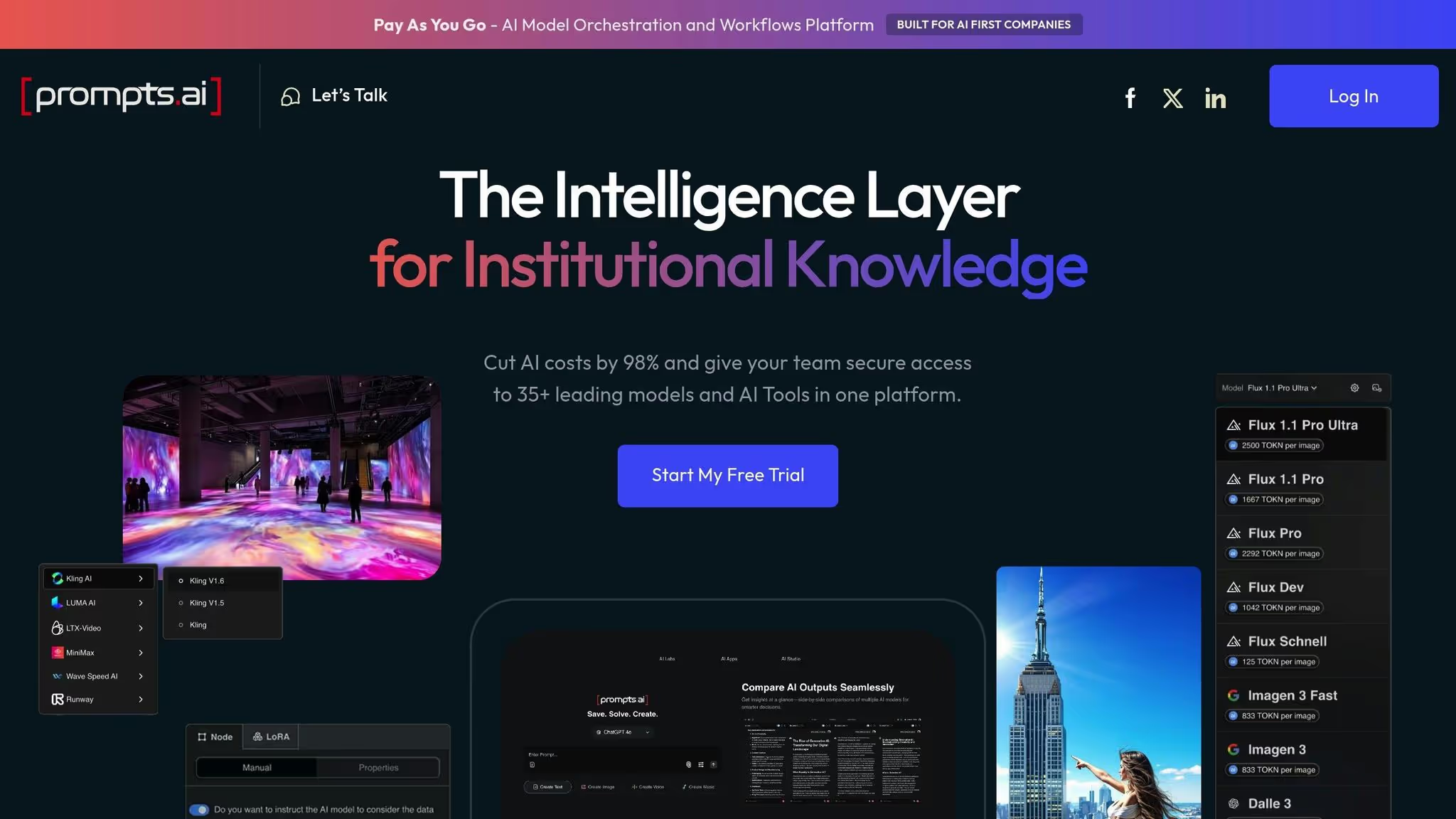
Prompts.ai streamlines access to over 35 AI models through a single, unified interface, addressing a key challenge many enterprises face: juggling multiple disconnected AI tools while ensuring security, governance, and cost efficiency.
At its core, Prompts.ai connects users to a variety of AI models, including GPT, Claude, LLaMA, and Gemini, all accessible from one platform. This eliminates the hassle of switching between different tools and mastering multiple interfaces.
One standout feature is the side-by-side model comparison, which allows teams to test the same prompt across various large language models simultaneously. This helps users determine which model is best suited for tasks like content creation, data analysis, or automating customer service. By enabling smarter model selection, the platform claims it can enhance team productivity by up to 10 times.
The Time Savers feature includes ready-made workflow templates designed to automate repetitive tasks across departments, from generating marketing content to drafting technical documentation. These templates can be tailored to specific needs or used as a foundation for creating entirely new automation sequences.
For visual projects, Image Studio offers tools for generating photorealistic images. Advanced options like LoRAs (Low-Rank Adaptation) allow teams to fine-tune models to align with specific visual styles or branding guidelines, ensuring consistent and professional results.
These features are designed to integrate smoothly into existing workflows, providing a cohesive experience.
Prompts.ai functions as a flexible layer that works with existing systems rather than replacing them. This design lets organizations retain their current data storage and processing setups while adding AI capabilities through a centralized interface.
The platform prioritizes governance and access control, focusing on secure management rather than direct integration with data warehouses or business intelligence tools. This approach is particularly useful for companies with strict data handling policies or regulatory requirements.
Security is a top priority, with protocols aligned to SOC 2 Type II, HIPAA, and GDPR standards. The platform began its SOC 2 Type II audit process on June 19, 2025, reinforcing its commitment to enterprise-grade security. All AI interactions remain within the platform’s secure environment, ensuring sensitive data isn’t dispersed across third-party services.
Prompts.ai tackles AI expenses with a pay-as-you-go token system called TOKN credits. Instead of managing multiple subscriptions, organizations only pay for what they use. The platform suggests that consolidating 35+ tools into one interface can reduce AI software costs by up to 98%.
The FinOps layer provides detailed, real-time spending insights, allowing teams to track costs by model, user, department, or project. This transparency helps businesses pinpoint high-value applications and identify areas where spending can be adjusted.
Flexible pricing options make it easy for teams to scale usage, from initial exploration to full enterprise deployment, ensuring cost efficiency at every stage.
Prompts.ai simplifies scalability by making it easy to onboard new users. Teams can set up access in minutes, assign roles, and start leveraging AI capabilities without the need for complex infrastructure setup or maintenance.
The platform also supports growth through its Prompt Engineer Certification program, which trains team members to create effective workflows and share best practices internally. This enables organizations to build AI expertise without relying heavily on external consultants or intensive technical training.
Its architecture is designed for adaptability, allowing new models to be added seamlessly as they become available. When a new language model or image generation tool hits the market, Prompts.ai typically integrates it quickly, ensuring users can access the latest innovations without disrupting existing workflows.
For large enterprises with multiple departments or business units, the platform offers centralized governance alongside decentralized flexibility. IT teams can enforce policies and monitor compliance, while individual departments retain the freedom to experiment with different models and develop workflows tailored to their specific needs. This balance ensures both control and creativity across the organization.

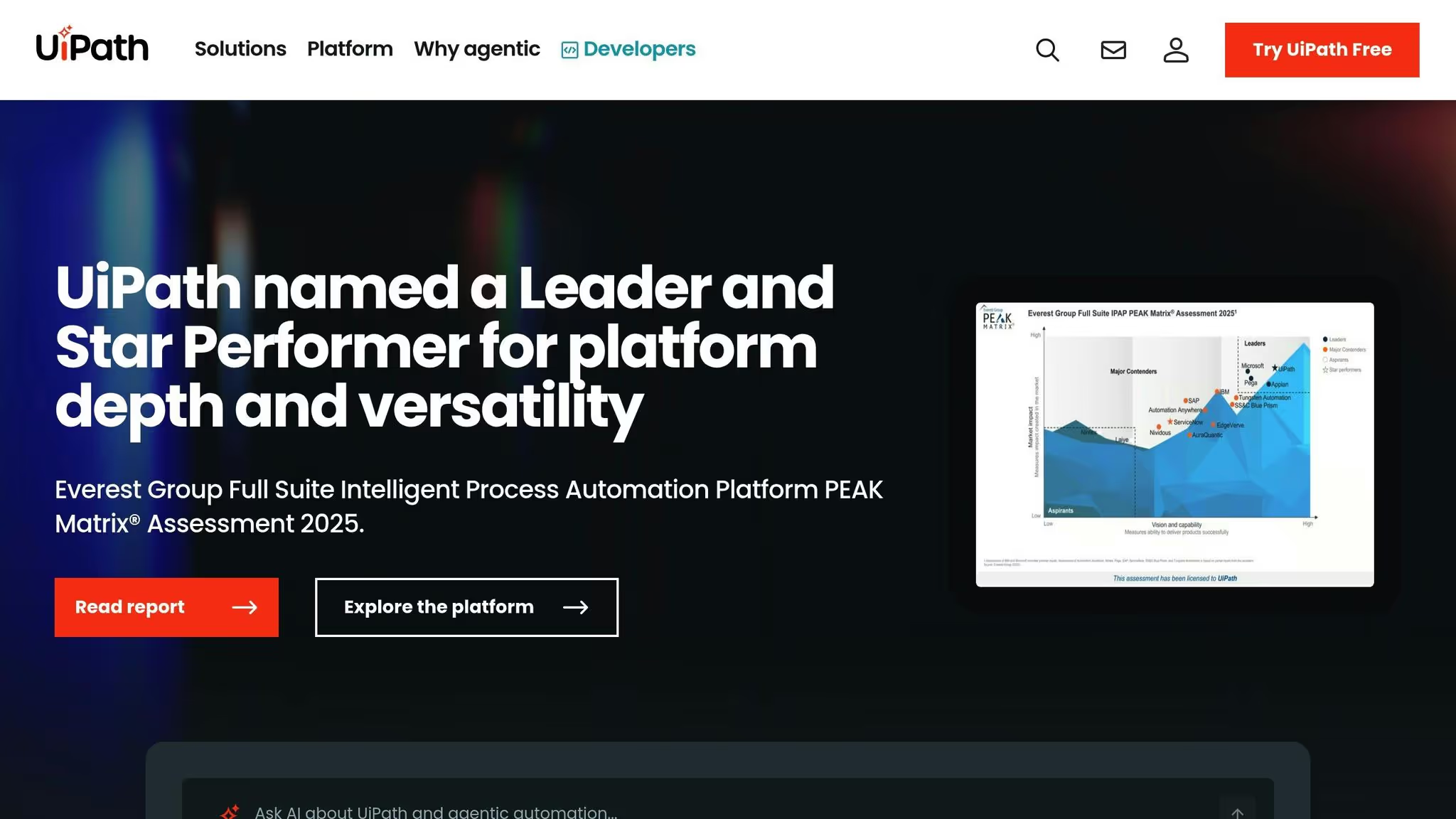
UiPath blends robotic process automation (RPA) with artificial intelligence (AI) through its Orchestrator, a hub designed to link RPA bots, AI models, and human workers into cohesive workflows. This setup is particularly effective for businesses looking to automate document-heavy tasks that benefit from both the precision of machines and human oversight.
UiPath's Agentic Automation and AI Fabric enable bots and AI agents to make decisions informed by context and business rules. Instead of following rigid, pre-defined scripts, these agents adapt to varying scenarios, allowing workflows to respond dynamically to changing demands.
The platform also offers a Document Understanding feature that handles natural language processing, recognizes handwriting, and processes lengthy documents. This capability allows workflows to extract data from diverse document types without requiring standardized formats or manual input, streamlining operations.
One of the standout tools is the Healing Agent, which identifies and fixes broken automations automatically. If a workflow encounters an error or a system change disrupts the process, the Healing Agent steps in to diagnose and resolve the issue without human intervention. This ensures smooth, uninterrupted operations and highlights UiPath's ability to integrate human and robotic processes effectively.
UiPath excels in connecting various components into unified workflows. Its Orchestrator ensures seamless transitions between automated tasks and moments requiring human judgment. For example, a workflow might automatically process documents, route exceptions to human workers, and then resume automation once the human input is complete.
The platform manages the entire lifecycle of document processing, from ingestion and data extraction to validation and final output. It can pull documents from multiple sources, apply AI-driven analysis, and send results to downstream systems, eliminating the need for multiple, disconnected tools.
Additionally, task routing is automated based on predefined rules and AI-driven insights. When human input is necessary, the system assigns tasks to the right person or team based on factors like workload, expertise, or availability. After the human step is completed, automation seamlessly resumes.
UiPath is designed to support enterprise-wide automation, making it ideal for large organizations deploying AI workflows across multiple departments. Its centralized Orchestrator provides full visibility and control over all automated processes while still allowing individual teams to manage their specific workflows.
For example, in 2025, Omega Healthcare leveraged UiPath's Document Understanding feature to save thousands of work hours each month while maintaining high accuracy in document-heavy operations. This demonstrates the platform's ability to handle the scale and complexity typical of large enterprise deployments.
As businesses scale their automation efforts, UiPath's self-healing features become increasingly valuable. These capabilities detect and resolve issues automatically, preventing minor disruptions from escalating into significant problems. This reduces the operational burden often associated with managing large-scale automation systems.
UiPath delivers cost savings by automating repetitive, document-intensive tasks that traditionally required human labor. By automating processes like reading, interpreting, and processing documents, organizations can redirect employees to higher-value tasks while potentially improving accuracy and efficiency.
The platform's ability to process unstructured data through its Document Understanding feature further enhances cost efficiency. It eliminates the need for manual data entry or extensive preprocessing, reducing both time and labor costs while maintaining operational effectiveness.

Automation Anywhere builds its platform around Agentic Process Automation (APA), a system designed to use reasoning AI agents for dynamic workflow management. Unlike traditional automation that relies on rigid processes, these agents work collaboratively with people, bots, and business systems to create adaptable and responsive automation solutions. This approach enables smarter decision-making and greater flexibility in handling complex tasks.
At the heart of the platform is the Process Reasoning Engine, which drives decision-making by analyzing requests, aligning them with appropriate processes, and dynamically routing tasks. Automation Anywhere also includes Prebuilt Agentic Solutions tailored for tasks like accounts payable and customer support. These solutions feature natural-language workspaces, allowing teams to set up workflows without requiring advanced technical skills. A key feature is the Responsible AI Layer, which incorporates governance, privacy, and compliance safeguards directly into the framework. This ensures that automation efforts remain secure and adhere to regulatory standards, emphasizing the platform's focus on secure and compliant operations.
The APA system seamlessly integrates conversational bots, automated workflows, and human input into cohesive processes. This makes it particularly valuable for industries such as healthcare, finance, and HR, where embedding AI into existing systems is essential for improved efficiency and performance.
With its integrated design, Automation Anywhere is built to scale across an entire enterprise, handling complex workflows that span multiple departments. Whether managing accounts payable/receivable or customer service processes, the platform's dynamic planning adapts to evolving business needs, ensuring it remains effective as organizations grow and change.
By automating repetitive tasks in areas like HR, customer support, and accounts payable, Automation Anywhere reduces the need for manual effort while improving task consistency. Its prebuilt solutions shorten implementation times, enabling businesses to roll out functional workflows quickly without extensive custom development, ultimately saving both time and resources.
Here’s a closer look at the strengths and weaknesses of each platform, providing a clearer picture of how they align with various organizational needs. While some platforms shine in technical customization, others focus on user accessibility and quick implementation.
Azure Machine Learning is a natural choice for organizations already embedded in the Microsoft ecosystem. Its tight integration with Azure services streamlines data workflows, and the AutoML capabilities significantly cut down on the time spent fine-tuning models. However, its steep learning curve and increasing compute costs can be challenging, especially for smaller teams or those new to Azure. The platform’s complexity can make setup and ongoing management daunting for less resourced teams.
Google Vertex AI performs exceptionally well for teams handling large-scale analytics and machine learning operations. Its unified interface simplifies model training and deployment, making workflows more efficient. That said, pricing unpredictability and migration obstacles for non–Google Cloud users can complicate adoption, requiring careful planning.
Amazon SageMaker offers unmatched flexibility with its wide array of pre-built algorithms and an established marketplace for third-party solutions. This makes it appealing for enterprises with diverse use cases across departments. However, its extensive features can add complexity, demanding a significant time investment in learning and documentation. While cost management tools are available, understanding the intricate pricing structure requires attention to detail.
Prompts.ai takes a different route by unifying access to over 35 leading language models within a single interface. Its real-time FinOps controls bring unparalleled cost transparency, and the pay-as-you-go TOKN credit system ensures you only pay for what you use - avoiding recurring fees. The built-in Prompt Engineer Certification program and shared workflows enhance productivity without needing deep technical expertise. For organizations emphasizing governance and compliance, enterprise-grade security and audit trails are embedded into every workflow. However, teams focusing heavily on custom model training may need additional specialized tools to meet their needs.
UiPath excels in robotic process automation (RPA), bridging traditional business processes with AI-enhanced workflows. Its visual workflow designer makes it accessible to non-technical users, and its extensive library of pre-built connectors speeds up integrations. However, bot-license pricing can escalate as automation scales, making it more suitable for RPA tasks than language model-based projects.
Automation Anywhere stands out with its Agentic Process Automation, where reasoning AI agents dynamically manage workflows instead of rigid scripts. Its Process Reasoning Engine adapts to shifting business needs, and the Responsible AI Layer addresses governance concerns. Prebuilt solutions for areas like accounts payable and customer support deliver quick results. That said, its sophistication requires careful change management and may exceed the needs of simpler automation tasks.
| Platform | Integration Capabilities | Cost Efficiency | AI Features | Scalability |
|---|---|---|---|---|
| Azure Machine Learning | Seamless Azure integration; connects with Azure services | Costs increase with compute usage; needs monitoring | AutoML, MLOps tools, custom model training | Handles large workloads; enterprise-grade |
| Google Vertex AI | Strong BigQuery integration; unified ML workflow | Pay-per-use; pricing can be unpredictable | Unified training/deployment, pre-built models | Scales with Google Cloud infrastructure |
| Amazon SageMaker | Extensive AWS service integration; marketplace access | Complex pricing; cost management tools available | Broad algorithm library, built-in Jupyter notebooks | Highly scalable; mature enterprise features |
| Prompts.ai | Access to 35+ LLMs; avoids tool sprawl | Pay-as-you-go TOKN credits; predictable costs | Multi-model access, prompt workflows, FinOps | Scales from individuals to large enterprises |
| UiPath | 400+ pre-built connectors; RPA-focused integrations | Bot-based licensing; costs rise with scale | AI-enhanced RPA, document understanding | Enterprise deployment across departments |
| Automation Anywhere | Conversational bots; integrates human input | Reduces manual effort; quick deployment | Process Reasoning Engine, Responsible AI Layer | Enterprise-wide deployment; dynamic planning |
This comparison highlights that no single platform excels in every category. Choosing the right platform depends on technical needs and business priorities. Azure, Google, and Amazon are ideal for teams building custom models from scratch. Prompts.ai simplifies access to multiple language models, eliminating the hassle of managing separate subscriptions and controlling costs. UiPath and Automation Anywhere focus on automating business processes, offering varying levels of AI sophistication.
Cost efficiency varies widely depending on usage. Traditional cloud platforms charge for compute, storage, and data transfer, which can lead to unexpected expenses during experimentation. Prompts.ai’s token-based pricing ties costs directly to usage, making budgeting easier. Meanwhile, RPA platforms like UiPath and Automation Anywhere reduce labor costs but require upfront investment in bot licenses and implementation, tying into broader cost efficiency considerations.
Integration capabilities are crucial when working within an existing tech stack. If your data resides in Azure, Google Cloud, or AWS, staying within that ecosystem simplifies workflows and enhances security. For organizations using multiple cloud providers or avoiding vendor lock-in, Prompts.ai’s cloud-neutral approach offers flexibility. RPA platforms excel at connecting legacy systems lacking modern APIs, reinforcing the integration themes discussed earlier.
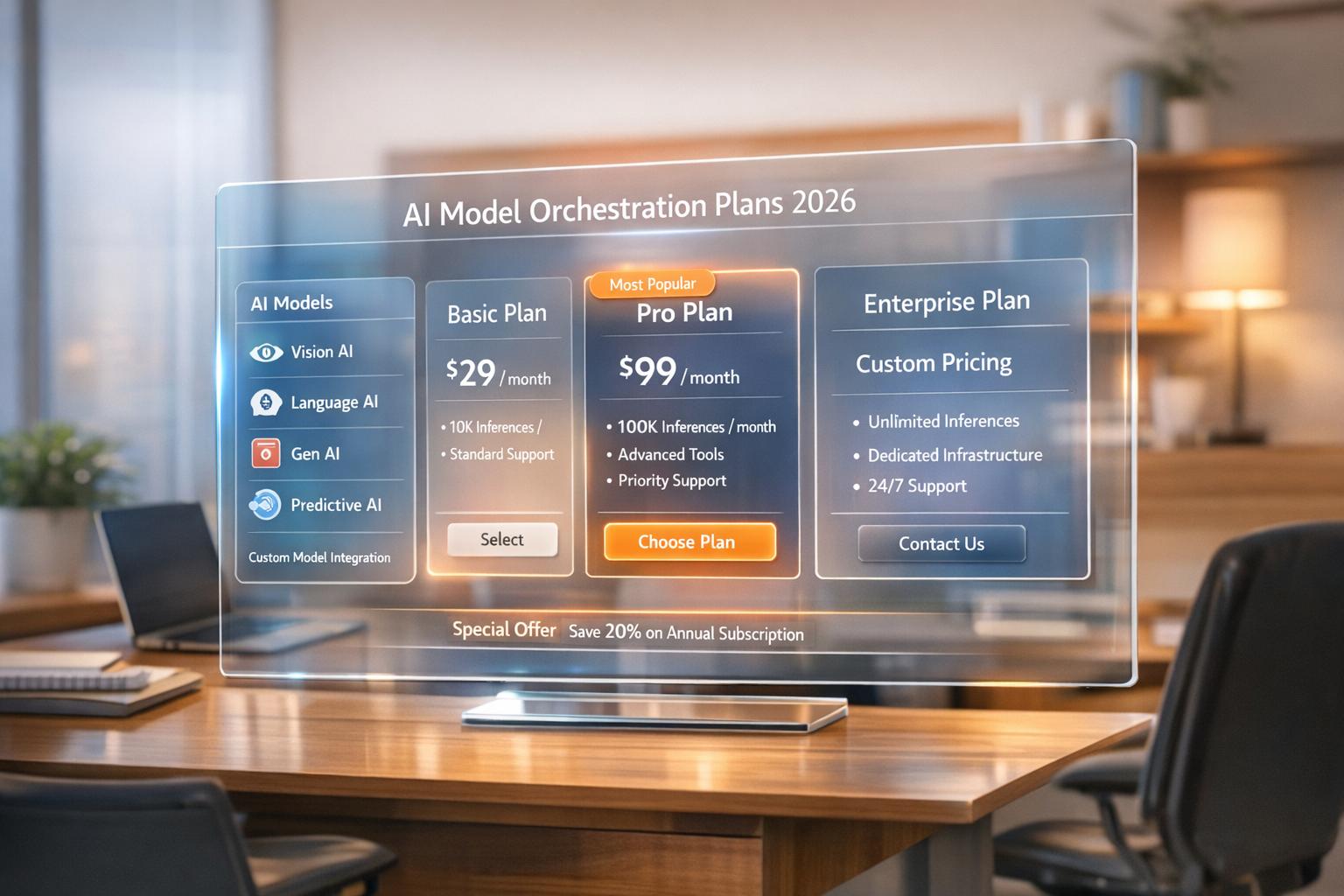
Scalability needs differ for technical and business users. Data science teams need platforms that handle complex models and large data volumes, where major cloud providers excel. Business teams, on the other hand, prioritize adding users and automating processes quickly, where visual interfaces and prebuilt solutions help. Prompts.ai bridges both, supporting individuals at $29 per month and enterprise teams at $129 per member monthly, using the same robust infrastructure. This dual scalability makes it a versatile option for various use cases.
Selecting the best AI workflow platform depends on aligning your organization’s goals with the specific capabilities of each solution. Some platforms, like Azure Machine Learning, Google Vertex AI, and Amazon SageMaker, are ideal for organizations that need extensive technical customization or want to build models from scratch. However, these options often require advanced technical expertise and careful cost management as usage scales.
On the other hand, Prompts.ai simplifies the complexity of managing multiple AI tools by bringing together over 35 leading language models into a single, unified interface. With its transparent token-based pricing, Prompts.ai can cut AI software costs by as much as 98%, while still providing enterprise-grade security. Its pricing structure - starting at $29 per month for individuals and $129 per member monthly for enterprises - ensures costs are predictable and tied directly to usage, making financial planning easier and more reliable.
For automating repetitive, document-heavy tasks, platforms like UiPath and Automation Anywhere excel. UiPath offers a strong visual, low-code automation experience, while Automation Anywhere’s reasoning agents adapt workflows to meet evolving business needs. While both reduce manual labor costs, they often require upfront investments in bot licenses and a well-thought-out implementation strategy.
Ultimately, the right choice depends on your organization’s priorities. Whether you need advanced model customization, seamless orchestration of language models, or efficient process automation, each platform brings distinct advantages to the table. By understanding your goals and weighing factors like cost, complexity, and control, you can confidently choose the AI workflow solution that best fits your needs.
When choosing an AI workflow platform, it's essential to focus on features that align with your organization's specific goals and requirements. Start by prioritizing platforms with built-in AI capabilities like machine learning, natural language processing, or generative AI. These features can help simplify and optimize your workflows while improving efficiency.
Consider platforms that support real-time data processing, enabling your team to respond quickly to live signals. Tools with low-code or no-code options, such as drag-and-drop builders, can make workflow creation more accessible to team members without technical expertise. Equally important are flexible integrations that allow seamless connections with your existing tools, custom APIs, or webhooks, ensuring the platform fits smoothly into your current ecosystem.
Scalability is another critical factor - choose a platform capable of handling growing demands, whether it's expanding across teams or regions. Lastly, prioritize solutions with strong security and governance features, such as role-based access controls and detailed audit logs, to ensure compliance and maintain transparency. By focusing on these elements, you can select a platform that drives productivity and supports your AI initiatives effectively.
Prompts.ai introduces a token-based pricing system that allows users to pay solely for the resources they actually use. Unlike conventional cloud platforms that often lock users into fixed subscription tiers or rely on broad estimates, this model ensures you avoid paying for more than what’s necessary.
This system is especially useful for businesses with changing workloads or unique project demands. It eliminates the risk of overpaying for unused capacity, enabling companies to better manage their budgets while still enjoying access to advanced AI tools tailored to their needs.
Prompts.ai simplifies the process of bringing together multiple AI models while keeping data security and governance front and center. It aligns with top-tier compliance standards like SOC 2 Type II, HIPAA, and GDPR, ensuring sensitive data remains protected and regulatory requirements are met.
On top of that, Prompts.ai features an integrated FinOps layer that provides real-time visibility into usage, spending, and ROI. This helps organizations effectively manage their resources while staying fully aware of the value their AI investments deliver.