Pay As You Go - AI Model Orchestration and Workflows Platform


AI tools are transforming businesses in 2025 by simplifying operations, reducing costs, and driving productivity. This article evaluates the top three platforms for business AI: prompts.ai, Microsoft Azure AI, and Google Cloud AI, focusing on critical features like cost management, security, workflow automation, and access to advanced models.
| Platform | Strengths | Weaknesses |
|---|---|---|
| prompts.ai | Unified access to 35+ models, cost savings, precise expense tracking | Less established in the market, transition needed from existing tools |
| Microsoft Azure AI | Seamless Microsoft 365 integration, secure data handling | Integration challenges for non-Microsoft users, requires oversight |
| Google Cloud AI | Advanced analytics, large token support, pre-built AI tools | Complex governance, over-reliance on Google infrastructure |
If you're looking for cost efficiency, security, and AI orchestration, prompts.ai stands out as the most versatile choice. For businesses deeply embedded in Microsoft or Google ecosystems, the other platforms offer tailored advantages.
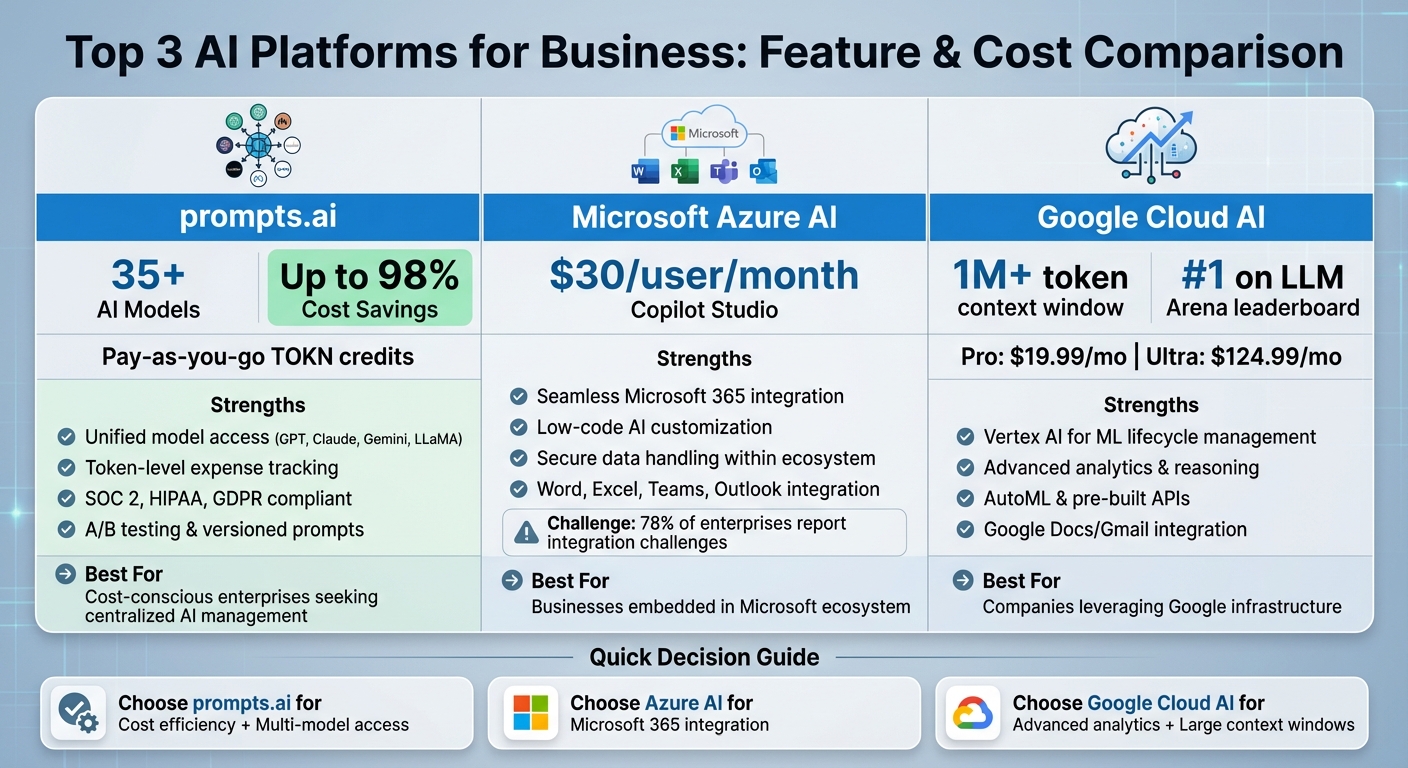
AI Platform Comparison: prompts.ai vs Microsoft Azure AI vs Google Cloud AI
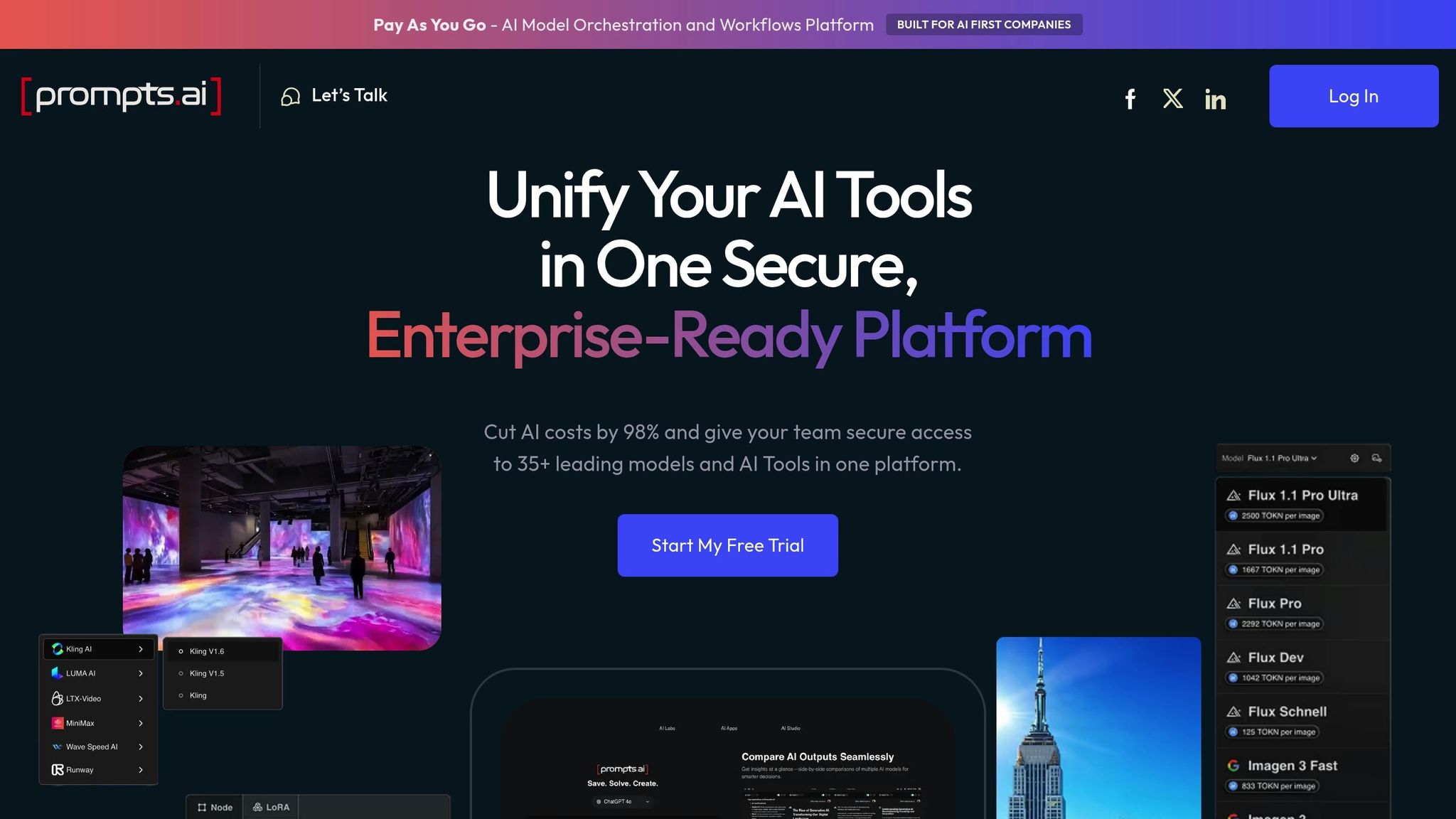
prompts.ai brings together 35 large language models, including GPT, Claude, LLaMA, and Gemini, into a single, secure interface. It offers U.S. businesses a streamlined way to manage AI by routing all requests through one endpoint. This setup enables seamless model selection, standardized prompt templates, and policy enforcement. It’s especially beneficial for mid-sized and enterprise teams aiming to integrate AI into their existing workflows. The platform’s key features are explored in detail below.
At the heart of prompts.ai is its orchestration capability, which simplifies prompt management and routing. Teams can create and maintain reusable, versioned prompt templates that work across departments. A/B testing is available to compare different configurations, helping teams identify the most effective setups. The platform also routes requests to the best model based on factors like cost, latency, or specific expertise.
To ensure safe experimentation, prompts.ai offers environment controls for development, staging, and production, along with monitoring dashboards that track usage, latency, and output quality. These tools help businesses optimize their operations and maintain efficiency.
By consolidating over 35 tools, prompts.ai can reduce AI costs by as much as 98%. Its cost-saving approach involves using budget-friendly models for high-volume tasks, like summarization, while reserving advanced models for more complex work. Features such as response caching, per-team usage limits, and token tracking in USD help teams manage expenses effectively.
For instance, a U.S. marketing agency might draft initial social media content using a lower-cost model and then switch to a premium model for refining campaign strategies. Additionally, the TOKN Pooling feature allows teams to share credits, ensuring balanced usage and avoiding overspending. This cost-conscious design is crucial for mid-sized and larger teams to stay competitive.
prompts.ai simplifies workflow automation by integrating seamlessly with existing tools, either through APIs or no-code connectors. This enables AI-driven processes to activate automatically based on business events. Tasks like support ticket triage, lead enrichment, and internal reporting can be automated, saving time and resources.
Here’s an example of its impact:
"With Prompts.ai's LoRAs and workflows, he now completes renders and proposals in a single day - no more waiting, no more stressing over hardware upgrades."
- Steven Simmons, CEO & Founder
Security and compliance are central to prompts.ai. The platform adheres to SOC 2 Type II, HIPAA, and GDPR standards, ensuring data is protected through encrypted transmission (TLS) and secure storage. It also supports robust authentication methods like SAML/SSO and OAuth, along with detailed audit trails using scoped API keys and least-privilege accounts.
The platform initiated its SOC 2 Type II audit process on June 19, 2025, and works with Vanta for continuous monitoring of its controls. Administrators can also enforce detailed policy restrictions, such as limiting access to specific models or regions, providing an additional layer of security.

Microsoft Azure AI, through its Copilot offering, provides businesses in the U.S. with a seamless AI solution integrated into the Microsoft 365 ecosystem. At $30.00 per user per month, it acts as a central AI assistant within widely-used applications such as Word, Excel, Teams, and Outlook. This integration allows companies to adopt AI without disrupting their existing workflows, offering tools for orchestration, automation, and enhanced security.
Copilot simplifies AI orchestration with its Copilot Studio, a platform that lets businesses create and customize AI agents using low-code tools. These agents are designed to streamline specific workflows and automate complex, multi-step processes - no advanced technical skills required. Additionally, specialized reasoning agents, like "Researcher" and "Analyst", handle deep data analysis and tackle intricate tasks. Features such as the Chat interface and the Create module empower users to generate documents, analyze data, and communicate effectively, all within their familiar Microsoft workspace.
Copilot shines in automating repetitive tasks, saving time and effort for teams. It can summarize documents, draft emails, convert file formats, and generate content, freeing employees to focus on higher-priority initiatives. For data analysis, Power BI with AI Insights automatically scans datasets to identify hidden patterns, correlations, and trends. This functionality speeds up data-driven decision-making and enhances business outcomes.
Copilot prioritizes the security of proprietary business data within the Microsoft ecosystem. Corsica Technologies highlights, "Copilot excels at generating content and insights within your Microsoft environment, using your proprietary data. The tool does not share your data outside your environment, which is a welcome protection compared to ChatGPT." By keeping sensitive information confined to the Microsoft ecosystem, Copilot addresses concerns about data leakage and supports compliance with data protection regulations.

Google Cloud AI Platform offers a comprehensive suite of machine learning tools tailored for U.S. businesses aiming to automate essential workflows without requiring extensive technical expertise. Operating under the Gemini branding, the platform features advanced AI models with subscription plans starting at $19.99 per month for the Pro plan and $124.99 per month for the Ultra plan. Impressively, Gemini holds the top spot on the LLM Arena leaderboard, validated by millions of blind tests. Its context window also supports over 1 million tokens.
With Vertex AI, Google Cloud simplifies AI orchestration by providing a unified hub for managing the entire machine learning lifecycle. This includes everything from model development and training to deployment and ongoing operations. The platform’s AutoML feature allows businesses to build custom models without needing to write code. Additionally, AI Building Blocks offer pre-built APIs for tasks like computer vision, natural language processing, and speech recognition. These tools make it easy for companies to embed sophisticated AI capabilities directly into their applications. Together, these orchestration solutions create a robust framework for automating processes across industries.
The Google Cloud AI Platform accelerates workflow automation by transforming raw data into actionable insights. By utilizing its diverse AI Building Blocks, businesses can turn data into smart applications, enabling them to gain an edge in their respective markets.
When evaluating AI platforms, it's essential to weigh their strengths against their limitations. The table below provides a clear comparison of key advantages and challenges for each platform.
| Platform | Key Strengths | Notable Weaknesses |
|---|---|---|
| prompts.ai | • Consolidates over 35 top-tier large language models (including GPT‑5, Claude, LLaMA, and Gemini) into a single, secure interface • Cuts AI software costs by up to 98% with pay‑as‑you‑go TOKN credits • Offers precise FinOps controls for tracking token-level expenses • Centralizes governance to reduce tool sprawl • Provides Prompt Engineer Certification and expertly designed workflows |
• As a newer platform, it has a less established presence in the market • Requires businesses to transition away from individual tool workflows to a unified orchestration model |
| Microsoft Azure AI | • Strong integration with Microsoft 365 apps (Word, Excel, PowerPoint, Outlook, Teams), streamlining document creation, data analysis, and communication • Copilot Studio supports low-code customization for AI agents • Includes advanced security features and IT administrative controls • Ensures secure handling of proprietary data within the Microsoft ecosystem |
• 78% of enterprises report challenges integrating AI into existing tech stacks • Requires human oversight to ensure AI output accuracy • Best suited for organizations already embedded in the Microsoft ecosystem |
| Google Cloud AI | • Handles over 1 million tokens for in-depth document analysis • Integrates seamlessly with Google Docs and Gmail • Excels in complex reasoning and mathematical tasks • Generates podcast-style audio summaries • Leverages insights from Google search data |
• The lack of specific AI regulatory frameworks complicates governance around ethics and data privacy • Over-dependence on the platform may widen skill gaps for developers • Primarily benefits organizations heavily invested in Google Cloud infrastructure • Requires manual verification of AI outputs |
These comparisons provide a deeper understanding of how each platform aligns with different business priorities. If your focus is on cost efficiency and unified model orchestration, prompts.ai may be the right fit. For businesses rooted in the Microsoft ecosystem, Microsoft Azure AI offers seamless integration and robust security. Meanwhile, Google Cloud AI stands out for advanced analytics and processing capabilities, particularly for organizations leveraging Google’s infrastructure. Each platform’s strengths and limitations should guide your choice based on your specific operational needs and goals.
Selecting the right AI platform hinges on your organization’s infrastructure, budget, and operational goals. While Microsoft Azure AI and Google Cloud AI excel within their ecosystems, prompts.ai sets itself apart for companies focused on cost savings, streamlined AI management, and scalable automation.
With access to over 35 leading large language models - including GPT-5, Claude, LLaMA, and Gemini - through one secure platform, prompts.ai eliminates the chaos of juggling multiple tools. It enables businesses to automate key operations efficiently while cutting AI software costs by up to 98% using pay-as-you-go TOKN credits. This approach transforms fixed expenses into flexible, on-demand solutions. The platform’s low-code design simplifies enterprise-grade governance, compliance monitoring, and expense tracking through precise FinOps controls, offering full transparency and reducing operational complexity.
For businesses aiming to expand AI adoption without heavy infrastructure investments or vendor lock-in, prompts.ai provides a practical, cost-conscious solution. Its centralized governance framework supports evolving standards in AI ethics and data security, while enabling teams to integrate multiple AI models into seamless workflows - all without requiring advanced technical skills.
If your focus is on maximizing ROI through unified model access, clear cost management, and repeatable processes, prompts.ai offers the orchestration tools modern enterprises need to excel in 2025.
Prompts.ai enables businesses to cut AI costs by as much as 98% by bringing together access to over 35 advanced AI models and tools in a single, secure platform. By eliminating the hassle of juggling multiple tools, it reduces operational burdens and simplifies workflows.
Designed with enterprise-grade governance and centralized management, Prompts.ai helps businesses get the most out of their AI investments while upholding strict security and compliance standards. This approach not only drives major cost savings but also boosts productivity to align with a variety of business objectives.
Prompts.ai prioritizes enterprise-grade security, safeguarding your business data with advanced measures. Key protections include robust encryption to keep your information secure, strict access controls to manage who can view or use your data, and adherence to industry-standard compliance protocols to meet regulatory requirements. These features work together to protect sensitive information and build trust in your workflows.
By focusing on data protection, prompts.ai shields your business applications from potential risks, giving you peace of mind to concentrate on boosting efficiency and driving progress.
Prompts.ai brings together more than 35 advanced AI models and tools into a single, secure platform designed for enterprise use. It integrates effortlessly with your current business workflows, streamlining automation, managing prompts with precision, and coordinating AI-driven processes across various operations.
This platform eliminates the chaos of multiple tools, ensures governance, and offers secure access to leading AI models like GPT, Claude, and LLaMA. The result? Improved real-time decision-making and increased operational efficiency across a wide range of business applications.