Pay As You Go - AI Model Orchestration and Workflows Platform



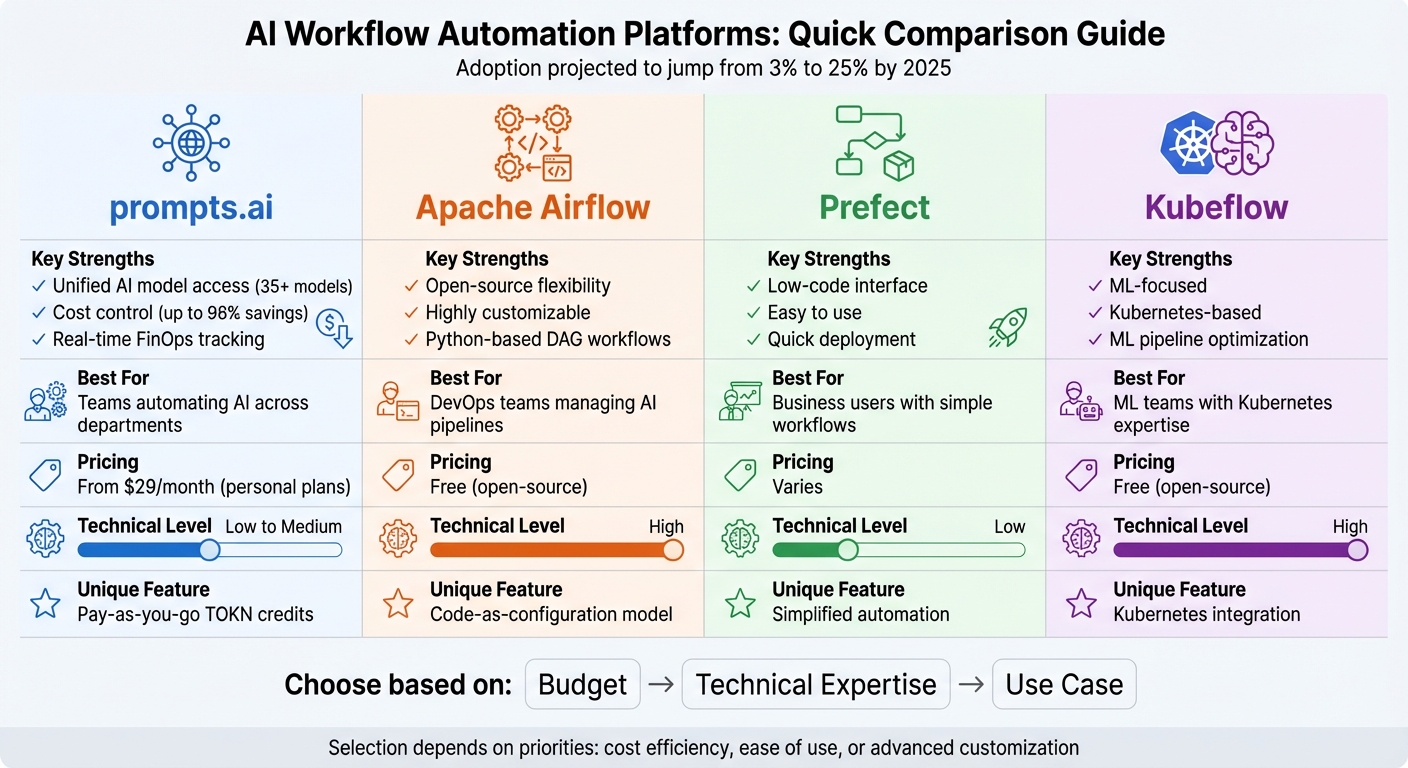
Automating AI workflows is transforming enterprise processes, with adoption projected to jump from 3% to 25% by 2025. Choosing the right platform can cut costs, boost productivity, and simplify operations. Here’s a quick look at four standout options:
Quick Comparison:
| Platform | Key Strengths | Best For | Pricing |
|---|---|---|---|
| prompts.ai | Unified AI model access, cost control | Teams automating AI across departments | From $29/month (personal plans) |
| Apache Airflow | Open-source, highly customizable | DevOps teams managing AI pipelines | Free (open-source) |
| Prefect | Low-code interface, easy to use | Business users with simple workflows | Varies |
| Kubeflow | ML-focused, Kubernetes-based | ML teams with Kubernetes expertise | Free (open-source) |
Selecting the right tool depends on your priorities - whether it’s cost efficiency, ease of use, or advanced customization. Keep reading for a deeper dive into each platform’s features.
AI Workflow Automation Platforms Comparison: Features, Pricing, and Best Use Cases
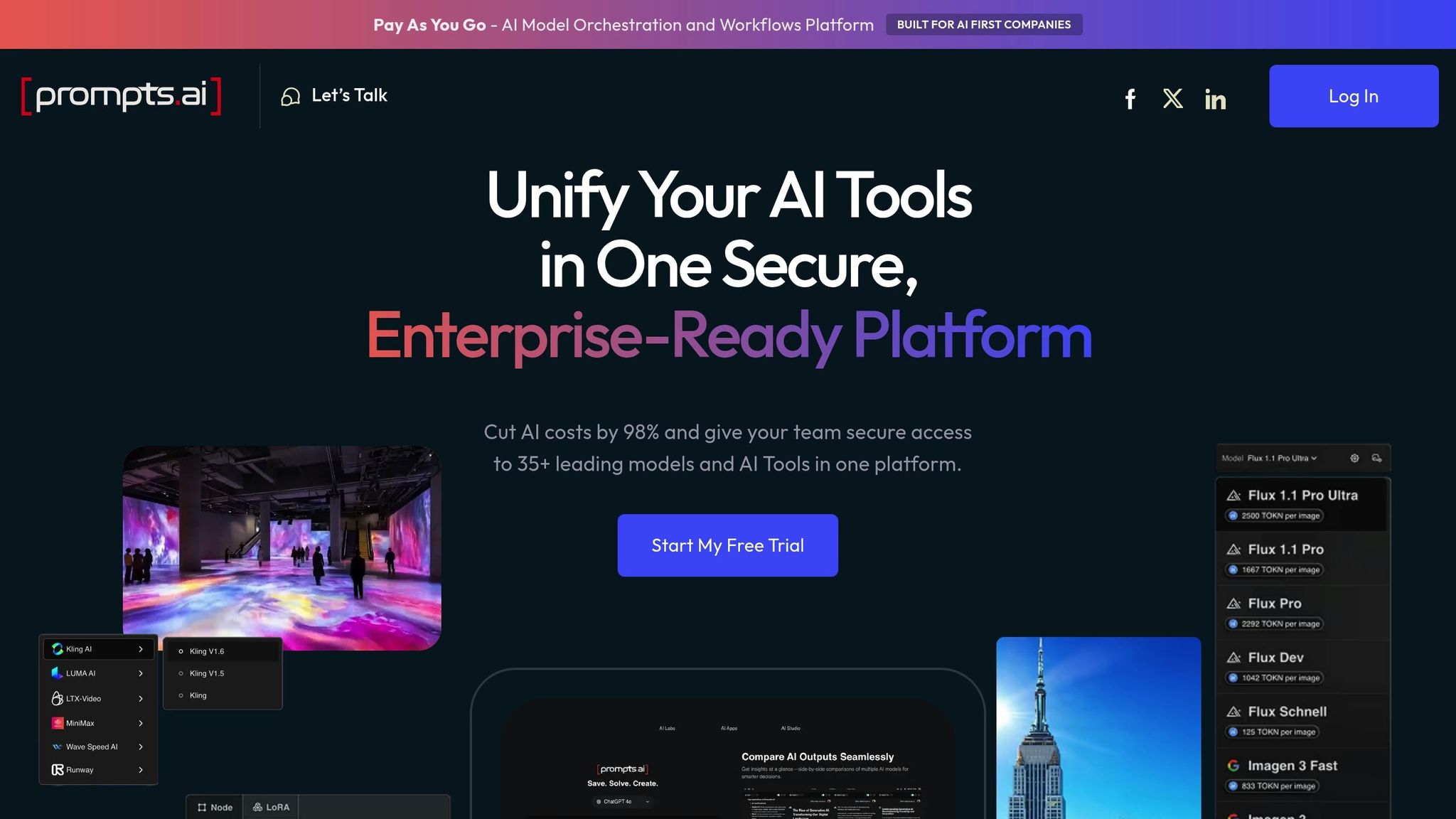
prompts.ai serves as an "Intelligence Layer", connecting users to over 35 AI models, including GPT, Claude, LLaMA, and Gemini, through a single, secure interface. By consolidating tools into one platform, it eliminates the hassle of managing multiple AI subscriptions. Additionally, it integrates seamlessly with popular business apps like Slack, Gmail, and Trello, enabling streamlined automation without the need for juggling multiple logins or APIs.
An impressive example of this interoperability came in February 2025, when Johannes Vorillon, a Freelance AI Visual Director, showcased its potential by creating a fictional BMW concept car. Using MidJourney for visuals, a custom LoRA model for fine-tuning, and prompts.ai to compile everything into a video, he demonstrated how various AI tools can be orchestrated into a cohesive project pipeline.
prompts.ai transforms one-off tasks into scalable, continuous processes. Users can instantly compare top language models to find the best fit for their needs, create AI agents for complex automation, and access prebuilt workflows that deliver results quickly without starting from scratch. The platform also enables custom model training and fine-tuning through LoRA (Low-Rank Adaptation), allowing teams to adapt AI tools to meet specific goals.
Steven Simmons, CEO & Founder, shared how prompts.ai revolutionized his workflow: "he now completes renders and proposals in a single day - no more waiting, no more stressing over hardware upgrades."
Similarly, Mohamed Sakr, Founder of The AI Business, highlighted its impact on businesses:
"automate sales, marketing, and operations, helping companies generate leads, boost productivity, and grow faster with AI-driven strategies".
prompts.ai provides robust oversight and transparency for AI operations, offering centralized governance that simplifies managing large-scale AI deployments. The platform adheres to industry-recognized standards, including SOC 2 Type II, HIPAA, and GDPR, ensuring data security and compliance. It also partners with Vanta for continuous monitoring and is undergoing a SOC 2 Type II audit. Users can explore its real-time security posture through the Trust Center (https://trust.prompts.ai/), where updates on policies, controls, and compliance efforts are readily available. Every plan - whether the $29 Creator tier or the $129 Elite tier - includes Compliance Monitoring and Governance Administration, bringing enterprise-grade controls to teams of all sizes.
prompts.ai is designed for effortless scalability, allowing organizations to add models, users, and teams without creating operational bottlenecks. Its Pay-As-You-Go TOKN credits system ensures costs align with actual usage, eliminating recurring fees and reducing AI software expenses by up to 98%. Business plans start at $99 per member per month for the Core tier, with Pro and Elite tiers priced at $119 and $129, respectively. Personal plans range from $0 for Pay As You Go to $99 per month for Family Plans. Additionally, the platform’s real-time FinOps layer tracks every token and ties spending directly to business outcomes, turning AI into a predictable and measurable investment.
These capabilities set the foundation for examining how prompts.ai compares to other leading platforms in the next sections.

Apache Airflow is an open-source platform designed to connect various data sources, cloud services, and machine learning frameworks through its pre-built operators and hooks. It works seamlessly with major cloud providers and on-premises systems, making it a practical choice for organizations with diverse technology environments. Built on Python, it also allows developers to create custom integrations for almost any API or service, offering significant flexibility.
The platform uses a Directed Acyclic Graph (DAG) structure to define workflows. This "code-as-configuration" model lets teams design and manage complex workflows while leveraging tools like Git for version control. By integrating workflows into standard development practices, Apache Airflow supports collaboration and ensures workflows remain adaptable and manageable, even in complex AI pipeline scenarios.
Apache Airflow excels in managing AI and machine learning workflows by orchestrating tasks such as data preprocessing, model training, evaluation, and deployment. It can handle both sequential and parallel task execution, triggered by schedules or external events. Its built-in monitoring tools ensure reliability by automatically retrying failed tasks and issuing alerts when something goes wrong.
The platform enforces task dependencies, ensuring that processes like data validation occur before training and that evaluation follows successful model creation. This structured approach helps maintain both the accuracy and efficiency of AI workflows.
Apache Airflow goes beyond orchestration by offering essential governance features. It includes role-based access control (RBAC), allowing administrators to define who can view, modify, or execute specific workflows. User groups can be configured with precise permissions to protect sensitive AI pipeline configurations. Additionally, the platform logs task execution details, making it easier for organizations to meet audit and compliance standards.
Security in Apache Airflow heavily relies on how it is deployed. Organizations managing their own instances must implement encryption, network security, and authentication protocols. The platform supports integration with enterprise authentication systems like LDAP and OAuth, adding another layer of protection to its governance capabilities.

While Apache Airflow provides extensive documentation on its features, Prefect's available resources reveal limited, concrete details. The current documentation does not provide enough verified information regarding its compatibility with other tools, support for AI/ML workflows, or governance functionalities. As a result, these aspects remain unaddressed here due to the absence of reliable technical specifics. This gap in detailed insights highlights Prefect as a platform with untapped potential, deserving closer examination when compared to alternatives like Kubeflow.
Kubeflow is a platform built specifically for machine learning workflows, leveraging Kubernetes as its foundation. While it offers a robust framework for managing ML tasks, its documentation falls short in covering key aspects like integrating with external tools, automating processes, handling scalability, and understanding cost implications. This gap can leave organizations unsure about whether Kubeflow aligns with their automation and operational needs. In contrast, other platforms often provide more comprehensive guidance, offering clearer insights into these critical areas, which can be essential for making well-informed decisions.
Here’s a breakdown of how different platforms approach AI workflow automation, each with its unique strengths and challenges. These tools balance priorities like cost efficiency, scalability, and seamless integration in distinct ways.
prompts.ai stands out by consolidating 35 models into a single, secure interface, eliminating the chaos of juggling multiple tools. With real-time FinOps controls, it slashes AI costs by up to 98% and uses pay-as-you-go TOKN credits, ensuring spending matches actual usage. The platform also offers a Prompt Engineer Certification program and pre-designed workflows to enhance team efficiency.
Apache Airflow provides a flexible, open-source framework that lets organizations customize deployments to fit their infrastructure and compliance requirements.
Prefect simplifies automation with its low-code interface, making it easier to build and manage dynamic workflows without needing deep technical expertise.
Kubeflow focuses on machine learning capabilities through Kubernetes-based deployment. However, organizations should assess their familiarity with Kubernetes before adopting this platform, as it requires a certain level of expertise.
This comparison highlights how each platform caters to different operational priorities, allowing businesses to choose the best fit for their needs.
The comparison above highlights how each platform caters to specific operational needs, making the choice dependent on your technical goals and priorities.
If unified access to a wide range of models is essential, prompts.ai stands out. With access to over 35 models, including GPT-5, Claude, and Gemini, it offers built-in cost controls that can cut AI expenses by up to 98%. Its unified interface, pay-as-you-go TOKN credit system, and real-time FinOps dashboard make it a strong choice for organizations focused on budget clarity and governance across diverse AI initiatives.
For teams with robust DevOps capabilities, Apache Airflow provides the flexibility to design highly customizable workflows. It’s especially useful for managing open-source infrastructure and meeting compliance requirements that demand on-premises deployment or advanced security configurations.
Prefect is ideal for teams looking to automate workflows without requiring deep technical expertise. Its low-code interface speeds up deployment, making it suitable for business users who need to orchestrate AI tasks quickly. However, its simplified approach may not meet the needs of more complex operations.
Organizations already invested in Kubernetes and focused on machine learning pipelines will find Kubeflow a fitting solution. It’s best suited for teams with Kubernetes expertise, as that knowledge is crucial to avoid potential delays during implementation.
When deciding, consider factors like security, compliance, and your primary focus - whether it’s LLM orchestration, machine learning pipelines, or broader data engineering. By aligning your choice with your specific needs, you can select the platform that delivers the most value and accelerates your AI initiatives.
When choosing a platform to automate your AI workflows, prioritize ease of use, scalability, and seamless integration with the tools you already rely on. It's also important to select a solution that allows for customization, ensuring it aligns with your unique requirements and efficiently manages multi-step or complex workflows.
Don't overlook security features, as safeguarding your data is critical. Evaluate pricing to ensure it fits within your budget, and confirm the availability of dependable customer support. A platform that balances straightforward implementation with powerful functionality can streamline your AI operations and enhance overall efficiency.
Prompts.ai slashes AI software expenses with its pay-as-you-go model, potentially reducing costs by as much as 98%. By bringing together access to over 35 AI models and tools within a single, secure platform, it eliminates the hassle and expense of managing multiple subscriptions. This consolidation not only reduces tool sprawl but also simplifies workflows, saving both time and resources while enhancing the efficiency of AI-driven operations.
Prefect stands out for its modern, user-friendly interface and extensive customization options, making it a strong choice for technical users seeking flexibility. In contrast, Apache Airflow offers a simpler setup, which can be an attractive option for beginners, though its interface may not feel as polished or intuitive as Prefect's.
Each platform has its own advantages: Prefect shines in its ability to adapt to complex needs while delivering a smooth user experience, whereas Airflow is often preferred for its straightforward approach and familiarity, especially for those just starting with AI workflow automation.