Pay As You Go - AI Model Orchestration and Workflows Platform



Generative AI is reshaping industries, but choosing the right platform can be overwhelming. This guide compares five leading vendors, highlighting their strengths, challenges, and use cases to help you decide.
| Vendor | Model Access | Workflow Management | Scalability | Pricing Approach | Compliance & Security |
|---|---|---|---|---|---|
| Prompts.ai | 35+ LLMs (GPT-5, Claude) | Unified, pre-built tools | High | Pay-as-you-go (TOKN) | SOC 2, HIPAA, GDPR |
| Apache Airflow | Custom integrations | DAG-based workflows | High | Open-source (variable) | User-configured security |
| Kubeflow | ML-focused models | Kubernetes pipelines | Very High | Usage-based (cloud) | Kubernetes-native controls |
| AWS Step Funcs | AWS-hosted models | Event-driven workflows | Very High | Usage-based (AWS) | AWS compliance frameworks |
| Prefect | General workflows | Python-defined tasks | High | Usage-based | Moderate (add-on needed) |
Next steps: Dive deeper into each platform's features, costs, and security to align with your goals.
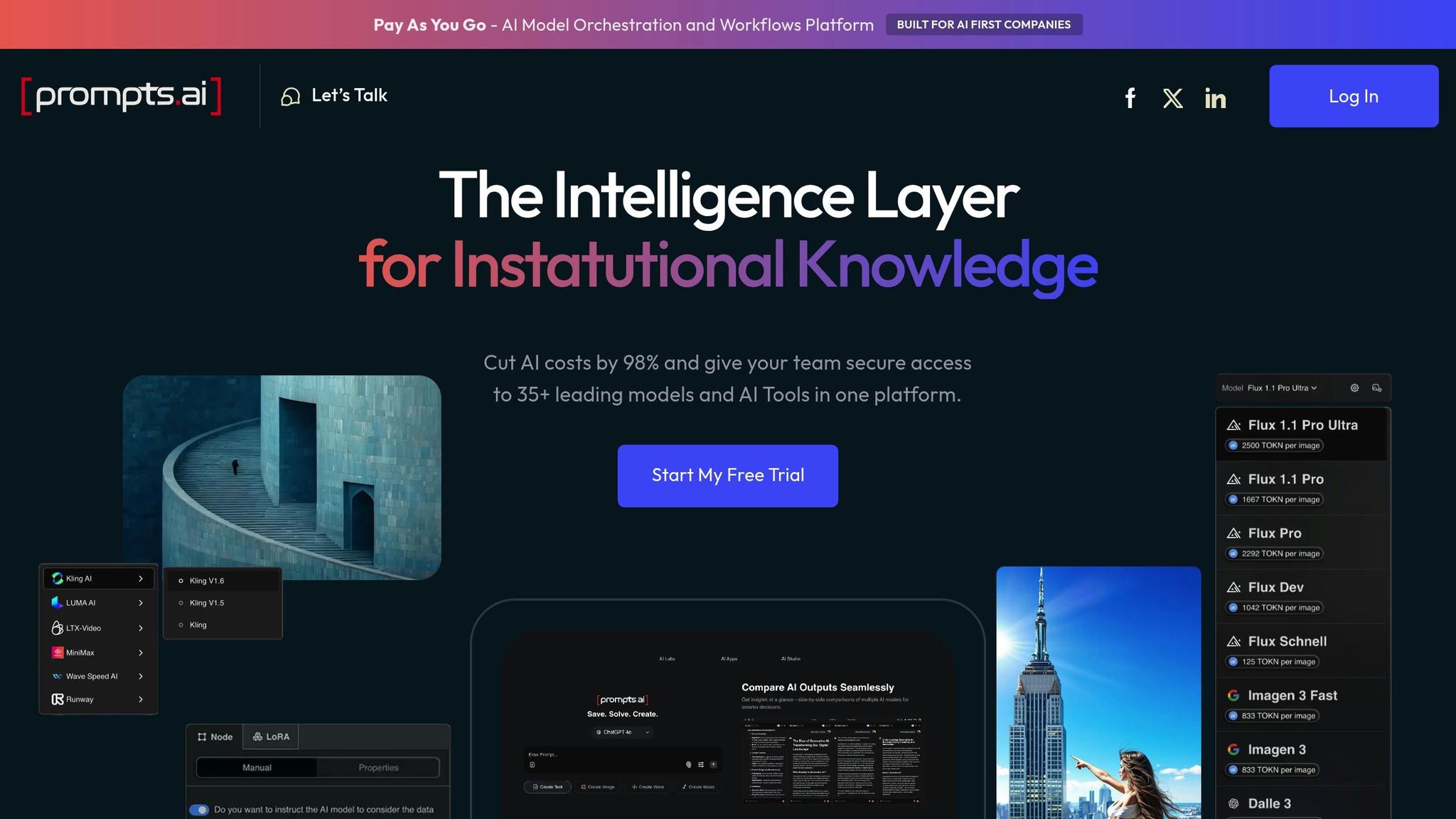
Prompts.ai is a powerful AI orchestration platform designed for enterprises looking to scale generative AI effectively. By bringing together over 35 leading large language models - such as GPT-5, Claude, LLaMA, and Gemini - into one seamless interface, it provides businesses with a centralized solution to manage their AI needs.
Prompts.ai’s vendor-neutral approach allows organizations to manage all their AI tools through a single interface. Teams can switch between models like GPT-5 for complex problem-solving, Claude for content creation, or Gemini for data analysis without disrupting existing workflows. This adaptability ensures optimal performance across a variety of tasks.
The platform’s side-by-side comparison feature is a game-changer, enabling users to evaluate outputs from different models in real time. This helps teams make informed, data-driven decisions while avoiding the limitations of vendor lock-in. With this streamlined access, automation becomes more efficient and accessible.
Prompts.ai transforms experimental AI processes into scalable, repeatable workflows with full auditability. By integrating with widely used business tools, the platform allows teams to automate workflows across departments effortlessly.
Custom workflows powered by LoRAs significantly reduce the time required for complex creative tasks. Steven Simmons, CEO & Founder, shared his experience:
"With Prompts.ai's LoRAs and workflows, he now completes renders and proposals in a single day - no more waiting, no more stressing over hardware upgrades."
Additionally, the Time Savers feature offers pre-built workflows that are ready to deploy, making it easier to implement AI solutions in areas like sales, marketing, and operations.
Prompts.ai’s "Scale Without Silos" architecture ensures smooth scaling for organizations of all sizes. Adding models, users, or teams takes just minutes, eliminating operational bottlenecks. Higher-tier plans include unlimited workspaces, collaborators, and workflow creation to meet the demands of growing enterprises.
Features like TOKN Pooling and Storage Pooling enhance resource sharing and management, empowering small teams to achieve enterprise-level efficiency while supporting the intricate needs of larger organizations.
By consolidating over 35 tools into one platform, Prompts.ai can reduce AI-related expenses by up to 98%. Its Pay As You Go pricing model, powered by TOKN credits, ensures transparent and usage-based costs. Real-time analytics dashboards provide detailed spending insights, turning fixed AI costs into scalable, on-demand solutions.
Prompts.ai prioritizes security and compliance, making it particularly suitable for regulated industries like healthcare and finance. With enterprise-grade security and complete audit trails, the platform meets critical standards such as SOC 2 and GDPR. This ensures that organizations can maintain secure, interoperable workflows without compromising compliance.
With an average user rating of 4.8/5, Prompts.ai has been recognized by GenAI.Works as a leading platform for enterprise automation and problem-solving, highlighting its ability to tackle practical AI challenges effectively.
Apache Airflow stands out as an open-source option for managing complex workflows, offering a flexible alternative to integrated enterprise platforms. Originally designed for orchestrating data pipelines and machine learning workflows, Airflow operates on a Python-based framework, enabling developers to define workflows as code using Directed Acyclic Graphs (DAGs).
Airflow excels in scheduling and monitoring data pipelines. It allows developers to use Python scripts to define task dependencies, enabling the seamless chaining of multiple operations in a specific order. Each task within a DAG represents a distinct workflow step, such as data preprocessing or model training.
The platform features a web-based interface where teams can visualize workflows, monitor execution statuses, and address failures. If a task fails, Airflow automatically retries it based on predefined rules, ensuring workflows continue with minimal disruption.
Airflow offers multiple execution options to suit different needs. For testing, the LocalExecutor is available, while the CeleryExecutor handles parallel processing in production environments. For large-scale operations, the KubernetesExecutor dynamically creates pods to manage tasks, ensuring efficient resource use and isolation.
Organizations often deploy Airflow on Kubernetes for its scalability and resource management capabilities. This setup allows dynamic task allocation, but it requires advanced configuration and expertise. Teams without dedicated DevOps support may face challenges in setting up and maintaining distributed Airflow deployments, especially when compared to platforms with simpler, out-of-the-box solutions.
As an open-source tool, Airflow is free to use, but production deployments come with additional costs. Infrastructure expenses, maintenance requirements, and engineering resources all contribute to the total cost of ownership. Running Airflow typically involves dedicated servers or cloud-based compute resources, and costs can vary depending on the complexity of workflows and how frequently they run.
This cost model is distinct from enterprise platforms, which often bundle infrastructure and support into a single, predictable expense.
Airflow includes role-based access control (RBAC) to manage user permissions and restrict access to sensitive workflows. It also integrates with enterprise authentication systems like LDAP and OAuth, providing centralized user management.
Audit logging tracks workflow execution and user actions, which can help organizations meet compliance standards in regulated industries. However, securing an Airflow deployment requires careful configuration. Sensitive data, such as API keys, is stored in the platform's metadata database, making it essential to implement strong encryption, network security, and secret management to prevent unauthorized access.
Kubeflow is an open-source platform built to streamline the deployment, management, and scaling of machine learning workflows on Kubernetes. By leveraging Kubernetes' scalability, it simplifies containerized deployments and supports complex ML pipelines. Designed with data scientists and ML engineers in mind, Kubeflow offers tools to handle the entire machine learning lifecycle - from experimentation and training to deployment and monitoring.
Kubeflow’s container-based architecture allows teams to create reproducible ML workflows using Kubernetes pods. It supports widely used frameworks like TensorFlow, PyTorch, XGBoost, and MXNet, enabling organizations to standardize their ML processes across various model types. Its pipeline feature lets users define multi-step workflows, where each stage - such as data preprocessing, model training, evaluation, and deployment - operates in separate containers. This ensures consistent performance across development and production environments while allowing integration with existing enterprise systems.
By utilizing Kubernetes' dynamic resource allocation, Kubeflow can automatically scale computing resources to match workload demands. This capability allows teams to distribute training jobs across multiple nodes, reducing the time required to process large datasets or train complex models. However, running Kubeflow effectively demands significant Kubernetes expertise and ongoing infrastructure management. While the platform itself is free, production use involves costs for cloud compute resources, storage, and the engineering time required for setup and maintenance. Organizations should also consider the additional expenses for monitoring tools and implementing security measures to ensure smooth and secure operations.
Kubeflow incorporates Kubernetes' built-in security features, such as namespace isolation, role-based access control, and network policies, to safeguard sensitive ML workflows. It supports enterprise authentication systems and includes audit logging to track activities like model training and deployment. With its container-native design, Kubeflow offers a solid solution for managing ML workflows, particularly for organizations already leveraging Kubernetes infrastructure and looking for specialized orchestration tools tailored to machine learning needs.
AWS Step Functions is a serverless orchestration tool designed to streamline the management of distributed applications and microservices through visual workflows. Seamlessly integrating with over 200 AWS services, it’s particularly suited for organizations already leveraging the AWS ecosystem and looking to incorporate generative AI workflows alongside their existing cloud infrastructure.
Step Functions integrates effortlessly with AWS AI and machine learning services like Amazon Bedrock for foundational models, SageMaker for custom model development, and Amazon Comprehend for natural language processing. For instance, a generative AI workflow might involve invoking models through Bedrock, processing the results with Lambda, storing outputs in S3, and triggering additional services - all within a unified workflow. This setup ensures efficient and interconnected AI processes, meeting the automation demands of modern enterprises.
The service also offers flexibility in handling model calls, whether immediate or delayed. This is particularly useful for generative AI tasks, where inference times can vary significantly. Workflows can be configured to wait for model responses, retry failed requests, or process outputs from multiple models simultaneously. This adaptability allows organizations to build resilient AI pipelines capable of managing variable response times and handling service interruptions effectively.
Step Functions uses Amazon States Language, a JSON-based format, to define workflows. Its visual designer simplifies complex orchestration, automates error handling, and incorporates retry mechanisms. Each state within a workflow represents a specific action, such as invoking a model, transforming data, making decisions, or managing errors.
If a generative AI model encounters an error or times out, Step Functions can retry the operation with increasing wait times, redirect workflows to alternative paths, or activate notification systems. Workflows can even include human approval steps, pausing execution until AI-generated content is reviewed and approved. This level of orchestration ensures workflows remain reliable, scalable, and adaptable to high-demand scenarios.
Step Functions automatically scales to meet demand, whether handling a handful of requests daily or thousands per second, without requiring manual adjustments to infrastructure. Each workflow execution operates independently, allowing for parallel processing during periods of increased demand.
The service offers two workflow types tailored to different needs. Standard Workflows can run for up to a year, making them ideal for long-running batch tasks, while Express Workflows are designed for rapid execution, completing within five minutes and supporting up to 100,000 executions per second. This scalability, combined with a pay-per-use pricing model, ensures organizations can align costs with actual usage while maintaining flexibility for varying workloads.
AWS pricing for Step Functions is based on state transitions for Standard Workflows and on request duration and memory usage for Express Workflows. However, the total cost of running generative AI workflows also includes charges from integrated services like model inference via Amazon Bedrock, S3 storage, Lambda executions, and inter-service data transfers.
To manage expenses effectively, organizations should use AWS Cost Explorer to monitor their spending patterns. The pay-per-use model offers flexibility for fluctuating workloads, but high-volume applications require careful cost oversight to avoid unexpected charges.
Step Functions incorporates robust security measures, including integration with IAM for fine-grained access control, encryption of execution data using KMS, and support for VPC endpoints to enable private resource access. Detailed logging through CloudWatch and CloudTrail ensures workflows are auditable and meet regulatory requirements. Teams can enforce the principle of least privilege by restricting access to specific state machines or limiting the AWS services a workflow can invoke, ensuring that generative AI workflows remain secure and compliant.
Prefect is a workflow orchestration platform built on Python, enabling teams to design and manage intricate workflows directly in code. By allowing users to define workflows with standard Python, it streamlines automation and simplifies the upkeep of data pipelines.
Unlike some platforms, Prefect does not include dedicated integrations for generative AI. Instead, it focuses on delivering strong workflow management capabilities, making it an ideal choice for organizations that value reliable automation over AI-specific features. This approach underscores the diverse strategies vendors adopt when incorporating generative AI into orchestration tools.
When choosing an enterprise AI platform, it's essential to evaluate vendors based on model access, automation capabilities, scalability, pricing, and security. Each platform tackles AI challenges differently, so understanding these distinctions can help organizations align their needs with the right solution. This comparison builds on the previously discussed features.
A key differentiator among platforms is model integration. Prompts.ai provides seamless access to over 35 leading AI models - including GPT-5, Claude, LLaMA, Gemini, and Flux Pro - through a single interface, removing the hassle of managing multiple vendors. In contrast, Apache Airflow requires custom development to link generative AI capabilities. Kubeflow offers moderate integration, focusing on Kubernetes-native machine learning models. AWS Step Functions prioritizes AWS-hosted models, making it ideal for AWS-centric operations. Prefect, while offering flexible scheduling, lacks deep, pre-built connections to generative AI platforms.
In terms of workflow orchestration, each vendor takes a distinct approach. Prompts.ai delivers a unified platform designed to automate processes across departments, transforming ad-hoc tasks into scalable workflows with integrations to tools like Slack, Gmail, and Trello. Apache Airflow employs DAG-based (Directed Acyclic Graph) orchestration, which is robust but may require custom plugins for AI-specific tasks. Kubeflow shines in orchestrating complex ML pipelines within Kubernetes environments, though its setup can be daunting for teams unfamiliar with Kubernetes. AWS Step Functions offers event-driven orchestration with high scalability, particularly for AWS-centric use cases. Prefect provides adaptable scheduling for diverse workflows but lacks the AI-specific features found in specialized platforms.
Scalability is another critical factor. Prompts.ai supports growth from small teams to enterprise-level operations, offering unlimited workspaces and collaborators in its business plans. Apache Airflow and Prefect both handle batch and scheduled workflows effectively, ensuring scalability. Kubeflow and AWS Step Functions excel in scaling massive workloads, leveraging container orchestration and cloud infrastructure to support global operations.
When it comes to cost transparency, differences are notable. Prompts.ai offers straightforward tiered pricing in US dollars, using TOKN Credits to eliminate recurring fees and align costs with actual usage. The platform claims to reduce AI costs by up to 98% by unifying access to multiple models. Apache Airflow, as open-source software, has minimal licensing costs, but deployment, maintenance, and infrastructure expenses can add up. Kubeflow, AWS Step Functions, and Prefect operate on usage-based pricing tied to cloud infrastructure and deployment configurations.
Security and compliance needs vary across industries. Prompts.ai ensures enterprise-grade security with SOC 2 Type II, HIPAA, and GDPR compliance, marking its SOC 2 Type II audit process as active as of June 19, 2025. AWS Step Functions benefits from AWS's robust compliance frameworks, making it a strong choice for regulated industries like finance. Kubeflow relies on Kubernetes' native security controls, while Prefect offers moderate security, often requiring additional configuration for strict compliance. Apache Airflow's open-source nature means security depends heavily on how organizations implement and maintain it.
| Vendor | Model Integration | Workflow Orchestration | Scalability | Cost Transparency | Security and Compliance |
|---|---|---|---|---|---|
| Prompts.ai | 35+ models (GPT-5, Claude, LLaMA, Gemini, Flux Pro) | Unified platform with tool integrations | High | Clear pricing with TOKN Credits | Enterprise-grade (SOC 2 Type II, HIPAA, GDPR) |
| Apache Airflow | Requires custom integration | DAG-based | High | Minimal licensing; variable costs | Implementation-dependent (open-source) |
| Kubeflow | Moderate (Kubernetes-native ML models) | Kubernetes-native | Very High | Usage-based pricing | Strong (Kubernetes controls) |
| AWS Step Functions | AWS-hosted models primarily | Event-driven | Very High | Usage-based pricing | Strong (AWS compliance frameworks) |
| Prefect | Moderate (flexible scheduling) | Flexible scheduling | High | Usage-based pricing | Moderate (may need additional configuration) |
These distinctions highlight the importance of interoperability and transparent pricing when building scalable AI workflows. For example, US marketing agencies streamline operations with Prompts.ai, reducing turnaround times through unified workflows. Healthcare providers rely on Kubeflow for scalable, compliant ML pipelines, while financial institutions use AWS Step Functions for event-driven tasks like fraud detection and document processing. Media companies leverage Apache Airflow for batch scheduling of AI-generated content, despite its need for custom integration. Startups often turn to Prefect for its user-friendly interface and adaptable scheduling, ideal for orchestrating AI-powered product features.
Each platform also has its downsides. Prompts.ai, while simplifying complex tasks, may pose a learning curve for non-technical users. Apache Airflow demands significant customization for AI integration, requiring technical expertise. Kubeflow's reliance on Kubernetes can be challenging for teams without container orchestration experience. AWS Step Functions is best suited for AWS-focused organizations, with limited multi-cloud flexibility. Prefect’s moderate security features may require additional tools to meet enterprise-grade compliance in heavily regulated industries.
Looking ahead, vendors are evolving to meet emerging demands. Prompts.ai is expanding support for multimodal models and real-time collaboration. Kubeflow is enhancing ML lifecycle management tools, while AWS Step Functions is improving event-driven AI automation and compliance features. Prefect is working on better monitoring and hybrid cloud orchestration. When choosing a platform, organizations should assess their specific needs, current infrastructure, and long-term AI strategies, balancing immediate requirements with future scalability and compliance goals.
When choosing a generative AI vendor, it's essential to align their offerings with your goals, infrastructure, and budget. The generative AI market has seen explosive growth, jumping from $191 million in 2022 to over $25.6 billion by 2024. In fact, 75% of U.S. enterprises plan to adopt generative AI technologies within the next two years.
Cost efficiency is a key consideration. Teams focused on managing expenses can benefit from Prompts.ai's predictable, pay-as-you-go TOKN Credits, which can reduce AI costs by up to 98%. While Apache Airflow offers minimal licensing costs as open-source software, deployment and maintenance expenses can add up. For startups or smaller teams managing diverse workflows, Prefect provides usage-based pricing with flexible scheduling options.
For large-scale operations, platforms like Kubeflow and AWS Step Functions are better suited to handle high-volume compute needs and complex orchestration. Kubeflow thrives in Kubernetes-native environments, offering robust scalability for intricate ML pipelines. AWS Step Functions, on the other hand, provides seamless event-driven orchestration within AWS, making it ideal for industries like finance (e.g., fraud detection) or healthcare (e.g., processing large volumes of documents). Both platforms benefit from significant investments in AI infrastructure.
Regulated industries, such as healthcare, finance, and government, require vendors with strong security and compliance capabilities. Prompts.ai meets these demands with SOC 2 Type II, HIPAA, and GDPR compliance. AWS Step Functions leverages AWS's extensive compliance frameworks, while Kubeflow ensures security through Kubernetes controls - though implementing it may require specialized expertise. Apache Airflow and Prefect may need additional configurations to meet stringent regulatory standards.
The industry is shifting toward integrated platforms, prioritizing compliance and security alongside functionality. Organizations are increasingly adopting unified orchestration platforms that streamline their technology stack, reducing complexity and operational overhead. Solutions like Prompts.ai, which consolidates access to over 35 models through a single interface, are gaining traction over platforms requiring extensive custom integrations.
As you evaluate vendors, consider both your immediate needs and long-term strategy. Whether your focus is on unified workflows, scalable ML pipelines, event-driven automation, or flexible scheduling, choose a solution that aligns with your goals.
While AI prices are projected to drop over time, enterprise costs are currently trending upward. Despite this, 95% of businesses report satisfaction with their AI ROI, and spending on AI systems is expected to reach $223 billion by 2028. By emphasizing interoperability, cost efficiency, and compliance, you can select a vendor that aligns with your workflows and infrastructure, positioning your organization to thrive in AI's rapidly evolving landscape.
When choosing a generative AI vendor, prioritize trust and reliability to ensure your data remains secure and results are dependable. Look into their data governance policies to verify they comply with privacy laws and safeguard sensitive information effectively.
Assess whether the vendor can scale to meet your organization's evolving needs and their dedication to staying ahead by integrating the latest AI technologies. Additionally, evaluate how they tackle the skills gap - whether through intuitive tools or training programs that empower your team. Lastly, confirm they can provide measurable ROI, showcasing outcomes that align with your business objectives.
Prompts.ai's FinOps layer delivers real-time insights into AI usage, expenses, and return on investment, giving businesses the tools to fine-tune their operations. With clear cost tracking and actionable data at your fingertips, it ensures you’re only paying for what’s necessary, cutting out wasteful spending.
This system allows organizations to simplify their AI workflows, improve budget management, and achieve lasting results - all while maintaining top-tier performance.
Prompts.ai is built with stringent security and compliance protocols to address the specific demands of highly regulated sectors such as healthcare and finance. It complies with SOC 2 Type II, HIPAA, and GDPR standards, offering robust safeguards for data protection and privacy.
These frameworks ensure that Prompts.ai delivers a secure platform, enabling organizations to meet rigorous regulatory requirements without compromising on workflow efficiency. It's a dependable choice for industries where safeguarding sensitive data is a top priority.