Pay As You Go - AI Model Orchestration and Workflows Platform



AI workflow systems simplify complex tasks by combining AI models, automation, and business logic. These platforms save time, reduce costs, and improve operational efficiency. Selecting the right system depends on integration capabilities, cost structure, and governance features.
Key highlights:
Quick Comparison:
| Platform | Strengths | Challenges |
|---|---|---|
| Prompts.ai | Cost tracking, 35+ AI models, compliance | Limited free plan features |
| Zapier | Broad app integrations, user-friendly | Higher pricing, less AI optimization |
| Vellum AI | Advanced AI model tools | Steep learning curve |
| n8n | Self-hosting, free option | Developer-focused, complex setup |
Choose based on your goals: streamline AI workflows, optimize costs, or integrate tools efficiently.

AI Workflow Platform Comparison: Features, Pricing, and Best Use Cases
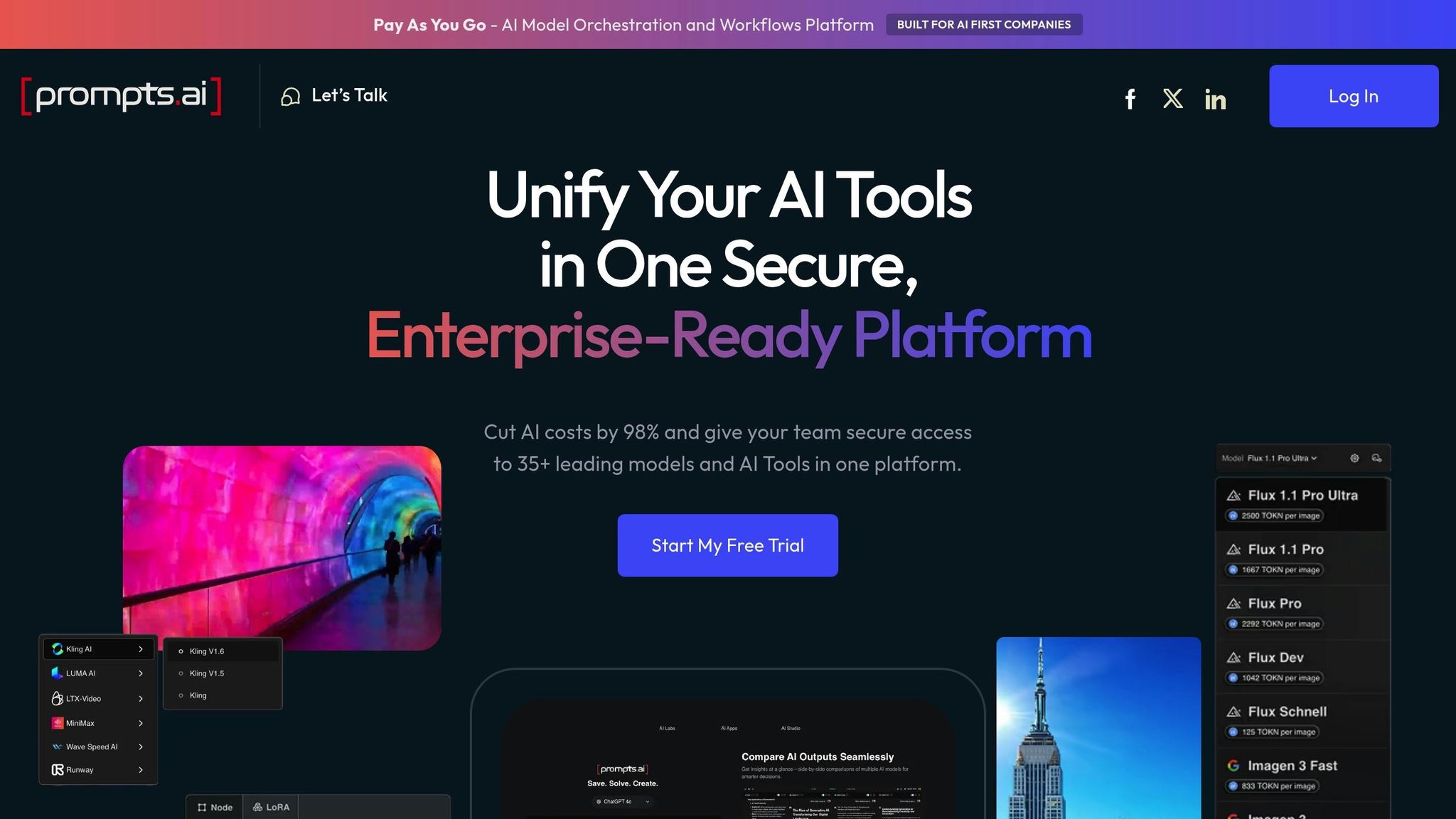
Prompts.ai is a specialized platform designed to streamline AI workflows for product teams, data engineers, and startups managing multiple prompts, models, and experiments in production. Unlike general-purpose automation tools that primarily connect apps, Prompts.ai focuses on scaling prompt versioning, evaluation, and observability. In the U.S., teams use it for tasks like automated document processing, customer support, content generation pipelines, and building internal tools that integrate LLM calls with business logic and external APIs. Let’s dive into how Prompts.ai handles integration, cost management, governance, and scalability.
Prompts.ai provides a model-agnostic interface that connects seamlessly to leading providers like OpenAI GPT-4, Anthropic Claude, and other hosted models. This unified framework allows teams to switch between model providers without reworking their workflows. Users can assign specific tasks to cost-effective or premium models based on complexity, while also integrating retrieval systems (like vector search), document stores, and external APIs to combine LLM outputs with company data and tools.
Operating on a SaaS pricing model, Prompts.ai includes subscription fees along with usage-based metering to track tokens, latency, and estimated costs per run. The platform offers detailed cost tracking for each workflow step, enabling teams to set spending limits by project, environment, or user. This prevents unexpected expenses and highlights workflows driving up costs. For example, a support automation workflow managing 50,000 monthly requests could cut API expenses by 20–40% by using lower-cost models for simpler tasks and reserving premium models for critical operations.
Prompts.ai includes robust role-based access control (RBAC), allowing administrators to assign roles like admin, editor, or viewer for specific projects. This ensures only authorized users can modify prompts, deploy workflows, or access production logs. Clear environment separation - development, staging, and production - keeps experimental prompts from accidentally entering customer-facing workflows. Audit logs track version histories and configuration changes, including who deployed what and when, which is particularly important for regulated industries. The platform also supports data residency and log retention settings, with options to mask or redact sensitive information.
Prompts.ai is built for horizontal scaling, deploying additional workers to handle increased LLM calls and workflow tasks during traffic spikes, such as campaigns or product launches. Distributed task queues, complete with retry policies and dead-letter queues, ensure reliable processing even under heavy loads. Its multi-tenant architecture allows multiple teams and projects to run concurrently while keeping resources and data isolated. Designed to handle thousands of concurrent executions and millions of tasks per month, the platform enables organizations to start small and expand seamlessly to enterprise-level deployments.
Enterprise AI workflow platforms are designed to integrate seamlessly with a wide range of business applications, leveraging pre-built connectors and APIs to connect thousands of tools. Unlike solutions focused solely on managing prompts, these platforms tackle broader challenges related to business integration. Below, we examine their performance in model integration, cost efficiency, governance, and scalability.
While these platforms include some AI-native capabilities, they often fall short in this area. Features like AI agents and retrieval-augmented generation (RAG) are available in some cases, but many platforms rely on custom API integrations to expand their functionality.
Pricing models vary significantly across enterprise AI workflow platforms, offering options for different budgets and needs. Here’s a quick breakdown:
Security and compliance are top priorities for these platforms.
These robust security measures make these platforms suitable for data-sensitive enterprises.
Scalability is another critical factor, especially for businesses aiming for large-scale AI deployment. These systems support various deployment options, including cloud, virtual private cloud (VPC), hybrid, and on-premise setups, enabling organizations to maintain control over data residency and meet regulatory demands.
Self-hosted tools like n8n and Activepieces provide additional control over infrastructure, while managed services simplify automatic scaling. Despite these options, scaling AI remains a significant hurdle. Research from MIT indicates that 95% of generative AI pilots fail to scale to production, and Capgemini projects that only 2% of organizations will have successfully deployed AI agents at scale by 2025.
When selecting an AI workflow platform, it's essential to weigh each option's advantages against its limitations. Below is a comparison of various platforms, highlighting their strengths and drawbacks to help you identify the best fit for your needs.
| Platform | Pros | Cons |
|---|---|---|
| Prompts.ai | • Combines 35+ top AI models (e.g., GPT-5, Claude, LLaMA, Gemini) into a single, secure interface, eliminating tool sprawl • Side-by-side LLM comparisons enhance productivity by up to 10× • Cuts AI costs by 98% using the TOKN credit system, replacing 35+ tools in under 10 minutes • Enterprise-ready with SOC 2 Type II, HIPAA, and GDPR compliance (SOC 2 Type 2 audit begins 06/19/2025) • Offers unlimited workspaces and collaborators on Business plans, with governance features • Integrates seamlessly with Slack, Gmail, and Trello for automated workflows |
• Limited workflow creation on the Creator plan ($29/month) • TOKN credit system requires careful monitoring to avoid interruptions • No collaborators included in the free Pay As You Go plan • Less flexibility for highly custom, code-heavy workflows compared to developer-focused platforms • Limited self-hosting options for startups needing backend control |
| Zapier | • Enterprise-grade reliability trusted by millions • Saves users an average of 282 days of manual work annually • Thousands of app integrations with intelligent outage detection and throttling • Intuitive visual canvas with conditional logic for quick automations • Accessible for both technical and non-technical users |
• Higher pricing, starting at $29.99/month after the free tier • Less suitable for complex AI model optimization • May overwhelm users seeking purely AI-focused tools • Limited self-hosting capabilities |
| Vellum AI | • Advanced troubleshooting with node-level traces, graph views, and real-time logs • Provides cost and latency metrics for optimization • TypeScript/Python SDKs with document retrieval and semantic search • Tailored for enterprise-level AI model optimization |
• Steep learning curve for non-technical users • Primarily developer-focused, with less emphasis on no-code collaboration • Credit-based enterprise pricing can become expensive • Less focus on simple team workflows |
| Relevance AI | • No-code AI Agent Builder supporting GPT-4/Claude models • Comprehensive analytics dashboards for tracking performance and costs • Vector search with auto-scaling for high-volume tasks • Collaborative workspaces with integrations like Slack, Google Sheets, and CRM tools |
• Credit-based pricing can escalate with heavy usage • Higher costs for enterprise-scale operations • Requires more setup for straightforward automations • Limited self-hosting options |
| Relay.app | • Human-in-the-loop workflows with approval gates • Advanced AI for tasks like summarization, extraction, and translation • Strong team collaboration features |
• Seat-based pricing can drive up costs for larger teams • Limited scalability for non-enterprise use cases |
| Gumloop | • User-friendly interface with the Gummie AI assistant for building workflows • Generous free plan that includes premium LLM access • No need for users to manage API keys • Active support through a Slack community |
• Paid plans start at $97/month • Less scalable for enterprise needs compared to platforms like Zapier or Vellum AI • Lacks advanced governance tools |
| n8n | • Full control with 5,000+ templates and a self-hosting option • Free self-hosting available • Cloud plans start at $20/month for 2,500 executions • SOC 2 compliance with source-available code for auditing |
• Paid plans required for production workflows • Developer-oriented, making it less accessible for non-technical users • Steeper learning curve compared to visual no-code platforms |
Each platform offers unique strengths. Prompts.ai stands out for consolidating numerous AI tools with robust governance and cost efficiency. Zapier excels in broad app integrations and enterprise reliability. Vellum AI is ideal for those prioritizing deep AI model optimization, while Relay.app focuses on collaborative workflows. For teams needing complete infrastructure control, n8n offers unmatched flexibility. Choose the platform that best suits your operational goals and technical requirements.
When choosing an AI workflow system, it's essential to weigh factors like cost, integration capabilities, and governance requirements. Prompts.ai brings together over 35 AI models in one secure, compliant platform, offering up to 98% cost savings and a 10× productivity boost through features like side-by-side LLM comparisons. It’s a powerful solution for organizations seeking streamlined and secure AI workflows.
Take a close look at your technical infrastructure, governance priorities, and budget. Then, consider trying the free trial to see how Prompts.ai can transform your processes. With its pay-as-you-go TOKN credit system, costs remain tied to actual usage, making it easier to move away from scattered tools and embrace a unified, efficient approach.
Prompts.ai transforms the way businesses manage AI workflows by uniting more than 35 top-tier AI models and tools into a single, secure platform designed for enterprise use. This approach can cut AI-related expenses by as much as 98%, offering an affordable solution for organizations of any size.
The platform empowers users to simplify intricate workflows, scale operations effortlessly, and adhere to strict governance standards. It also ensures smooth integration and efficient deployment, making AI-driven solutions both accessible and manageable.
Prompts.ai enables businesses to significantly cut costs with its pay-as-you-go model, offering potential savings of up to 98% on AI expenses. The platform grants secure access to more than 35 top-tier AI models and tools, all seamlessly integrated into one enterprise-ready system. This setup ensures smoother workflows, improved cost control, and strong governance for AI-powered operations.
Prompts.ai brings together more than 35 cutting-edge AI models, such as ChatGPT, Claude, LLaMA, Mistral, and Gemini, all within a single, streamlined platform. This unified interface makes it easier to deploy, coordinate, and manage these models across enterprise workflows.
Built with scalability and security in mind, Prompts.ai integrates effortlessly into your current systems. It's the perfect choice for businesses aiming to enhance their operations and achieve greater efficiency through AI-driven solutions.