Pay As You Go - AI Model Orchestration and Workflows Platform



In 2026, AI compliance is no longer optional - it's mandatory. With the EU AI Act taking effect on August 2, 2026, and state-level laws like California AB 2013 and Colorado's AI Act already in force, enterprises face steep penalties for non-compliance: up to €35 million or 7% of global revenue. The risks are compounded by shadow AI, with 48% of employees admitting to uploading sensitive data into public AI tools, driving average breach costs to $4.4 million.
To tackle these challenges, three platforms stand out for enterprise compliance: Prompts.ai, ComplianceShield AI, and RegulAI. Each offers tools like automated risk detection, audit logging, and privacy safeguards to help businesses meet regulatory requirements. Here’s a quick breakdown:
Choosing the right platform depends on your enterprise’s scale, technical needs, and compliance goals. Below, we explore each solution in detail to help you make an informed decision.
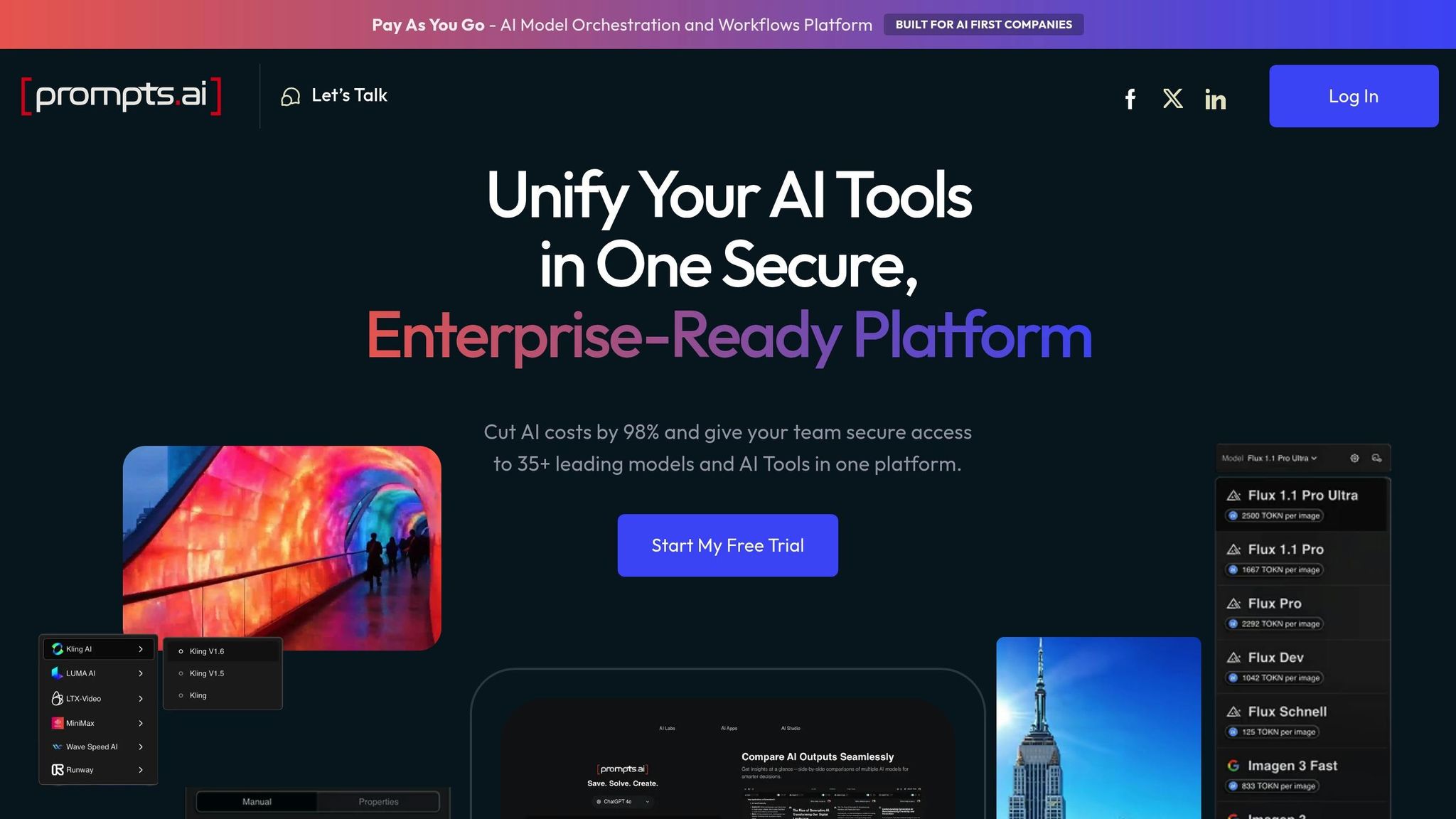
Prompts.ai is an enterprise-focused AI orchestration platform that brings together over 35 top-tier large language models - such as GPT-5, Claude, LLaMA, and Gemini - into a single, secure interface. It simplifies AI tool integration while ensuring governance on a large scale. For organizations navigating the complex compliance requirements of 2026, the platform provides automated evidence collection, real-time risk detection, and audit trails aligned with major regulations like GDPR, HIPAA, the EU AI Act, ISO 27001, and SOC 2.
Prompts.ai leverages natural language processing to map logs, access records, and system events directly to compliance frameworks, drastically reducing the need for manual evidence collection. This proactive approach to compliance is especially beneficial in highly regulated industries such as finance and healthcare. For financial services, the platform automates KYC and anti-money laundering processes, offering real-time anomaly alerts. Meanwhile, healthcare organizations gain HIPAA-compliant data privacy, predictive risk management, and automated evidence mapping for access deviations. With continuous 24/7 compliance monitoring, enterprises remain audit-ready, eliminating the traditional manual workload and addressing the growing regulatory pressures of 2026.
Built as a cloud-based solution, Prompts.ai seamlessly scales across industries like finance, healthcare, and manufacturing. Its predictive analytics and API integrations allow it to grow alongside expanding deployments without requiring infrastructure overhauls. This adaptability ensures compliance remains intact as models, users, and teams grow - an essential feature as the EU AI Act and state-level regulations become fully enforceable.
Prompts.ai operates on a SaaS subscription model with custom enterprise pricing. The platform provides clear cost tracking through self-service portals and analytics dashboards, enabling businesses to measure ROI effectively. By transitioning from reactive audits to predictive compliance, enterprises can avoid costly penalties tied to 2026 regulations. The platform’s ability to justify its costs with measurable performance metrics makes it a practical choice for businesses aiming to manage compliance costs efficiently.
Security is at the core of Prompts.ai, featuring role-based access control (RBAC), detailed audit logs, and isolated data environments for customers. The platform meets stringent certifications, including SOC 2, ISO 27001, HIPAA, and GDPR. It also includes tools to monitor agent behavior, track model drift, and maintain an AI Bill of Materials for managing third-party risks. With policy enforcement and traceable AI decisions, organizations can meet emerging global compliance standards throughout 2026. This strong security and governance framework establishes Prompts.ai as a trusted solution for managing compliance at scale.
ComplianceShield AI transforms enterprise compliance by shifting from periodic audits to real-time monitoring and automated policy enforcement. Its AI CoPilot assists by drafting policies, suggesting controls, and automatically linking them to standards like ISO 27001, NIST, SOC 2, GDPR, and HIPAA.
The platform automates evidence collection by connecting directly to cloud APIs, CI/CD pipelines, and IAM systems, removing the need for manual log gathering. Using advanced language analysis, ComplianceShield identifies policy gaps, analyzes configurations, and offers actionable recommendations. With regulatory timelines tightening, this kind of automated gap analysis is essential for organizations managing high-risk AI systems.
"2026 is the year of enforcement: the EU AI Act reaches general application... and regulators across jurisdictions expect documented governance programs, not just policies." - Secure Privacy
A standout feature is its cross-framework normalization, which uses a meta-control library to map internal controls across overlapping regulations. This eliminates redundant efforts and ensures consistency for organizations juggling multiple compliance standards. Additionally, the platform delivers predictive insights by analyzing historical data and telemetry, helping teams preemptively fix controls likely to fail audits.
These tools enable enterprises to keep pace with growing regulatory demands without overburdening their teams.
ComplianceShield AI supports scalability by embedding compliance into existing DevSecOps workflows. It integrates with tools like AWS Config, Azure Policy, and Kubernetes to enforce compliance policies before deployment. The platform fosters collaboration across security, risk, and compliance teams by enabling real-time task assignments and tracking remediation progress. This integration helps dismantle departmental silos that often slow down larger organizations.
Every change is automatically versioned, with full audit trails, and the system generates documentation such as Statements of Applicability (SoA) and risk assessments. This ensures compliance processes scale seamlessly with enterprise needs.
ComplianceShield AI follows a consultation-based pricing model. Enterprises schedule a free consultation to assess their needs and receive a tailored proposal. While this approach may lack upfront pricing clarity, the platform’s automation can improve compliance efficiency by about 30% compared to manual processes. Considering that AI-related losses average $4.4 million and penalties can reach €35 million or 7% of revenue, these efficiency gains are crucial for large organizations.
By combining cost efficiency with robust compliance capabilities, ComplianceShield AI delivers a solution designed to meet the financial and operational demands of enterprises.
The platform ensures regulatory defensibility with immutable audit trails and a unified governance system that aligns controls across standards like ISO 27001, SOC 2, GDPR, PCI DSS, HIPAA, and DPDPA. This creates a centralized view of compliance status. Real-time dashboards provide insights into compliance maturity and track failed controls, offering visibility unmatched by traditional periodic audits.
As businesses brace for tighter regulations in 2026, RegulAI steps in to address a pressing need with its real-time regulatory update capabilities. Powered by a specialized legal LLM, this platform automates the complex process of regulatory mapping. By decoding over 3,200 global regulations in real-time, it eliminates the manual task of tracking legal changes. This functionality becomes especially critical with the enforcement of the EU AI Act in 2026, which carries potential fines of up to €35 million or 7% of global revenue for non-compliance. RegulAI’s approach aligns seamlessly with proactive compliance strategies.
RegulAI is tailored to operationalize the EU AI Act, offering pre-built frameworks to classify risks into unacceptable, high, limited, and minimal categories. It directly implements Articles 9 through 15, addressing requirements like risk management and technical documentation. The platform also ensures continuous monitoring for bias across 18 demographic dimensions, conducting tests both before deployment and throughout the AI lifecycle to meet fairness standards.
Built around a 7-stage AI lifecycle framework, RegulAI incorporates automated governance checkpoints to minimize AI-related incidents. This reduces such occurrences by 94% and slashes the mean resolution time from 6.7 days to just 2.3 hours. As Jinal Shah, CEO of RegulAI, explains:
"AI governance isn't a compliance burden that slows AI deployment - it's the foundation that enables responsible AI at scale."
RegulAI brings together over 10 disparate governance tools into a single, unified platform, offering real-time visibility across an enterprise’s entire AI ecosystem. It automatically identifies and classifies all AI systems within an organization, building comprehensive inventories and flagging "shadow AI" that might evade oversight. The platform supports multi-cloud and on-premise deployments, integrating seamlessly with major AI platforms for complete governance.
In large, complex environments, RegulAI maps dependencies by tracking models that rely on more than 12 upstream data sources and over 8 third-party APIs, helping prevent cascading failures. Through a structured four-phase implementation process - Foundation, Core Governance, Advanced Capabilities, and Optimization - enterprises can deploy AI systems 3.2 times faster while reducing compliance risks by 87%. Mature governance can be achieved in just 8–12 weeks.
RegulAI offers a tailored ROI analysis based on the number of AI systems and specific regulatory needs, rather than a fixed pricing model. The financial benefits are clear: proactive interventions cost around $15,600, compared to $188,500 for reactive alerts or $3.1 million for unmonitored incidents. By managing AI portfolios strategically, organizations can see a 247% increase in returns on investment, while better vendor oversight reduces compliance violations by 91%.
The platform employs AES-256 encryption for stored data and TLS 1.3 for data in transit, meeting rigorous standards like SOC 2 Type 2, ISO 27001, and GDPR. RegulAI ensures customer data is never used to train AI models, safeguarding proprietary information. It offers flexible deployment options, including cloud-based SaaS, hybrid, and on-premises setups, to comply with strict data residency rules.
RegulAI enforces five key AI guardrails: input validation to detect prompt injection, output filtering to prevent PII leaks and toxicity, ongoing bias detection, access control, and performance monitoring. Role-Based Access Control (RBAC) and Single Sign-On (SSO) integration secure user permissions. Additionally, specialized AI agents collect evidence and generate audit-ready documentation, reducing compliance team workloads by 80%.

AI Compliance Software Comparison 2026: Prompts.ai vs ComplianceShield AI vs RegulAI
This section provides a concise overview of the main advantages and challenges associated with each platform, helping organizations navigate the growing regulatory pressures expected by 2026. By weighing these trade-offs, businesses can align their regulatory goals, technical needs, and budgets with the most suitable solution.
Prompts.ai stands out for its extensive model integration and cost-effective pricing structure. Its pay-as-you-go TOKN credit system eliminates recurring subscription fees, making it an attractive option for enterprises with variable AI workloads. The platform also embeds governance features like audit trails and compliance controls directly into workflows, while its Prompt Engineer Certification program helps build internal expertise. However, companies heavily invested in existing GRC systems may face challenges in integrating these tools without creating additional data silos.
ComplianceShield AI provides a centralized repository for AI metadata and pre-built policy packs that align with frameworks such as the EU AI Act and NIST standards, enabling faster compliance implementation. On the downside, it requires advanced technical skills and has non-transparent pricing, which can complicate financial planning.
RegulAI simplifies regulatory tracking with its legal LLM-based mapping and phased onboarding approach, making it easier to adopt governance practices incrementally. However, it requires substantial resources to maintain, which could be a hurdle for organizations without dedicated compliance teams. Pricing details are also only available through direct consultation.
| Platform | Key Strengths | Primary Weaknesses |
|---|---|---|
| Prompts.ai | Broad model integration; cost-efficient pay-as-you-go pricing; embedded governance | Integration with legacy GRC systems may require planning |
| ComplianceShield AI | Automates policy translation; supports EU AI Act and NIST compliance; centralizes metadata | Requires advanced technical knowledge; unclear pricing |
| RegulAI | Simplifies regulatory tracking; phased implementation for governance adoption | Resource-intensive; pricing requires direct inquiry |
Selecting the right platform depends on your priorities. If cost efficiency is key, Prompts.ai offers a flexible pricing model. For businesses seeking automated policy-to-code solutions, ComplianceShield AI excels. Meanwhile, RegulAI is ideal for organizations focused on streamlining regulatory tracking. With 71% of business leaders viewing AI as essential for tackling compliance challenges and 61% of compliance teams feeling stretched thin, finding a platform that balances functionality with organizational capacity is crucial for long-term success. This analysis lays the groundwork for exploring how to choose the best fit for your enterprise.
Prompts.ai emerges as a standout choice for enterprises navigating the complex compliance landscape of 2026. With AI-related incidents climbing by 56.4% year-over-year and average losses from breaches reaching $4.4 million, the platform addresses both regulatory demands and risk management head-on.
Prompts.ai combines cost efficiency with robust governance through its pay-as-you-go TOKN credit system, eliminating recurring fees while granting access to over 35 top-tier models. These models come equipped with built-in audit trails and compliance controls, ensuring regulatory alignment. The Prompt Engineer Certification program empowers teams to establish best practices and develop in-house expertise, while the unified interface reduces tool sprawl and scales AI workflows to meet operational demands. Whether your governance efforts are spearheaded by legal, compliance, or engineering teams, Prompts.ai’s adaptable architecture integrates seamlessly into any organizational structure.
In an environment where non-compliance risks severe penalties, Prompts.ai provides the secure, scalable framework enterprises need. With the EU AI Act’s high-risk system requirements set to take effect in August 2026, organizations failing to comply face fines of up to €35 million or 7% of global annual revenue. As Reggie Townsend, Vice President of Data Ethics Practice at SAS, emphasizes:
"Organizations without AI governance face not just potential regulatory penalties... they face a potential competitive disadvantage because public trust has become the new currency for AI innovation."
Prompts.ai ensures your enterprise is audit-ready, secure, and well-positioned to thrive in a future where public trust is paramount to success in AI-driven innovation.
To figure out if your AI system qualifies as "high-risk" under the EU AI Act, start by checking if it aligns with the categories listed in Annex III or functions as a safety component in specific products. This process includes evaluating classification criteria, performing a thorough risk assessment, and maintaining accurate documentation. For detailed steps and requirements, consult the guidelines provided in the Act.
The fastest way to spot and handle shadow AI within your organization is by leveraging advanced monitoring tools. These tools can detect unapproved AI usage, monitor data flows, and enforce governance policies effectively. Solutions like Relyance AI, WitnessAI, and Zenity offer detailed oversight, helping to reduce risks while maintaining compliance and control over unauthorized AI activities.
To get ready for an audit by August 2, 2026, compile evidence that demonstrates your AI systems meet compliance standards, maintain proper controls, and uphold accountability. Focus on collecting:
Additionally, map out your operations across different regions and industries to handle overlapping regulations effectively. This approach ensures you're prepared for shifting compliance demands.