Pay As You Go - AI Model Orchestration and Workflows Platform



AI-driven content strategies streamline workflows, cut costs, and boost performance by automating tasks like research, drafting, and distribution. By integrating tools like Prompts.ai, businesses can scale content production, enhance personalization, and optimize ROI. Key insights include:

AI-Driven Content Strategy ROI and Performance Statistics
When teams adopt AI tools without coordination - each department relying on its own solutions - it often leads to fragmented usage. This creates security vulnerabilities, duplicate costs, and an inconsistent brand voice. By 2024, 56% of companies using generative AI tools reported these exact issues: disjointed implementation slowed adoption across the organization and made governance nearly unmanageable.
Interoperable platforms address these challenges by uniting access to multiple AI models under one interface. This eliminates the hassle of juggling separate subscriptions and APIs. Companies adopting this approach typically reduce their AI spending by 20-35% by cutting duplicate subscriptions. Beyond cost savings, centralized governance boosts ROI by 40%, as every AI interaction becomes transparent, auditable, and aligned with organizational standards. This approach not only reduces costs but also strengthens compliance frameworks.
"The organizations seeing the most value from generative AI are those that have implemented structured governance while still giving teams access to best-in-class models for their specific needs." - Sarah Chen, Research Director, Forrester
A unified platform helps prevent "shadow AI" - the use of unsanctioned tools by employees that bypass IT oversight, creating compliance risks and undermining consistent branding. Without a centralized system, proprietary insights and customer data might end up in tools without proper audit trails or role-based access controls, leading to security and governance gaps.
Interoperability also allows teams to choose the best model for specific tasks. For instance, Claude is ideal for deep reasoning and legal analysis, GPT excels at rapid prototyping and general content creation, and Gemini is tailored for multimodal inputs and data-intensive research. A unified platform enables teams to leverage these strengths within a single, governed workspace rather than forcing a one-size-fits-all solution. Take the example of U.K. e-commerce retailer MandM: in 2025, the company transitioned from a few manual Python models to hundreds of production models on a unified platform. By integrating automated retraining and drift monitoring, they cut deployment times from weeks to days and now process data for millions of customers daily.
This unified approach, as demonstrated by platforms like Prompts.ai, showcases how centralized control can harness the strengths of diverse models to achieve optimal outcomes.
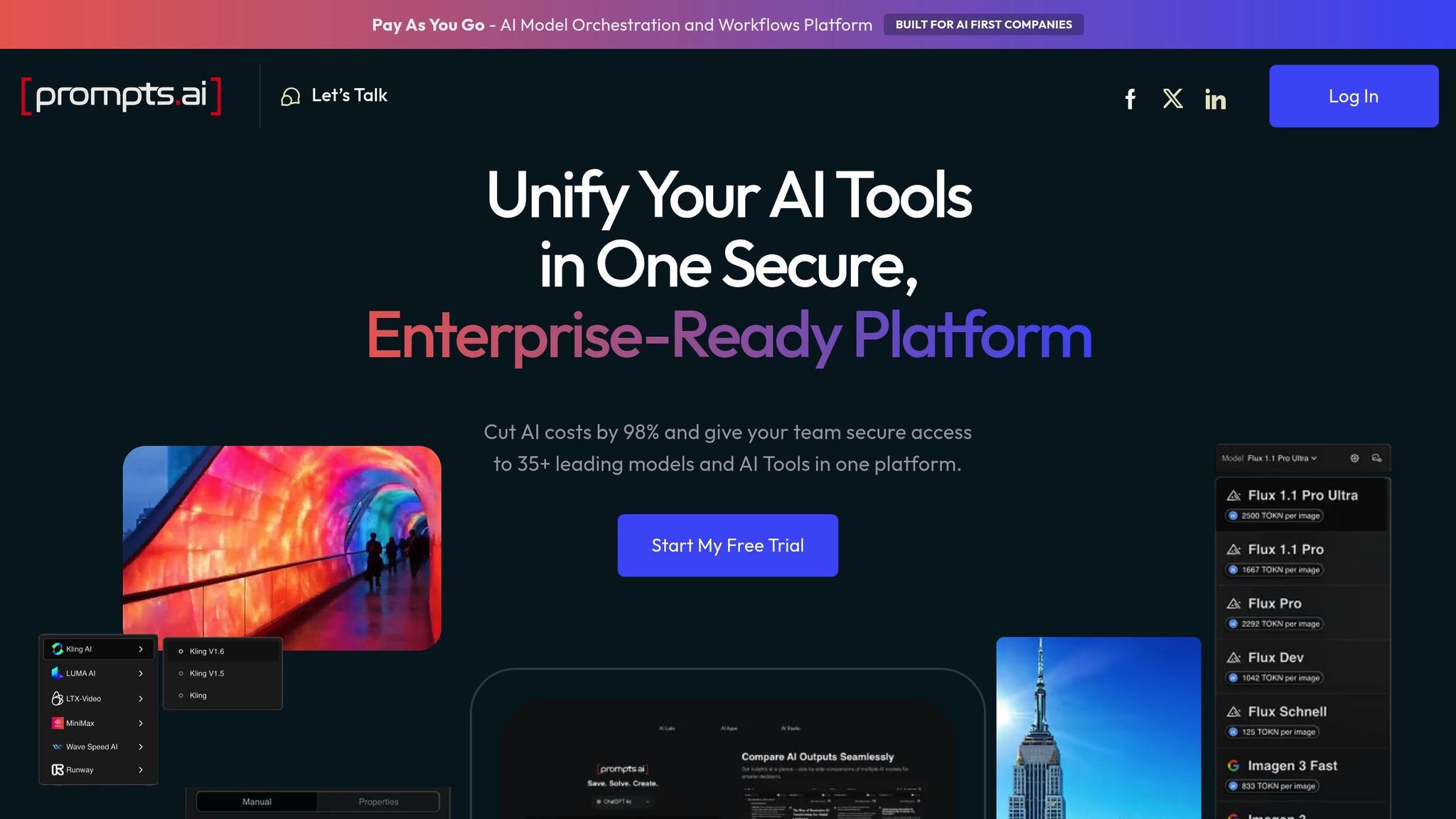
Prompts.ai grants access to 35+ LLMs, including GPT-5, Claude, Gemini, LLaMA, and Mistral, all through a single interface. Teams can compare model performance side-by-side, select the best fit for specific tasks, and monitor every interaction with real-time FinOps cost controls. This eliminates the need for multiple API keys, separate billing systems, and scattered analytics tools.
The platform's governance capabilities include role-based access controls, centralized audit trails, and standardized prompt libraries, ensuring all AI-generated content aligns with brand guidelines. Instead of each team crafting prompts independently, organizations can maintain a repository of pre-approved, high-quality prompts that reflect company standards. Cost tracking is seamlessly integrated: every token is monitored and linked to specific teams and projects, enabling real-time spending management.
For enterprises scaling AI, Prompts.ai transforms individual tools into a cohesive, compliant process. By combining centralized access, governance, and cost control, the platform supports efficient, scalable content production - key to any successful AI-driven strategy.
Marketing teams often lose 12.7 hours each week reworking AI-generated content due to inconsistent results. The root of this issue lies in unstructured interactions with AI tools. Transitioning from casual, one-off prompts to multi-stage workflows transforms content creation from a hit-or-miss effort into a predictable, repeatable process. Instead of relying on a single, all-encompassing prompt, structured workflows break the process into distinct stages: research, outlining, drafting, quality assurance, and publishing. Each stage uses tailored prompts designed for specific tasks, ensuring consistent quality and a smoother workflow.
The real game-changer comes with the shift to modular prompt chaining, which significantly reduces production time by 60–70%. Teams report cutting the process for publication-ready articles from an average of 3.8 hours to just 9.5 minutes. This method divides tasks among multiple prompts: one generates headlines, another focuses on data-driven content, and a third adjusts tone. Organizations using documented AI workflows report an impressive average return of $8.55 for every $1 spent, translating to a 750% ROI.
Retrieval-Augmented Generation (RAG) takes this efficiency even further by integrating first-party data - such as product specs, case studies, and internal research - directly into prompts. This ensures the AI output is grounded in accurate, company-specific information. Instead of relying solely on the AI model's training data, RAG pulls relevant documents into the process, making every claim verifiable. Automated style validators also play a key role, reducing brand voice inconsistencies by up to 89% before human review even begins.
Prompt workflows are designed to maximize efficiency while maintaining quality and consistency. Prompts.ai simplifies the creation of these workflows with its unified interface, connecting over 35 models and providing a centralized prompt library. Teams can store and reuse tested prompts, saving time and ensuring reliable results. The platform is built around the R-C-F-E framework, which defines the Role (e.g., "Expert SEO Strategist"), Context (e.g., "B2B SaaS audience"), Format (e.g., "Markdown table"), and Examples (few-shot prompting). This approach ensures outputs meet specific requirements every time.
Workflows also include human-in-the-loop (HITL) checkpoints at critical stages, such as outline approvals, introduction reviews, and final fact-checks. AI handles repetitive tasks like summarization and initial drafting, while humans focus on strategy, emotional engagement, and brand alignment. Teams can fine-tune AI behavior by adjusting temperature settings - lower values (0.3–0.5) for factual tasks and higher values (0.7–0.9) for creative brainstorming. Additionally, the platform's audit trails track every prompt version, making it easy to identify what works and improve workflows over time.
Not all AI models are equally suited to every task, so selecting the right one is crucial. For example, GPT-4o excels at long-form and creative writing, while Claude’s extensive 200K context window makes it ideal for research-heavy projects. Perplexity is great for real-time research with cited sources, and tools like Jasper are tailored for short-form marketing content. Prompts.ai’s side-by-side comparison feature allows teams to test multiple models on the same prompt, evaluating factors like quality, tone, and accuracy before finalizing a workflow.
This model selection process also considers factors like context window size, multimodal capabilities (e.g., audio/video transcription, image generation), and task-specific strengths. For instance, workflows can process webinar recordings or podcast audio, automatically generating transcripts and turning them into structured blog posts or social media snippets. Real-time cost tracking further enhances decision-making by linking token usage to specific projects, helping teams balance performance with budget considerations. By testing and comparing models in a controlled environment, organizations can avoid vendor lock-in and stay flexible as new AI models become available.
Creating great content is only half the battle - it also needs to reach the right audience at the perfect moment. The traditional, manual approach to distributing content is time-consuming, requiring endless hours to reformat posts, schedule updates, and monitor performance. With advancements in AI, this process has been transformed. AI not only automates distribution but also personalizes messaging at a scale far beyond what human teams could manage. By seamlessly connecting content creation with audience engagement, effective distribution becomes the key to amplifying the impact of AI-driven workflows.
AI-driven distribution platforms serve as a central hub for managing content across multiple channels. Instead of reformatting a single blog post manually for LinkedIn, X, email newsletters, and Instagram, AI handles the heavy lifting. A single long-form piece is processed to create dozens of platform-specific variations. Each variation is tailored to its destination: LinkedIn posts are crafted with a professional tone and relevant hashtags, X threads are broken into concise snippets with mentions, and Instagram captions are written to complement visual storytelling.
Smart scheduling further enhances the process by analyzing historical engagement data to determine the best times to post. Forget the guesswork - AI examines weeks or even months of data to pinpoint optimal posting windows. It can even identify the right moments to reshare older content for maximum visibility. Additionally, channel-specific optimization is handled automatically, with AI adjusting image sizes, character limits, and tone to match the unique requirements of each platform.
Prompts.ai simplifies this entire process through its unified interface, connecting content workflows directly to distribution channels. Teams can use prompt chains to transform a single strategic brief into fully realized multi-channel campaigns in as little as 48 hours. The platform’s audit trails provide insights into which variations perform best, feeding this data back into future workflows. Real-time cost tracking ensures efficient token usage, so your campaigns remain cost-effective while delivering consistent results across all channels.
While automation ensures your content reaches a broad audience, personalization ensures those messages resonate on an individual level.
Generic messaging doesn’t cut it anymore - 76% of customers find it frustrating. AI personalization solves this problem by consolidating behavioral, transactional, and demographic data into unified profiles. This data fuels predictive personalization, where machine learning identifies high-intent users, predicts churn risks, and triggers the next best action automatically.
The results speak for themselves: companies leveraging AI-driven personalization report 10-15% higher conversion rates and up to 8x better returns on their marketing investments. Tailored calls-to-action outperform generic ones by 202%, as they address specific user needs and contexts. For instance, a visitor from the healthcare sector might see case studies focused on hospital systems, while someone from manufacturing might encounter examples of factory automation - all dynamically generated from the same content framework.
Prompts.ai enables this level of precision with its R-C-F-E framework. This system defines the Role (e.g., "B2B Sales Strategist"), Context (industry-specific challenges), Format (e.g., email or social post), and Examples (few-shot learning). Teams can experiment with various personalization strategies across multiple AI models simultaneously, measuring engagement to identify the most effective approach before scaling. To ensure quality, human-in-the-loop checkpoints verify that AI-generated personalized content aligns with the brand’s voice and remains factually accurate before it’s delivered to customers.
Taking content creation and distribution to the next level, optimizing performance turns raw data into actionable strategies.
Publishing is just the first step. The real game-changer lies in analyzing performance data to uncover what resonates and scaling those successes. Traditional analytics tools often require teams to manually sift through data - a process that can take days or even weeks. In contrast, AI analytics processes engagement data instantly, predicts outcomes before content even goes live, and continuously fine-tunes strategies to focus on what delivers results. This proactive approach allows teams to address potential issues before they impact traffic and to measure the return on every content decision with precision.
AI analytics integrates seamlessly with platforms like Google Analytics 4, uncovering valuable insights in moments that would take human analysts much longer to find. For example, tracking scroll depth can pinpoint where readers lose interest, highlighting sections that need improvement. Metrics like session duration, conversion rates, and click-through rates are monitored in real time, with anomalies flagged for immediate review.
AI tools also keep an eye on brand visibility, tracking mentions in large language model (LLM) outputs and AI-driven search results. This is critical as 63% of marketers predict that by 2025, most of their content will be AI-generated. Traditional SEO metrics alone no longer tell the full story. Businesses now need to optimize for search engines, voice assistants, and AI citations simultaneously - a multi-channel strategy that demands constant monitoring.
Prompts.ai simplifies this process with a unified dashboard that lets teams track token usage, model performance, and engagement metrics side by side. Detailed audit trails link specific prompt chains to concrete outcomes, such as demo requests or lead form submissions. For example, when HubSpot noticed a drop in blog traffic due to Google's AI Overviews in 2024, they used AI-driven content clustering to pivot their approach. Over six months, Marketing Hub customers saw website traffic grow by 134% and inbound leads increase by 107% [1].
These real-time insights not only identify problems but also fuel ongoing improvements.
Performance data does more than measure effectiveness - it shapes the next steps. AI-powered A/B testing generates multiple versions of headlines, meta descriptions, and calls-to-action, then predicts which will perform best before they’re published. This approach removes guesswork and speeds up the process of validating results.
In 2024, Wine Deals adopted this strategy by focusing on 200 high-intent pages using data-backed topic clustering. The result? A 325% surge in clicks within just three months [2]. Prompts.ai supports this kind of iterative improvement with tools that compare outputs across multiple AI models, helping teams identify which versions drive the most engagement before scaling them. Quality is maintained throughout the process with human-in-the-loop checkpoints, ensuring that every refinement aligns with strategic goals.
After proving the value of AI optimization, the next hurdle is scaling these workflows across teams. Many organizations rush into expanding AI adoption, only to encounter challenges like rising costs, compliance risks, and inconsistent quality. The key to a successful rollout lies in building strong governance frameworks that balance speed with necessary safeguards, alongside financial discipline that ties every dollar spent to measurable outcomes. With proper governance in place, scaling becomes both efficient and impactful.
Expanding AI content production calls for a structured approach, where a central Responsible AI team sets the standards while individual business units manage specific risks. This decentralized model avoids bottlenecks while ensuring consistency. A tiered risk system can define which types of content require legal oversight - such as medical claims or financial advice - and which can flow through automated checks. To streamline this, integrate reviews into existing product councils or advisory boards rather than adding new approval layers.
Standardized guidelines are essential for fast yet secure workflows. Pre-approved models and prompt libraries can save time and reduce errors. For instance, setting clear boundaries - like prohibiting AI-generated customer quotes, fabricated research data, or regulated advice without expert review - helps avoid costly legal issues and protects brand integrity. Additionally, tools like Data Security Posture Management (DSPM) can secure sensitive data in generative AI applications, particularly those handling customer or proprietary information.
Human-in-the-loop (HITL) checkpoints at critical stages ensure the brand’s voice remains intact. As Ameya Deshmukh, an AI Strategy Guide, explains:
"Governance must enable business-led AI, not block it."
To achieve this, adopt MLOps practices such as version control for prompts, automated accuracy checks, and continuous monitoring for misuse or model drift. Platforms like Prompts.ai support these efforts by providing detailed audit trails that connect specific workflows to their outcomes, making it easier to identify what works and what needs fine-tuning. These governance measures lay the groundwork for predictable and scalable financial performance.
Financial discipline is what separates stalled pilots from scalable initiatives. Calculate ROI using the formula: (Return − Cost) ÷ Cost, accounting for all inputs like tool licenses, per-token fees, editing time, and compliance reviews. While marketing and sales leaders report that AI adoption contributes a median 15% of their EBIT, nearly three-quarters of companies struggle to fully capture this value due to poor cost-benefit analysis.
Start small with a tightly controlled pilot, setting clear success benchmarks. Once those are met, expand budgets incrementally. Tag AI-assisted assets in your CMS to directly compare their performance. Companies that adopt structured AI workflows often see a 5× boost in content production, alongside a 20× increase in organic traffic and notable gains in customer acquisition.
Using a centralized platform like Prompts.ai, you can easily track every aspect of operational efficiency and ROI. Monitor metrics like content velocity, publishing speed, and editing time, while also measuring financial returns. For AI-specific insights, track brand mentions in LLM outputs and AI answer engines - metrics often referred to as "Share of Voice." Quality scores based on rubrics (scored 0–100) can assess E-E-A-T and brand voice consistency, ensuring speed doesn’t sacrifice trust. Prompts.ai’s unified dashboard simplifies this process, displaying token usage, model performance, and engagement metrics side by side. This makes it straightforward to identify which workflows are delivering value and which need adjustments before scaling further.
Relying on AI-driven content strategies is no longer a choice for enterprises aiming to remain competitive in 2026 and beyond. The data speaks volumes: earlier examples highlight measurable returns when organizations embrace these tools effectively. Achieving such results requires a single, unified platform that integrates every phase of the content lifecycle - from research and drafting to distribution and performance tracking. This streamlined approach reinforces earlier points about improving efficiency and scalability.
The key to success lies in interoperability. Fragmented AI systems cost marketing teams an average of 12.7 hours per week due to disjointed workflows. Prompts.ai eliminates this inefficiency by bringing multiple models together in one interface. Features like real-time cost tracking, audit trails, and side-by-side performance comparisons ensure teams stay aligned and productive. This structural integration drives results: companies with documented AI workflows report an average return of $8.55 for every $1 spent, equating to an impressive 750% ROI.
To build on these outcomes and ensure long-term success, consider this approach: adopt the 80/20 rule, where AI handles tasks like research, outlining, and drafting, while humans focus on oversight and refining brand strategy. Establish governance frameworks that strike the right balance between speed and compliance. Track key metrics such as content velocity and revenue attribution to measure impact. By following this strategy, companies won’t just produce more content - they’ll create high-performing content optimized for traditional search, AI assistants, and generative platforms alike.
AI-powered content strategies significantly boost ROI and efficiency by automating time-consuming tasks, streamlining workflows, and delivering actionable insights. Tasks like research, drafting, and publishing can be handled by AI, allowing teams to produce high-quality content more quickly and at a lower cost.
Beyond efficiency, AI tools elevate audience engagement by tailoring content through data analysis. By spotting trends, refining keyword strategies, and monitoring performance, AI ensures that content aligns with audience preferences, driving stronger connections and higher conversion rates. Businesses leveraging AI often report tangible benefits, such as increased organic traffic and smarter resource use, all of which contribute to a stronger ROI.
Using a comprehensive AI platform like Prompts.ai simplifies your content strategy by bringing everything you need into one place. With access to over 35 AI models, it eliminates unnecessary complications, speeds up workflows, and saves valuable time. The platform’s flexible pay-as-you-go pricing and real-time expense tracking also make it a cost-effective choice for managing your AI resources.
Prompts.ai emphasizes security and scalability, ensuring peace of mind with enterprise-grade protections such as SOC 2 Type II and HIPAA compliance. It enhances productivity by automating tasks like research, drafting, and editing while maintaining top-notch quality through tools like style guides and fact-checking features.
By using Prompts.ai, organizations can boost ROI, increase the speed of content creation, and deliver tailored, high-impact content - all within a secure and scalable system designed to meet business demands.
AI transforms content personalization by leveraging machine learning (ML) and natural language processing (NLP) to analyze audience data, including preferences, behaviors, and feedback. This enables businesses to craft content that aligns closely with the interests of specific audience segments, fostering stronger engagement and making the content more relevant.
When it comes to distribution, AI pinpoints optimal publishing times by examining audience activity patterns, ensuring content reaches the right people at the right moment. Beyond scheduling, AI tools can also assist with drafting content, freeing up creators to concentrate on strategic planning and creative endeavors. By streamlining these tasks, AI not only enhances efficiency but also ensures content strategies are scalable and finely tuned to audience expectations.