Pay As You Go - AI Model Orchestration and Workflows Platform



AI tools are transforming workplace productivity by automating repetitive tasks like email sorting, scheduling, and data management. By 2025, 75% of knowledge workers are expected to use generative AI daily, with productivity gains of up to 40%. However, selecting the right tools is crucial to ensure integration with existing systems, cost efficiency, and compliance with security standards like GDPR and HIPAA.
Here’s a quick overview of 10 top AI platforms designed to streamline tasks, unify tools, and optimize workflows:
Each platform addresses specific needs, from cost management and security to workflow customization and scalability. Whether you're a small team or a large enterprise, these tools can help reduce administrative workloads, improve efficiency, and deliver measurable ROI.
Quick Tip: Start with tools that integrate seamlessly into your existing systems and scale as your needs evolve.
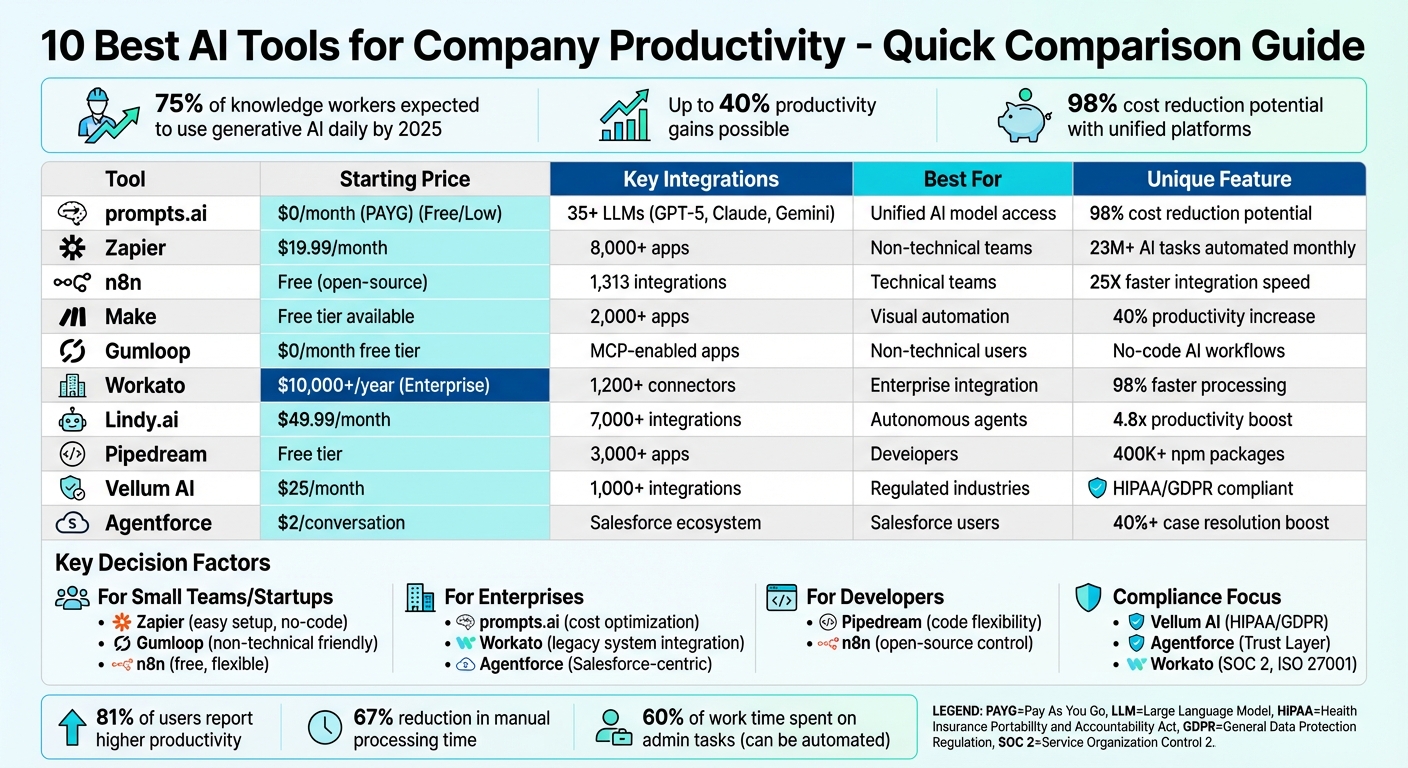
AI Productivity Tools Comparison: Features, Pricing, and Best Use Cases

Prompts.ai is an AI orchestration platform that brings together over 35 leading language models - like GPT-5, Claude, LLaMA, Gemini, Grok-4, and Flux Pro - into a single, unified interface. This setup allows teams to access multiple models from one secure dashboard, addressing the common pain points of integrating disparate tools. Here's a closer look at how its features simplify workflows.
Acting as a central hub for AI operations, Prompts.ai enables teams to compare outputs from different models side-by-side, ensuring they can pinpoint the most effective option for each task. By consolidating these interactions into one platform, it eliminates the inefficiencies of juggling multiple tools. This means teams can focus their time and energy on tasks that drive results instead of wasting hours navigating disconnected systems.
Prompts.ai is built with enterprise needs in mind, offering features like governance tools, audit trails, and team-level usage tracking to ensure compliance and maintain transparency. Its flexible pay-as-you-go TOKN credit system ensures businesses only pay for what they use. This approach can lead to cost reductions of up to 98% compared to managing separate licenses for various AI tools, providing a clear financial advantage.
The platform includes a Prompt Engineer Certification program and a library of pre-built "Time Savers" designed to tackle common business challenges. Teams can adapt these templates or create entirely new workflows tailored to their needs. By sharing these customized solutions across the organization, teams can boost productivity and foster a culture of efficiency.
Prompts.ai provides real-time FinOps controls that allow organizations to track every token used, mapping spending directly to specific projects. This level of transparency simplifies budget management and helps justify ROI. Additionally, built-in security measures and ethical guidelines ensure that sensitive data remains protected, even as teams push the boundaries of AI-driven innovation.
Zapier serves as a universal connector, seamlessly linking over 8,000 business applications on a single platform. With nearly 500 AI-specific integrations, it empowers businesses to coordinate apps, data, and AI models - all without needing to write any code. This robust platform enables companies to orchestrate entire AI systems without building separate connections, making automation accessible and efficient.
Zapier's Model Context Protocol allows external AI platforms like ChatGPT and Claude to securely execute more than 30,000 specific actions across its supported apps. This creates sophisticated workflows that combine traditional tools with cutting-edge AI. Every month, the platform automates over 23 million AI-related tasks, contributing to a total of 350 million tasks completed to date. These impressive numbers underscore Zapier's reliability and strength in enterprise environments.
With enterprise-grade infrastructure, Zapier offers compliance features like single sign-on (SSO) and human-in-the-loop controls, ensuring high-quality results at scale without compromising AI speed. Real-world examples highlight its scalability:
"Zapier makes our team of three seem like a team of ten." – Marcus Saito, Head of IT and AI Automation, Remote
Zapier's Copilot assistant simplifies building multi-step workflows using plain language, removing technical barriers to automation. Users can create autonomous AI agents trained on company-specific data from sources like Google Drive, Notion, or Confluence to handle multi-step tasks independently. Additional tools such as Zapier Tables (a spreadsheet-style database) and Canvas (a visual workflow designer) enhance customization. For advanced users, JavaScript or Python steps can be added for more tailored solutions.
This flexibility delivers measurable results. For instance, Vendasta developed an AI-powered lead enrichment system through Zapier, recovering $1 million in potential revenue and saving 282 working days annually for their sales team.
Zapier ensures centralized control over all AI interactions, preventing unauthorized "shadow AI" projects with detailed audit logs and role-based permissions. The platform guarantees 99.99% uptime, backed by Enterprise-level Service Level Agreements. Pricing is designed to fit varying needs:
Zapier's blend of automation, customization, and governance makes it a powerful tool for businesses looking to scale efficiently.
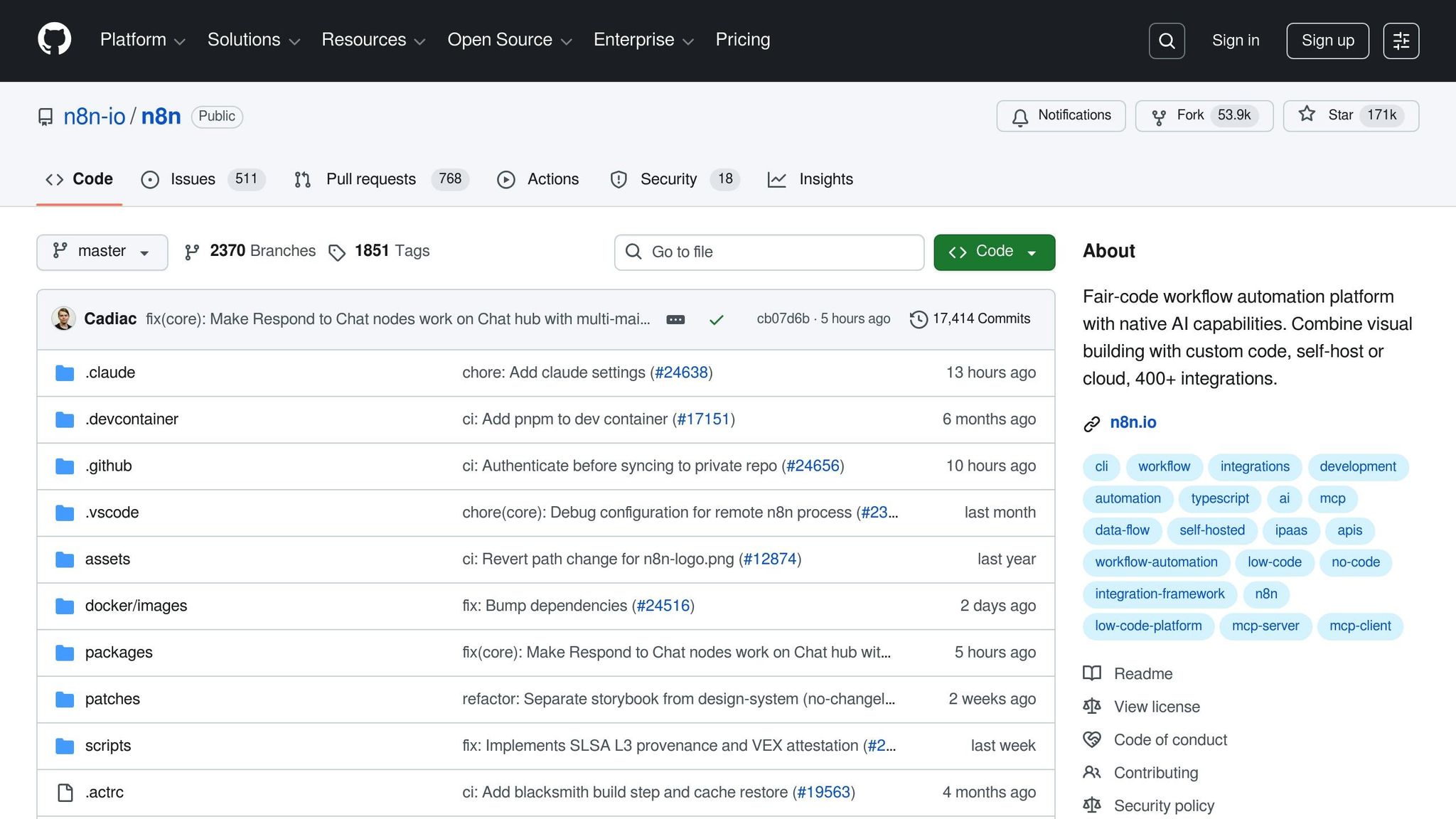
n8n is an automation platform designed to combine user-friendly visuals with the technical depth needed for advanced workflows. With 1,313 integrations, it connects popular business tools like Slack, Salesforce, and Google Workspace, while also supporting specialized AI applications through built-in LangChain and vector stores like Pinecone and Weaviate. Its universal HTTP Request node adds even more versatility, enabling teams to integrate any service with an API. This makes n8n a powerful choice for creating tailored, efficient workflows.
n8n takes a "code-when-you-need-it" approach. Users can visually construct workflows with a drag-and-drop interface but have the freedom to write custom JavaScript or Python code for more control. Developers can also incorporate npm or Python libraries and quickly connect APIs by pasting cURL requests. Unlike many platforms that only allow branching workflows, n8n supports merging branches, making it ideal for building complex logic, including multi-agent AI orchestration.
Luka Pilic, Marketplace Tech Lead at StepStone, shared:
"We've sped up our integration of marketplace data sources by 25X. It takes up to 2 hours to connect up APIs and transform the data we need. You can't do this that fast in code."
The platform's debugging tools, like re-running individual steps and using mock data to bypass delays, provide quick feedback loops. These features save valuable time and enable technical teams to focus on strategic projects, boosting overall productivity.
n8n is built to scale, offering Queue mode and multi-instance setups to handle parallel workflows and traffic surges. The Enterprise plan supports 200+ concurrent executions and includes horizontal scaling for high-demand environments. Companies can choose between a managed cloud option or self-hosted deployment via Docker for full on-premise control. Delivery Hero, for instance, reported saving 200 hours monthly with a single ITOps workflow. Dennis Zahrt, Director of Global IT Service Delivery at Delivery Hero, remarked:
"We have seen drastic efficiency improvements since we started using n8n for user management. It's incredibly powerful, but also simple to use."
With its scalability and ease of use, n8n is well-suited for enterprise needs, ensuring operational efficiency even in high-volume scenarios.
n8n prioritizes enterprise security with SOC 2 compliance, Role-Based Access Control (RBAC), and SSO integration through SAML and LDAP. Audit logs and log streaming to third-party services allow for thorough monitoring. For sensitive data, the platform supports external secret stores like AWS Secrets Manager, GCP Secret Manager, Azure Key Vault, and HashiCorp Vault. Teams can also use Git-based version control to track workflow changes, ensuring strong governance. Pricing begins at $20/month for the Starter plan (2,500 workflow executions), while Enterprise plans offer custom pricing for enhanced security and dedicated SLA support.
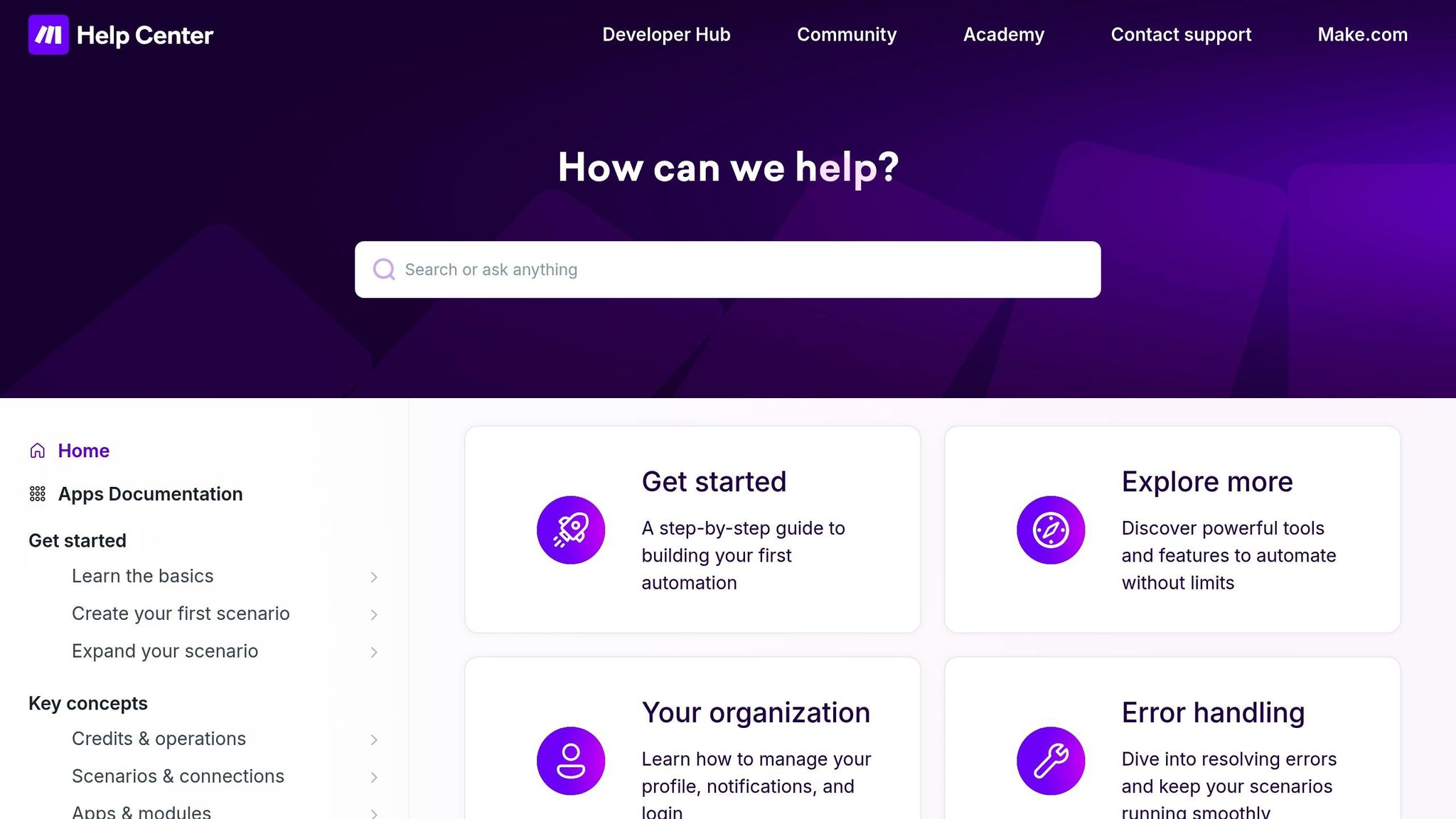
Make is a visual automation platform trusted by over 350,000 customers to design and automate workflows without writing a single line of code. It simplifies task automation across departments, aiming to enhance productivity. With its intuitive drag-and-drop interface, users can create "scenarios" that connect apps, transform data, and manage complex logic. While Make offers fewer than 2,000 native integrations, its HTTP Request toolkit allows users to expand beyond the official app library.
One of Make's standout features is its support for non-linear workflows. The drag-and-drop interface enables branching, array processing, and custom error handling, empowering users to create intricate automations without needing coding expertise. A Product Owner at Smaily highlighted this advantage:
"Its simple, flexible interface enables complex automations without coding."
This capability is particularly valuable for those who require advanced automations but prefer to skip traditional programming.
Make’s citizen development model empowers teams across the organization to implement automation solutions tailored to their needs. The CTO & Co-founder at FINN shared how this approach revolutionized their company:
"True citizen development in the entire company. Make is present in every department, empowering the company to offer a unique customer experience."
The platform’s operations-based pricing model accounts for every step, including testing and error handling, and it offers a free plan without time limits. For enterprise users, Make ensures reliability with its Verified apps system, where critical integrations are reviewed and maintained. Teleclinic's Head of Operations shared their experience:
"Make streamlined our operations, reduced costs, and eased support demands."
Research indicates that employees using AI automation tools like Make experience an average productivity increase of 40%, making it a compelling choice for organizations aiming to optimize workflows across various teams. These features pave the way for even more tools designed to refine enterprise operations.
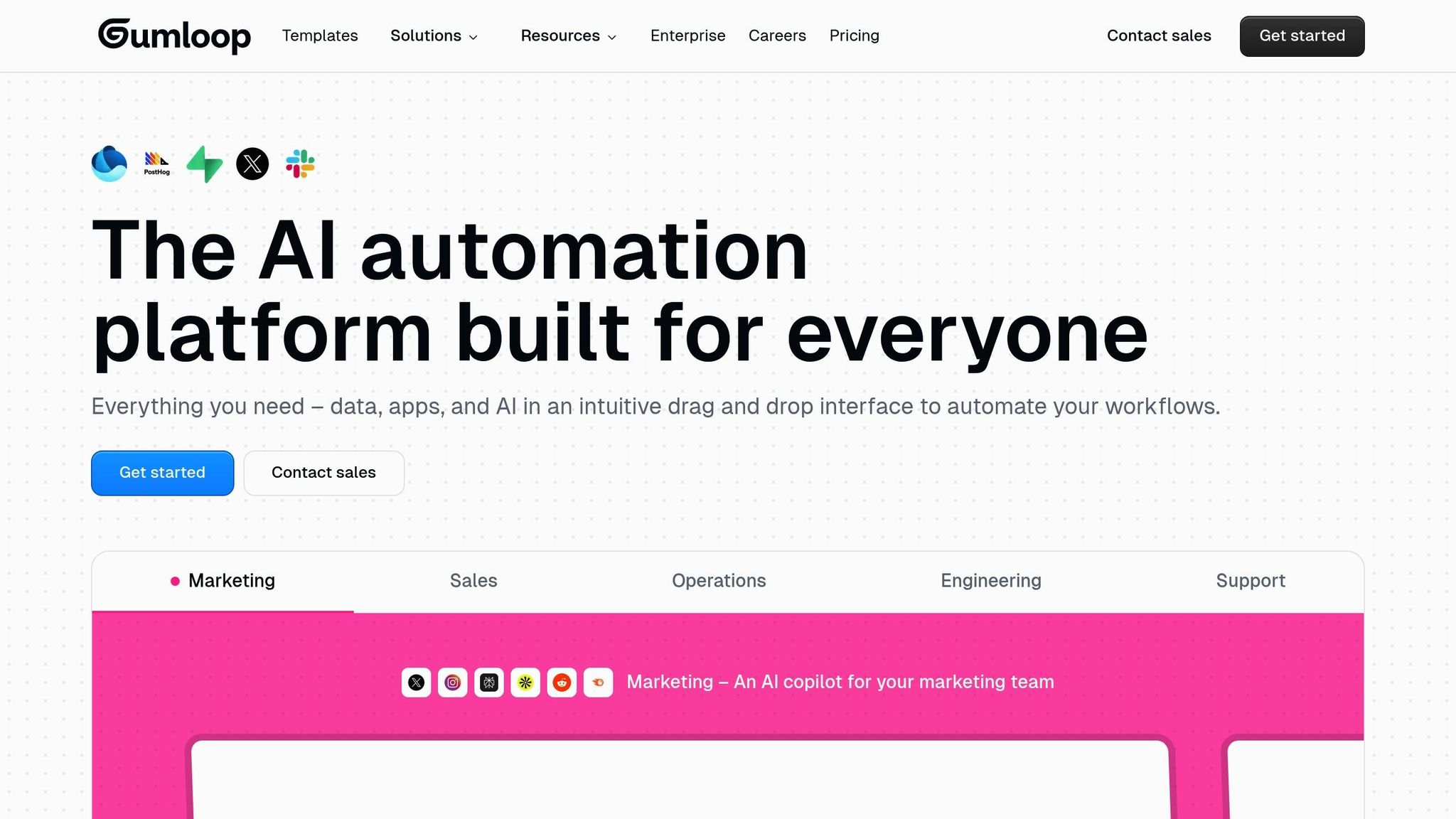
Gumloop is a powerful AI-driven automation platform designed to help non-technical teams create efficient workflows without needing to write a single line of code. Trusted by major enterprises like Shopify, Instacart, and Webflow, the platform streamlines operations across organizations, automating tasks for hundreds of employees. Fidji Simo, CEO of Instacart, highlighted its transformative impact:
"Gumloop has been critical in helping all teams at Instacart - including those without technical skills - adopt AI and automate their workflows, which has greatly improved our operational efficiency."
By focusing on simplicity, Gumloop ensures AI integration is accessible even in non-technical settings.
With its guMCP technology, Gumloop connects seamlessly to any application that supports a Model Context Protocol (MCP) server. It integrates with top-tier LLMs like ChatGPT, Claude, Gemini, and Grok, enabling AI to handle tasks and make decisions within workflows. Users can tap into these advanced models whether or not they have their own API keys, offering unmatched flexibility.
Gumloop’s visual canvas makes designing workflows intuitive, using drag-and-drop tools paired with conditional logic and AI-powered decision-making. A standout feature, Interfaces, transforms workflows into standalone apps that teams can use directly. Additionally, the platform includes the Gummie AI assistant, which guides users in building, debugging, and refining automations through natural language prompts. Bryant Chou, Co-Founder of Webflow, praised its efficiency:
"Gumloop wins time back across an org. It puts the tools into the hands of people who understand a task and lets them completely automate it away."
Gumloop offers pricing plans tailored to various needs, starting with a free plan at $0/month (2,000 credits, 1 seat). For growing teams, the Solo plan is available for $37/month (10,000+ credits), while the Team plan costs $244/month (60,000+ credits, 10 seats). For larger enterprises, custom Enterprise pricing provides enhanced security features and Virtual Private Cloud options, ensuring a solution that scales with organizational demands.
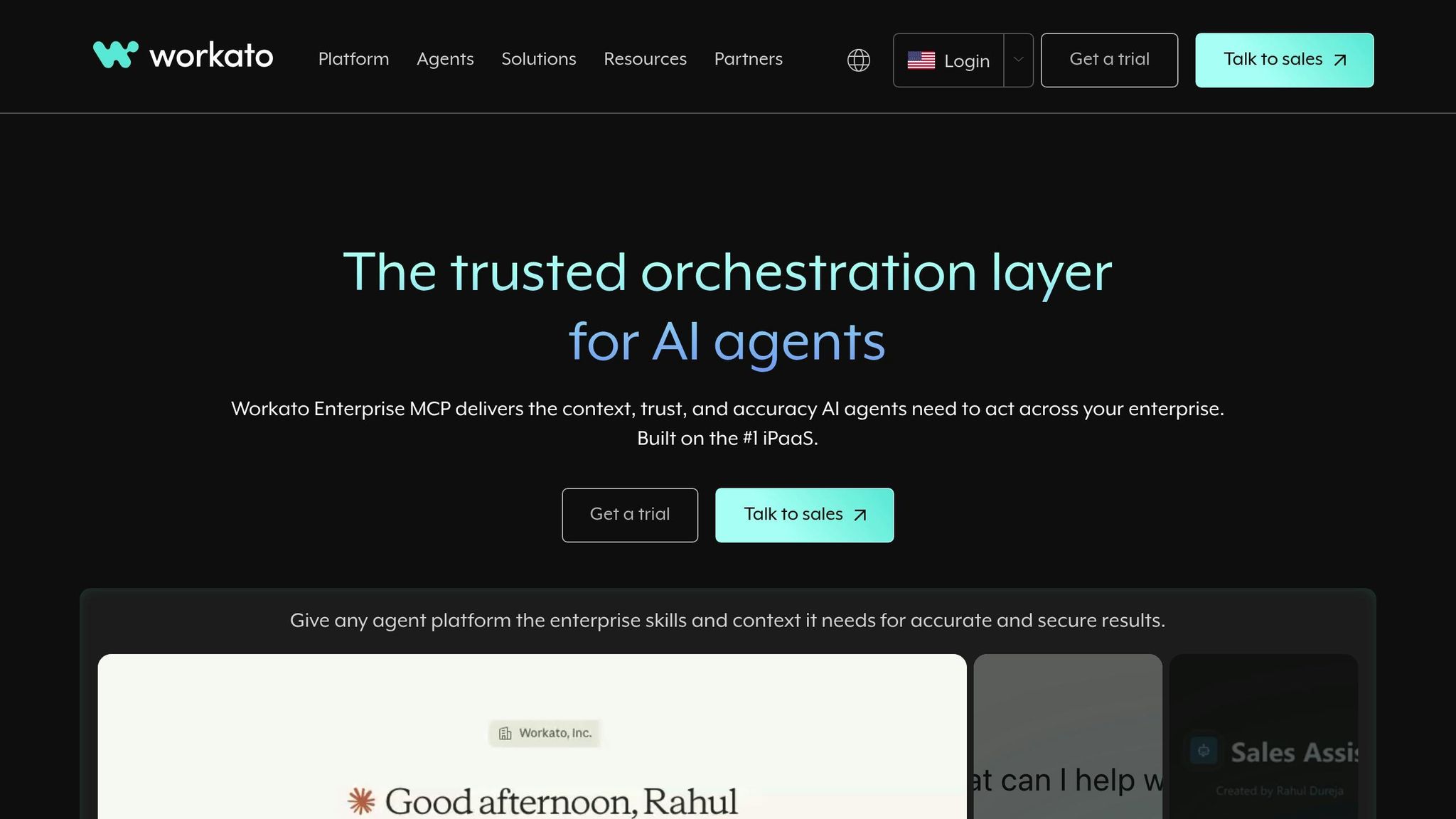
Workato is a powerful automation platform designed to help organizations connect and integrate complex systems on a large scale. With 1,200+ connectors, it bridges modern SaaS tools like Salesforce and Workday with legacy systems such as mainframes, on-premises ERPs like SAP, and databases including Oracle and SQL Server. It also integrates seamlessly with leading large language models (LLMs) such as OpenAI, Claude, and Llama. Recognized as a Leader in the Gartner® Magic Quadrant™ for Integration Platform as a Service for seven consecutive years, Workato boasts a 99.9% uptime SLA, ensuring reliable performance for enterprise needs.
Workato’s cloud-native, serverless architecture ensures it can scale effortlessly to meet fluctuating demands. This adaptability supports complex, long-running processes across multiple regions, making it ideal for enterprises managing global operations. By leveraging Workato, companies have achieved impressive results, such as processing relocation requests 98% faster and saving over 100,000 hours through automation. Mohit Rao, Head of Intelligent Automation, highlighted the platform's organic growth within organizations:
"Business users have organically started using Workato. Once we identify those business users, we elevate them to be champions to empower other teams or other people, and use them to get the next wave of scale."
Workato simplifies automation with its recipe-based approach, allowing both technical and non-technical users to design workflows visually. The platform includes tools like Agent Studio and Skills Builder, which help teams create standardized, governed processes. Its Workato AIRO agent offers real-time diagnostics and optimization tips, enabling users to fine-tune automations as business needs evolve. Additionally, features like Recipe Lifecycle Management and CI/CD tools ensure smooth transitions between development, testing, and production environments, all without downtime.
Workato prioritizes security and compliance, holding certifications such as SOC 2 Type II, ISO 27001, and GDPR, which align with global data protection standards. Its MCP Gateway enforces runtime policies to ensure automations adhere to organizational protocols. Features like role-based access control (RBAC) and data masking safeguard sensitive information while maintaining transparency. These capabilities reduce friction in automating workflows, allowing teams to focus on driving productivity. Pricing for Workato typically ranges from $10,000 to over $100,000 annually, reflecting its robust enterprise capabilities and extensive feature set.
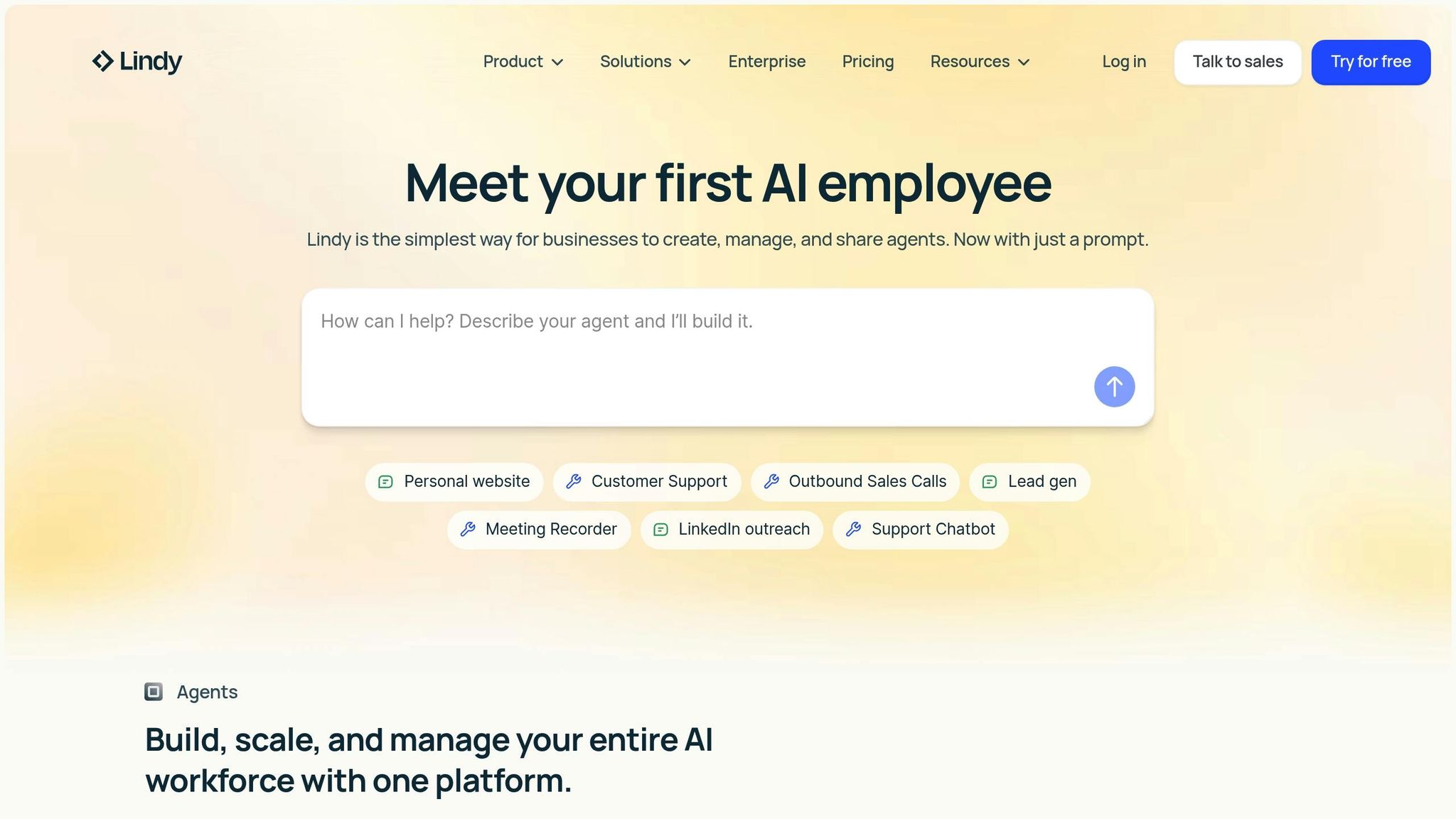
Lindy.ai stands out as a platform designed to streamline enterprise operations with tailored automation solutions. By creating autonomous AI agents that act as digital teammates, Lindy.ai takes on tasks typically handled by junior staff. With over 7,000 integrations across 1,600+ apps, including Gmail, Slack, HubSpot, Salesforce, Notion, Zoom, and Google Drive, it seamlessly connects with your existing tools. This extensive network allows Lindy.ai to manage and optimize your entire tech stack efficiently.
Lindy.ai's no-code approach makes workflow customization accessible to everyone. Users can create AI agents through natural language prompts or a drag-and-drop visual builder - no technical expertise required. The platform supports multi-agent collaboration, enabling agents to work together on complex workflows. For example, one agent might capture meeting notes while another drafts follow-up emails and updates your CRM, all happening simultaneously. For workflows requiring oversight, human-in-the-loop checkpoints ensure sensitive operations receive manual approval before execution. Companies using Lindy.ai have reported up to 4.8x increases in productivity and a 67% reduction in manual processing time.
Lindy.ai's architecture is designed to handle thousands of transactions simultaneously, making it ideal for scaling operations. Simple workflows can be launched within days, while more complex processes typically take 2–8 weeks. For larger organizations, features like custom agent implementation, dedicated account managers, and live onboarding ensure a smooth transition. Businesses often see an ROI of 30–200% in the first year, with knowledge workers saving an average of 26 minutes per day thanks to automation.
Lindy.ai prioritizes security and compliance, meeting SOC 2, HIPAA, GDPR, and PIPEDA standards. The platform also includes exception handling, escalating cases to human oversight when the AI encounters tasks it cannot resolve independently. Pricing options cater to a range of needs, starting with a free tier offering 400 credits per month. The Pro plan, at $49.99/month, includes 5,000 credits, while the Business plan provides 30,000 credits for $299.99/month. For unlimited credits and dedicated support, custom enterprise pricing is available.
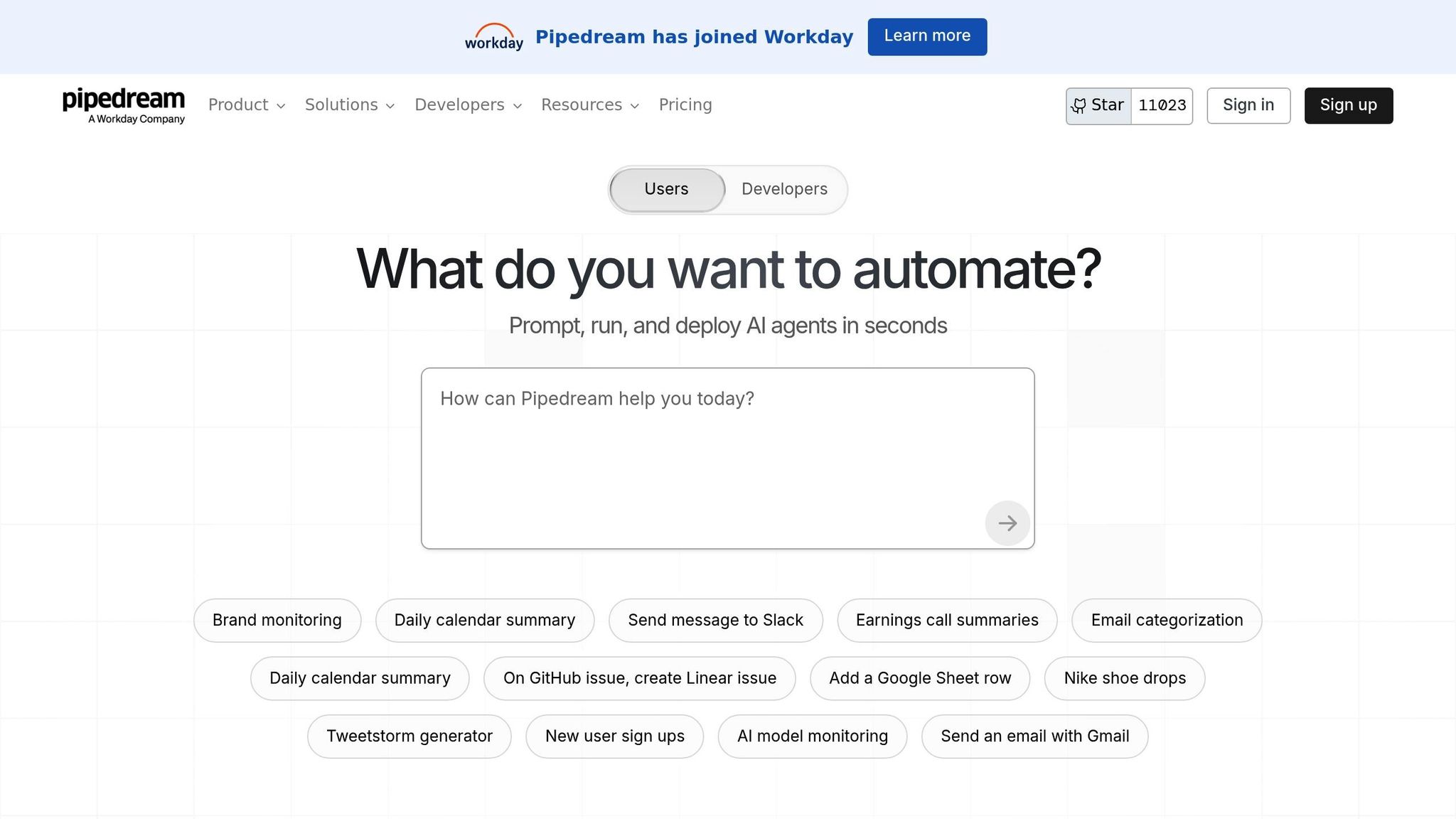
Pipedream is a powerful platform designed for developers, offering unmatched flexibility in workflow automation. Trusted by over 1,000,000 developers, including teams from startups and Fortune 500 companies, it connects more than 3,000 apps through thousands of pre-built triggers and actions. For technical teams, it provides the added benefit of customization using Node.js or Python code. This hybrid approach enables users to handle tasks like syncing Coda tables with Google Sheets using no-code steps while integrating Python scripts for advanced data transformations that go beyond pre-built capabilities. With its blend of integration options and customization, Pipedream is a versatile tool for businesses of all sizes.
Pipedream provides access to over 400,000 npm and 350,000 PyPi packages, allowing teams to build custom workflows tailored to their needs. Developers can create workflows to track GitHub issues, send Slack notifications, or interact with undocumented API endpoints. The platform securely manages API keys, enabling safe use of credentials in both code and no-code steps. Workflows can be triggered in various ways, including HTTP webhooks, app-specific events, or custom cron schedules, giving teams complete control over automation processes.
Built to handle production workloads, Pipedream’s architecture supports execution environments with up to 10 GB of RAM and 750-second execution durations. Advanced concurrency controls ensure smooth handling of high-volume operations. The Advanced plan accommodates queue sizes of up to 10,000 tasks, while businesses with greater demands can choose a custom Business plan with additional enterprise-level features. Pricing begins with a free tier that includes 3 active workflows and 100 credits per month. For teams managing production workflows, the Advanced plan costs $49/month (or $588 annually), offering unlimited workflow capacity.
Pipedream prioritizes governance and compliance, with SOC 2 Type II and GDPR certifications. For organizations in regulated industries, the Business plan offers HIPAA-compliant workloads, Virtual Private Clouds (VPCs), VPC peering, and unique egress IPs for secure database queries. Enhanced administrative controls, such as Single Sign-On (SSO), SCIM-based user provisioning, data retention policies, and restricted login methods, ensure robust governance. Business customers also gain access to dedicated Success Engineers, Slack Connect support channels, and uptime Service Level Agreements, ensuring that mission-critical operations remain reliable and secure.
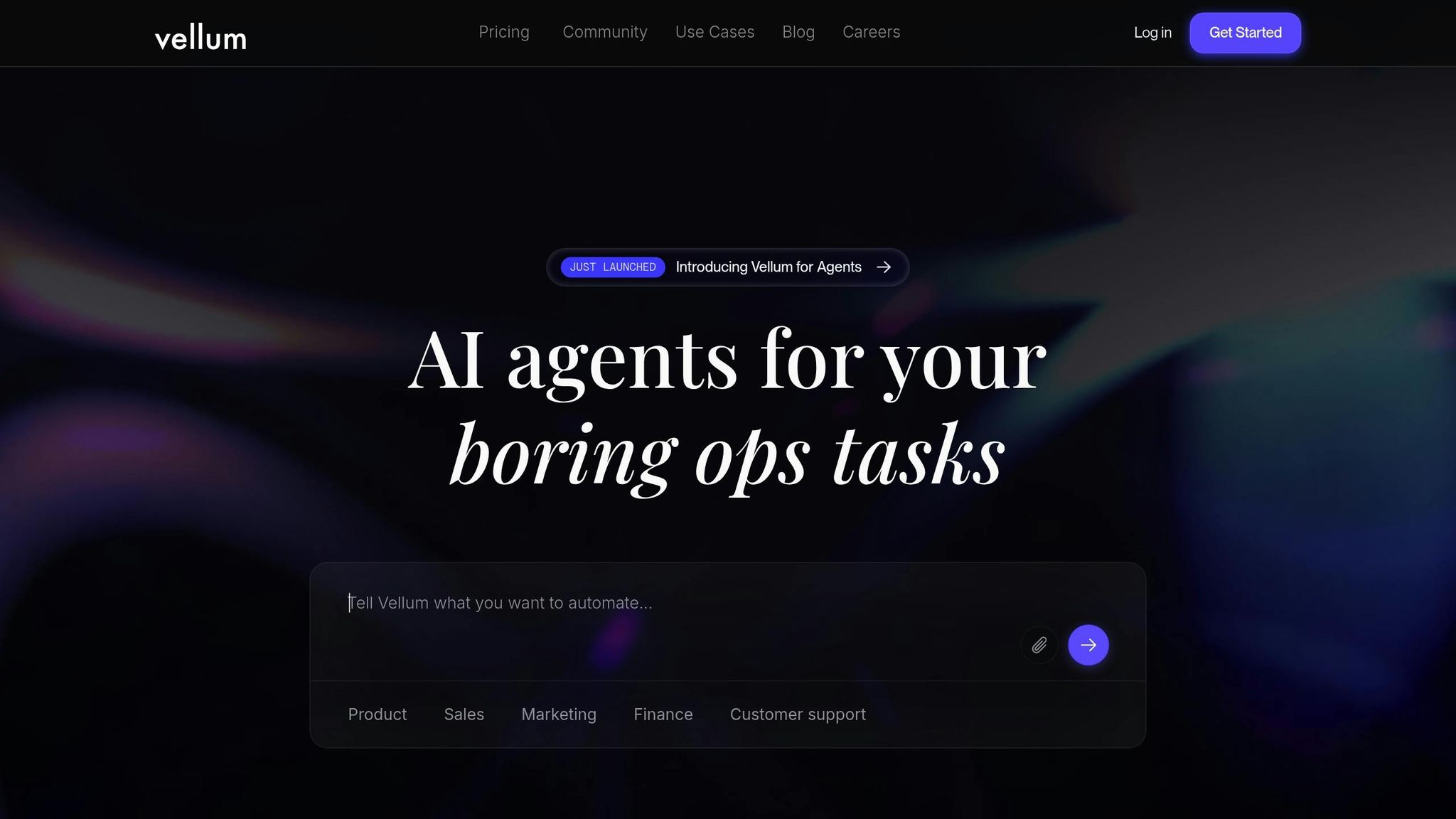
Vellum AI is designed to deliver enterprise-grade AI automation with a strong focus on governance. The platform supports over 1,000 integrations, seamlessly connecting AI agents to business tools like CRM, ERP, ITSM, and data warehouses. Teams can design workflows using a no-code visual builder, REST APIs, webhooks, or SDKs for TypeScript and Python. Each workflow can be accessed through an API endpoint or SDK method, secured with role-based authentication, making it simple to integrate AI automation into existing systems.
Vellum AI stands out with its extensive customization options. Its "Prompt-to-Build" feature allows users to describe processes in plain English, which the platform then translates into operational workflows. This hybrid approach combines the simplicity of no-code tools with the control of developer-level coding. Non-technical users can build visually, while technical teams can fine-tune workflows using TypeScript or Python. The platform’s model-agnostic orchestration lets teams compare leading LLMs like OpenAI, Anthropic, and Google for both performance and cost before finalizing deployments. Built-in evaluation tools, versioning, and rollback capabilities ensure safe testing and updates. Additionally, human-in-the-loop checkpoints enable manual reviews for critical processes, ensuring sensitive automations are handled with care.
Vellum AI is well-suited for handling large-scale, complex workflows, particularly in regulated industries. The platform offers deployment options tailored to enterprise needs, including cloud, private VPC, and on-premises environments to meet data residency requirements. Its hybrid workflow design seamlessly integrates no-code simplicity with developer-level customization, making it adaptable for diverse use cases. Pricing starts with a free tier for testing, followed by paid plans at $25 per month, and custom enterprise plans for larger-scale requirements. The platform also provides end-to-end observability, tracing every input, output, tool call, and decision, ensuring full transparency for debugging even the most intricate automation processes.
Vellum AI addresses enterprise-level governance with a comprehensive set of features. These include compliance with SOC 2, GDPR, and HIPAA standards, along with RBAC, SSO/SAML/SCIM, immutable audit logs, and enforced approval workflows. For industries requiring detailed compliance documentation, the platform offers exportable audit packets. These governance tools are built to meet the increasing demand for secure and compliant scaling. According to recent data, 79% of senior executives report that AI agents are already in use within their organizations, with CFOs projected to allocate 25% of their AI budgets to AI agents by 2026[1].
Agentforce stands out as a powerful AI platform designed to enhance productivity by seamlessly integrating with existing systems. Built on the Salesforce Platform, it utilizes Data Cloud to synchronize customer data in real time, ensuring smooth and efficient operations. Its deep integration with tools like MuleSoft, Salesforce Flow, and Apex enables agents to activate workflows effortlessly. A standout feature, "Zero Copy", allows the platform to connect with structured and unstructured data from external systems, such as data lakes, without replicating it within Salesforce. Through the Agentforce Partner Network, users can expand functionality by deploying third-party agents and actions from notable providers like AWS, Google, IBM, and Workday, further solidifying Agentforce's role in unified AI workflow automation.
Agentforce is built for enterprise-level scalability, powered by the Atlas Reasoning Engine, which allows organizations to deploy autonomous agents capable of planning and executing complex tasks as needed. This scalability has already delivered tangible results. For instance, in September 2024, the publishing company Wiley adopted Agentforce to manage routine customer inquiries during the demanding back-to-school period. Under the leadership of Kevin Quigley, Senior Manager of Continuous Improvement, Wiley experienced a more than 40% boost in case resolution rates compared to their previous chatbot system. Pricing for Agentforce starts at $2 per conversation, with standard discounts available for higher volumes.
Agentforce offers a suite of tools to tailor workflows and agents to specific business needs:
For example, in 2024, Zota, a global payments marketplace, utilized Agentforce and Data Cloud to develop a merchant FAQ agent in just five weeks. This agent was designed to handle 180,000 annual inquiries and provide 24/7 support for 500,000 merchants, showcasing the platform's adaptability and efficiency.
Agentforce incorporates the "Salesforce Trust Layer", which ensures top-tier security and compliance. Features like advanced data masking and adherence to GDPR and CCPA standards guarantee that proprietary data remains protected. Importantly, the Trust Layer prevents sensitive enterprise information from being used to train public AI models, addressing critical governance concerns. Highlighting the platform's innovation, Marc Benioff, Chair and CEO of Salesforce, remarked:
"Agentforce represents the Third Wave of AI - advancing beyond copilots to a new era of highly accurate, low-hallucination intelligent agents that actively drive customer success."
The table below outlines key features of popular AI productivity tools, focusing on pricing, integrations, security, and target user groups.
| Tool | Starting Price | Integration Scope | Compliance & Security | Best For |
|---|---|---|---|---|
| prompts.ai | $0/month (Pay-As-You-Go) | 35+ LLMs (GPT-5, Claude, LLaMA, Gemini) | Enterprise-grade governance, audit trails, secure data handling | Organizations streamlining AI workflows with unified model access |
| Zapier | $19.99/month | 8,000+ apps | Standard encryption, permission-based access | Non-technical teams automating workflows |
| n8n | Free (open-source) | Self-hosted infrastructure | Full control over data security and compliance | Technical teams needing custom AI node integration |
| Make | Varies by usage | Multiple SaaS tools | Standard security protocols | Power users managing complex branching logic |
| Agentforce | ~$25/user/month | Salesforce CRM, Slack, MuleSoft | GDPR/CCPA compliance, Salesforce Trust Layer | Salesforce-centric enterprises utilizing autonomous AI agents |
Pricing Models:
Tools like prompts.ai stand out with a pay-as-you-go model, potentially cutting AI costs by up to 98%. On the other hand, Agentforce and Zapier rely on subscription-based pricing. Free tiers from n8n and Zapier are ideal for small businesses, while prompts.ai's Core plan ($99 per member/month) serves medium-sized teams.
Integration Capabilities:
Integration is a critical factor for smooth operations. Zapier’s expansive ecosystem of over 8,000 apps caters to businesses using a wide range of SaaS tools. For technical teams, n8n’s self-hosted infrastructure provides unmatched control. Agentforce shines within Salesforce ecosystems, offering seamless compatibility for enterprises already invested in Salesforce tools. Prompts.ai, with access to 35+ leading LLMs, simplifies AI tool management for organizations.
Security and Compliance:
Data protection remains a top priority. Agentforce’s Trust Layer ensures robust compliance with regulations like GDPR and CCPA, while prompts.ai integrates enterprise-grade audit trails into workflows, delivering complete visibility into AI interactions. These features are essential for businesses managing sensitive information across various functions.
This comparison highlights how each tool caters to specific needs, whether it’s cutting costs, ensuring compliance, or integrating seamlessly into existing systems. Each solution plays a unique role in enabling efficient and secure AI automation.
When selecting AI tools, it’s essential to consider factors like your company's size, the technical skills of your team, and the specific workflow challenges you aim to address. For smaller teams and startups, platforms that offer quick setup and require minimal IT management are ideal. Larger enterprises, on the other hand, benefit from orchestration layers that streamline interactions across multiple apps and data sources. With nearly 70% of business leaders under pressure to improve productivity - and workers spending 60% of their time on administrative tasks rather than core responsibilities - choosing the right tools becomes a game-changer.
Unified AI platforms can deliver impressive results, such as a 41% boost in operational efficiency, a 38% reduction in costs, and a 42% faster turnaround time. These platforms also eliminate the productivity drain caused by context switching, which can waste up to 23 minutes with each interruption.
To make the most of these tools, start by identifying your team’s biggest pain points - whether it’s endless meetings, repetitive data entry, or disjointed communication. Begin with one or two "anchor tools" that integrate seamlessly with your current tech stack, and then expand your ecosystem over time. Look for platforms that offer enterprise-grade security, audit trails, and compliance features to avoid the costly pitfalls of poorly implemented AI solutions, often referred to as "AI debt."
The key to a successful deployment lies in prioritizing workflow improvements over chasing the latest technology trends. AI tools that integrate directly into everyday tasks - like email, project management software, or CRM systems - can deliver quick returns on investment. With 81% of users reporting higher productivity and reduced stress, the right tools can transform workplace challenges into a competitive edge. Use these strategies to seamlessly incorporate AI into your existing systems and drive meaningful results.
AI tools are reshaping the way businesses function by taking over repetitive tasks and simplifying workflows. This allows your team to dedicate their energy to higher-value, strategic initiatives. Tasks like scheduling, data entry, and email management can be handled with accuracy and speed, cutting down on time spent and minimizing mistakes.
These platforms also boost teamwork and project management by blending effortlessly with the tools your team already relies on. This integration improves communication and makes workflows more efficient. On top of that, AI can analyze data to deliver actionable insights, enabling quicker and smarter decision-making. Incorporating AI into your operations not only drives noticeable productivity improvements but also fosters a more motivated and engaged team.
When selecting an AI tool for your business, prioritize how effectively it integrates with your current systems and workflows. Smooth integration minimizes disruptions and helps boost efficiency right from the start.
Think about whether the tool meets your specific needs, such as automating tedious tasks, enhancing team collaboration, or providing clear, actionable insights. It’s essential that the tool supports your business objectives and is straightforward for your team to use. Tools with user-friendly interfaces are more likely to gain widespread adoption and deliver real value.
Finally, weigh the cost against the potential productivity improvements. Ensure the tool aligns with your company’s ethical guidelines and compliance requirements. The right AI tool should streamline operations, save time, and produce tangible benefits for your business.
AI tools protect sensitive information through strong security protocols, including encryption, strict access controls, and continuous monitoring. These measures help prevent breaches and unauthorized access, ensuring data remains secure. Additionally, they emphasize privacy by securely storing user data and restricting its sharing outside the organization.
Many AI platforms also align with key compliance standards like GDPR, HIPAA, and other relevant legal frameworks. By combining robust technical defenses with adherence to regulatory requirements, businesses can confidently integrate AI tools while upholding high standards for data security and privacy.