Pay As You Go - AI Model Orchestration and Workflows Platform



AI workflow automation is transforming how businesses operate, combining data, human oversight, and advanced tools to streamline processes and cut costs. Key factors for success include interoperability to integrate with existing systems, governance to ensure compliance with regulations like HIPAA and GDPR, and cost control to avoid overspending while maximizing efficiency. Companies using these solutions report significant productivity gains, reduced processing times, and lower operational costs.
Top Platforms Explored:
Each platform type has strengths and trade-offs, from ease of use to scalability and compliance. Selecting the right one depends on your organization's size, priorities, and technical needs.
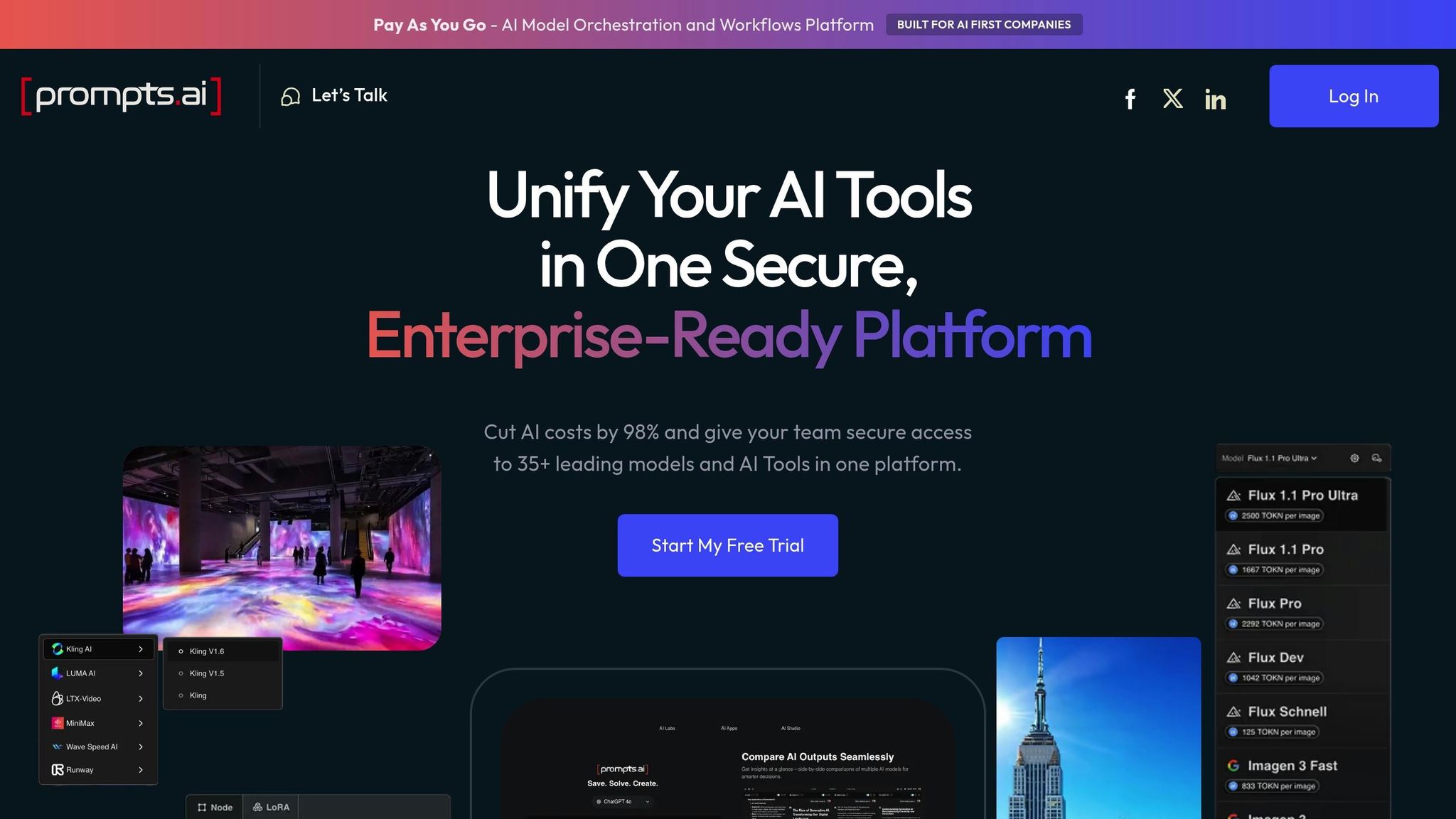
Prompts.ai is an AI-native orchestration platform designed to streamline the development of prompt-based workflows. Unlike general automation tools that primarily connect SaaS applications, Prompts.ai focuses on creating, testing, and deploying workflows across multiple large language models (LLMs). It offers access to over 35 leading AI models through a single interface, enabling teams to build, compare, and optimize their AI-driven processes without the hassle of managing separate subscriptions or APIs. Let’s explore how Prompts.ai stands out in interoperability, workflow design, governance, and cost management.
Prompts.ai tackles the challenge of tool sprawl by integrating more than 35 AI models alongside external systems like Slack, Gmail, and Trello - all within one platform. This multi-model capability allows U.S. enterprises to evaluate LLMs side-by-side on the same workflow and dynamically assign tasks to the most efficient or cost-effective model. Built with an API-first approach, the platform supports a wide array of integrations, prioritizing LLM orchestration over generic app-to-app automation.
With its low-code workflow builder, Prompts.ai empowers teams to create prompt chains without needing to write code. Users can simply drag and drop elements to design workflows with branching logic. For instance, a customer inquiry can be routed to different response templates based on sentiment analysis. The platform also supports A/B testing and experiment tracking, allowing teams to fine-tune prompts before deploying them in production.
Steven Simmons, CEO & Founder, shared, “3D renders and business proposals that used to take weeks or even a month are now completed in a single day using Prompts.ai’s LoRAs and workflows”.
Subscription options start at $29 per month for limited workflows, with Business AI plans available at $99 per member per month.
For organizations in the U.S. navigating compliance standards like HIPAA, SOC 2, and GDPR, Prompts.ai offers robust governance tools. These include role-based access control (RBAC), audit logs, and separate environments for development, staging, and production. The platform began its SOC 2 Type 2 audit on June 19, 2025, and provides real-time security updates through its public Trust Center (https://trust.prompts.ai/). All plans, from the free Pay As You Go tier to the $129 per member/month Elite plan, come with Compliance Monitoring and Governance Administration features. This centralized governance ensures teams can track prompt changes and avoid risks tied to using disconnected AI tools.
Prompts.ai introduces the TOKN Credits system to manage usage and costs in U.S. dollars, offering detailed dashboards that track spending by workflow, prompt, and business unit. By consolidating over 35 tool subscriptions and reducing redundant API calls, the platform claims to cut AI costs by up to 98%. Business AI plans include between 250,000 and 1,000,000 TOKN Credits per member per month, while personal plans start at $0 on a pay-as-you-go basis. Teams can also set budget alerts to monitor token consumption and use the multi-model comparison feature to assign tasks to more cost-effective models when performance differences are minimal - helping scale AI workflows without incurring excessive costs.
Unlike Prompts.ai's focus on AI-specific orchestration, general automation platforms aim to integrate workflows across an entire enterprise. These platforms take a holistic approach, connecting essential business tools like CRM, ERP, HR, and finance systems. By embedding AI insights into existing infrastructures, they modernize operations without requiring a complete overhaul. They also create environments where traditional rule-based automation works alongside AI-driven processes, offering a blend of stability and adaptability. Let’s dive into how these platforms ensure smooth data integration across diverse systems.
General automation platforms excel at creating a unified integration layer that pulls raw data from various sources - such as ERP, CRM, HR, finance systems, and even IoT devices - into one centralized pool for AI models to analyze. This consolidated data access is critical for meeting the efficiency demands of U.S. enterprises. Once the data is processed, the execution layer uses AI-driven decisions to initiate actions across connected business applications. Many of these platforms come equipped with pre-built connectors for popular enterprise software, simplifying the process of linking disparate systems.
Building on the integrated data foundation, these platforms provide user-friendly tools for designing workflows. Features like drag-and-drop interfaces in visual workflow builders make it possible for non-technical staff to create complex automation sequences without needing to write code. This accessibility accelerates workflow creation while reducing the workload on IT teams. Additionally, AI-driven logic allows these workflows to adapt dynamically to changing inputs, making them more responsive to real-world business challenges compared to static, rule-based automation.
Security and compliance are top priorities for general automation platforms. Data protection measures include AES-256 encryption, TLS 1.3 protocols, and techniques like tokenization and masking. Identity and access controls rely on robust frameworks such as Role-Based Access Control (RBAC), Multi-Factor Authentication (MFA), and the principle of least privilege to ensure only authorized users can access systems. API security is maintained through OAuth 2.0 authentication, rate limiting, and detailed logging via API gateways. For U.S. organizations, these platforms also address regulatory requirements by supporting standards like GDPR, CCPA, HIPAA, and SOC 2. They achieve this through continuous monitoring and tamper-proof audit trails, ensuring compliance aligns with stringent U.S. regulations. These measures provide a strong foundation for secure and compliant operations.
Low-code and open-source frameworks open the door for employees to create and deploy workflows with minimal coding knowledge. These platforms simplify automation by offering visual builders, pre-designed templates, and modular components that integrate effortlessly with existing business systems. Unlike traditional enterprise AI platforms that often require lengthy setup processes, these frameworks enable quick and accessible automation. This allows teams to act swiftly, experiment with ideas, and scale solutions as their needs evolve, providing a practical solution for organizations looking to innovate without enduring long development timelines.
One of the standout features of these frameworks is their ability to eliminate data silos through pre-built connectors and flexible API integrations. With a modular design, users can link AI models to a wide variety of systems - whether it's CRMs, ERPs, or IoT devices - without needing to write complex code. For example, in May 2025, Fungible Labs utilized BlinkOps, a low-code platform, to create smart workflows for managing user access across multiple systems. This approach saved considerable time by automating the synchronization of user groups and integrating changes from identity providers like Okta or Google Workspace. The seamless integration of these tools ensures smooth data flow across the organization, enabling AI models to access real-time information effortlessly. This level of connectivity lays the groundwork for intuitive and efficient workflow design.
With visual drag-and-drop builders and natural language prompts, teams can quickly design, test, and refine workflows. Freshworks highlights this accessibility:
"With AI features such as prompting and Natural Language Processing (NLP), automation systems are now accessible to everyone, not just specialists. These systems are easy to build, flexible, and adaptable to changing needs".
A practical example comes from BDO Israel, which used BlinkOps to automate over half of its monthly security alerts. This automation led to a 50% faster response time for incidents and enhanced the overall user experience. BlinkOps’ low-code approach streamlined automation where traditional methods had fallen short. These platforms empower teams to start with small-scale projects, fine-tune their workflows through testing, and expand gradually - all without the need for extensive code modifications.
Low-code and open-source frameworks also shine in managing costs. By automating repetitive tasks and enabling teams to build workflows independently, these platforms provide a cost-friendly solution for organizations seeking incremental innovation. Unlike enterprise platforms with hefty licensing fees, these frameworks allow businesses to innovate without breaking the bank. The benefits go beyond labor savings - automated workflows reduce human error, speed up processes, and improve adaptability to changing business needs. For U.S. companies operating within tight budgets, the ability to scale automation efforts gradually ensures that investments align with measurable returns, avoiding the risk of large upfront expenses.
Enterprise AI workflow platforms blend AI, machine learning, and robotic process automation to enable scalable, organization-wide integration. These platforms are tailored for businesses that need to manage intricate workflows spanning multiple departments, systems, and data sources. Unlike simpler automation tools, enterprise platforms embed AI deeply into complex systems. While low-code tools focus on speed and ease of use, enterprise platforms prioritize robust security, governance, and seamless integration - offering a cohesive solution for large-scale operations.
A key strength of enterprise platforms lies in their ability to integrate across diverse ecosystems. For instance, Workato provides over 1,200 pre-built connectors and accelerators, enabling rapid automation at scale. Salesforce's Agentforce leverages existing Salesforce apps, workflows, and data to deliver AI-powered CRM solutions. MuleSoft bridges legacy systems, cloud applications, and custom software, transforming them into actionable tools for AI-driven workflows. Similarly, Microsoft Power Automate integrates seamlessly with Teams, Excel, and Power BI, streamlining automation within the Microsoft ecosystem.
These platforms extend their capabilities by allowing AI agents to interact with external systems, APIs, and databases for tasks beyond basic text generation. This ensures effective coordination across systems and supports multi-step data processing. Middleware solutions and custom API development further address compatibility challenges in complex or legacy environments.
Focusing on high-impact, repetitive tasks is crucial for maximizing return on investment. Start by addressing data challenges - ensure data is clean, structured, and accurate by standardizing formats, removing duplicates, and validating inputs. This reduces errors and improves AI performance.
Freshworks highlights the transformative power of AI workflow platforms:
"AI workflow automation is reshaping how work gets done. Across customer support, HR, IT, and operations, teams are adopting AI to automate repetitive tasks, integrate fragmented systems, and make informed decisions more efficiently and effectively".
To ensure scalability, design workflows using flexible architectures that can adapt to evolving organizational needs. Implement integration in phases, starting with less critical systems to minimize disruptions, especially when dealing with legacy systems. A well-designed workflow naturally supports strong governance, which is particularly vital in regulated industries.
Meeting compliance standards is a top priority, especially in industries like finance, healthcare, and legal sectors. Enterprise AI platforms incorporate advanced governance and security features to address these needs. They maintain unalterable audit trails for all actions, ensuring full traceability during audits. Built-in approval workflows ensure that AI automations are thoroughly reviewed before deployment.
Strict governance policies manage model usage, data residency, and privacy. These platforms also monitor for issues like bias, hallucinations, or unsafe content in AI outputs, ensuring consistent and compliant operations. Key security features include Role-Based Access Control (RBAC), Single Sign-On (SSO)/SAML, data residency options, private networking (e.g., VPC and IP allowlisting), and Key Management Systems (KMS).
Jitterbit set a notable precedent by becoming the first in its industry to achieve ISO 42001 certification. Deployment options - ranging from cloud to private VPC, on-premise, and air-gapped environments - offer flexibility to meet stringent security and data residency requirements.
Managing costs effectively is essential when adopting enterprise AI workflow platforms. While these platforms often come with higher upfront costs compared to simpler automation tools, their long-term benefits in streamlining operations and reducing manual configurations make them a worthwhile investment. Platforms with extensive integration ecosystems can help minimize custom development expenses. For organizations with complex workflows or legacy systems, choosing solutions that support middleware or API development is a smart move.
The strategic coordination of AI, machine learning, and robotic process automation across departments - referred to as hyperautomation - offers significant advantages. This approach not only improves workflow visibility but also reduces the need for dedicated technical resources, delivering value over time.
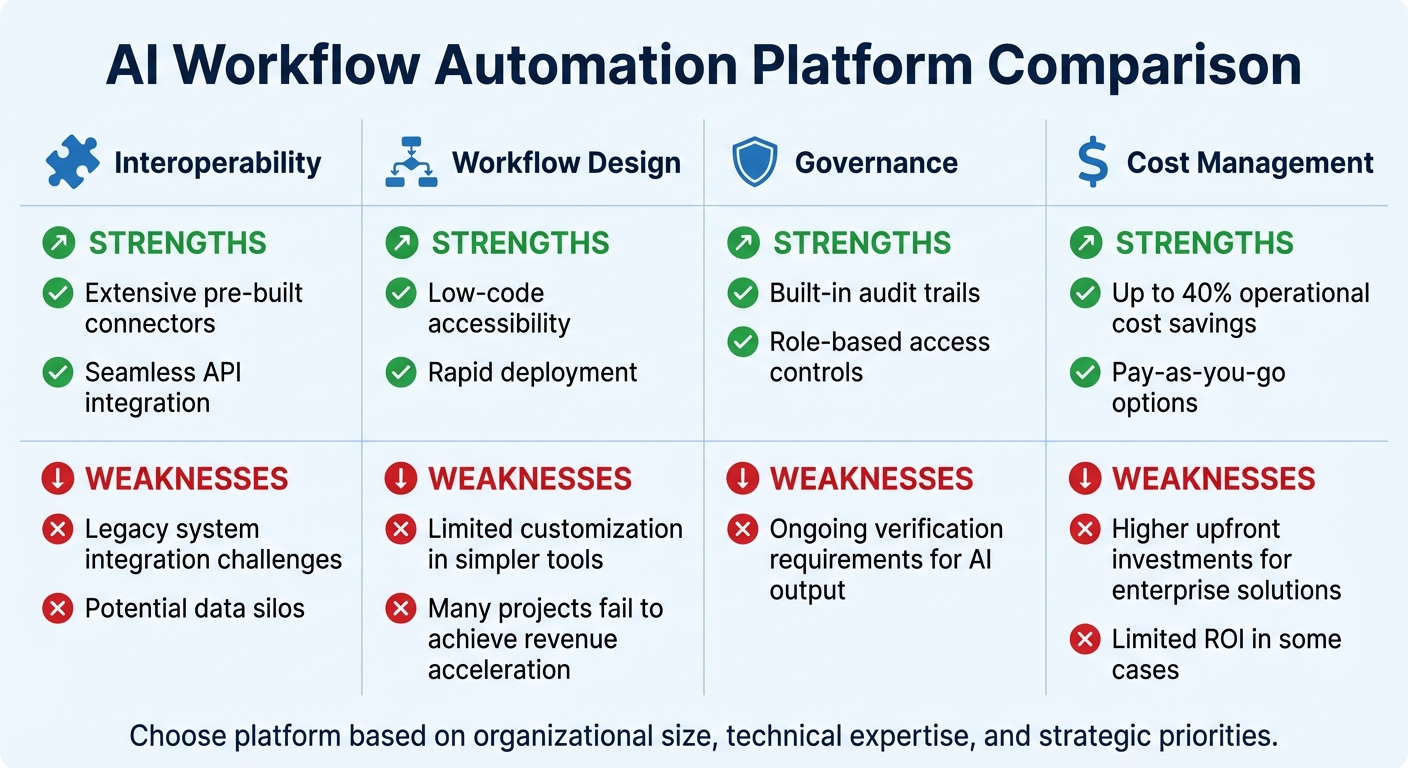
AI Workflow Automation Platform Comparison: Strengths and Weaknesses
This section provides a clear comparison of the strengths and weaknesses across different platform types, focusing on key areas like interoperability, workflow design, governance, and cost management. Understanding these aspects can help organizations make informed decisions about which platform aligns best with their goals and operational scale.
Interoperability stands out as a major advantage for platforms equipped with comprehensive pre-built connectors. These connectors simplify API integration across various business systems like ERPs, CRMs, and collaboration tools. By embedding AI capabilities into familiar environments, these platforms enable quicker adoption and ensure automated insights seamlessly integrate into everyday workflows. However, legacy systems can complicate this process, often resulting in data silos and inconsistent workflows that hinder efficiency.
Workflow design capabilities differ greatly across platforms. Low-code and open-source frameworks offer quick and user-friendly deployment, catering to both technical and non-technical users. These tools are ideal for creating and launching new applications rapidly. On the other hand, enterprise AI workflow platforms are tailored for handling high-volume, complex operations. They provide scalability and deep customization options through both low-code and pro-code functionalities. The trade-off is evident: simpler platforms prioritize speed but may lack advanced features, while enterprise solutions demand more initial effort but deliver greater long-term flexibility.
Governance and compliance also highlight important contrasts. Enterprise platforms often include essential features like audit trails, role-based access controls, and continuous monitoring, which are critical for industries such as finance and healthcare. However, governance lapses can limit the effectiveness of these tools. AI models may inherit biases from training data or experience model drift over time. Furthermore, while some platforms boast low hallucination rates (as low as 0.7%), handling sensitive data continues to pose privacy and regulatory challenges.
Cost management reveals a key tension. Automation has the potential to reduce operational costs by up to 40%, but enterprise platforms often come with higher upfront expenses. A common misconception is that AI workflow automation is prohibitively expensive or will entirely replace human workers. In truth, many cost-effective automation solutions exist, and AI is most effective as a complement to human expertise. According to the World Economic Forum, while AI could displace 92 million jobs by 2030, it is also expected to create 170 million new roles, resulting in a net gain of 78 million jobs. This highlights the ongoing need for human oversight in critical decision-making tasks.
Choosing the right platform involves carefully weighing these trade-offs. The table below provides a quick reference to compare the strengths and weaknesses of different platform types.
| Platform Type | Interoperability | Workflow Design | Governance | Cost Management |
|---|---|---|---|---|
| Strengths | Extensive pre-built connectors; seamless API integration | Low-code accessibility; rapid deployment | Built-in audit trails and role-based access controls | Up to 40% operational cost savings; pay-as-you-go options |
| Weaknesses | Challenges with legacy system integration and potential data silos | Limited customization in simpler tools; many projects fail to achieve revenue acceleration | Ongoing verification requirements for AI output | Higher upfront investments for enterprise solutions; limited ROI in some cases |
While many organizations are adopting AI-driven automation, success requires a thoughtful approach. Starting with pilot workflows in less critical areas, maintaining transparency, and iterating based on performance metrics can help mitigate risks and maximize benefits. Aligning platform capabilities with your organization’s specific priorities is essential for achieving the full potential of AI workflow automation.
Selecting the right AI workflow automation platform hinges on your organization's size, technical expertise, and strategic priorities. For startups and smaller teams, simplicity and cost-efficiency are paramount. A unified platform that eliminates tool sprawl and turns fixed costs into scalable, on-demand solutions can be transformative. For instance, Prompts.ai’s Creator plan, priced at $25/month (billed annually), offers 250,000 TOKN credits, workflow creation, and integrations with tools like Slack and Gmail. This package equips smaller teams to stay competitive without incurring significant overhead.
On the other hand, larger organizations need platforms designed for scale, with a strong emphasis on security and compliance. Enterprises require solutions that provide advanced governance and meet stringent regulatory standards. Prompts.ai’s Business plans, starting at $99 per member per month, deliver features such as SOC 2 Type II, HIPAA, and GDPR compliance, unlimited workspaces, and full audit trails for AI interactions. For technical teams, advanced functionalities like model fine-tuning, side-by-side LLM comparisons, and dynamic workflow creation are essential. Prompts.ai’s Problem Solver and Business plans enable teams to train LoRAs, develop AI agents, and quickly prototype complex solutions.
The industry is also shifting toward the adoption of Multi-Agent Systems (MAS), which promise even greater efficiency by replacing monolithic AI with collaborative, specialized agents. This evolution emphasizes the importance of interoperability, data quality, and platform consolidation, positioning organizations to achieve sustainable ROI. Unlike rigid rule-based systems, AI workflow automation leverages machine learning to analyze data, identify patterns, and make real-time decisions, driving smarter, more adaptive processes.
No matter your organization's size or focus, piloting workflows in low-risk areas is a crucial first step. Transparency in operations and iterative improvements based on performance are key to long-term success. Whether you're a startup aiming for streamlined efficiency, an enterprise prioritizing compliance, or a technical team exploring cutting-edge solutions, aligning platform features with your operational goals is essential. By integrating AI tools with strong governance practices, your organization can unlock the full potential of AI-driven automation and maximize its return on investment.
Prompts.ai transforms AI workflow automation by uniting more than 35 AI models into a single, secure platform designed for enterprise needs. By consolidating tools and processes, it enables organizations to cut AI-related expenses by up to 98%, simplify intricate workflows, and reduce dependence on multiple tools, leading to smoother and more efficient operations.
The platform also prioritizes strong governance and compliance, ensuring organizations maintain control and uniformity across all AI-driven activities. This approach not only improves productivity but also strengthens the dependability of AI-powered systems.
Prompts.ai places a strong emphasis on adhering to regulations like HIPAA and GDPR, ensuring that data protection, privacy, and governance are at the core of its operations. By incorporating secure access controls and scalable AI workflows, the platform is built to handle sensitive information with care and responsibility.
Designed for enterprise-level security, Prompts.ai supports organizations in meeting compliance standards while enabling smooth, AI-powered processes that align with their operational goals.
Businesses can take control of their expenses with Prompts.ai's pay-as-you-go pricing model, designed to cut out unnecessary tools and simplify workflows. This strategy has the potential to slash AI-related costs by as much as 98%.
With access to over 35 AI models consolidated into one secure, enterprise-ready platform, organizations can make smarter use of their resources, reduce redundancies, and keep budgets in check. This setup ensures a streamlined and cost-efficient way to integrate AI into everyday operations.