Pay As You Go - AI Model Orchestration and Workflows Platform



Cut Costs, Save Time, and Simplify AI Operations
Managing AI tools can be overwhelming for businesses, especially when balancing costs, complexity, and compliance. This guide breaks down three leading platforms - Prompts.ai, Apache Airflow, and Zapier - designed to tackle these challenges from different angles. Here's what you need to know:
Quick Comparison
| Platform | Best For | Key Features | Limitations |
|---|---|---|---|
| Prompts.ai | Enterprise AI management | 35+ AI models, TOKN credits, governance | Limited to AI orchestration |
| Apache Airflow | Technical customization | Open-source, Python-based workflows | Requires coding skills |
| Zapier | No-code task automation | Connects 8,000+ apps, fast deployment | Limited complex customizations |
Each platform has strengths tailored to specific needs. Whether you’re consolidating AI operations, building custom workflows, or automating tasks, there’s a solution to fit your goals. Let’s dive into the details.
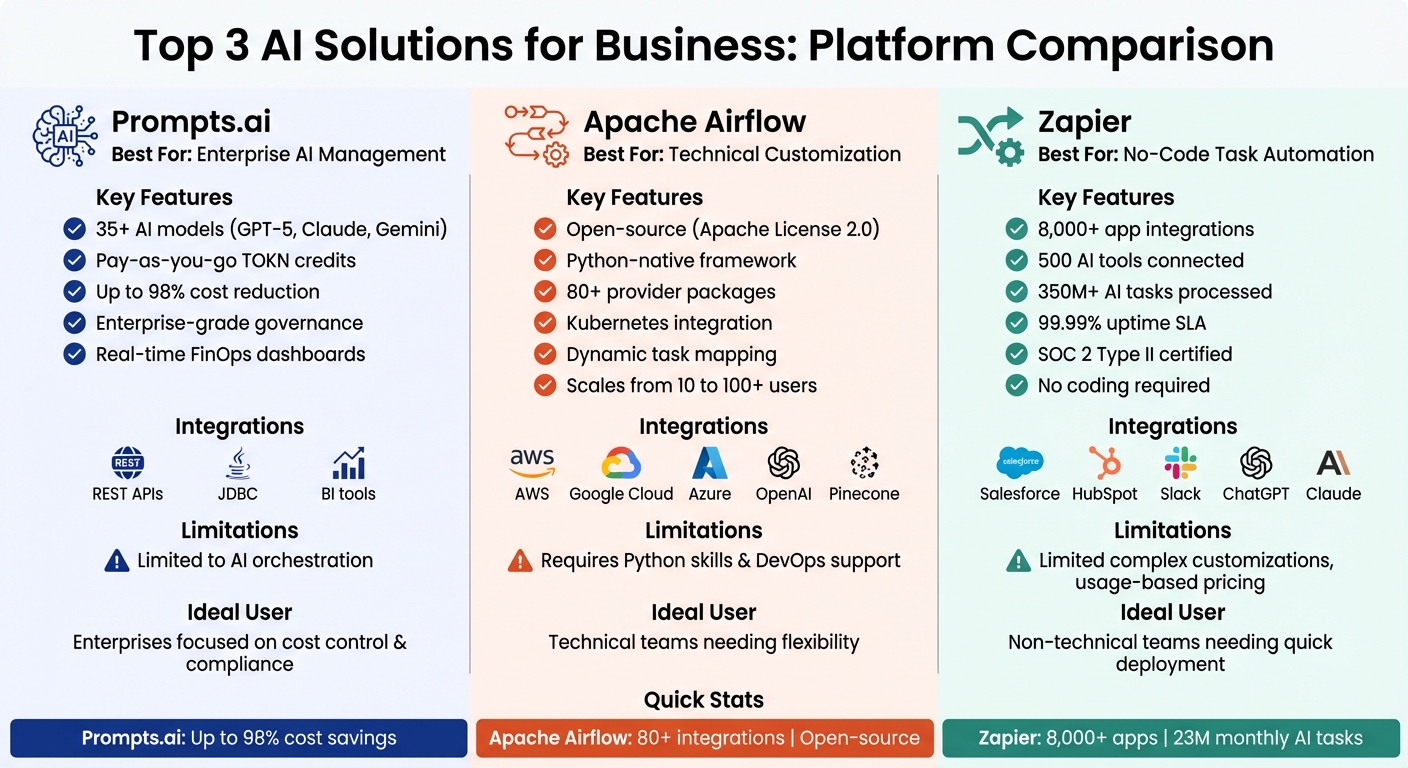
Comparison of AI Workflow Platforms: Prompts.ai vs Apache Airflow vs Zapier

Prompts.ai is a cutting-edge platform designed for enterprise-level AI orchestration. It brings together over 35 leading language models, such as GPT-5, Claude, and Gemini, into a single, secure interface. By consolidating access, it eliminates the need for multiple subscriptions and fragmented workflows, while also reinforcing governance across your AI operations.
The platform seamlessly integrates with your existing enterprise systems, covering essential layers like data, metadata, semantics, and security. Using open standards such as Parquet and interfaces like REST APIs, JDBC, and secure filesystems, prompts.ai connects effortlessly with your BI tools, data warehouses, and analytics platforms. This eliminates the need for custom middleware, streamlining operations and unlocking significant cost advantages.
Managing separate AI model subscriptions can be expensive. With prompts.ai, the pay-as-you-go TOKN credit system ensures you only pay for what you use, removing the burden of recurring fees. Real-time FinOps dashboards provide detailed usage insights, helping organizations cut AI software costs by as much as 98%.
Prompts.ai prioritizes security and governance at every level. All AI interactions are managed through enterprise-grade controls, supported by detailed audit trails. This centralized framework allows organizations to enforce compliance standards, establish usage policies tailored to teams or departments, and maintain full visibility into system activity. Importantly, all sensitive data stays securely within your organization’s boundaries.
Apache Airflow is an open-source platform designed to streamline and automate complex AI and data workflows. Licensed under Apache License 2.0, it’s free to use, though you’ll need to provide your own computing infrastructure. With the release of versions 3.0 (April 2025) and 3.1.0 (September 2025), Airflow introduced workflows designed with a user-first approach, further enhancing its capabilities.
Airflow's Python-native framework makes it highly adaptable, allowing seamless integration with a wide range of technologies. It supports over 80 active provider packages, including AI-focused tools like OpenAI, Pinecone, Weaviate, and Cohere, as well as major cloud providers such as AWS, Google Cloud, and Microsoft Azure. These packages come with pre-built operators and hooks, eliminating the need for custom integration coding. The platform’s REST API and Task SDK ensure compatibility across versions, while the Jinja templating engine allows workflows to adjust dynamically during runtime.
"Airflow's extensible Python framework enables you to build workflows connecting with virtually any technology." - Apache Airflow Documentation
As an open-source tool, Airflow eliminates licensing fees, leaving computing resources as your main expense. It’s designed to optimize cloud costs by dynamically provisioning and shutting down infrastructure as needed. If a pipeline encounters an error, you can rerun only the failed tasks instead of restarting the entire workflow, saving both time and resources. However, setting up and managing Airflow requires Python proficiency, as pipelines are coded directly.
Airflow’s modular design leverages a message queue to coordinate an unlimited number of workers, making it versatile enough to scale from a single laptop setup to distributed systems managing large-scale workloads. Organizations have reported scaling to support 10 to over 100 users across more than 20 teams. The official Helm Chart enables Kubernetes integration, ideal for handling scalable LLMOps and RAG pipelines. Features like dynamic task mapping allow tasks to be created at runtime for each customer or data shard, while the Dataset feature supports event-based scheduling, triggering workflows only when the necessary data is ready, rather than relying on fixed schedules.
Zapier is a no-code automation platform that seamlessly connects nearly 8,000 applications and 500 AI tools, empowering teams in marketing, HR, and sales to create AI-driven workflows - no coding required. With over 350 million AI tasks processed for more than 1 million companies and 23 million AI-related tasks executed monthly, Zapier has proven its ability to deliver efficiency, security, and scalability.
Zapier's Model Context Protocol (MCP) acts as a bridge between AI platforms like ChatGPT or Claude and your business apps, enabling over 30,000 actions without the need for custom API development. The AI by Zapier integration allows direct access to large language models within workflows, eliminating the hassle of managing separate API keys or subscriptions. Tools like Zapier Canvas, Zapier Tables, and Interfaces provide teams with the ability to visually design workflows, store structured data, and create custom interfaces that trigger AI-powered automations. For example, you can link Salesforce to ChatGPT, send the results to Slack for approval, and update HubSpot - all in one streamlined process.
Zapier charges only for successful workflow actions, giving you unlimited use of internal logic, filtering, formatting, and error handling. With Tables and Interfaces included in every plan, you can avoid the expense of third-party database or form tools. In April 2025, an IT helpdesk powered by Zapier Enterprise saved $500,000 annually by resolving 28% of support tickets for 1,700 employees, automating 2,219 workdays each month. Similarly, Popl, a digital business card company, saved $20,000 annually by replacing a costly third-party integration with over 100 custom AI workflows built on Zapier in December 2025.
Zapier prioritizes security with SOC 2 (Type II) and SOC 3 certifications and compliance with GDPR, GDPR UK, and CCPA. Data is encrypted in transit using TLS 1.2 and at rest with AES-256 encryption. Enterprise customers benefit from automatic opt-outs from data being used to train AI models. Additional security features include Single Sign-On (SSO/SAML), SCIM for user provisioning, Two-Factor Authentication (2FA), and Role-Based Access Control (RBAC). Granular audit logs track user activity, while human-in-the-loop controls allow team members to review AI-generated content in Slack before finalizing it.
"Customers trust us to keep their data secure and safe. I have 100% confidence that Zapier handles that data with the utmost security." - Connor Sheffield, Head of Marketing Ops and Automation at Zonos
With a 99.99% uptime SLA, Zapier's infrastructure is built for high-volume processing across distributed teams. In April 2025, a lead enrichment system powered by Zapier reclaimed 282 working days annually and increased potential revenue by $1 million. Zapier Agents manage complex, multi-step tasks independently, adapting to dynamic situations and pulling live data to scale operations without increasing staff. Companies like Popl have implemented hundreds of workflows simultaneously, using over 100 custom AI workflows to handle daily leads efficiently, eliminating the need for manual intervention.
When it comes to interoperable AI workflow platforms, each option brings its own set of strengths and limitations to the table, tailored to address specific business needs. Below, we break down the key features of three popular platforms, highlighting what they excel at and where they fall short.
Prompts.ai streamlines access to over 35 AI models, offering substantial cost reductions through its pay-as-you-go TOKN credits system while ensuring enterprise-grade governance with transparent usage tracking. However, its focus is squarely on AI orchestration, leaving broader SaaS integration out of its scope.
Apache Airflow delivers highly customizable data pipelines and the freedom of an open-source framework, but it requires Python expertise and ongoing DevOps support, presenting a steep learning curve for less technical teams.
Zapier shines with its no-code builder and compatibility with over 8,000 apps, making it ideal for quick and seamless integrations. However, its limited ability to handle complex customizations and rising costs with increased usage can be drawbacks for some users.
Here’s a side-by-side comparison of their core strengths and weaknesses:
| Platform | Key Strengths | Key Weaknesses |
|---|---|---|
| Prompts.ai | Access to 35+ AI models; cost efficiency; governance controls | Limited to AI orchestration |
| Apache Airflow | Flexible, customizable pipelines; open-source; avoids vendor lock-in | Requires Python skills; steep learning curve |
| Zapier | Integrates with 8,000+ apps; no-code setup; quick deployment | Limited customization; usage-based pricing |
The best platform for your organization depends on your priorities. If consolidating AI models and managing costs is your main focus, Prompts.ai is a strong contender. For teams needing deep technical customization, Apache Airflow offers unmatched flexibility. Meanwhile, Zapier is perfect for teams looking for rapid, no-code integrations. Many businesses find value in combining these tools - using Zapier for front-end automation, Airflow for backend data management, and Prompts.ai to oversee AI operations effectively.
Prompts.ai stands out as a top choice for centralized AI management. By bringing together access to over 35 leading models in a single, unified platform, it offers businesses enterprise-level control with complete visibility into AI usage. The platform also delivers impressive cost savings - up to 98% - through its pay-as-you-go TOKN credits system, while integrating effortlessly with existing business systems.
Its tiered plans cater to a wide range of users. Solo creators and small teams can consolidate multiple subscriptions into one efficient workspace. Growing organizations benefit from unlimited workflow automation and tailored AI training, while enterprises gain access to robust compliance monitoring and governance tools. These options directly address common challenges like reducing tool sprawl, managing costs, and ensuring regulatory compliance without compromising functionality.
The ability to compare large language models (LLMs) side by side dramatically enhances productivity, turning days of work into hours. Coupled with SOC 2 Type II certification and a real-time Trust Center, prompts.ai meets the stringent security needs of regulated industries. For businesses with older infrastructure, the platform acts as a bridge, seamlessly integrating modern AI tools with legacy systems without requiring a complete overhaul.
With a setup time of under 10 minutes and a pay-as-you-go pricing model that aligns costs with actual usage, businesses can achieve quick wins and scale confidently. Whether you're a startup streamlining vendor onboarding or a Fortune 500 company managing AI agents across departments, prompts.ai delivers the tools for governance, transparency, and flexibility. It turns scattered AI efforts into repeatable, high-value processes, offering a smarter way to manage AI operations.
Prompts.ai enables businesses to slash their AI software expenses by up to 98% with its unified platform. By bringing together more than 35 large language models (LLMs) into a single, streamlined system, it removes the hassle and cost of juggling multiple subscriptions or standalone tools.
With this consolidated approach, businesses can tap into a broad spectrum of AI-powered solutions while keeping costs under control. It gives teams the tools they need to tackle challenges effectively - without breaking the budget on disjointed systems.
Apache Airflow streamlines the process of managing AI workflows by providing flexible, Python-powered orchestration. With its user-friendly interface, you can monitor and control tasks in real time, ensuring everything runs smoothly and efficiently.
Airflow also connects effortlessly with leading cloud platforms and machine learning tools, enabling businesses to build seamless, end-to-end workflows. Its adaptability and ability to handle complex processes make it an excellent option for managing advanced AI operations.
Zapier excels at handling complex AI customizations, offering powerful tools to coordinate AI workflows, integrate various AI models, and automate sophisticated decision-making processes within businesses.
By simplifying intricate tasks and bridging multiple AI-powered tools, Zapier enables businesses to work more efficiently, cut down on manual labor, and improve outcomes through seamless automation and intelligent integrations.