Pay As You Go - AI Model Orchestration and Workflows Platform



Scaling AI securely is now a priority. In 2026, managing AI workflows means balancing security, compliance, and efficiency. Platforms must protect sensitive data from risks like prompt attacks, data leaks, and compliance violations (GDPR, HIPAA). The top orchestration tools - Prompts.ai, TrueFoundry, Zapier, and Prefect - offer solutions tailored to these challenges.
| Platform | Deployment Options | Compliance | Best For |
|---|---|---|---|
| Prompts.ai | Cloud | SOC 2, HIPAA | Unified model access, cost control |
| TrueFoundry | Cloud, Hybrid, On-Prem | SOC 2, GDPR, HIPAA | Regulated industries, active threat defense |
| Zapier | Cloud | SOC 2, GDPR | No-code AI automation |
| Prefect | Cloud, Hybrid, On-Prem | SOC 2, GDPR | Teams handling sensitive data workflows |
Conclusion: Choose based on your security, compliance, and deployment needs. Platforms like Prompts.ai excel in unified AI management, while TrueFoundry and Prefect cater to hybrid and sensitive environments. For simplicity, Zapier is ideal. Start by assessing your organization's data sovereignty and compliance priorities.

Comparison of Top 4 Secure AI Orchestration Platforms 2026
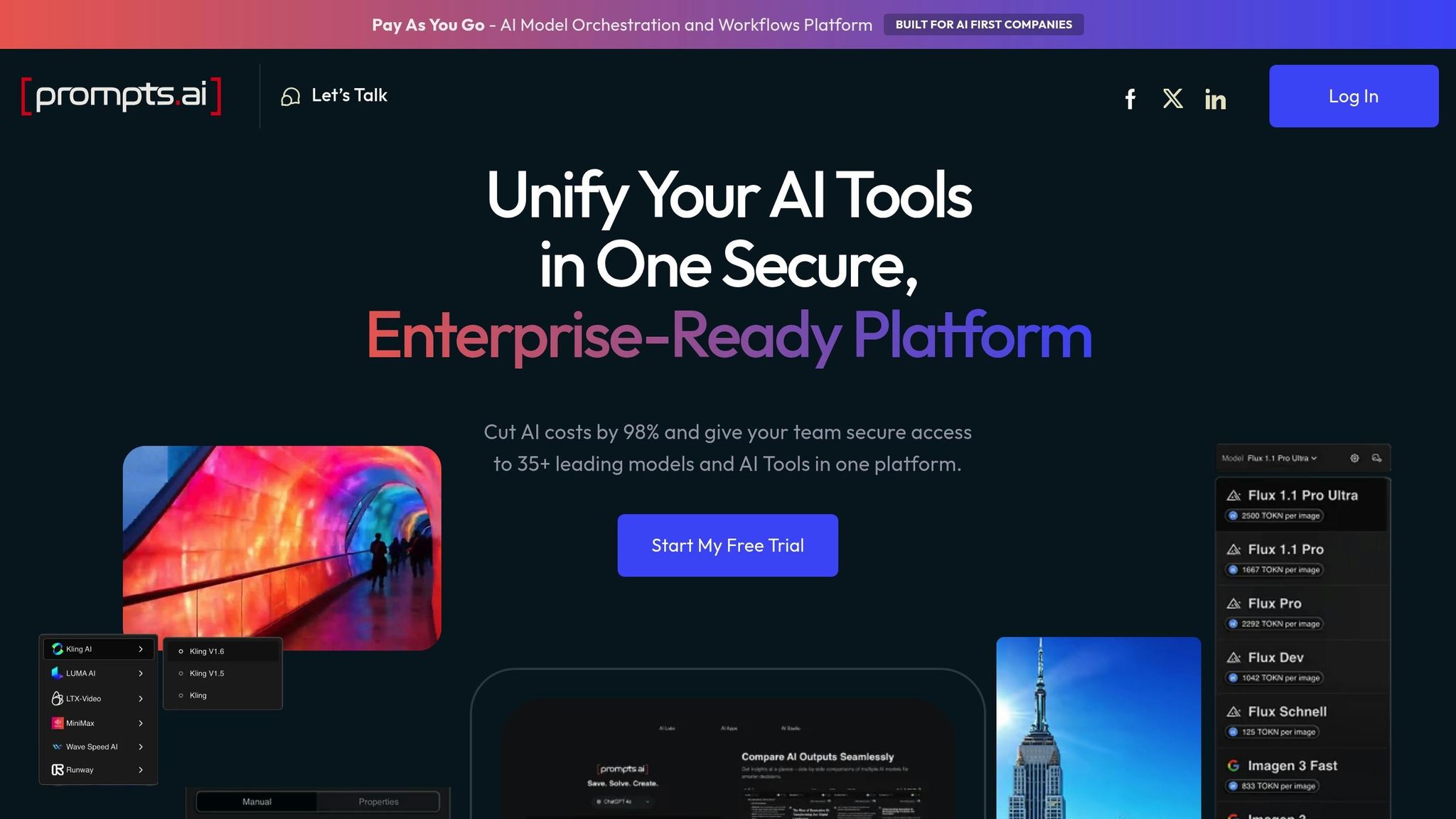
Prompts.ai has positioned itself as a leader in secure AI orchestration, offering a platform built with a strong focus on security and compliance.
Prompts.ai brings together 35+ large language models, including GPT-5, Claude, LLaMA, and Gemini, into a single, governed interface. By centralizing these models, the platform reduces the risks associated with spreading sensitive data across multiple environments. It ensures secure management of proprietary prompts and customer data while implementing advanced access controls. Features like fine-grained Role-Based Access Control (RBAC), Single Sign-On (SSO)/SAML, and SCIM-enabled identity management help restrict access and eliminate orphaned accounts.
These measures provide a solid foundation for meeting strict regulatory requirements.
As of 2026, Prompts.ai complies with key industry standards such as SOC 2, ISO 27001, GDPR, and HIPAA. Every interaction on the platform generates a detailed audit trail, connecting usage, costs, and outputs to specific users and teams. This level of documentation simplifies compliance reviews and ensures accountability.
The platform’s SaaS model allows for rapid deployment without the need to manage additional infrastructure. For enhanced security, it also integrates with private networking options, ensuring that data remains within your established security boundaries. This flexibility complements its secure and compliant architecture.
Prompts.ai includes a FinOps layer that provides real-time tracking of token usage across models, offering cost and performance insights at the team, project, and individual levels. This level of transparency helps organizations avoid budget overruns and directly links AI spending to measurable business outcomes. The pay-as-you-go TOKN credit system aligns costs with actual usage, potentially reducing AI software expenses by up to 98% compared to traditional multi-vendor agreements. Additionally, the Prompt Engineer Certification program equips team members with the expertise to securely and effectively configure workflows, reinforcing governance best practices.
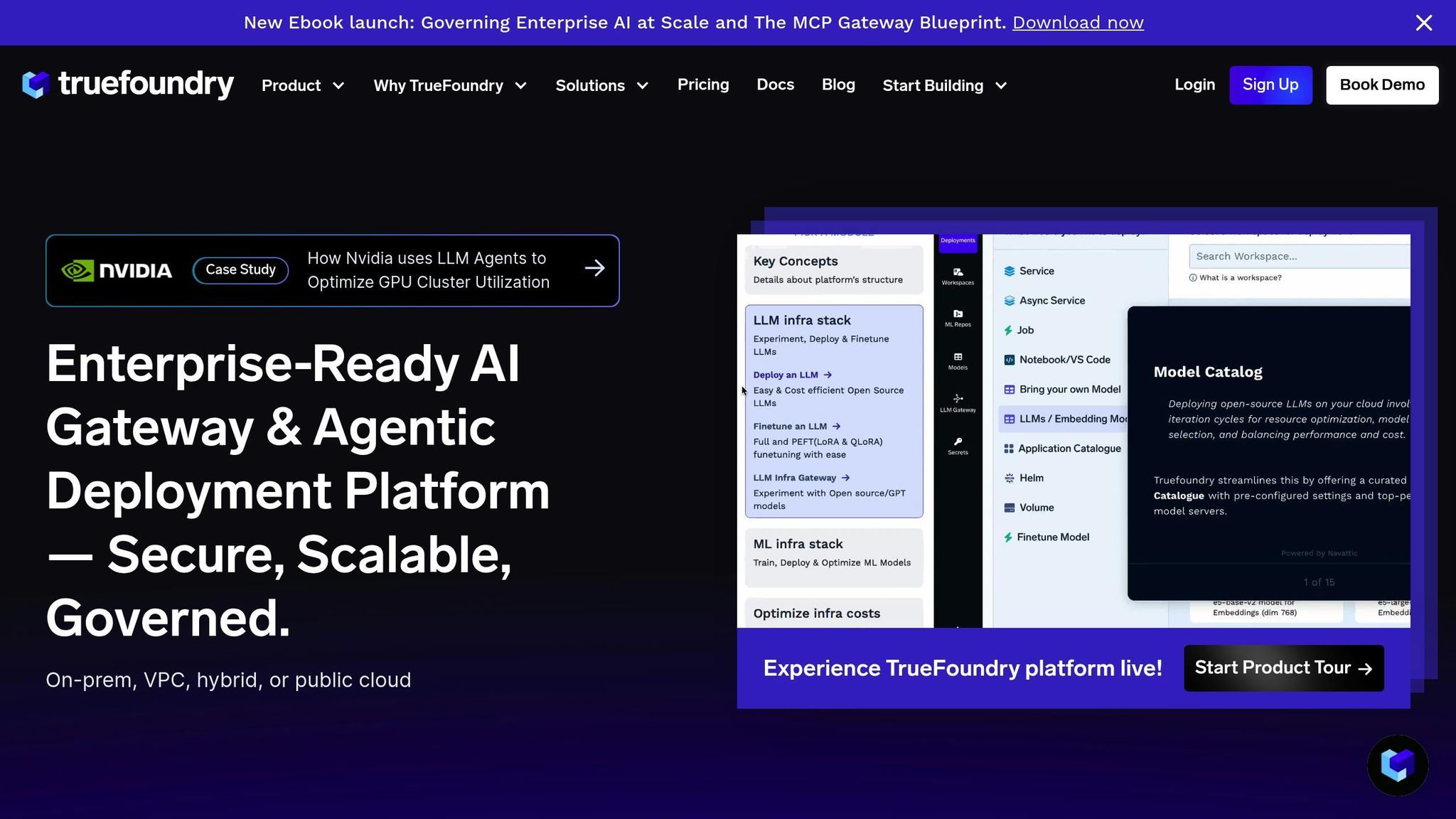
TrueFoundry strengthens security by ensuring sensitive data stays within your infrastructure. By isolating critical workloads from the control interface, it supports data sovereignty - an essential feature for industries with strict regulations. The platform’s dual-plane architecture separates the control and data planes, keeping the management interface distinct from workload execution. Your AI models, training data, and inference logs remain securely within your Kubernetes cluster, whether hosted on AWS EKS, Google GKE, Azure AKS, or on-premises hardware. This setup forms the backbone of a range of technical controls outlined below.
TrueFoundry’s security starts at the code level, running over 30 automated scans for static analysis, secrets detection, and container hardening. These measures ensure non-root execution and enforce read-only filesystems. Data security is maintained with AES-256 encryption for data at rest and TLS 1.2+ for data in transit. The tfy-agent connects to the control plane via secure outbound WebSocket connections, eliminating the need to open inbound firewall ports.
The AI Gateway adds an additional layer of security, offering built-in authentication with support for OIDC, JWT, and API keys, along with automated token rotation. It also features PII detection and defends against prompt injection attacks. Impressively, the gateway introduces less than 10ms latency at the 95th percentile and can process 350+ requests per second on a single vCPU.
TrueFoundry is certified for SOC 2 Type II, GDPR, and HIPAA standards. The platform guarantees that critical vulnerabilities will be addressed within 10 days if a fix is available. For government workloads requiring FIPS 140-2/3 compliance, TrueFoundry achieves this by deploying within AWS GovCloud or Azure Government, leveraging validated cryptographic modules from these providers. The platform also supports compliance with frameworks like the EU AI Act, NIST AI Risk Management Framework, and ISO/IEC 42001:2023, aligning with the growing emphasis on regulatory adherence and data sovereignty within hybrid architectures.
TrueFoundry accommodates a variety of deployment options, ranging from a SaaS-only AI Gateway (starting at $0) to fully self-hosted setups priced at approximately $1,200 per month, plus scaling costs. Organizations can choose to run the compute plane in their VPC while using a managed control plane or opt for fully on-premises hosting to maximize data control. The platform supports AWS, GCP, Azure, OpenShift, and even air-gapped environments, catering to the hybrid deployment needs of today’s AI orchestration landscape. Companies using TrueFoundry have reported 40-50% reductions in cloud costs and an 80% boost in GPU cluster utilization due to its automated optimization features.
TrueFoundry delivers robust governance through granular role-based access control, allowing organizations to manage access at the tenant, resource, and team levels. The "Workspaces" feature enables resource isolation by tying them to specific clusters and geographic regions, ensuring compliance, such as keeping EU customer data within EU infrastructure. These governance tools are supported by real-time auditability, with all user actions and API calls logged immutably. Logs can be exported to external platforms like Splunk or Datadog. Additionally, TrueFoundry integrates with cloud-native secret managers like AWS Secrets Manager, HashiCorp Vault, and Azure Key Vault, securely storing only references to credentials rather than the credentials themselves.
Zapier takes a managed cloud approach to AI orchestration, linking over 8,000 apps, including more than 300 AI tools. The platform, hosted on Amazon Web Services (AWS), handles an impressive 23 million tasks monthly for 3.4 million companies. Unlike platforms that offer self-hosted options, Zapier emphasizes the security benefits of its managed infrastructure, citing that 60% of corporate breaches stem from delayed patching. Below, we’ll explore how Zapier’s security architecture and governance features bolster its platform’s reliability.
Zapier employs strong encryption protocols, using AES-256 for data at rest and TLS 1.2 for data in transit. To proactively address vulnerabilities, the platform conducts annual third-party penetration tests and runs a bug bounty program. A standout feature is VPC Peering, which establishes a private connection between cloud services and on-premises databases, ensuring these databases remain inaccessible via the public internet. Additionally, Zapier includes intelligent throttling and API change management to mitigate workflow disruptions caused by partner downtime or unexpected traffic surges.
These measures align with Zapier’s commitment to maintaining a secure and reliable service.
Zapier meets several compliance standards, holding SOC 2 Type II and SOC 3 certifications, along with compliance for GDPR (EU and UK), CCPA, and the EU-US Data Privacy Framework. However, it does not support HIPAA-regulated data and does not sign Business Associate Agreements (BAAs), making it unsuitable for organizations managing Protected Health Information. For added privacy, enterprise users are automatically excluded from having their data used for AI training, while others must manually opt out. Data retention policies range from 29 to 69 days, though Enterprise and Company plans allow customization to as short as 7 days.
Zapier exclusively operates as a managed cloud service, a choice the company views as advantageous. Many cutting-edge AI models, such as those from OpenAI and Anthropic, are only accessible via cloud-hosted APIs, reinforcing Zapier’s approach. In August 2025, UltraCamp, a summer camp management software provider, used Zapier and ChatGPT to create a personalized onboarding system, saving about one hour per new customer. Similarly, Remote.com automated over 11 million tasks in a single year through Zapier’s enterprise platform, significantly scaling its operations.
Zapier provides robust governance tools tailored for enterprise needs. Features include SSO (SAML), SCIM for automated user provisioning, and Domain Capture, which helps identify and manage company accounts to prevent shadow IT. Administrators can use Application Controls to block unauthorized third-party AI integrations. Additionally, real-time audit logs track all user actions and API calls, with options to export logs to external systems. In early 2026, Benchmark Mortgage leveraged Zapier’s secure workflows to connect core systems, cutting compliance review times from several days to just minutes.
Prefect stands out as a platform that prioritizes both data security and efficient workflow execution. Its hybrid architecture separates orchestration from execution, ensuring that while the control plane handles coordination and scheduling, your workflow code and sensitive data stay within your infrastructure. Workers connect to Prefect Cloud using outbound-only connections over port 443, eliminating the need for inbound firewall rules. This approach ensures that your AI code and data remain securely within your network. Prefect’s architecture is designed with strict security measures to protect sensitive operations.
Prefect only stores orchestration metadata - such as flow run states, schedules, and logs - in Prefect Cloud. Task parameter values and the actual data processed by AI models remain entirely within your environment. Data in transit is protected with TLS 1.2+ encryption, while data at rest is secured using unique encryption keys. Prefect Blocks utilize AES-256 encryption for added security. To ensure system integrity, the platform employs Trivy for continuous vulnerability scanning, addressing critical issues before they impact production. For AI workflows, Prefect Horizon offers managed infrastructure for Model Context Protocol (MCP) servers. Remarkably, it powers 70% of MCP servers worldwide, providing centralized oversight for AI agents accessing sensitive business data.
Prefect meets stringent compliance standards, holding a SOC 2 Type II certification and adhering to GDPR guidelines. It is also HIPAA ready, making it suitable for healthcare organizations managing Protected Health Information (PHI) when using the Hybrid Execution model. For U.S. federal agencies, Prefect provides a Customer-Managed deployment option, enabling orchestration APIs to be hosted within secure environments like AWS GovCloud or Azure Government to comply with FedRAMP standards. Additionally, the platform supports fully air-gapped deployments for highly sensitive government operations, including NIPRNet, SIPRNet, and JWICS, with no reliance on external networks.
Prefect offers a range of deployment models, including Hybrid Execution, Customer Managed, and Managed Execution. These options ensure that your code and data remain secure within your VPC while benefiting from advanced orchestration capabilities. For instance, Endpoint's Data Engineering team transitioned 72 pipelines to Prefect Cloud, achieving a 73.78% cost reduction. Prefect’s infrastructure supports more than 100,000 tasks per minute across over 100,000 teams, all while maintaining a 99.99% uptime.
Prefect enhances its security and deployment capabilities with robust governance tools. Enterprise features include SAML 2.0/OIDC SSO, SCIM synchronization, and object-level access control. Administrators can limit access to specific workspaces or objects, ensuring that only authorized service accounts can trigger production AI pipelines. Comprehensive audit logs with SIEM export functionality allow for detailed compliance tracking. Additional features like IP allowlisting and AWS PrivateLink ensure that orchestration metadata moves through private network connections rather than public internet pathways. For example, Cash App's Machine Learning Engineering team, led by Wendy Tang, utilized these governance tools to create a secure infrastructure provisioning system. This setup not only upheld enterprise security standards but also accelerated fraud prevention workflows.
Each platform brings its own set of strengths and challenges. Below is a comparison of their standout features and potential limitations.
Prompts.ai combines access to over 35 models within a secure, unified interface. It offers organizations a cost-effective pay-as-you-go system through TOKN credits while adhering to SOC 2 Type II compliance standards. However, its cloud-native design may not suit organizations that require air-gapped or on-premises deployments to meet specific data residency or security requirements.
TrueFoundry employs a robust defense-in-depth strategy with its AI Gateway, which actively identifies personally identifiable information (PII), blocks prompt injection, and filters toxicity in real time. Built on Kubernetes, it allows flexible deployments. That said, smaller teams may find the initial setup process challenging, which could impact their ability to secure AI workflows effectively.
Zapier excels in simplifying AI workflow orchestration for business teams, offering thousands of pre-built integrations and certifications like SOC 2 Type II and GDPR. Its no-code interface makes automation accessible, with plans starting at $19.99 per month. However, its cloud-only deployment model may not meet the needs of industries requiring private VPCs or on-premises solutions.
Prefect provides a hybrid architecture that allows orchestration metadata to reside in the cloud while keeping your data and code on-premises. While this setup supports more control over sensitive data, advanced features are only available in cloud-based plans, which may limit governance options for teams preferring fully self-hosted solutions.
The table below summarizes deployment options, compliance certifications, governance capabilities, and ideal use cases for each platform:
| Platform | Deployment Options | Compliance Certifications | Key Governance Features | Best For |
|---|---|---|---|---|
| Prompts.ai | Cloud | SOC 2 Type II | Real-time FinOps, unified model access, audit trails | Enterprises aiming to streamline tools and control AI costs |
| TrueFoundry | Cloud, Kubernetes | - | AI Gateway with PII detection, prompt injection prevention | Teams prioritizing active threat detection in workflows |
| Zapier | Cloud | SOC 2 Type II, GDPR | SSO/SCIM support, audit logs | Business teams seeking fast, no-code AI automation |
| Prefect | Cloud, On-Prem, Hybrid | SOC 2 Type II, GDPR | Audit trails, state tracking; limited webhook/RBAC support | Data engineering teams handling large-scale AI pipelines |
Selecting the right AI model orchestration platform requires a careful balance between your organization’s security needs, deployment options, and team capabilities. Prompts.ai stands out for enterprises aiming to streamline tools while ensuring SOC 2 Type II compliance. With its pay-as-you-go TOKN credits and access to over 35 models, it simplifies workflows and helps control AI-related costs.
For those already invested in established cloud ecosystems, TrueFoundry offers seamless integration with existing infrastructures. Zapier provides a no-code solution with a vast library of integrations, while Prefect excels in managing sensitive data in hybrid environments. These platforms highlight the growing demand for secure, integrated AI workflows.
The market is clearly shifting. By 2026, 79% of senior executives report having AI agents in their organizations, with 25% of AI budgets allocated to these systems[1]. This reflects the increasing importance of robust security features as a baseline requirement.
To navigate these trends, it’s crucial to develop a security strategy tailored to your specific needs. Begin by evaluating whether your organization requires private VPC deployment or if cloud-native options suffice. Ensure the platform supports the foundation models your teams depend on, avoiding vendor lock-in to maintain flexibility and cost efficiency. Additionally, confirm that the platform offers full traceability for prompts and outputs - critical in a landscape where breaches can take nearly eight months to detect and contain across multiple environments[1].
Ultimately, choose a platform that combines strong security measures with the ability to quickly deploy governed AI workflows.
In 2026, Prompts.ai delivers robust security measures designed to safeguard your AI workflows and sensitive information. Key features include end-to-end encryption to protect data during transmission, role-based access control (RBAC) to restrict access based on user roles, and real-time threat monitoring to detect and address risks as they arise.
The platform also supports compliance with major regulations such as GDPR, HIPAA, and SOC 2. Tools like PII redaction and tamper-evident audit logs provide transparency and secure record-keeping, ensuring operations remain both safe and compliant. These capabilities make Prompts.ai a trusted option for organizations focused on protecting data and meeting regulatory standards while managing AI models at scale.
Prompts.ai helps organizations adhere to critical regulations such as GDPR and HIPAA through robust security features and governance tools. These include encryption, role-based access control (RBAC), and real-time monitoring, all aimed at safeguarding sensitive information and maintaining secure workflows.
The platform also offers audit trails and supports compliance certifications like AIRTP+, showcasing its dedication to strict regulatory standards. By consolidating access to over 35 AI models within a secure framework, Prompts.ai empowers organizations to handle data responsibly, minimize risks, and remain compliant with legal obligations.
Prompts.ai offers deployment options tailored to meet diverse organizational needs, ensuring secure and efficient AI model management. Whether your team operates in on-premises environments or prefers cloud-based setups, the platform is equipped to align with your specific security requirements.
Key features like role-based access control (RBAC), real-time monitoring, and tamper-evident audit logs provide robust safeguards to protect sensitive data. Prompts.ai is built to comply with major standards, including SOC 2, HIPAA, and GDPR, adding an extra layer of assurance. Its encryption protocols and prompt protection tools further secure information throughout the orchestration process.
With a focus on scalability and dependability, Prompts.ai empowers organizations to handle AI workflows while confidently meeting rigorous security and compliance expectations.