Pay As You Go - AI Model Orchestration and Workflows Platform


AI workflows often become chaotic without proper coordination, leading to delays, increased costs, and inefficiencies. Tools like Prompts.ai, n8n, Zapier, Make, and Workato address these challenges by connecting AI systems with business applications, ensuring smooth data flows and enhanced productivity. Each platform offers unique features tailored to different needs, from cost management to governance and orchestration.
These platforms help teams reduce costs, increase efficiency, and manage AI workflows with precision. Choose based on your team's expertise, budget, and governance needs.
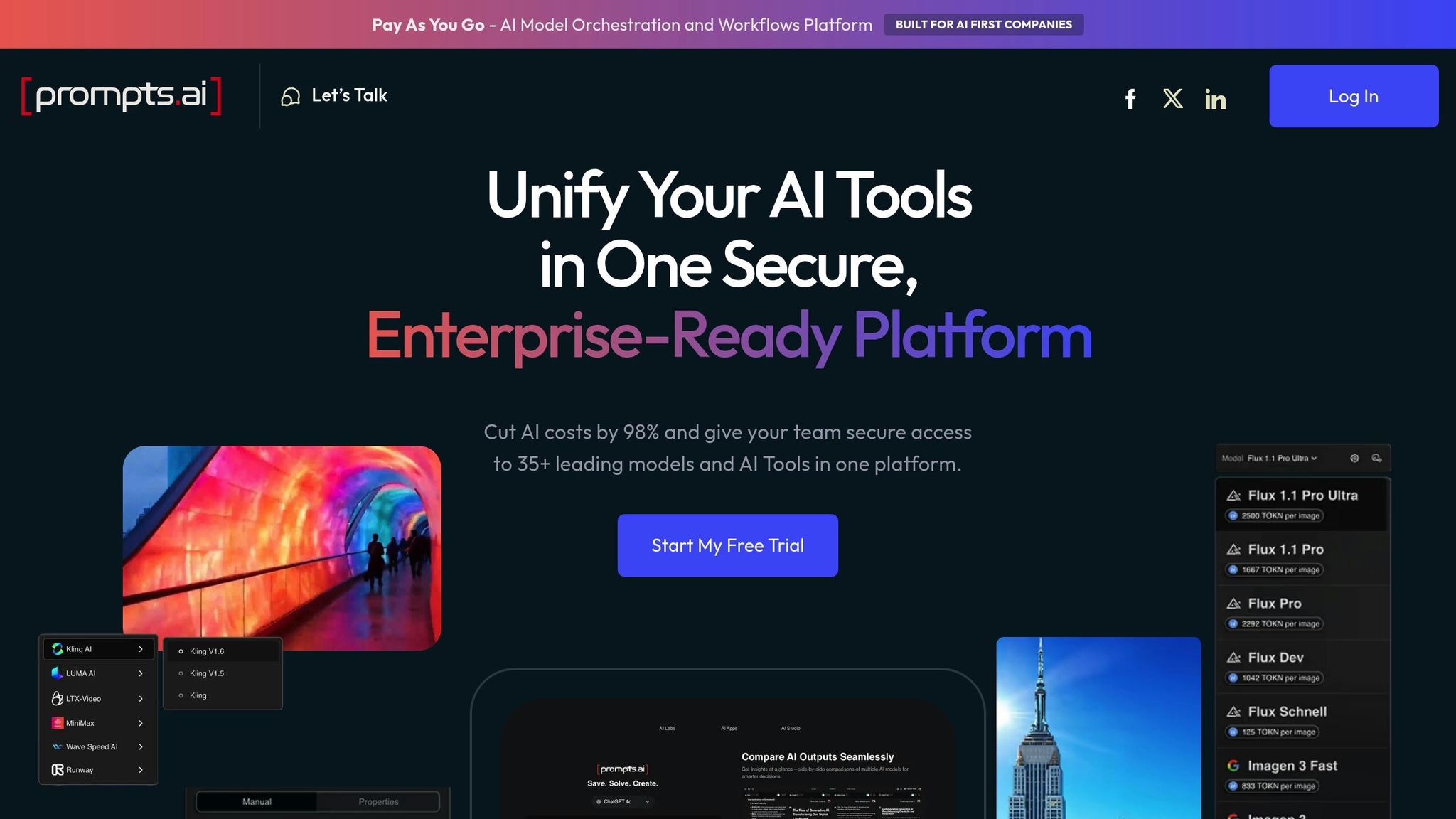
Prompts.ai brings together over 35 models, including GPT, Claude, LLaMA, and Gemini, into a single, streamlined interface. By consolidating tools into one dashboard, it eliminates the hassle of juggling multiple subscriptions. This approach tackles the issue of fragmented AI tools, allowing organizations to transition seamlessly in under 10 minutes. The platform also enhances efficiency with dedicated layers for interoperability, orchestration, cost management, and governance.
Prompts.ai’s interoperability layer seamlessly integrates AI models with popular business tools like Slack, Gmail, and Trello, creating automatic data flows between systems. The platform also offers a side-by-side comparison feature, enabling teams to test the same prompt across multiple models simultaneously. This helps identify the most accurate model for specific tasks, reportedly increasing team productivity tenfold by removing the trial-and-error process in model selection.
The platform transforms isolated AI experiments into scalable workflows. Teams can create AI Agents to handle complex, multi-step processes autonomously, converting one-off tasks into consistent, repeatable operations across departments. Steven Simmons, an Emmy-winning creative director and CEO, shared his experience:
"Prompts.ai's LoRAs and workflows enable completing renders and proposals within a day, eliminating delays and hardware constraints."
Prompts.ai also simplifies cost management through its TOKN Pooling feature, which centralizes AI usage credits across teams. This ensures resources are allocated efficiently, prioritizing critical projects and reducing overall AI expenses. The Business Pro plan, priced at $119 per member per month, includes 500,000 TOKN credits and usage analytics. For $129 per member, the Elite tier offers 1,000,000 TOKN credits along with advanced workflow creation capabilities.
Governance is a key strength of Prompts.ai, providing full visibility into all AI activities. The platform achieved its SOC 2 Type 2 audit on June 19, 2025, and integrates best practices from both HIPAA and GDPR frameworks. Admins can allocate resources using Storage Pooling and maintain detailed compliance audit trails. The Trust Center (trust.prompts.ai) offers real-time updates on security and compliance, ensuring enterprise deployments meet the highest standards.
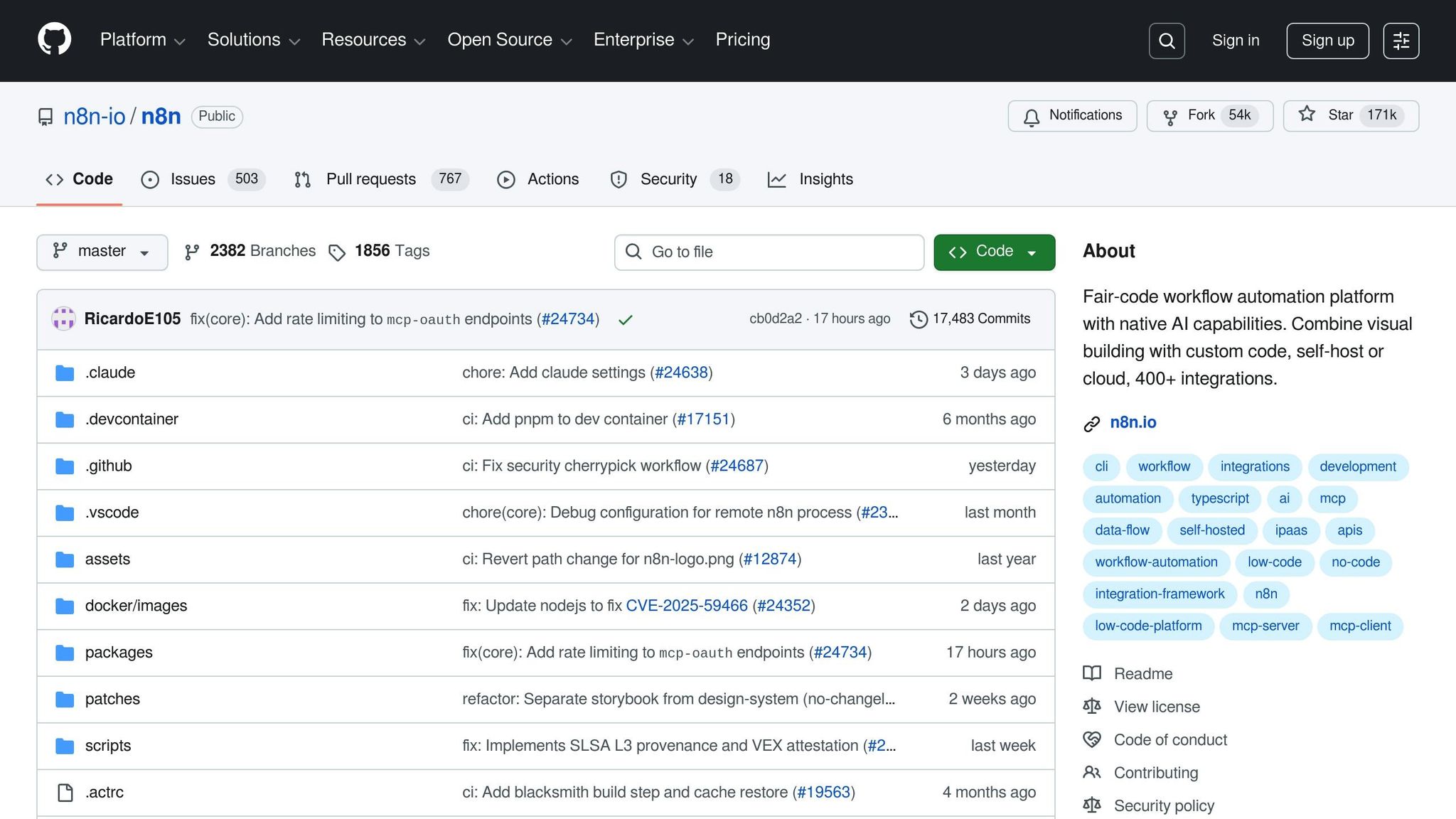
n8n offers an open-source, drag-and-drop platform that connects over 1,000 business tools, while also allowing developers to incorporate custom JavaScript or Python for added functionality. With over 169,600 GitHub stars and a thriving community of more than 200,000 members, it has become a trusted choice for technical teams crafting AI-driven workflows.
n8n’s vast integrations and support for MCP ensure smooth communication between AI models and business tools. Its HTTP Request node enables connections to any REST API. Built on LangChain, the platform supports modular AI applications that can seamlessly integrate into existing business operations. Luka Pilic, Marketplace Tech Lead at StepStone, highlighted its impact:
"It takes me 2 hours to connect APIs and transform required data. You can't do this that fast in code."
This level of flexibility and connectivity empowers teams to automate processes with unmatched efficiency.
n8n simplifies task management by enabling workflows to run sequentially, in parallel, or hierarchically. The platform supports up to 220 workflow executions per second and includes built-in error triggers and fallback mechanisms, ensuring reliable automation. In 2025, SanctifAI created its first workflow in just 2 hours - three times faster than coding Python controls for LangChain. CEO Nathaniel Gates remarked:
"There's no problem we haven't been able to solve with n8n."
This capability to orchestrate tasks with speed and precision makes it a strong tool for AI-powered automation.
Unlike credit-per-step pricing models, n8n charges based on workflow executions, making it a cost-efficient option for handling complex AI tasks. The Cloud Starter plan starts at $20 per month for 2,500 workflow executions, while the self-hosted Community Edition provides unlimited executions for free. Event-driven triggers ensure AI models activate only when needed, and rate-limiting features help teams control expenses.
n8n meets SOC 2 compliance standards and integrates with tools like AWS Secrets Manager and Azure Key Vault for encrypted secret storage. It also offers advanced security features such as Role-Based Access Control (RBAC), Single Sign-On (SSO) integration, and detailed audit logs with streaming capabilities. Dennis Zahrt, Director of Global IT Service Delivery at Delivery Hero, shared how n8n transformed their operations:
"We have seen drastic efficiency improvements since we started using n8n for user management. It's powerful, but also simple to use."
With these governance tools, n8n ensures security and accountability while driving productivity.
Zapier connects an impressive 8,000 apps and 500 AI tools, powering over 350 million AI tasks so far. It stands out as a go-to automation platform for teams integrating AI into their daily workflows. With its Model Context Protocol (MCP), Zapier acts as a bridge between AI models like ChatGPT or Claude and its vast library of 30,000+ actions, enabling seamless execution of tasks across your tech ecosystem.
Zapier's Model Context Protocol simplifies connecting diverse systems through its no-code interface. This allows teams to align AI responses with real-time company data effortlessly. The platform integrates tools like Google Drive, Notion, and various AI services. With AI by Zapier, users can switch between models from OpenAI, Anthropic, Google, and Azure without juggling multiple API keys. This flexibility removes the technical barriers, giving users access to advanced AI capabilities without needing specialized expertise. Such smooth integration is a cornerstone of Zapier's ability to unify complex workflows.
Zapier Canvas offers a visual tool for designing AI-driven workflows, helping teams map out processes, identify key decision points, and include human-in-the-loop steps. For example, in April 2025, Marcus Saito, Head of IT and AI Automation at Remote, deployed an AI-powered helpdesk through Zapier Enterprise. This system handled Slack and email requests, prioritized issues using AI, and automatically resolved 28% of tickets. The result? Saito’s three-person team saved over 2,200 days of manual work per month and cut approximately $500,000 in annual hiring costs. Reflecting on the impact, Saito remarked:
"Zapier makes our team of three seem like a team of ten."
Zapier’s orchestration tools include conditional routing with Paths, data management using Filters, and even custom Python scripting - all within its no-code framework. Its Zapier Agents can autonomously make decisions and complete multi-step tasks based on natural language goals. Combined with clear pricing, these features enable teams to scale workflows efficiently and effectively.
Zapier’s pricing starts at $19.99 per month for the Professional plan (billed annually), with a free tier offering two-step workflows. The platform helps teams manage AI expenses by incorporating token limits per workflow step and cost-cap alerts, ensuring budgets stay under control even in complex processes. AI by Zapier simplifies financial management by bundling access to multiple language models, so teams don’t need to handle separate billing for each AI provider. This streamlined approach makes financial oversight much easier for organizations running multiple AI workflows.
Zapier prioritizes security and compliance with SOC 2 Type II and GDPR standards. Enterprise features like SSO/SCIM integration, audit logs, and role-based permissions provide teams with centralized control over AI usage. These governance tools help prevent "shadow AI" projects - unauthorized or untracked AI initiatives - by offering detailed activity tracking. Steph Spector, Editor at Zapier, highlighted this:
"AI orchestration can't flourish when there are shadow AI projects about, or when access is limited to developers."
Zapier also ensures data security with encryption during transit and at rest, alongside customizable data retention policies and granular permissions. These measures allow teams to scale AI processes while maintaining strict security and compliance standards. Together, Zapier’s governance and orchestration tools deliver the reliability enterprises need to confidently expand their AI capabilities.
Make is a visually-driven AI workflow platform that simplifies integration and offers a high degree of transparency. With connections to over 3,000 apps and 30,000+ actions, it’s trusted by more than 350,000 users globally. The platform’s standout feature is its visual-first approach, which gives users precise control over complex automations. The Make Grid feature is particularly noteworthy, as it automatically maps out your entire automation setup in real time, offering a centralized view of agents, apps, and workflows.
Make supports the Model Context Protocol (MCP), which standardizes communication between AI agents and external data sources. The platform is compatible with multiple large language models (LLMs), including OpenAI models, Anthropic Claude, Google Vertex AI (Gemini), and Mistral AI. Users can create modular AI agents that utilize existing Make scenarios as tools for specific tasks, such as retrieving data from Google Sheets or sending Slack messages. The drag-and-drop scenario builder provides advanced options for branching and data transformations, allowing for greater customization and control compared to simpler automation platforms.
Make takes a dynamic approach to orchestration, allowing AI agents to handle natural language tasks, reason through objectives, and select the most suitable tools to complete them. Philipp Weidenbach, Head of Operations at Teleclinic, highlighted the platform’s impact:
"Make really helped us to scale our operations, take the friction out of our processes, reduce costs, and relieved our support team."
The platform offers detailed logs and reasoning for every agent action, as well as an Analytics Dashboard to monitor workflow performance over time. Make also includes execution limits to manage resource usage, with features like "Steps per agent call" to prevent issues like infinite loops.
Make operates on a credit-based pricing model. The Free Plan includes 1,000 credits per month, while the Core Plan starts at $9/month (billed annually) for 10,000 credits. Credits are consumed with each workflow step, with AI-specific steps often requiring more than one credit. Annual billing unlocks the full yearly credit allotment upfront. Administrators can set execution limits for teams and enforce spending caps within agent configurations, helping to manage costs effectively. By optimizing scenario logic, users can reduce unnecessary steps and maximize credit efficiency.
Make incorporates SOC 2 Type II and GDPR compliance, along with features like data encryption and Single Sign-On (SSO). Role-based access control (RBAC) allows administrators to manage team permissions, set operational limits, and configure safeguards like "Max output tokens" to control response length and costs. The platform’s principle of minimal access ensures agents only interact with explicitly provided data. However, some reviewers have noted that Make’s security governance could be improved, particularly in areas like RBAC and secret management, which are less robust compared to enterprise-grade platforms. The Make Grid helps mitigate these concerns by offering a centralized, visual overview, reducing the risk of siloed AI tools operating without proper oversight.
Workato is a robust enterprise orchestration platform, offering 1,200+ pre-built connectors and an impressive 99.9% uptime. It has been recognized as a Leader in the Gartner® Magic Quadrant™ for Integration Platform as a Service (iPaaS) for 7 consecutive years, with its most recent 2025 recognition highlighting its forward-thinking approach. What truly distinguishes Workato is its emphasis on "Agentic Orchestration." This approach enables AI agents to collaborate dynamically with people, legacy systems, and other agents to handle complex, multi-step workflows, going far beyond simple trigger-based automation.
Workato seamlessly integrates various systems, from SaaS platforms like Salesforce and Workday to on-premises solutions such as SAP and ServiceNow. It also connects databases and large language models (LLMs) like OpenAI, Claude, and Llama through its Enterprise MCP layer. This layer provides AI agents with essential business context and governed actions, ensuring predictable interactions with enterprise tools. Technical teams can incorporate LLM calls into existing workflows to handle tasks like text summarization, data categorization, or email drafting. The platform supports diverse integration patterns, including ETL, ELT, and reverse ETL, enabling smooth data movement and transformation across systems like Snowflake, BigQuery, and Databricks for AI-powered insights. This comprehensive connectivity lays the groundwork for advanced and reliable orchestration.
Workato’s orchestration capabilities extend far beyond basic automation. The platform ensures stateful execution through a serverless, containerized runtime that delivers elastic performance and maintains transactional integrity across systems. These features have led to tangible results, such as saving 100,000+ hours and achieving a 98% faster relocation request process. Mohit Rao, Head of Intelligent Automation at a leading enterprise, shared how the platform gained traction:
"Business users have organically started using Workato. Once we identify those business users, we elevate them to be champions to empower other teams or other people, and use them to get the next wave of scale."
Workato also features Workato AIRO™, an AI-powered solution architect agent that offers real-time diagnostics and optimization for workflow design. To manage high-volume operations, the platform sets rate limits for AI connector actions at 60 requests per minute for direct customer workspaces.
Managing costs is a key focus for any enterprise, and Workato addresses this with tools like Workato Insights and Enterprise Acumen. These provide real-time monitoring of both costs and performance. The AIRO agent further assists by identifying unnecessary steps and suggesting workflow improvements to enhance efficiency. With its operational analytics, administrators can evaluate automation ROI and make informed decisions about resource allocation. While Workato doesn’t publicly share standard pricing tiers, its pricing model is tailored to enterprise-scale deployments, taking into account usage patterns and connector needs.
Workato integrates interoperability, orchestration, and cost management into a unified governance framework. Its Workato Aegis feature offers comprehensive visibility into users, usage, and integrations across the organization. The platform adheres to SOC 2 Type II and ISO 27001 standards, along with GDPR compliance and data residency controls in the US and EMEA regions. Security measures include BYOK (Bring Your Own Key), hourly key rotation, and container isolation for runtime environments. The MCP Gateway ensures secure access to enterprise skills while enforcing policies and authentication at runtime. Role-based access control enables IT teams to adopt a "Citizen Integrator" model, allowing business users to design AI automations while IT maintains centralized oversight. Built-in observability provides full transparency into every agent action, ensuring accountability and clear explanations for AI-driven decisions.

AI Workflow Tools Comparison: Features, Pricing, and Best Use Cases
Below is a detailed comparison of how each platform excels and where it faces challenges across four critical areas.
| Tool | Interoperability | Orchestration | FinOps | Governance |
|---|---|---|---|---|
| Prompts.ai | Strength: Provides unified access to over 35 top-tier LLMs (e.g., GPT-5, Claude, Gemini, LLaMA) in a secure interface, cutting down on tool sprawl. Weakness: Primarily focuses on prompt workflows, with limited broader system integration capabilities. |
Strength: Enables side-by-side model comparisons and rapid deployment through prompt templates. Weakness: Struggles with complex, multi-system orchestration beyond LLM usage. |
Strength: Real-time token tracking via pay-as-you-go TOKN credits, delivering up to 98% cost savings. Weakness: Focuses cost optimization on LLM usage rather than full infrastructure. |
Strength: Offers robust audit trails, role-based access, and ensures no third-party data handoff. Weakness: Governance features are tailored specifically to AI model interactions. |
| n8n | Strength: Offers hundreds of integrations with a self-hosted option for complete data control. Weakness: Smaller library of connectors compared to enterprise iPaaS tools. |
Strength: Features a visual workflow builder with the flexibility to add custom code. Weakness: Lacks advanced AI-specific orchestration features, like dynamic branching. |
Strength: Self-hosting eliminates per-execution fees and offers transparent pricing. Weakness: Requires your team to manage infrastructure costs. |
Strength: Allows full data control through self-hosting. Weakness: Comprehensive governance controls require manual setup. |
| Zapier | Strength: Extensive app integrations allow for quick automation setups. Weakness: Limited support for on-premises connectivity and database integration. |
Strength: No-code simplicity facilitates rapid deployment. Weakness: Task-based billing may not scale effectively for high-volume workflows. |
Strength: Predictable monthly pricing tiers simplify budgeting. Weakness: Task-based billing may become costly for workflows involving high-volume AI processes. |
Strength: Provides user-friendly permission settings. Weakness: Audit capabilities may not meet stringent enterprise compliance needs. |
| Make | Strength: Includes over a thousand integrations and a visual scenario builder. Weakness: Has a steeper learning curve for non-technical users compared to simpler tools. |
Strength: Advanced routing and error-handling support complex branching scenarios. Weakness: Requires additional configuration for highly dynamic AI workflows. |
Strength: Operation-based pricing can be more cost-effective than task-based models. Weakness: Costs may increase significantly with heavy LLM usage. |
Strength: Offers scenario versioning and rollback features. Weakness: Governance features may not match the sophistication of dedicated enterprise iPaaS tools. |
| Workato | Strength: Provides a wide range of connectors and enterprise-grade integration capabilities. Weakness: Higher entry costs due to its enterprise focus. |
Strength: Features stateful execution and robust workflow automation. Weakness: Complexity of the platform may require a dedicated integration team. |
Strength: Includes cost monitoring and ROI analytics for automation efforts. Weakness: Pricing transparency can be an issue with custom enterprise plans. |
Strength: Advanced governance features, such as audit logs and compliance controls. Weakness: Governance sophistication may be excessive for smaller teams. |
This comparison outlines how each platform caters to specific needs, highlighting their strengths while acknowledging areas where they may not be the best fit.
Selecting the right AI workflow tool hinges on your team’s expertise, governance requirements, and budget. For non-technical users, Zapier provides a straightforward solution. n8n offers flexibility for technical teams managing their own infrastructure. Make shines with its visual scenario-building capabilities, making it ideal for mid-sized operations. Meanwhile, Workato stands out with its strong governance features, catering to organizations that need SOC 2 compliance and cross-departmental automation. These tools each bring unique strengths to the table, paving the way for a closer examination of how Prompts.ai differentiates itself.
Prompts.ai is the go-to choice when your focus is on LLM interoperability and cost efficiency. Tackling the common challenge of fragmented workflows, Prompts.ai unifies access to over 35 leading models - including GPT-5, Claude, Gemini, and LLaMA - within a single secure interface. With real-time token tracking, it enables savings of up to 98%, making it a game-changer for teams handling high-volume AI operations where token usage directly impacts budgets.
For AI-specific workflows requiring both model flexibility and financial clarity, Prompts.ai addresses gaps that general automation platforms often overlook. Its side-by-side model comparison and unified governance controls are tailored to solve pain points unique to AI-heavy environments. And for operations demanding extensive multi-system integrations, combining Prompts.ai with broader platforms like n8n or Workato can offer a well-rounded solution.
Each platform has its strengths - technical teams appreciate n8n for custom integrations, enterprises rely on Workato for compliance, and cost-conscious users benefit from Prompts.ai’s precise tracking of token usage. The right tool ultimately depends on your team’s primary challenge. Whether it’s simplifying integration, tightening governance, or reducing AI costs, start by identifying your biggest bottleneck and choose the platform that directly addresses it.
Prompts.ai streamlines oversight in AI workflows by offering a unified platform to handle more than 35 AI models, including cutting-edge options like GPT-5 and Claude. It features integrated governance tools such as compliance controls, security measures, and audit trails, ensuring workflows adhere to organizational policies and standards.
With its pay-as-you-go pricing, the platform allows businesses to monitor and adjust AI spending with ease. By merging model management, security, and cost tracking into one solution, Prompts.ai simplifies oversight and ensures compliance in even the most intricate AI setups.
Prompts.ai's TOKN Pooling feature helps you manage costs effectively by bringing together access to over 35 AI models in one place. Using pay-as-you-go TOKN credits, you can reduce AI-related expenses by up to 98%. This approach ensures you’re only charged for what you actually use, making it a smart and cost-efficient way to handle your AI workflows.
Prompts.ai makes it easier than ever to connect with your favorite business tools through its powerful AI orchestration platform. Built to bring together and manage over 35 large language models (LLMs) alongside existing enterprise systems, it enables smooth collaboration and ensures compatibility across the board.
With features like multi-model orchestration, cost savings of up to 98%, and enterprise-level security, Prompts.ai helps simplify even the most complex workflows. This solution empowers businesses to boost productivity while building a scalable, interconnected AI ecosystem that works seamlessly with their current tools.