Pay As You Go - AI Model Orchestration and Workflows Platform


Securing access to AI models is now a board-level budget line. Gartner projects worldwide AI spending to pass $630 billion in 2028, IBM puts the average cost of a data breach at $4.88 million, and Stanford's 2025 AI Index records 233 documented AI privacy and security incidents in 2024, a 56 percent jump in a single year. Meanwhile the EU AI Act's high-risk obligations are phasing in through 2026 and 2027, so every untracked API key pointed at a frontier model is now both a cost leak and a compliance exposure. Teams that once shared one OpenAI key over Slack are being asked to prove who called which model, with what data, at what price. Here's a breakdown of three leading platforms:
TL;DR
| Platform | Key Strengths | Key Weaknesses | Best For |
|---|---|---|---|
| Prompts.ai | 35+ models behind one governed layer; per-inference audit logs; TOKN credit accounting; up to 98% cost cut | Not a secrets manager or SIEM; focused on the inference layer | Teams that want access control, compliance evidence, and token-level cost in one place |
| Portkey | Open source, self-hostable gateway; guardrails, PII masking, request signing; 250+ models | BYO infrastructure: you run the proxies, budgets, and dashboards | Engineering teams that want gateway control inside their own VPC |
| OpenRouter | ~400 models, one key, spend caps per key, automatic fallbacks, ZDR options | Usage governance stops at the key; no workspace policy engine | Developers who need broad gated access fast, with simple spend control |
Your next step: decide whether the audit record must live where inference runs (runtime layer) or in a gateway you operate (infrastructure layer); that single choice narrows this list to one platform.
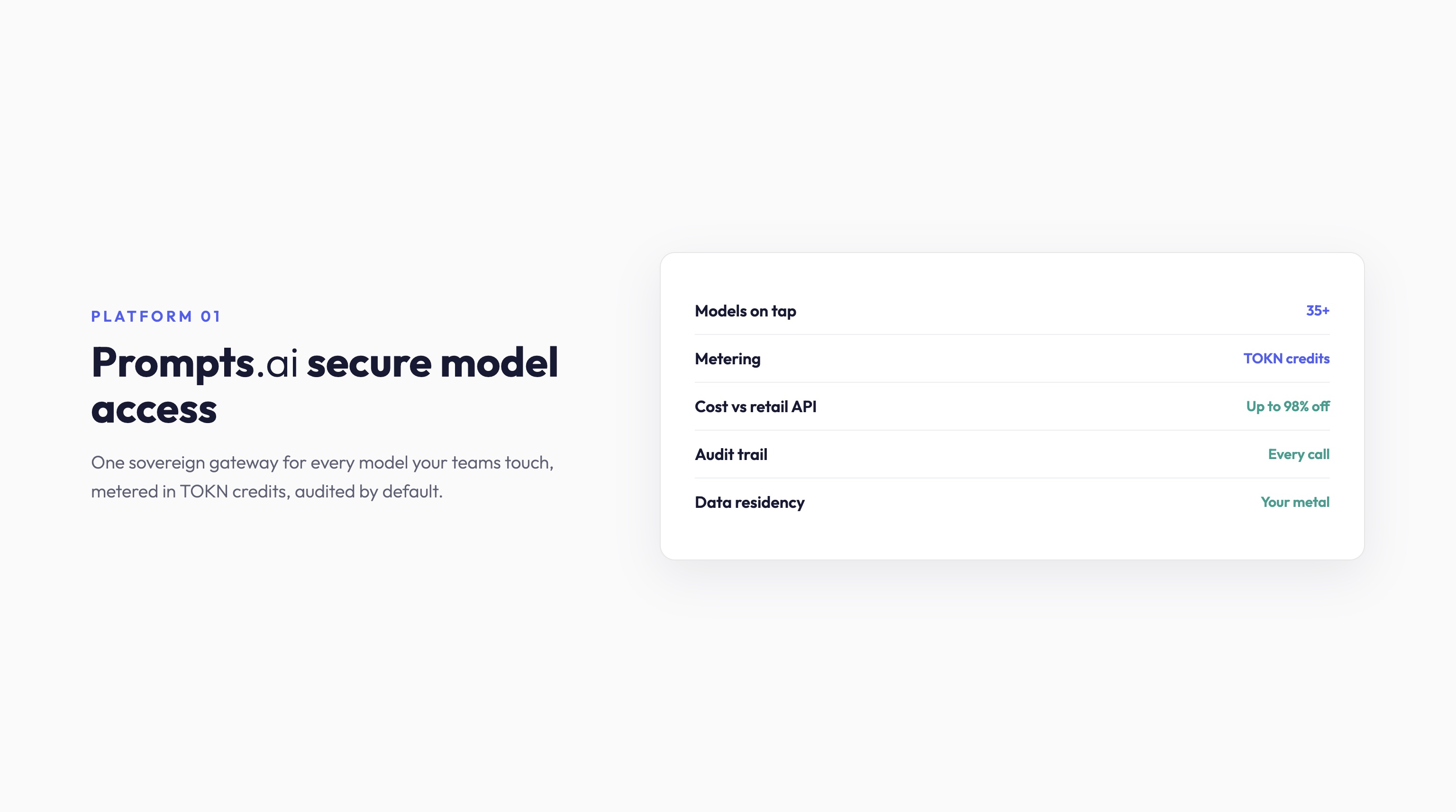
Prompts.ai treats secure access as an inference-layer property: every call to any of 35+ models passes through one governed route that authenticates the user, applies policy, logs the exchange, and prices it in TOKN credits. Access control is workspace-scoped, so a marketing pod gets different model entitlements than a finance pod, and no one needs a raw provider key at all.
The catalog spans frontier providers (GPT-5.x, Claude, Gemini, Llama, Mistral, DeepSeek and more) exposed through a single API and prompt interface. Adding a model is a configuration change, not a procurement cycle, and switching models inside a running workflow does not break the audit trail because the log schema is model-agnostic. Access grants are role-based, so contractors, full-time staff, and service accounts can hold different entitlements against the same catalog without separate vendor contracts.
TOKN credits bill pay-as-you-go, so there are no seat licenses idle over the weekend and no shadow subscriptions to reconcile. Consolidating 35+ model subscriptions into one credit pool cuts AI software costs by up to 98% in documented cases, and every department sees spend per model, per workflow, down to the token.
Every inference carries a signed log entry: user, workspace, model, prompt, output, cost. That record exports as audit evidence for SOC 2 and EU AI Act documentation. Guardrails screen for PII leakage, prompt injection, and toxic output before results reach the user, and approved-model registries stop shadow AI at execution time rather than reporting it afterwards.
Workspaces inherit central policy, so onboarding a department opens no new compliance gap. The routing layer is multi-tenant and model-switching is dynamic, which matters when a provider degrades or a cheaper equivalent model ships; you re-point workloads without renegotiating access.
Portkey is the open-source option: a gateway you can run in your own cloud that sits between your application and 250+ models. It ships guardrails, semantic caching, retries with fallback, and budget tracking, and the codebase on GitHub (1,400-plus stars) is inspectable, which procurement teams in regulated industries appreciate.
The gateway normalizes 250+ provider APIs into one schema, including Azure OpenAI, Bedrock, Vertex, and the usual direct APIs. Config-as-code routing means integration lives in your repo and travels through code review like any other infrastructure change.
Semantic caching alone cuts repeat-inference spend, and per-team budgets plus usage analytics surface waste before finance does. But you pay the platform tax differently: the compute, uptime, and on-call rotation for the gateway are yours, and those line items land on your invoice, not Portkey's. Portkey's own cloud removes that burden at published per-request pricing, so the build-versus-buy question is really a staffing question: if nobody on your team wants a gateway pager, the managed tier is the honest answer.
This is Portkey's core pitch: PII masking on requests, content filtering on responses, request signing, and a full audit log you keep. SOC 2 and HIPAA options exist on the managed tier. Because the gateway runs in your VPC, data residency arguments are short ones.
Scales as far as your Kubernetes cluster does, which is either the appeal or the job posting. Multi-region deployments are on you; the managed tier abstracts them.
OpenRouter aggregates roughly 400 models behind one API key and one bill. It is the quickest way to give a team gated access to models that would otherwise require a dozen procurement conversations, and its transparent per-token pricing (with a 5% fee on credits) is published on the site.
Coverage is the widest of the three: frontier labs plus niche open-weights models, all through OpenAI-compatible endpoints. Fallbacks route around outages automatically, and :nitro variants prioritize throughput when latency matters.
Spend caps per API key stop runaway loops, and the unified ledger replaces a dozen provider invoices. ZDR routing and BYOK (bring your own key) let enterprises keep their negotiated provider rates while using OpenRouter purely as an access broker.
Per-key limits, usage analytics, and optional zero-data-retention routing cover the basics. There is no workspace-level policy engine, no PII masking, and no compliance evidence pack; logs are the developer's responsibility. For a two-pizza team that is fine. For a bank, it is a gap.
It scales effortlessly in the access sense (new models appear weekly, endpoints stay OpenAI-compatible), but organizational governance does not scale with it: there are no teams, workspaces, or inherited policies to grow into, so every new hire inherits whatever the key distribution happened to be that week.
| Platform | Pros | Cons |
|---|---|---|
| Prompts.ai | Runtime-layer audit evidence; TOKN pay-as-you-go, up to 98% cost cut; 35+ models, one governed route; workspace-inherited policy | Requires adopting its workspace model; not a secrets manager or SIEM |
| Portkey | Open source and self-hostable; guardrails, PII masking, request signing; 250+ models | You operate the infrastructure; budgets and dashboards are DIY on the OSS path |
| OpenRouter | ~400 models, one key; per-key spend caps; ZDR and BYOK options | Governance stops at the key; no policy engine or evidence exports |
The three platforms answer different questions. OpenRouter answers "how do I reach any model tomorrow?" Portkey answers "how do I run the gateway myself?" Prompts.ai answers "how do I prove every call was authorized, recorded, and priced?"
The decision rule: if your obligation is evidence (SOC 2, EU AI Act, internal audit), put access control where inference runs and choose Prompts.ai; the TOKN credit model alone usually pays for the move, with cost cuts up to 98%. If your constraint is infrastructure sovereignty and you have the platform team to staff it, self-host Portkey. If you just need breadth of access with a corporate card and a spend cap, OpenRouter is the fastest path.
Secure AI model access means every call to a language model is authenticated, authorized, logged, and priced through a controlled route, instead of raw provider keys circulating among developers. Mature setups add PII screening, approved-model registries, and audit exports that satisfy SOC 2 or EU AI Act documentation requests.
Three mechanisms dominate: a governed routing layer that authenticates users and applies policy per inference (Prompts.ai), an operator-run gateway with guardrails and request signing (Portkey), or per-key credential management with spend limits (OpenRouter). The first produces audit evidence as a byproduct of usage; the third produces only a ledger. Whichever you choose, the test is the same: ask the vendor to show you the log entry for one specific inference, including user, model, prompt, output, and cost. If that query takes a support ticket instead of an API call, access is not actually secured.
Prompts.ai documents up to 98% cost reduction when scattered point subscriptions are replaced by TOKN pay-as-you-go credits across 35+ models. The saving comes from eliminating idle seats, duplicate subscriptions, and shadow spend; your number depends on how many concurrent subscriptions you retire.